Tag: Climate Change
Wave Power – Wave Goodbye to Taxpayers Money
Wave goodbye to your money. Its almost like the ocean is tough on equipment.
Just two years after revealing its grand vision to turn the West Australian town of Albany into a world-famous renewable energy hub by harnessing the power of waves, the WA Government is walking away.
It was touted as Australia’s first commercial-scale wave farm, but Carnegie Clean Energy could not even get the project past its first milestone.
Its failure has hurt not just the people of Albany — who were excited about the Government’s plan for their future — but their fellow WA taxpayers, who have got little to see for the $2.6 million they paid Carnegie.
There are many passionate believers in the potential of wave energy who have lost money or had their hopes shattered by the demise of the $16 million project.

Energy analyst Simon Holmes a Court said it was a huge setback for Australia’s fledgling wave industry as it struggled to compete with solar and wind energy.
“So while the potential is there, the economics of the [research and development] and bringing a solution to market is very difficult and very challenging,” he said.
“It’s very sad that such a lot of work has gone into the Carnegie solution, but they haven’t been able to bring it to market fast enough in order to compete with wind and solar.”
‘We have honoured our commitment’: MacTiernan
The axing of the project is also a huge loss of face for the WA Government, especially its Regional Development Minister Alannah MacTiernan, who rejected suggestions she had broken an election promise.
“No, we have honoured our commitment,” she said.
Sure.
But there are winners.
But not everyone has walked away a loser from the failed project.
Until recently, the cost of top-level executives has not been cheap for a company which has never made a profit.
Before Carnegie began to tighten its belt about six months ago, its annual bill for board and executive salaries was about $1.4 million.
Former chief executive and managing director Michael Ottaviano took home a pay package of more than $780,000 in 2016-17.
He was made redundant last year, taking with him a payout of six months’ salary.
Windy
Polar Bear Update Mar 12 2019
From Susan Crockfords site:
Abundant ice in Svalbard, East Greenland and the Labrador Sea is excellent news for the spring feeding season ahead because this is when bears truly need the presence of ice for hunting and mating. As far as I can tell, sea ice has not reached Bear Island, Norway at this time of year since 2010 but this year ice moved down to the island on 3 March and has been there ever since. This may mean we’ll be getting reports of polar bear sightings from the meteorological station there, so stay tuned.
Read it all here

Arctic Sea Ice Volume 12-Mar-2019 – Data Has Been Intermitttent
DMI data for Sea Ice Volume has been flakey/intermittent.
So no data today (well … really no data for the 12th … data is always a day behind.)
From DMI
Damned Snow
Europe’s Renewable Energy Policy is Built on Burning American Trees
More CO2 thanks to the EU. As the EU says: CO2 bad … unless we say otherwise.
in 2009, the EU committed itself to 20 percent renewable energy by 2020, and put biomass on the renewables list. Several countries, like the United Kingdom, subsidized the biomass industry, creating a sudden market for wood not good enough for the timber industry. In the United States, Canada, and Eastern Europe, crooked trees, bark, treetops, and sawdust have been pulped, pressed into pellets, and heat-dried in kilns. By 2014, biomass accounted for 40 percent of the EU’s renewable energy, by far the largest source. By 2020, it’s projected to make up 60 percent, and the US plans to follow suit.
Fueling this boom is a simple, intuitive idea: that biomass is both renewable and “carbon neutral,” and a way to keep an economy built on burning fossil fuels humming along.
But a cadre of scientists and policy activists are now pushing back, saying that biomass energy rests on deceptive accounting. Rather than being carbon neutral, biomass is liquidating millions of tons of irreplaceable carbon stocks in the midst of a climate crisis already out of control.

If you believe CO2 is bad and more CO2 is worse:
The analysis was later confirmed by a colleague at MIT, John Sterman, who did the math, and confirmed that burning wood today would worsen climate change, “at least through the year 2100 — even if wood displaces coal, the most carbon-intensive fuel.”
More here
Arctic Sea Ice Volume 10-Mar-2019
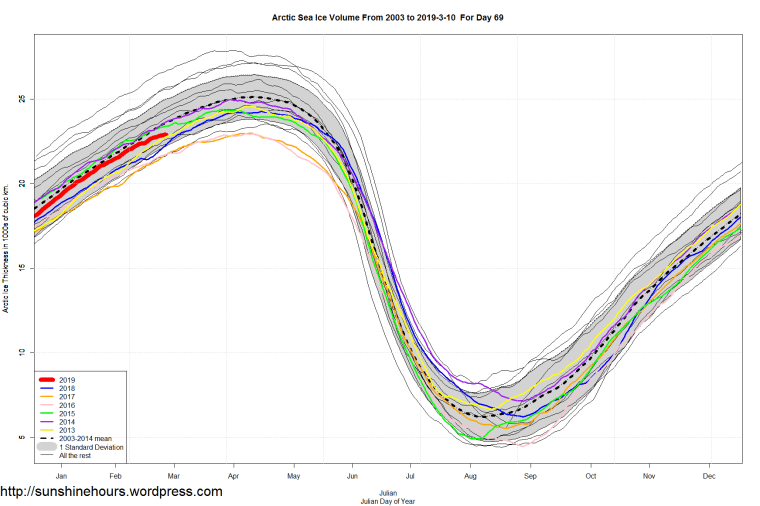
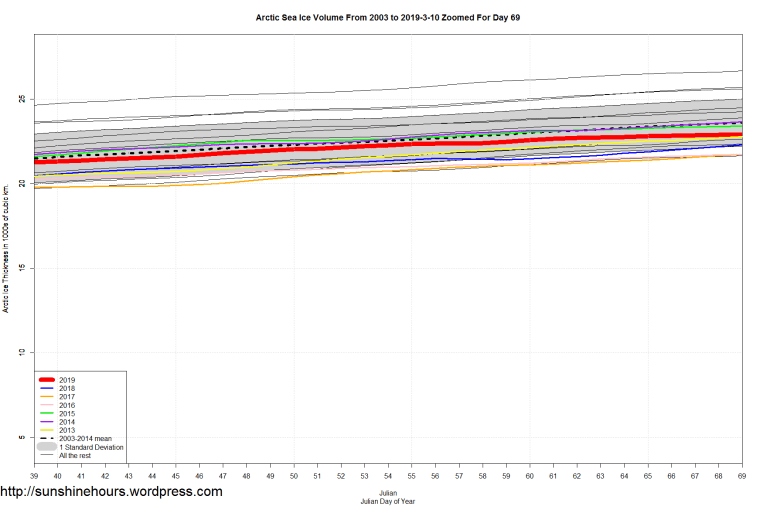
From DMI
 sunshine hours