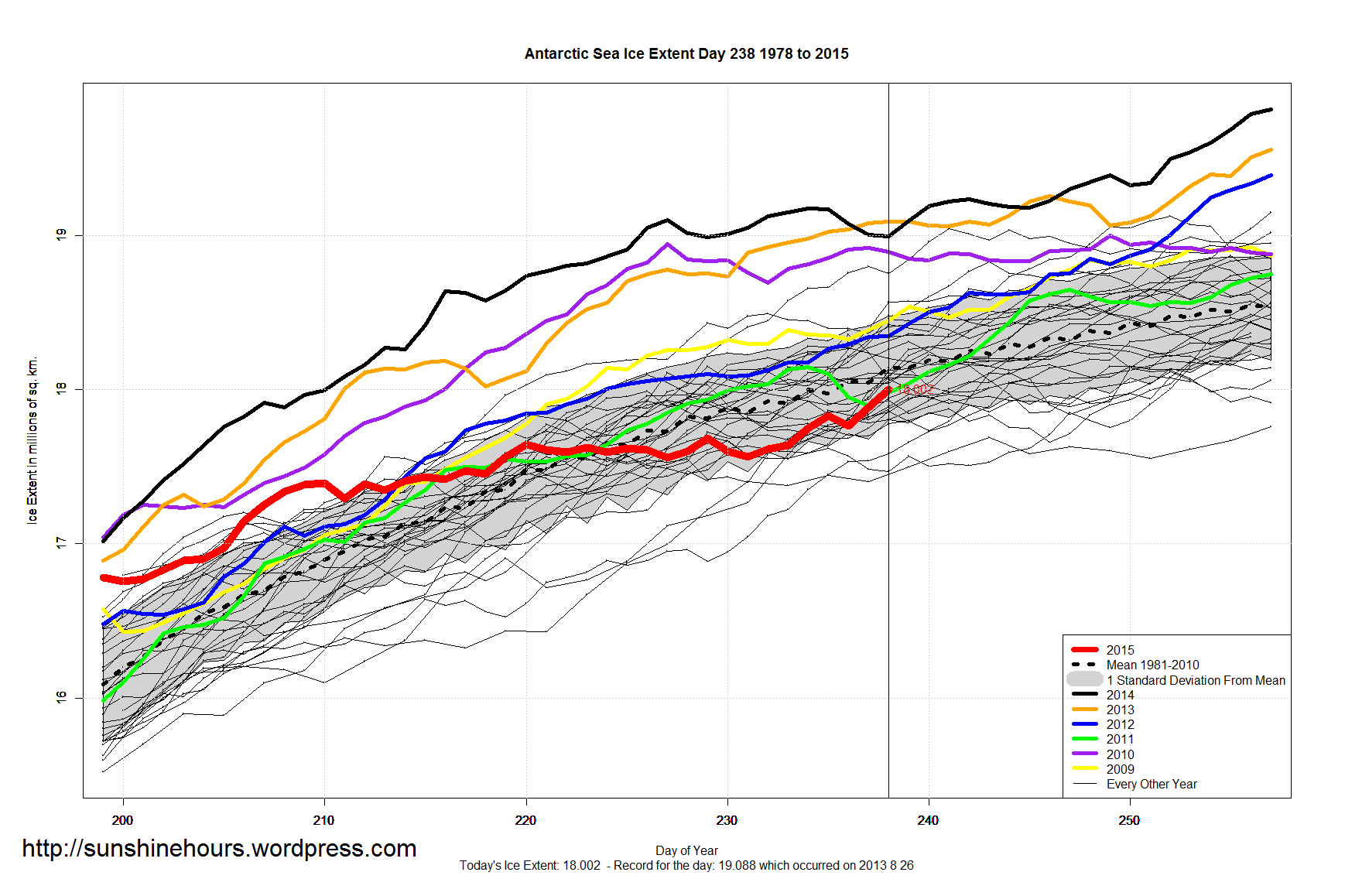
I’ve been wondering what happened that changed the rate of Antarctic sea ice extent accumulation this year, about 40 days ago. Did wind patterns shift? Has it been more stormy than normal? Nothing about gyres impeding ice formation in the news – it would be nice if the experts at NOAA would do a little more discussion rather than simply saying “hottest year ever” especially since declining sea ice extent plays into their doom-and-gloom predictions.
Am I correct in my understanding that the ozone hole naturally depletes over the Antarctic due to the extreme cold and lack of direct insolation for large parts of the year? And since ozone absorbs IR at a different wavelength spectrum than either CO2 or methane, isn’t a hole a GOOD thing?
Ozone is a greenhouse gas when it’s low level, while higher-level ozone protects us from harmful radiation from the Sun.
The ozone layer is a good thing, but ozone that is low in the atmosphere is bad.
So in answer to your comment, the ozone hole is a bad thing. I’m a bit confused about your question but hope this answers it.
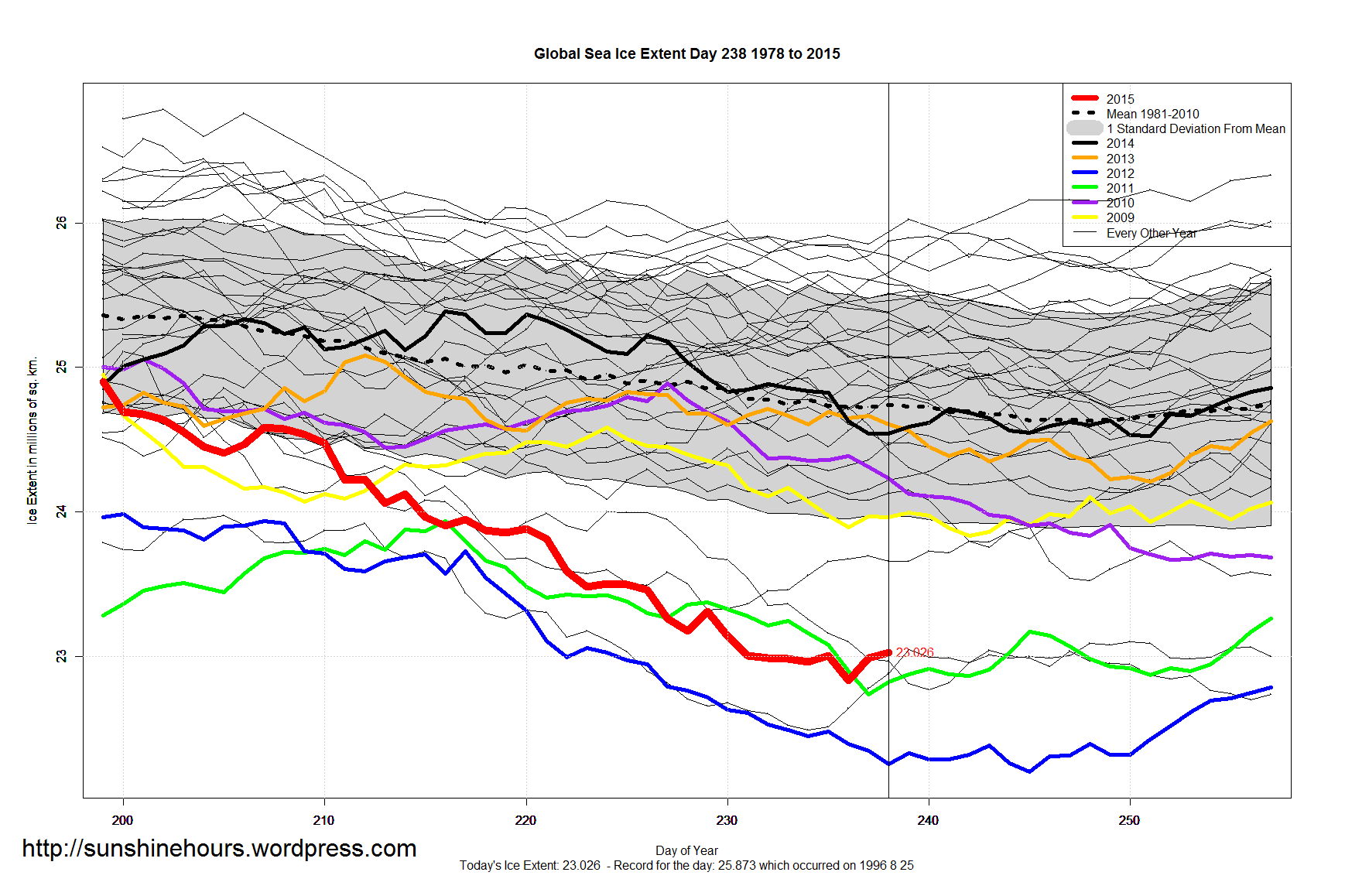
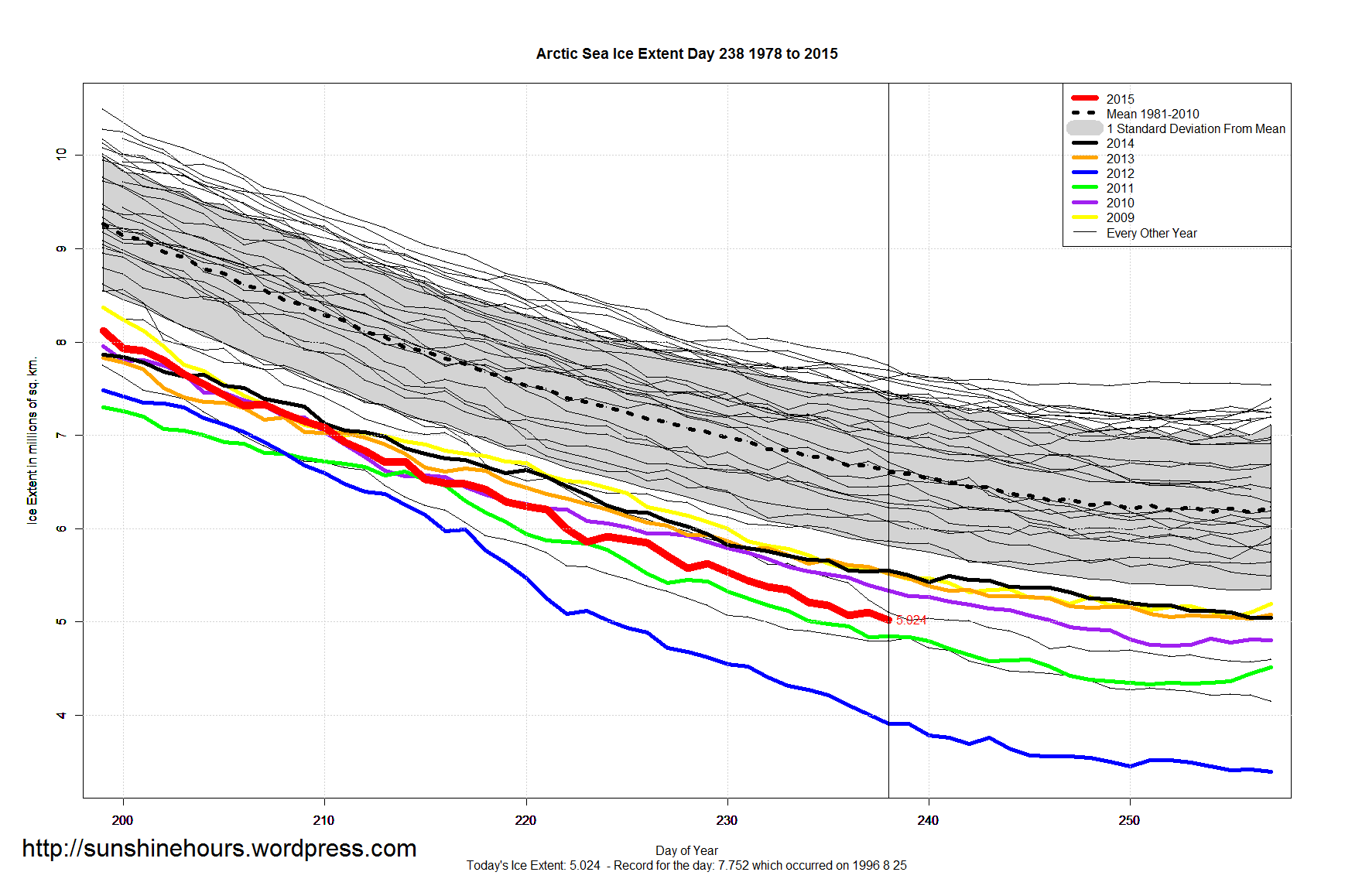
Arctic ice extent has now passed the 2014 minimum.
 sunshine hours
How in 20-30 days can we go from +2 dev to -2 dev?
Does this match A change in temps (Antarctica)?
I’ve been wondering what happened that changed the rate of Antarctic sea ice extent accumulation this year, about 40 days ago. Did wind patterns shift? Has it been more stormy than normal? Nothing about gyres impeding ice formation in the news – it would be nice if the experts at NOAA would do a little more discussion rather than simply saying “hottest year ever” especially since declining sea ice extent plays into their doom-and-gloom predictions.
Shocking news from the Arctic: Water extent today in the Arctic nearly matches 2014 at annual ice minimum.
https://rclutz.wordpress.com/2015/08/28/arctic-2015-extent-matches-2014-at-minimum-august-28-2015/
Latest view of the Ozone Hole:
http://ozonewatch.gsfc.nasa.gov/Scripts/big_image.php?date=2015-08-25&hem=S&source=IOMI_PAURA_V8F_MGEOS5FP§ion=HOME
Am I correct in my understanding that the ozone hole naturally depletes over the Antarctic due to the extreme cold and lack of direct insolation for large parts of the year? And since ozone absorbs IR at a different wavelength spectrum than either CO2 or methane, isn’t a hole a GOOD thing?
Ozone is a greenhouse gas when it’s low level, while higher-level ozone protects us from harmful radiation from the Sun.
The ozone layer is a good thing, but ozone that is low in the atmosphere is bad.
So in answer to your comment, the ozone hole is a bad thing. I’m a bit confused about your question but hope this answers it.
Arctic ice extent has now passed the 2014 minimum.
https://rclutz.wordpress.com/2015/08/28/arctic-2015-extent-matches-2014-at-minimum-august-28-2015/