Climate science says:
CO2 was about 280ppm in 1750.
CO2 is about 404ppm now.
CO2 levels have been rising by about 2ppm since 1997.
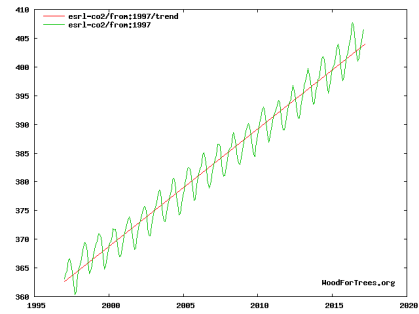
Therefore a doubling of CO2 from 1750 will occur around 78 years from now – say 2100.
The Transient Climate Response to a doubling of CO2 is around 1.35C.
Therefore temperatures from 1750 to 2100 will have risen by 1.35C
And for temperature to rise another 1.35C CO2 will have to go from 560ppm to 1120ppm – 280 more years 2380.
I don’t know about you, but 2.7C by 2380 sounds pretty nice.
And remember, for temperatures to go up 1.35C from today, it will take 200 years.
Whats everybody worrying about?
(h/t Hockey Schtick)
 sunshine hours
Nice straight line there…
Interesting to note that there is zero effect on that curve from the changes in global fossil fuel use since about 2008 due to fluctuations in the economy of China and the USA, nor of the influence of shale gas.
Not to mention absolutely zero fluctuation correlated with changes in Global temperature either…
Just shows how little humans have influenced global CO2 concentrations.
Yeah. Its almost as if the earth is in balance or something and can handle fluctuations in CO2 by growing more vegetation which absorbs more CO2. Or the other way around.
That’s all very nice, but CO2 is not causing the planet to warm by any perceptible amount.
“That’s all very nice, but CO2 is not causing the planet to warm by any perceptible amount.”
Funny you should say that!
Yes, funny you should say that, PhySciTech!
Sorry, first post didn’t show up.
Yeah, I know. This is where the rebuttal should start.
Someone might do some math and say CO2 went up 40ppm in last 20 years after going up 80ppm in the 250 years and then question the assumption of trend continuing at 2ppm/year. But not me. I also would never question the use of some random low short-term climate sensitivity value while also ignoring long-term effects. Like you say, warming will be a good thing anyway!
“I also would never question the use of some random low short-term climate sensitivity value”
It is worth considering what extrapolating the averages of trends of the ECS and TCR measurements out to 2020 – or 2025 at the latest – would indicate.
Approaching 0 …
“Approaching 0 …”
Now extrapolate it to 2030…
The top left corner is the boogey man trying to scare people into spending unnecessary trillions.
Thanks for the graph.