April 29 2014 MASIE Update (This Arctic Sea Ice dataset frm MASIE only has 28 days of data.
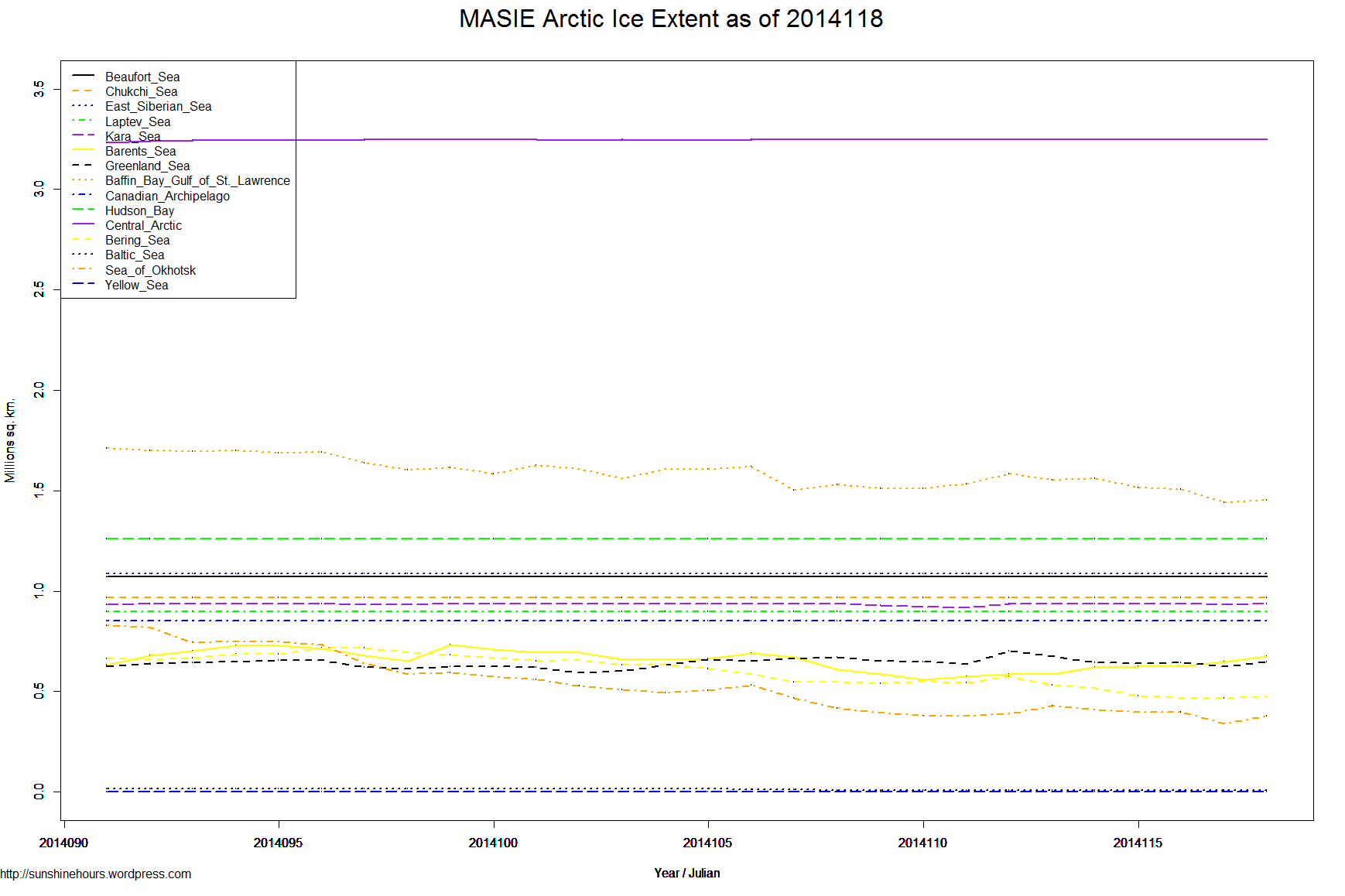
This is the gain/loss from day 91 to day 118. Negative = loss. Sorted with biggest loser in last 7 days at top. Northern Hemisphere is the grand total.
Notice that even though the NH shows a 404,000 melt in the last 14 days, only 16,782 melted in last 7 days.
The bottom 5 have all gained in last 7 days. Including 102,200 in the Barents Sea.
| Region | Start | End | Last 28 | Last 14 | Last 7 Days |
| Northern Hemisphere | 14,789,245 | 13,959,969 | -829,276 | -404,018 | -16,782 |
| Baffin Bay Gulf of St. Lawrence | 1,711,230 | 1,454,513 | -256,717 | -151,655 | -79,359 |
| Bering Sea | 664,041 | 474,076 | -189,965 | -160,060 | -70,680 |
| Baltic Sea | 15,337 | 8,725 | -6,612 | -7,013 | -653 |
| Beaufort Sea | 1,070,445 | 1,070,445 | 0 | 0 | 0 |
| Chukchi Sea | 966,006 | 966,006 | 0 | 0 | 0 |
| East Siberian Sea | 1,087,137 | 1,087,137 | 0 | 0 | 0 |
| Laptev Sea | 897,845 | 897,845 | 0 | 0 | 0 |
| Canadian Archipelago | 853,214 | 853,214 | 0 | 0 | 0 |
| Hudson Bay | 1,260,903 | 1,260,903 | 0 | 0 | 0 |
| Yellow Sea | 0 | 0 | 0 | 0 | 0 |
| Sea of Okhotsk | 829,717 | 376,689 | -453,028 | -118,565 | 223 |
| Central Arctic | 3,231,886 | 3,248,013 | 16,127 | 4,581 | 1,482 |
| Greenland Sea | 624,163 | 649,651 | 25,488 | 15,511 | 13,156 |
| Kara Sea | 932,891 | 935,023 | 2,132 | 0 | 16,849 |
| Barents Sea | 634,409 | 675,523 | 41,114 | 15,469 | 102,200 |
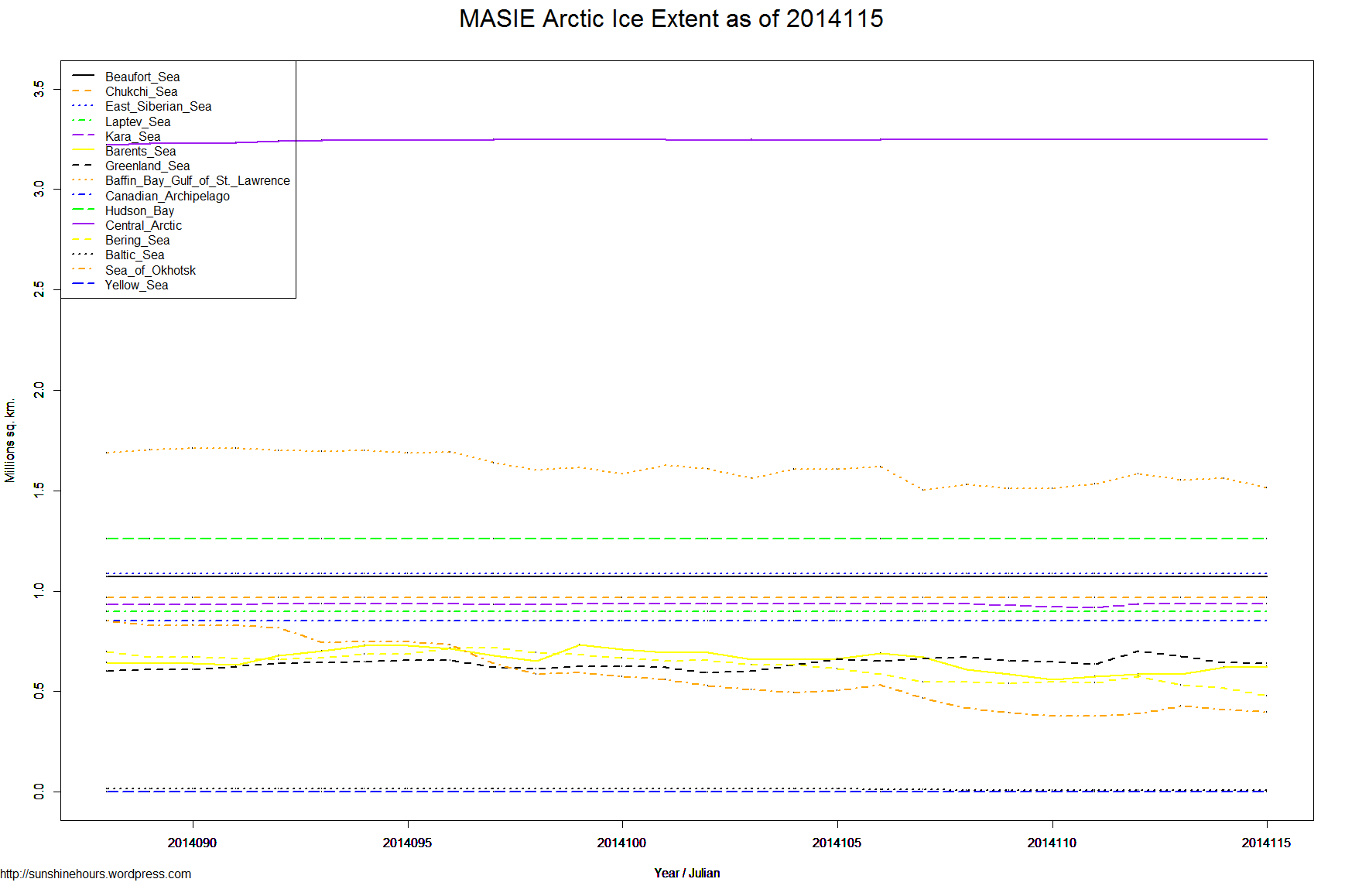
Here is the MASIE graph. The flat lines at the bottom are regions that have melted and are now ice free. The completely flat lines elsewhere indicate no melting at all yet. The changing lines indicate melting regions.
Click for bigger.

 sunshine hours