


1.5 Billion Gallons of Lava
Thats a lotta lava. Nice video at source.
A volcano wall collapse was recently captured on Kīlauea volcano, one of the most active volcanoes in the world. The collapse occurred on February 10th, at 8:21 a.m. local time when a chunk of the volcano collapsed, part of an ongoing collapse of the pit crater.
The source of this constant lava flow is a massive lava tube running from the volcano to the Pacific Ocean, which lasted 15 months, an incredibly long period of time for a lava tube.
The USGS estimated that 1-2 cubic meters of lava flowed into the ocean per second, totaling up to 1.5 billion gallons of lava during the lava tube’s year-plus long lifespan.
The following picture is from Jan 2017

Sea Ice Extent (Global Antarctic and Arctic) – Day 78 – 2018


We can’t burn our way out of the climate crisis
I don’t believe we are in a climate crisis. I think more CO2 is good for greening the planet.
I think 1C or 2C of warming over the next century would be great (even though I probably won’t be around to enjoy the warmth).
But I hate the hypocrisy of replacing coal with wood in power plants and then claiming it is renewable and green.
It ain’t green.
Burning wood produces more CO2 than coal and more particulate matter than coal.
Now … even Leonardo di Caprio (his foundation anyway) agrees with me (sort of).
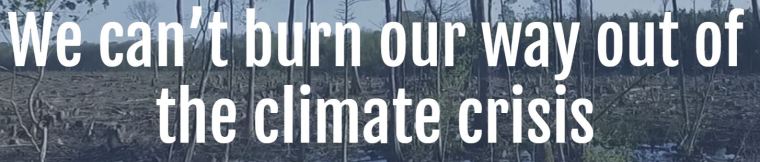
“Burning trees in power plants is a vision from Mordor, not one of clean energy, but electricity generation from wood and other biomass is growing around the world, spurred on by billions in renewable energy subsidies.
Policymakers subsidize bioenergy based in part on the myth that biomass energy has low or zero carbon emissions – even though in reality, wood-burning power plants emit more CO2 than coal plants per unit energy. The treatment of bioenergy as “carbon neutral” extends to carbon trading schemes, providing an incentive for coal plants to convert to burning wood. “
…
“Bioenergy advocates often claim that CO2 pollution from wood-burning power plants doesn’t harm the climate, because biomass is sourced from “forestry residues” (tree tops and branches left over after the tree trunk is taken away for sawtimber or pulp). Since these residues would decompose and emit CO2 anyway, they argue, burning them for energy does not increase CO2 in the atmosphere.
There are two big problems with this argument. First, new wood-burning power plants being built in the EU, UK, and even Asia burn wood pellets that are largely made from whole trees, not residues. Tens of thousands of acres of forest in the U.S. and Canada, including bottomland hardwood forests that represent some of the most carbon-rich ecosystems in North America, are being cut for pellet manufacture, replacing the forest’s natural climate and carbon control infrastructure with mud flats.
Second, even when biomass is derived from forestry residues, it still has a carbon impact, because burning wood emits CO2 quickly, and letting it decompose emits CO2 slowly. “
Read the rest.
Sea Ice Extent (Global Antarctic and Arctic) – Day 77 – 2018
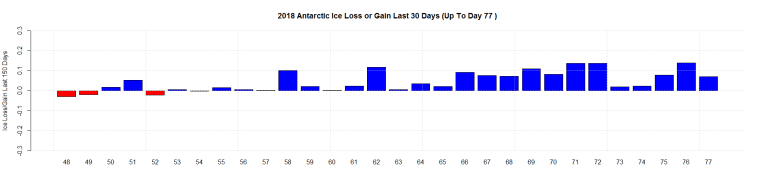
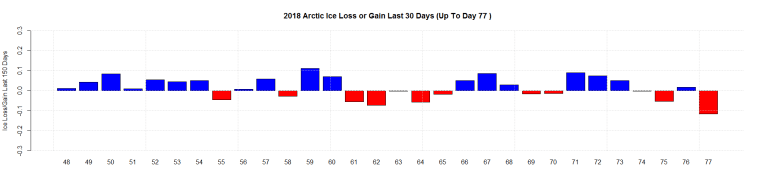
Sea Ice Extent (Global Antarctic and Arctic) – Day 77 – 2018
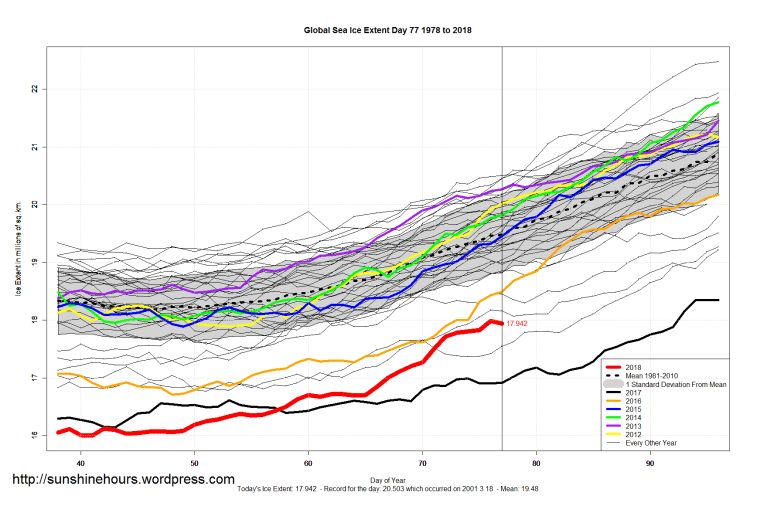
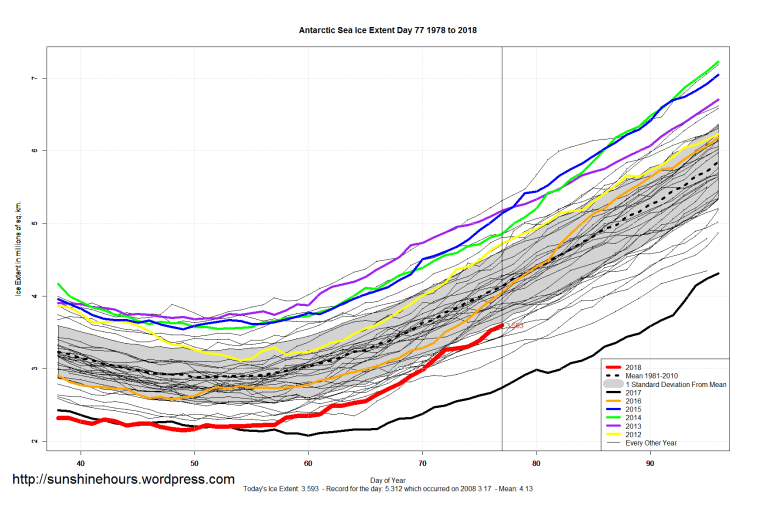
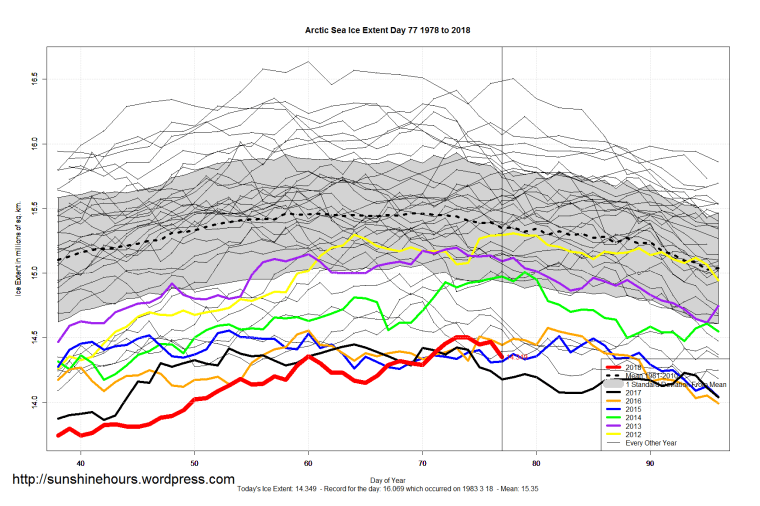
Sea Ice Extent (Global Antarctic and Arctic) – Day 76 – 2018

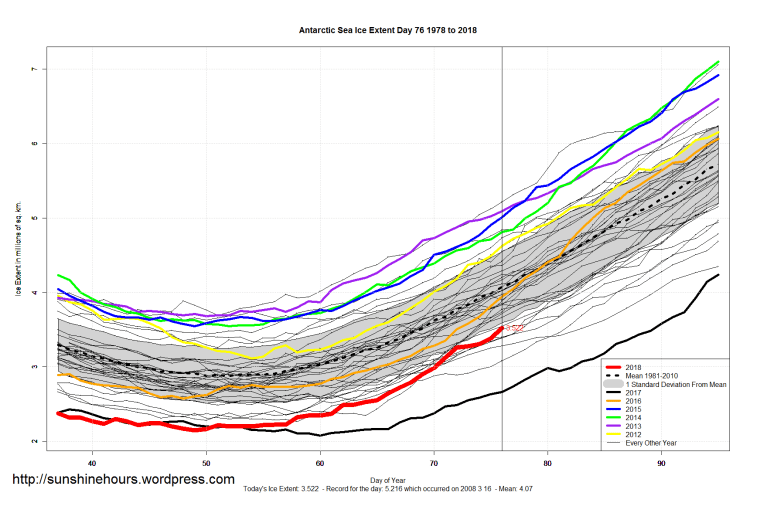
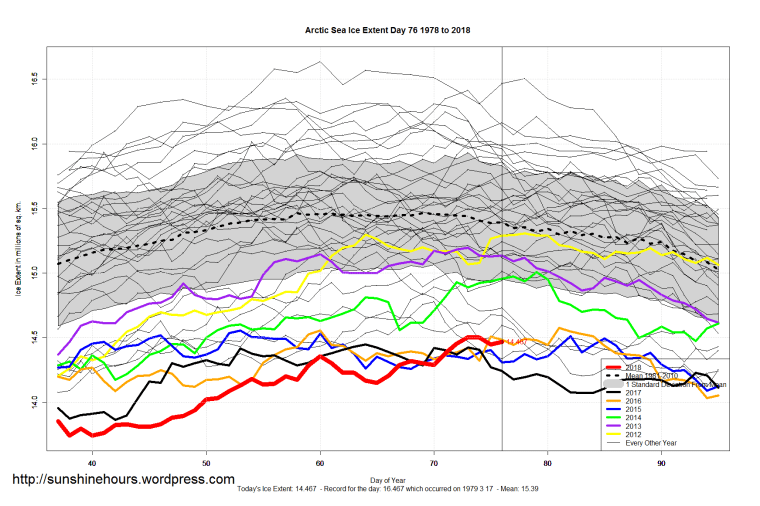
Sea Ice Extent (Global Antarctic and Arctic) – Day 75 – 2018
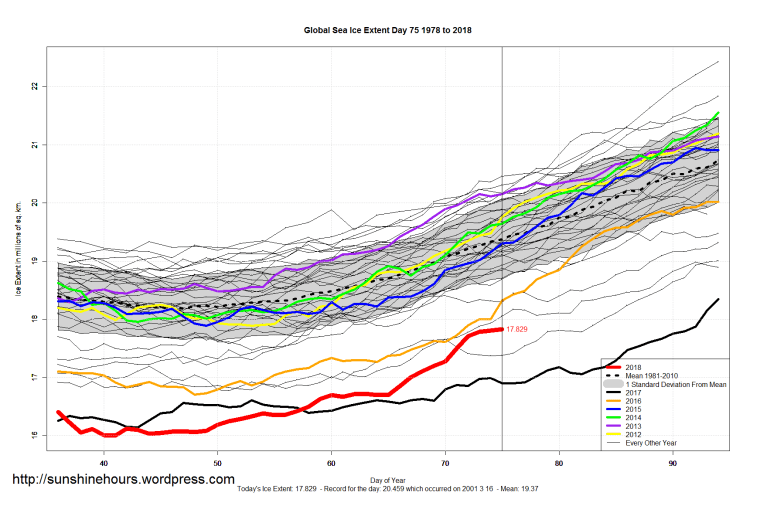
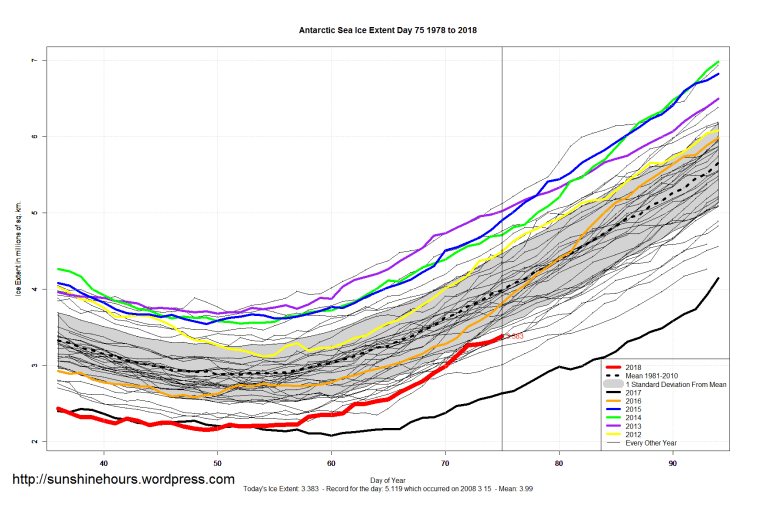

Sea Ice Extent (Global Antarctic and Arctic) – Day 74 – 2018


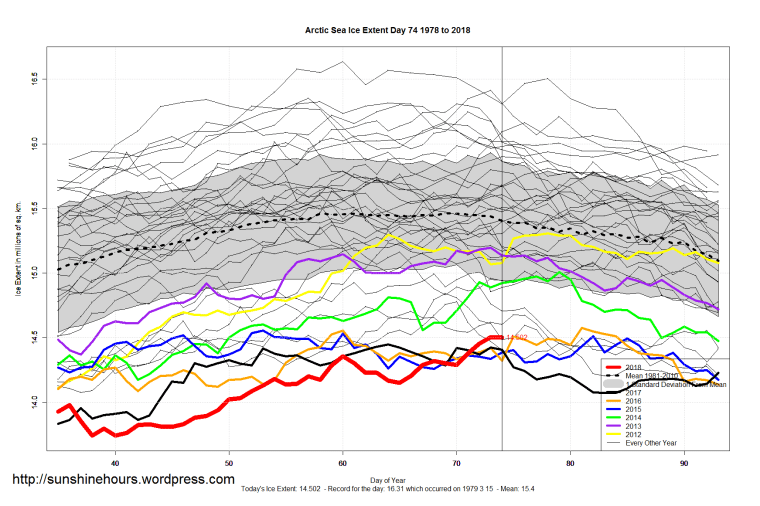
Sea Ice Extent (Global Antarctic and Arctic) – Day 73 – 2018
Yesterday I noted that 2018 avoided a record low max by 6,000 sq km.
As of day 73 Arctic was still climbing and max for 2018 is 57,000 sq km higher than the max for 2017.
   Year   Max  Day
 4 2016 14.576 81
 3 2015 14.554 53
 2 2018 14.504 73
 1 2017 14.447 64
The latest day of Max was 90 in 1995 and 2010.


 sunshine hours