⚡⚡ In Los Angeles, nearly 2,200 flashes of lightning were detected in the space of five hours! ⚡⚡ pic.twitter.com/5MroygfcbI
— BBC Weather (@bbcweather) March 6, 2019
Flash Flood
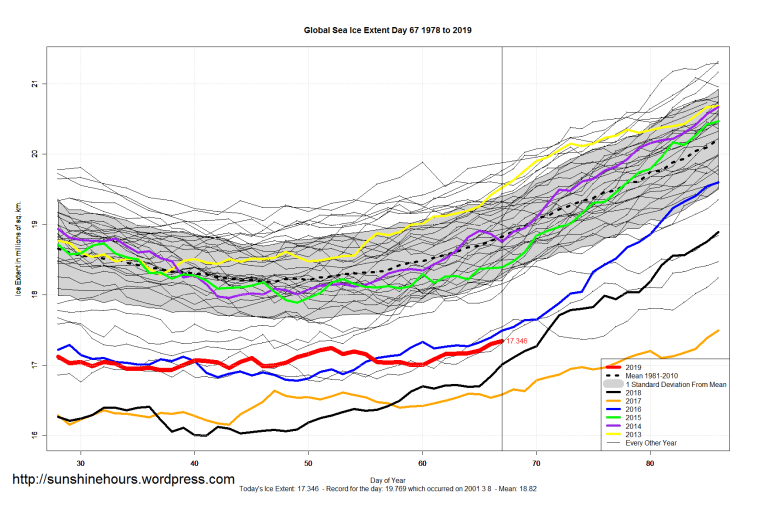
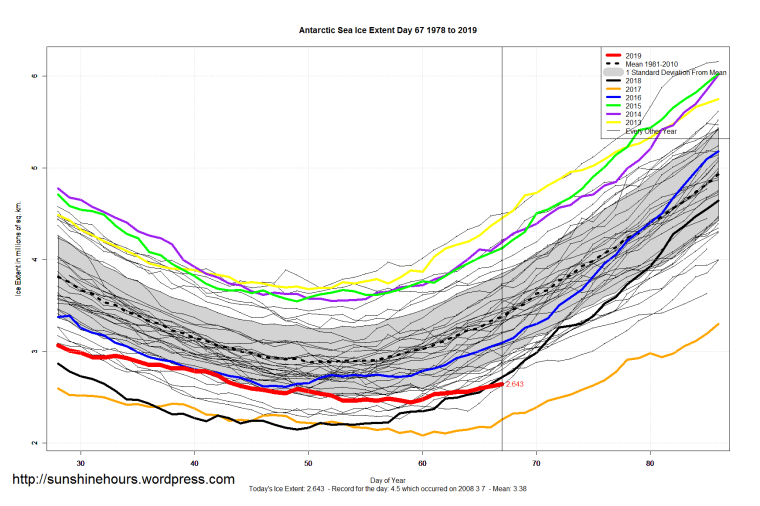
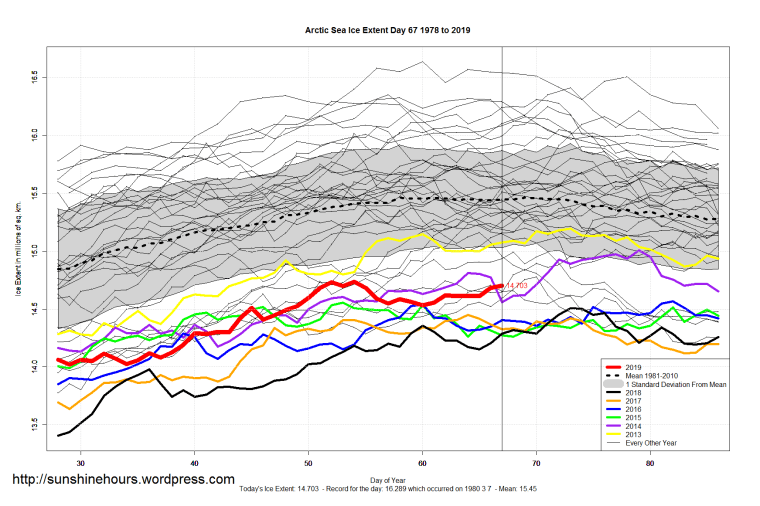
Sea Ice Extent (Global Antarctic and Arctic) – Day 67 – 2019
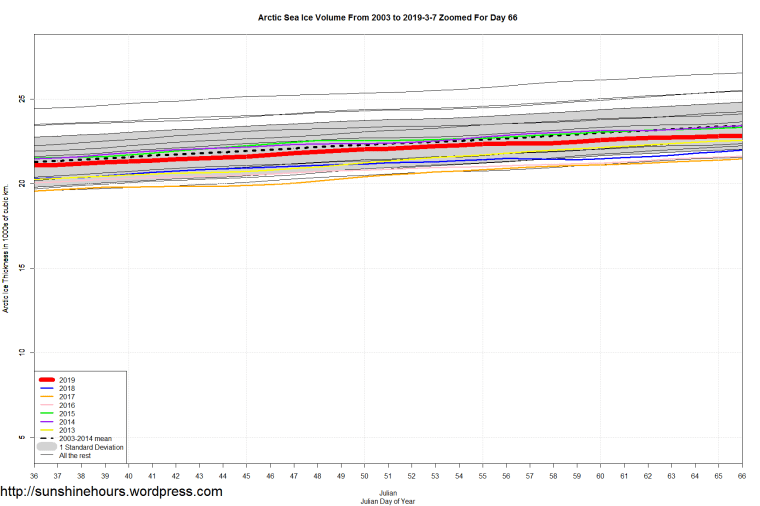
Arctic Sea Ice Volume 08-Mar-2019
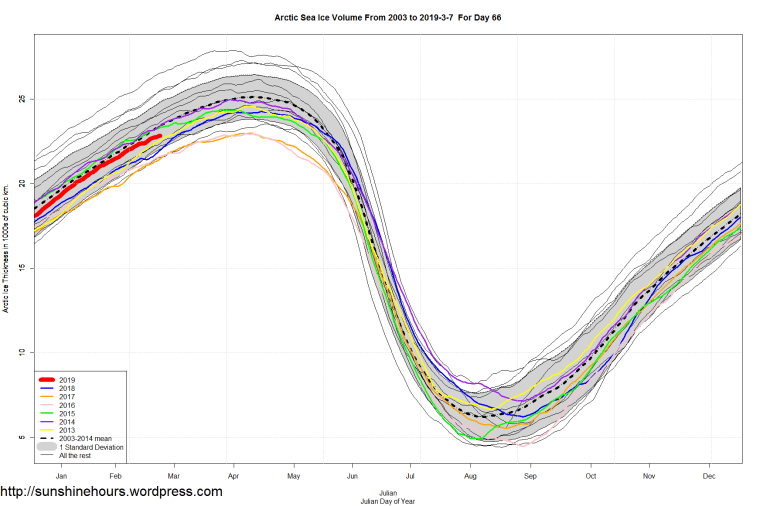
From DMI
Frequent flier climate activists
This is not surprise to me, but I like to see it in print. (Thanks to NoTricksZone)
A commentary at flagship German online daily FAZ looked at a recent study by the German Umweltbundesamt – UBA – (Federal Environment Agency) which examined the per capita consumption of natural resources by different population groups.
Not surprisingly, high income groups were found to own a large number of cars and live in large homes with energy-guzzling appliances – thus making this group of people large consumers of energy.
Frequent flier climate activists
Also the study found that the “urban, academic young classes who tend towards voting for the Greens have far above-average CO2 emissions per capita” and these emissions “are not offset by them buying vegetables from the local region in the organic shop”.
The FAZ writes that the study found that this particular class — who are worried about the CO2 emissions and the climate — have “an above-average number of frequent flyers” and like to take long-haul flights to distant places like “New Zealand or Canada to admire nature”.
The UBA study also found that traditional working classes (whose lifestyles the Greens often complain about) in fact are energy modest and fly less frequently.
Here the FAZ concludes:
The bottom line of the study was that those with a ‘positive environmental attitude’ had the highest actual energy consumption and CO2 emissions.”
Big Climate Court Case Coming Up In Australia
Peter Ridd is suing James Cook University for daring to challenge “settled science” about the Great Barrier Reef. Court case is coming up later in March.
Just letting you know that my court case is scheduled for 26-28th March in Brisbane. The main arguments of both sides have been submitted to the court and the James Cook University arguments will certainly make interesting reading when they become public during the hearing. My legal people have been excellent and I am confident that if this can be won, then they will do it.
On a philosophical note, in my opinion JCU will lose the ethical argument even if they manage to win on some narrow legal definition. If they win, it will mean that a judge has decided that a university has set up legally binding contracts that give them the power to effectively take away the right to intellectual freedom of an academic and silence him/her. That would be something of a pyrrhic victory. The university hierarchy may feel vindicated but the general public, especially those in North Queensland who are most affected by the questionable Great Barrier Reef science, will take a different view.
But without getting over-confident, I reckon the chances of us winning are considerably above average, so we will see.
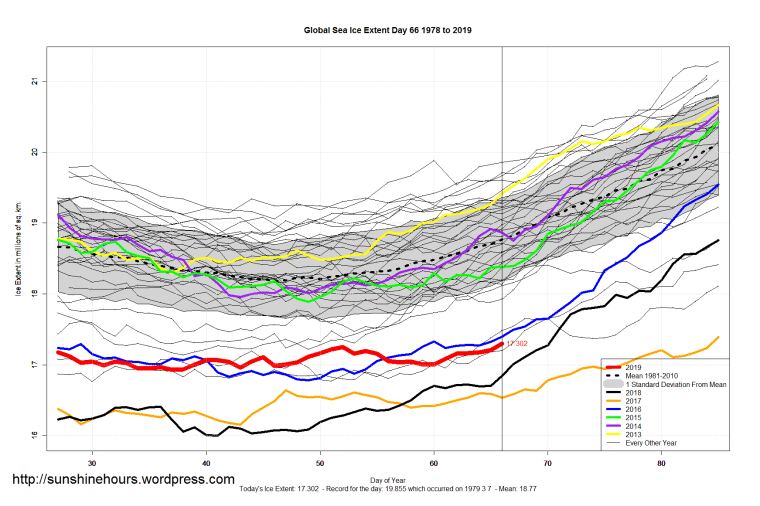
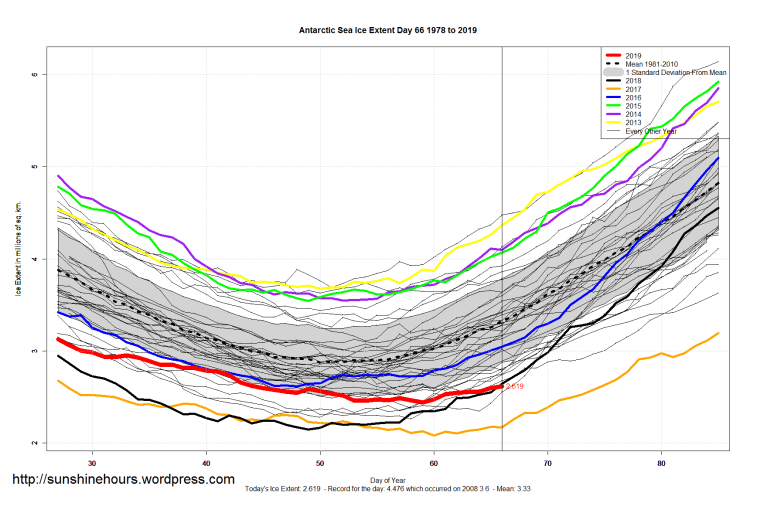
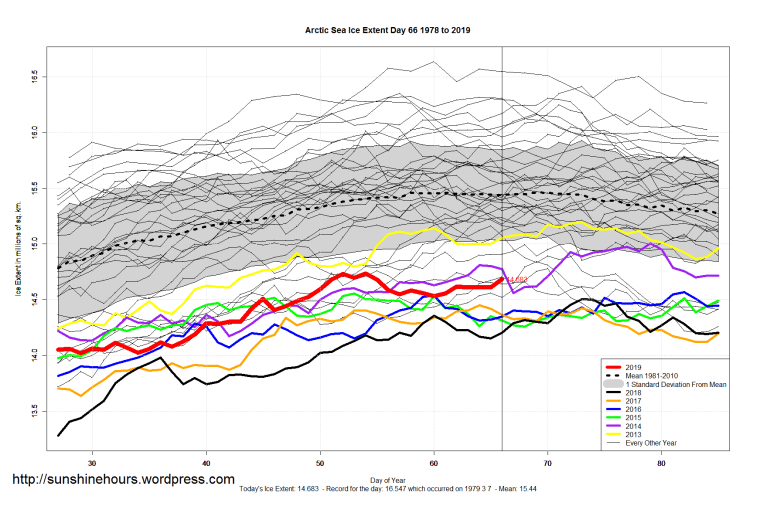
Sea Ice Extent (Global Antarctic and Arctic) – Day 66 – 2019
Arctic Sea Ice Volume 07-Mar-2019
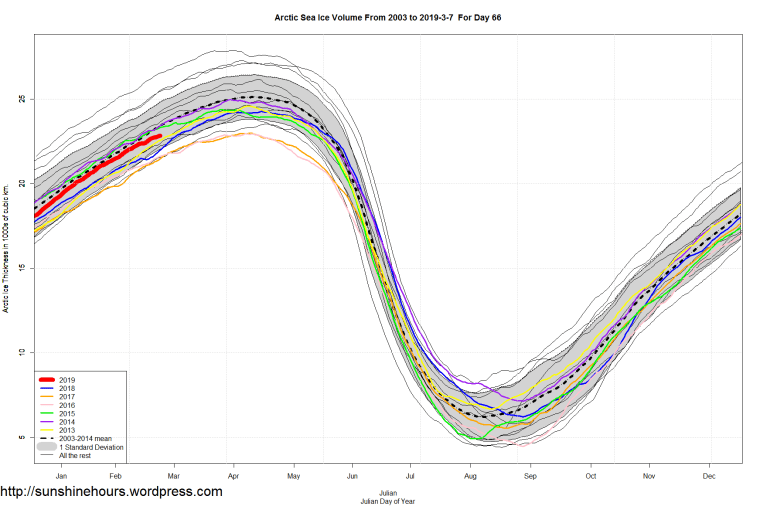
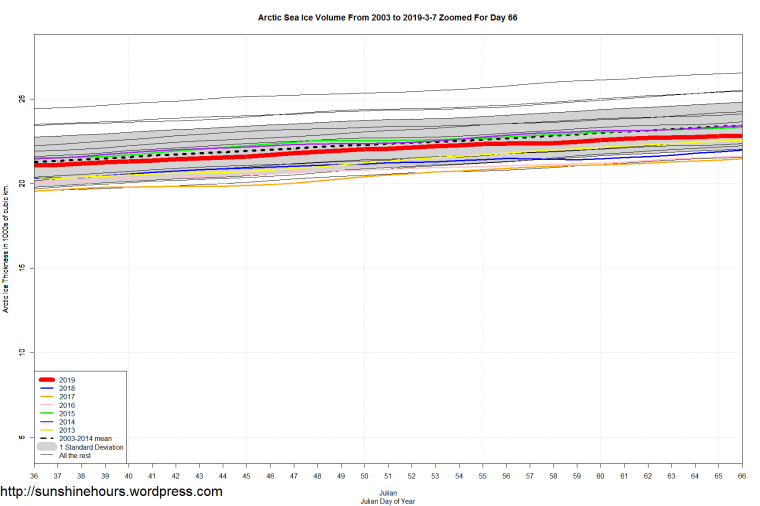
From DMI
Arctic region was warmer than today during the 1930s.
It has been warmer in the Arctic.
Air temperature in 1899–1914 during three expeditions was 1.8–4.6 °C lower than the modern period in winter (Oct–Apr). However, during the 1930/31 expedition it was 4.6 °C warmer than the years 1981–2010. Our results relate to what has been called the ‘1930s warming’, referred to by various authors in the literature as the ETCW or the ETCAW.
Thanks to NoTricksZone
And I look forward to this:
This article is one of the first in the literature to present an analysis of biometeorological conditions in the Arctic in historical periods. The Department of Meteorology and Climatology of Nicolaus Copernicus University has a sizeable database of early instrumental data for the Arctic region, the Historical Arctic Database (HARD 2.0, http://www.hardv2.prac.umk.pl/), and work on climate reconstructions of the region is ongoing. This line of application of the data, i.e. the historical bioclimatology of the Arctic, will continue to be developed in the near future.
Scientists Detect ‘Shocking’ Drop in Male Fertility
I’m amazed the word climate change isn’t in this article.
The homes we live in and the food we eat might contain chemicals that reduce male fertility – and that goes for both men and their dogs, new research suggests.
Recently, experts have grown ever more worried by what appears to be a ‘shocking‘ drop in human male fertility.
According to the team behind the latest research, some studies show that in the past 80 years alone, there has been a 50 percent global reduction in sperm quality, and no one can figure out why this is happening.
Then, we looked at dogs – and this could be an important clue. In 2016, a team at the University of Nottingham found that sperm quality had also taken a plummet in domestic dogs over the course of several decades.
Unlike the research on humans, this time the scientists could trace back the sperm quality decrease to dangerous chemicals in the dogs’ environment and food.
The results had the team curious: did this mean there was something in the shared environment of dogs and people that was to blame?
Their new research certainly suggests this might be the case. Specifically, the team identified two human-made chemicals, commonly found in homes and diets, that had the same adverse effects on both human sperm and dog sperm.
“This new study supports our theory that the domestic dog is indeed a ‘sentinel’ or mirror for human male reproductive decline,” says Richard Lea, a reproductive biologist at the University of Nottingham.
Using sperm samples from 11 men and 9 dogs in the same region, the researchers tested the effects of two human-made chemicals. One was the common plasticiser DEHP, which is commonly found in carpets, flooring, clothes and toys, and which can leach into our food and drink.
The other is polychlorinated biphenyl 153 (PB153), which belongs to a group of industrial chemicals found to be persistent organic pollutants in the 1960s and 70s.
Using the sperm samples and these two chemicals at concentration levels that are commonly found in our current environments, the researchers carried out identical experiments for the men and the dogs. In both subjects and with both chemicals, the effect was reduced sperm motility and increased fragmentation of DNA.
Read the rest here
 sunshine hours