This enormous rotating ice disk formed in the Presumpscot River in Westbrook, Maine yesterday! pic.twitter.com/6zaneBQv4h
— AccuWeather (@accuweather) January 16, 2019
Offset By ‘Natural Variability’ – Unmelting Snowpack
The models say the snowpack should be melting. Natural variabilty is the excuse for why this hasn’t happened.
The money quote: “Although the amount of water contained in the snowpack has declined over the past century, it has been surprisingly stable since the 1980s”
The excuse: “However, here we show that the contribution of global warming to western U.S. snowpack loss has in reality been large and widespread since the 1980s, but mostly offset by natural variability in the climate system.”
Translation: The models are wrong.
The abstract:
Melting snowpack is a vital source of water in the western United States during the summer, when rainfall is usually scarce. Although the amount of water contained in the snowpack has declined over the past century, it has been surprisingly stable since the 1980s, despite 1 °C of warming over the same period. At first glance, this result might appear to indicate that the snowpack is quite resilient to warming. However, here we show that the contribution of global warming to western U.S. snowpack loss has in reality been large and widespread since the 1980s, but mostly offset by natural variability in the climate system. This result points to a faster rate of snowpack loss in coming decades, when the impact of global warming is more likely to be amplified, rather than offset, by natural variability.
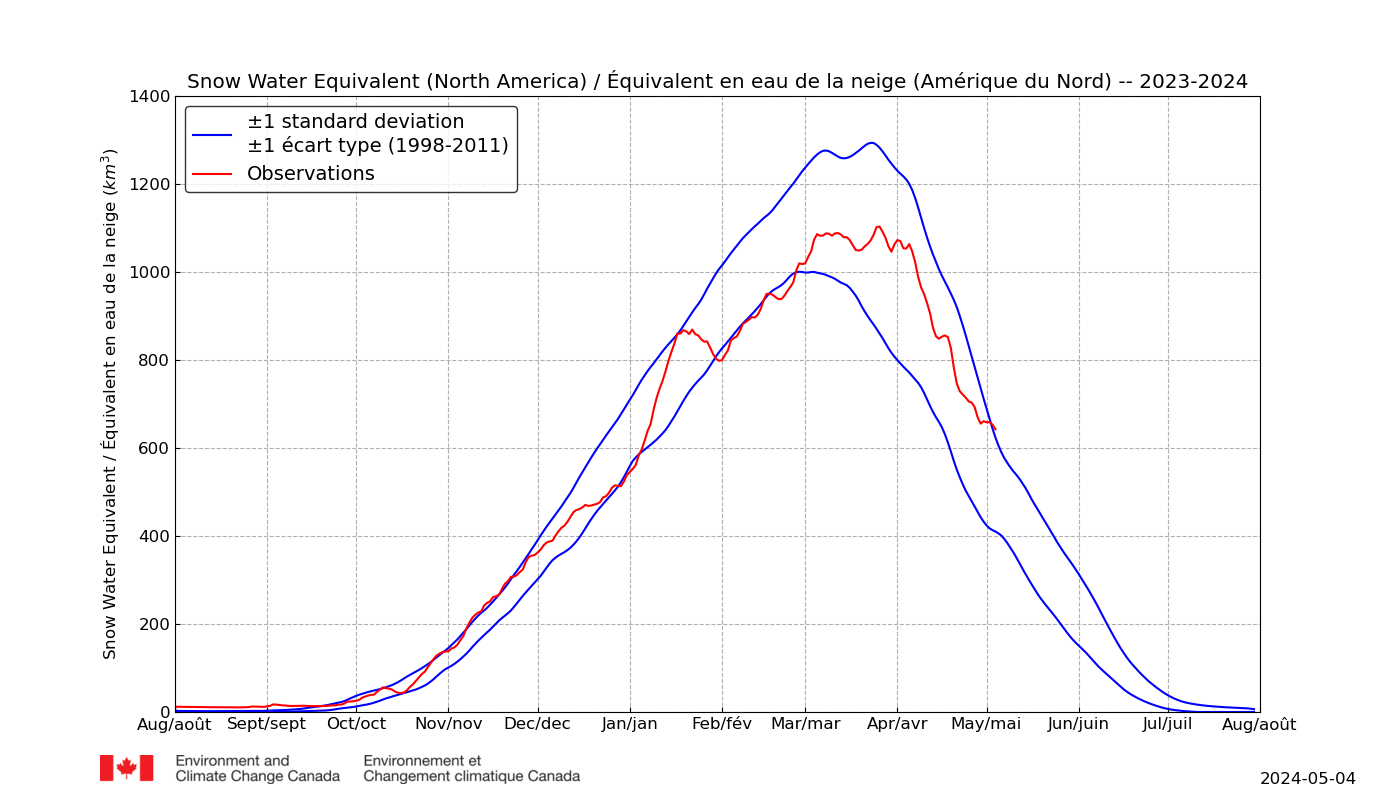
And remember, North America Snowpack is above normal (snow water equivalent) in 2018/2019.
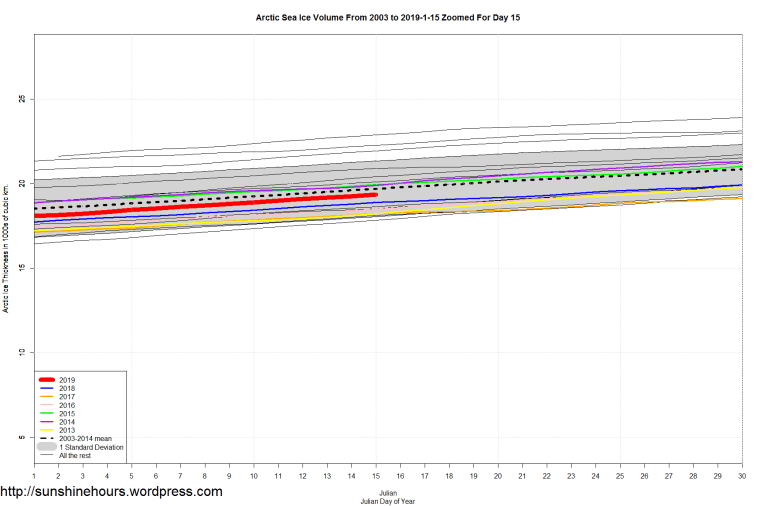
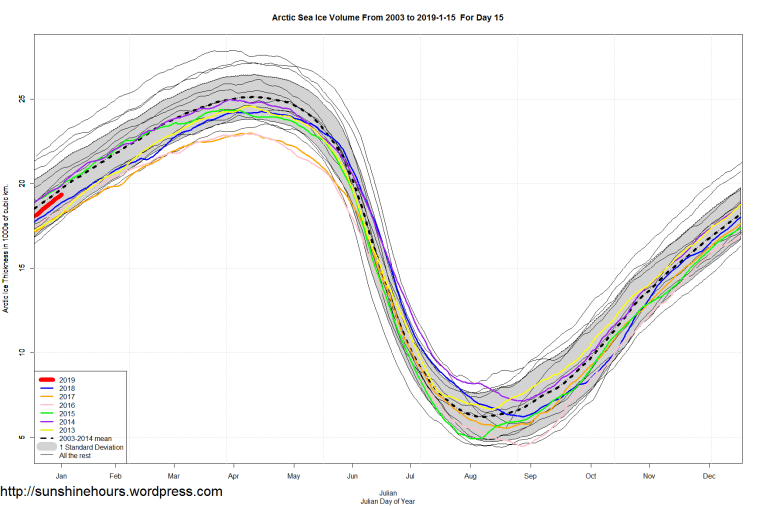
Arctic Sea Ice Volume 15-Jan-2019
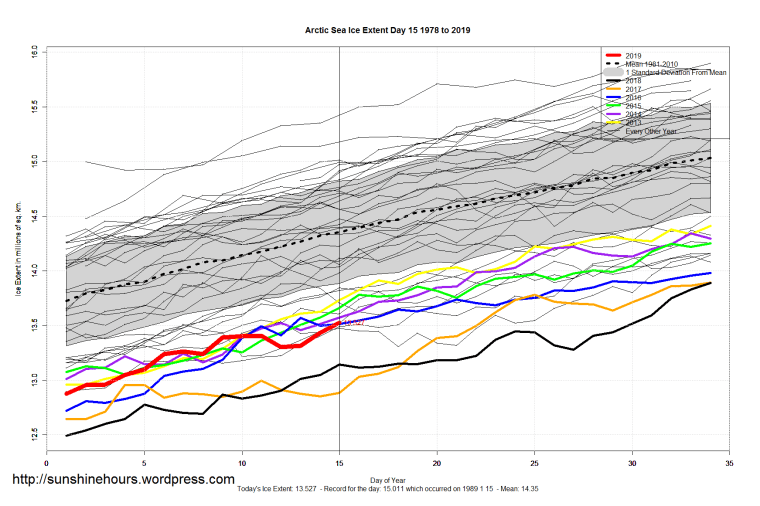
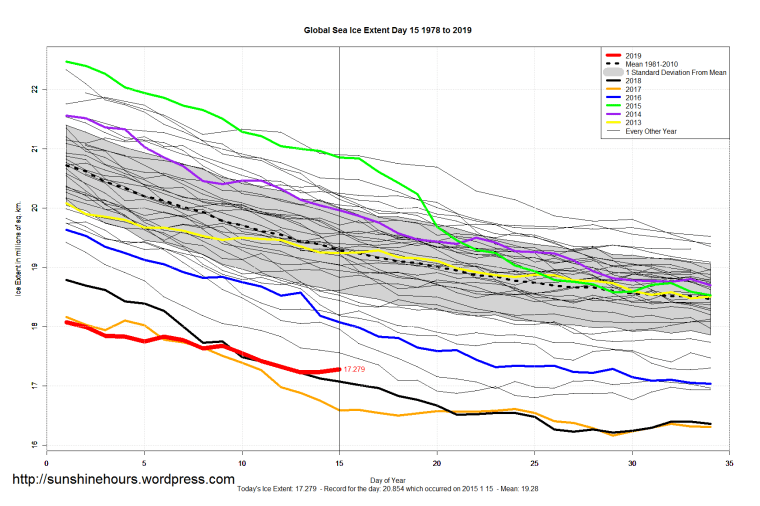
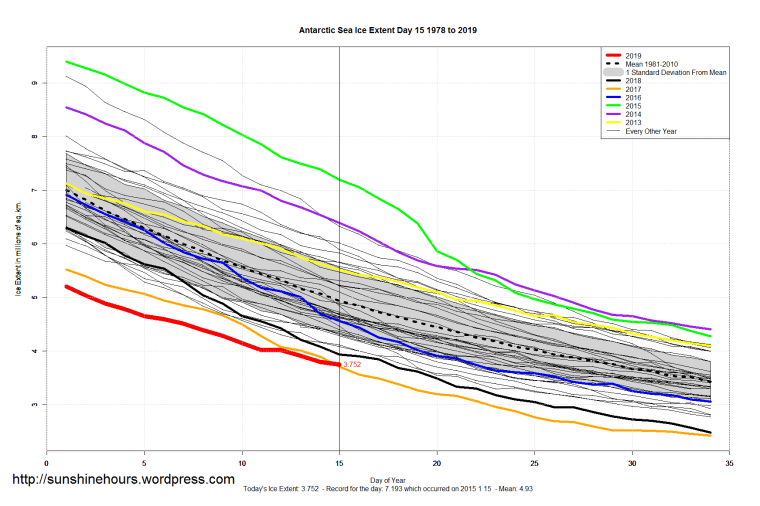
Arctic 640,000 sq km Higher Than 2017 – Sea Ice Extent (Global Antarctic and Arctic) – Day 15 – 2019
Avalanche
The first people to run had it right. (NSFW language)
UK: Maybe Some Sanity on the Wood Pellet Issue?
1,000,000,000£ subsidy for burning wood pellets might be scrapped?
Controversial subsidies for burning wood in power stations could be scrapped in the drive to clean up Britain’s air.
Firms that burn wood pellets currently receive about £1billion a year because, unlike coal, these are considered renewable sources of energy.
But critics say burning wood produces similar amounts of carbon dioxide to coal, contributing to air pollution.
It also increases the logging of forests in the US, while shipping them to Britain in vast quantities has a further negative effect on the environment.
Environment Secretary Michael Gove yesterday revealed subsidies for burning wood could be scrapped as he unveiled the Government’s clean air strategy.
The U-turn comes after years of state support for ‘biomass’ such as wood pellets, in schemes pioneered by disgraced former Liberal Democrat energy secretary Chris Huhne.
He was hired by US firm Zilkha Biomass, which makes wood pellets, after serving a prison sentence in 2013 for perverting the course of justice.
The clean air strategy includes proposals to scrap some subsidies paid under so-called ‘contracts for difference’.
The contracts, which last until 2027, offer payments of about £100 per megawatt hour for burning imported wood – more than double the wholesale energy price.
Britain’s biggest power station, Drax, near Selby, North Yorkshire, burns about 7million tons a year of compressed wood pellets imported from the US and Canada.
Arctic Sea Ice Volume 14-Jan-2019


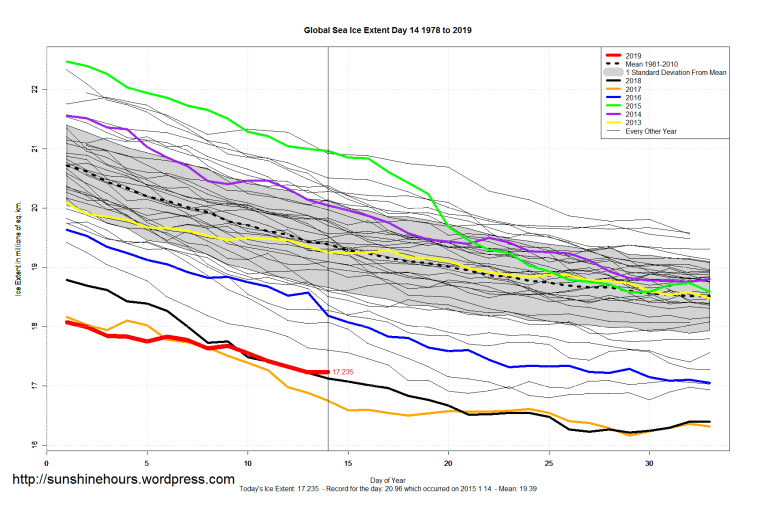
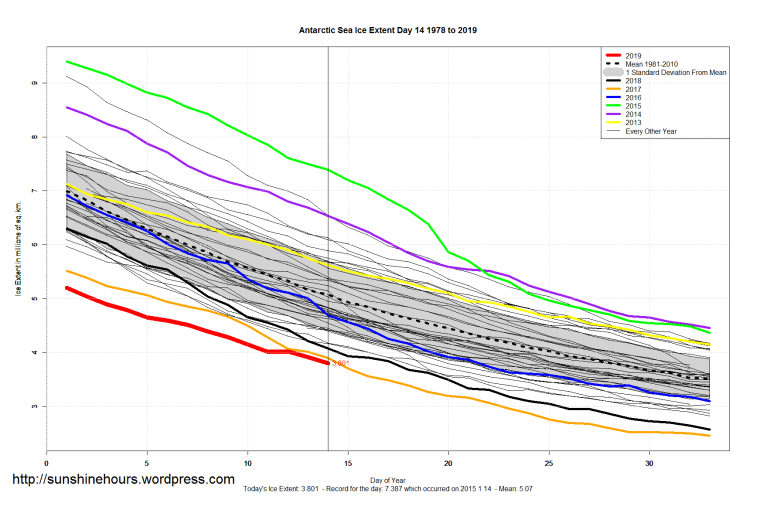
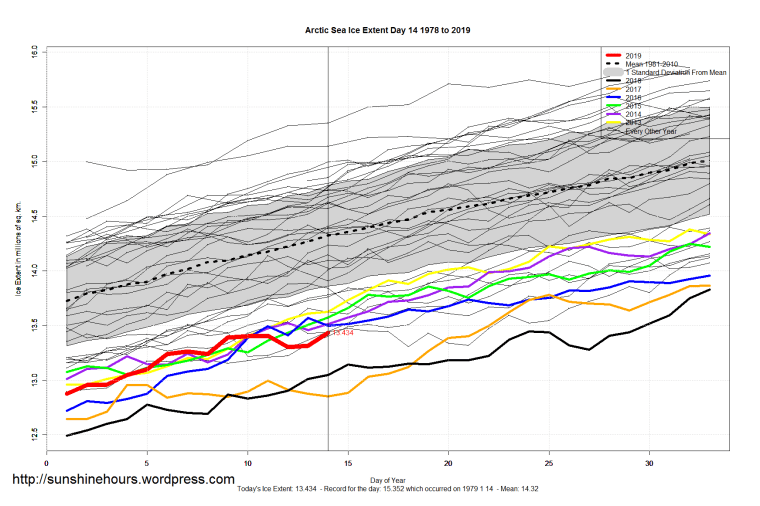
Sea Ice Extent (Global Antarctic and Arctic) – Day 14 – 2019
Polar Bear vs Submarine
Great pictures of a polar bear encounter with a submarine.

Anak Krakatoa Over Just One Month
On 22 December 2018, a tsunami that followed an eruption and partial collapse of the Anak Krakatau volcano in the Sunda Strait struck several coastal regions of Banten in Java and Lampung in Sumatra, Indonesia. The tsunami was caused by an undersea landslide that followed an eruption of Anak Krakatau, the “Child of Krakatoa”. On 23 December, it was found that much of the island of Anak Krakatau had collapsed into the sea.
The first tweet shows the changes in the volcano just over one one month.
The second shows the neighboring islands some of which have had the coastline scoured by the tidal wave.
 sunshine hours