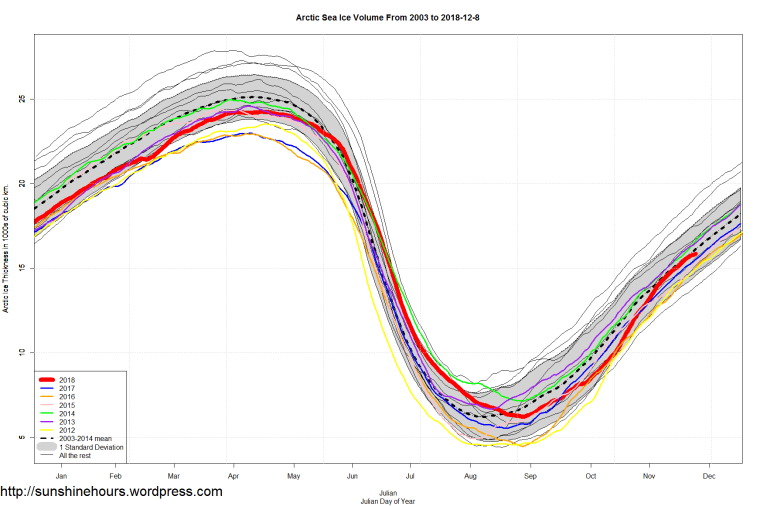
From DMI
Marc Morano exposes climate hypocrisy on Fox
Arnold Schwarzenegger who just went to the U.N. summit in Poland and called President Trump crazy for not believing in climate change, he commuted daily to the governor’s mansion when he was governor at the same time touting his global warming bill.
Watch the whole thing.
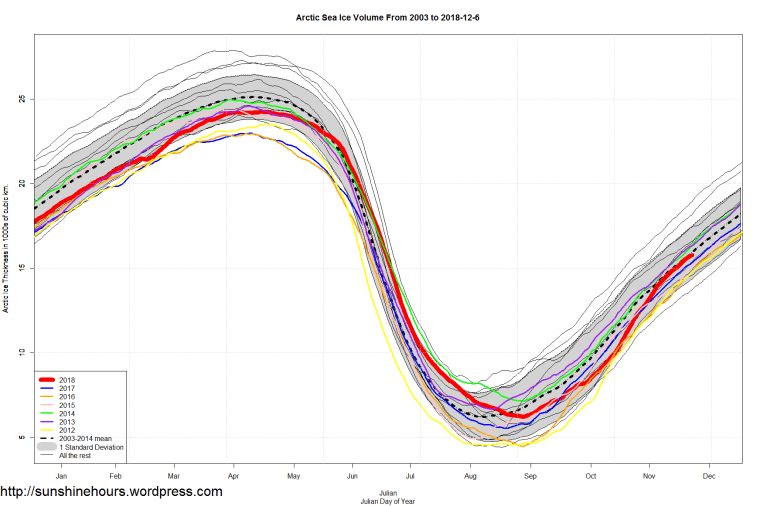
From DMI
Update: Willis made a mistake. Read about it here.
Original post below:
Willis Eschenbach is looking at the CERES satellite data trends from 2000.
While the Globe is averaging a tiny .07C per decade, the Northern Hemisphere trend is 0.
And Land is trending down -0.09C per decade.
As he says
“I’ve never seen a climate model from the turn of the century that predicted that for the first 18 years of the 21st Century the land would be cooling … and despite that, we’re supposed to believe that those same climate models can tell us what the temperatures will be doing in the year 2100 … yeah, that’s totally legit …”


Update: Willis made a mistake. Read about it here.
Original post below:
Willis Eschenbach is looking at the CERES satellite data trends from 2000.
While the Globe is averaging a tiny .07C per decade, the Northern Hemisphere trend is 0.
And Land is trending down -0.09C per decade.
As he says
“I’ve never seen a climate model from the turn of the century that predicted that for the first 18 years of the 21st Century the land would be cooling … and despite that, we’re supposed to believe that those same climate models can tell us what the temperatures will be doing in the year 2100 … yeah, that’s totally legit …”
Someone decided to study plants that have grown for generations near high CO2 springs.
Normally these studies look at FACE experiments and then criticize those experiments because they are only single generation.
Guess what they found.?
In a new meta-analysis, Saban et al. took a different approach and assessed all of the data collected for plant response to high CO2 concentration from plants grown for multiple generations over many decades in naturally high CO2 springs. Such springs are found across the world – with 23 highlighted here- and many have been the focus of studies on the physiological responses of plants to rising CO2, similar to those undertaken in FACE experiment. Comparing these two approaches, plants subjected to higher CO2against plant lineages that have had time to acclimate, has never been done before.
High CO2 springs harbour a vast array of plant types and in contrast to FACE, provide critical insight into the decadal, long-term response of plants such as those likely to occur in future, where multiple generations ensure that time-travelling seed sources are no longer an issue. Remarkably, the analysis shows that many of the responses for spring plants are similar to those observed in FACE experiments. This gives us confidence that plants are likely to keep responding positively to rising CO2. They will not become acclimated and the increased global greening that is currently happening across the world, 80% of which is attributed to rising CO2 is likely to continue.

 sunshine hours