CO2 is a Benefit

CO2 is a huge benefit to agriculture and nature.

It’s an undeniable fact that increasing CO2 increases plant growth. CO2 increases since 1985 have led to increased rainforest and crop growth, satellites show a 14 per cent increase in global greenery – fantastic news for nature and food security. Despite climate pessimists, global food prices remain low, with record yields achieved last year. Food prices would be even lower if the US ceased growing subsidised, inefficient “green” bioethanol crops. Extra production from rising “CO2 fertilisation” is equivalent to an extra 15 per cent land globally. This equals 35 times UK arable area, enough to feed the entire world their daily bread, worth over £100 billion yearly, plus the environmental benefit of increased growth in natural ecosystems. All down to a supposed “villain”.

Dr Keith P Dawson is vice President at the Scottish Society of Crop Research

Read more: The Scotsman


Climate “Scientists” off by a factor of 5.

Another study proving the science isn’t settled and the previous assumptions about catastrophic climate change just aren’t true.

Until now, most scientists have thought that a warming planet would cause plants to release more carbon dioxide into the atmosphere, which in turn would cause more warming.

But in a study published Wednesday in Nature, scientists showed that plants were able to adapt their respiration to increases in temperature over long periods of time, releasing only 5 percent more carbon dioxide than they did under normal conditions. Based on measurements of short-term temperature responses in this study and others, the scientists expected that the plants would increase their respiration by nearly five times that much.


Word of the Day: Sewage Sludge

Ok. Technically Sewage Sludge is a phrase.

The other day I was talking about cofiring. And I discovered that one of the fuels they cofire alongside coal is sewage sludge.

What is sludge?

Up to 95 percent is water. But it starts as wastewater, which is a mix of food, paper, diapers, plant mater, feces, condoms, sanitary napkins, paints, pesticides, bacteria, pathogens, pharmaceuticals, sand, metal particles, road salt, insects and gases.

I think I would prefer 100% coal.


Word of the Day: Cofiring and more CO2

Cofiring: the combustion of two different types of materials at the same time.

This word may not be new to many of you (or some of you) but it was to me. Or course I have mocked the idea of replacing coal with wood since burning wood from the USA creates more CO2 than coal. The DRAX post from the other day points out that even DRAX’s own study showed more CO2 from wood pellets than from coal.

And destroying forests to produce more CO2 in the atmosphere seems to me to be amazingly stupid.

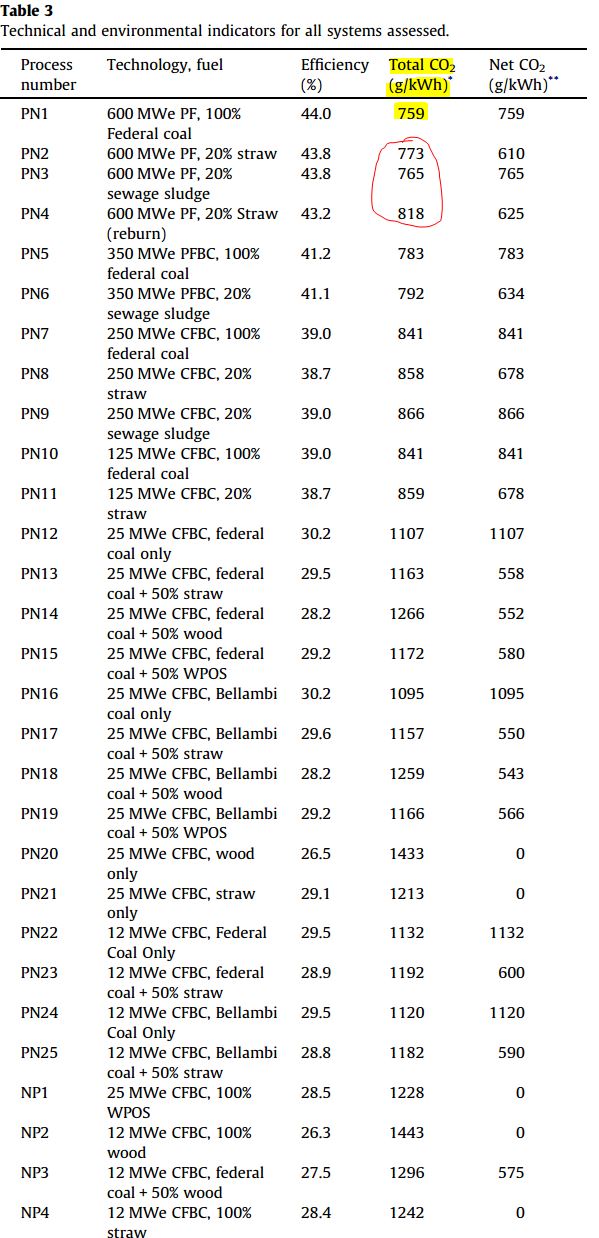
So I’ve been investigating to see what kind of cofiring goes on and how much CO2 is produced. The really important terms are Total CO2 and Net CO2 and CO2 neutral.

Total CO2 refers to the gross emissions of CO2 from this power plant.

Net CO2 refers to the emissions of CO2 from the fossil fuel used in this power plant, since biomass is assumed to be CO2 neutral. Gross CO2 and net CO2 will be the same where only fossil fuel is used.

In my opinion the concept of CO2 neutral is bogus. CO2 is CO2. If you generate 600MW of power and you care about CO2 then it shouldn’t matter whether you use coal or sewage sludge or any other biomass. It should be total CO2. (Not completely true because other things are produced from coal power plants like SO2 etc but today we talk CO2)

I came across this paper: A Techno-economic assessment of the reduction of carbon dioxide emissions through the use of biomass co-combustion

The paper claims:

Using sustainably-grown biomass as the sole fuel, or co-fired with coal, is an effective way of reducing the net CO2 emissions from a combustion power plant. There may be a reduction in efficiency from the use of biomass, mainly as a result of its relatively high moisture content, and the system economics may also be adversely affected.

Notice the term net CO2 is used. Their conclusions are based on the fallacy that the CO2 produced by burning the biomass is zero. But they were nice enough (honest enough?) to show the figures for total CO2.

The table shows the result of the experiments. The one I highlighted has 4 sections:

PN1: a 600MW power plant burning 100% coal. CO2 = 759 g/kWh
PN2: a 600MW power plant burning 80% coal and 20% straw. 773 g/kWh
PN3: a 600MW power plant burning 80% coal and 20% sewage sludge. 765 g/kWh
PN4: a 600MW power plant burning 80% coal and 20% straw (reburn). 818 g/kWh

In all cases biomass+coal cofiring produces more CO2. And the CO2 numbers don’t take into account transportation of coal or biomass. So locally sourced biomass isn’t a disaster. But wood pellets from the USA produce a lot of CO2 just in transport costs.
Capture


Increased carbon dioxide enhances plankton growth


CO2 is good.

“Coccolithophores–tiny calcifying plants that are part of the foundation of the marine food web–have been increasing in relative abundance in the North Atlantic over the last 45 years, as carbon input into ocean waters has increased. Their relative abundance has increased 10 times, or by an order of magnitude, during this sampling period, report researchers.”

We never expected to see the relative abundance of coccolithophores to increase 10 times in the North Atlantic over barely half a century. If anything, we expected that these sensitive calcifying algae would have decreased in the face of increasing ocean acidification (associated with increasing carbon dioxide entering the ocean from the burning of fossil-fuels). Instead, we see how these carbon-limited organisms appear to be using the extra carbon from CO2 to increase their relative abundance by an order of magnitude.

Gephyrocapsa_oceanica_color

http://www.sciencedaily.com/releases/2016/01/160116215419.htm


CO2 increases of 80ppm to 100ppm are normal

While CO2 has increased by 85 ppm from when measurements began  in 1958 and are estimated to have risen by 120 ppm since 1750, we should also realize that increases of 80 ppm to 100 pm occurred during the last 3 glaciations without humans burning fossil fuels.

” Air trapped in bubbles in polar ice cores constitutes an archive for the reconstruction of the global carbon cycle and the relation between greenhouse gases and climate in the past. High-resolution records from Antarctic ice cores show that carbon dioxide concentrations increased by 80 to 100 parts per million by volume 600 ± 400 years after the warming of the last three deglaciations. Despite strongly decreasing temperatures, high carbon dioxide concentrations can be sustained for thousands of years during glaciations; the size of this phase lag is probably connected to the duration of the preceding warm period, which controls the change in land ice coverage and the buildup of the terrestrial biosphere.”

http://www.sciencemag.org/content/283/5408/1712.abstract