Record Sea Ice Low Predicted (Short Memories)

They are predicting a record low sea ice for 2016 because ” Comparably little new ice formed during the past winter.”

Even though I am now using JAXA (because the NSIDC sensor problems) and Jaxa sea ice data only goes back to 2002, I’d like to point out two things.

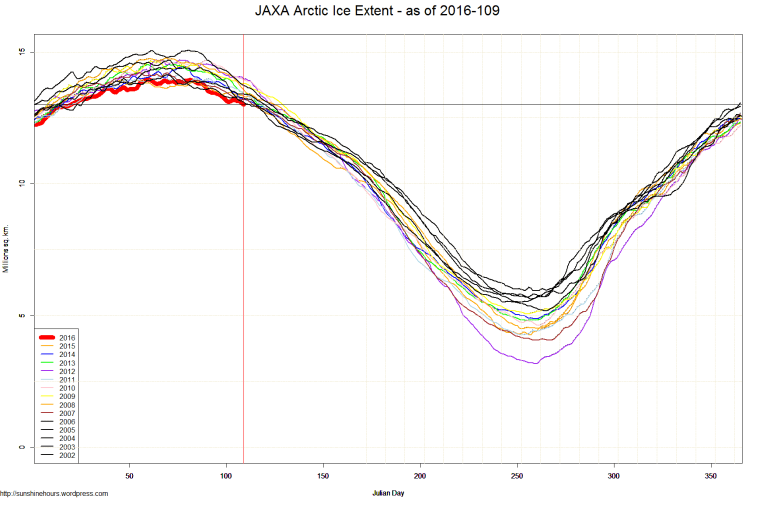
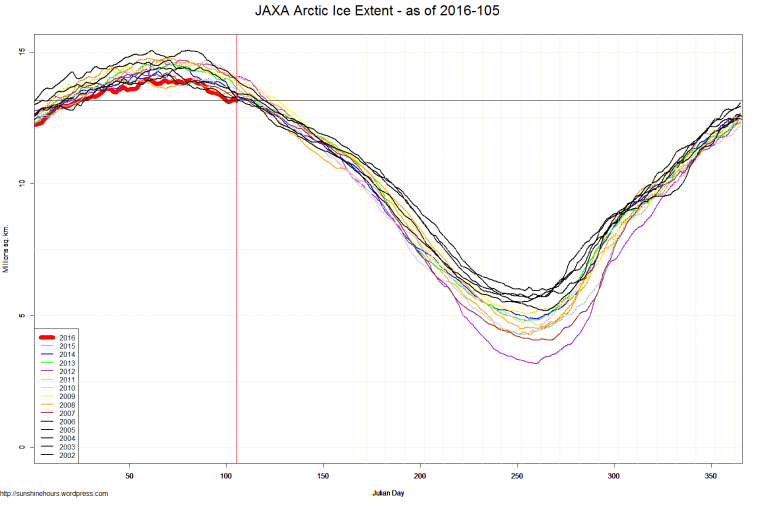
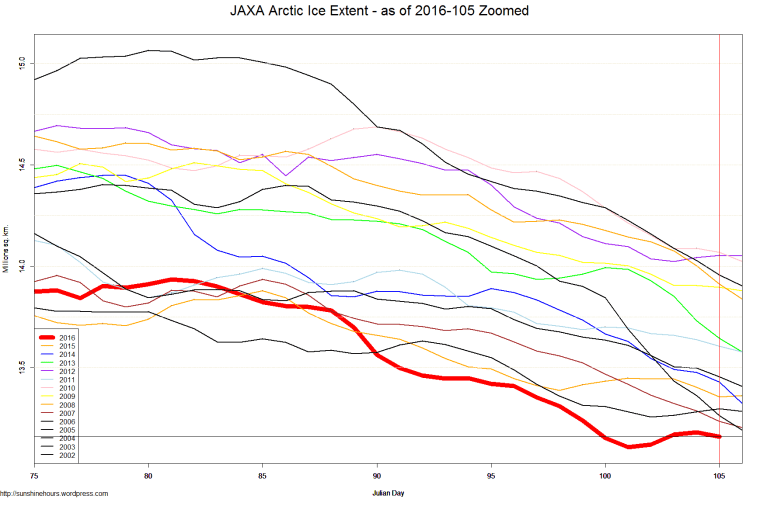
  1. April 20th 2012 sea ice extent was highest ever (in history of Jaxa)  as you can see below (the purple line) It wasn’t low ice in April that caused a record in 2012.
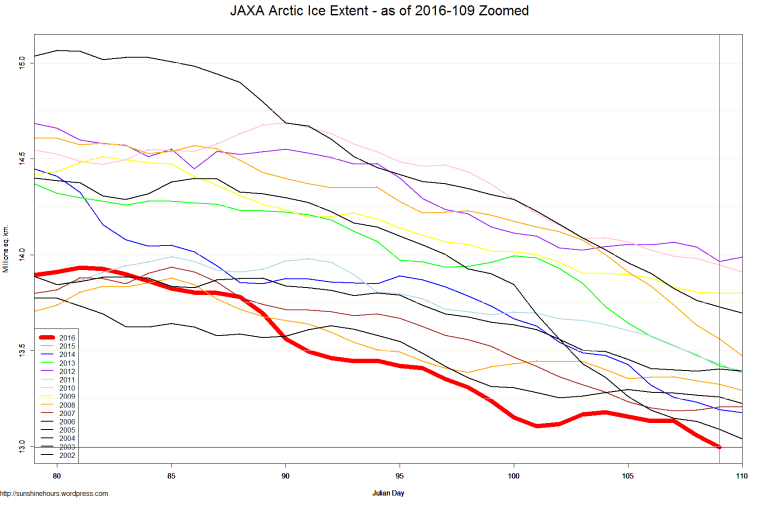
JAXA Arctic Ice Extent - as of 2016-109 Zoomed

2. The Great Arctic Cyclone 2012 Caused the Record Low. You can read my blog post here.

The opening paragraph:

Great Arctic Cyclone 2012 Caused the Record Low

Update: Watch a NASA simulation of the cyclone breaking up the ice.

The Great Arctic Cyclone of 2012 hit on Aug 5 and passed over the North Pole on Aug 6.

“An unusually strong storm formed off the coast of Alaska on Aug. 5, then moved over the central Arctic. The Moderate Resolution Imaging Spectroradiometer (MODIS) on NASA’s Aqua satellite took the images that make up the mosaic during various passes over the North Pole on Aug. 6, when the storm was swirling over the middle of the Arctic Ocean. According to a NASA statement,there have only been about eight storms of similar strength during the month of August in the last 34 years of satellite records.

Using Jaxa data, note that from July 20 all the way to Aug 5, Arctic Sea Ice area was higher than in 2007. The peak day was Aug 5th, when 2012 was 229,062 sq km more than 2007.

Once the Cyclone hit, the ice broke and melted.  It isn’t the apocalypse in the Arctic. It was weather!


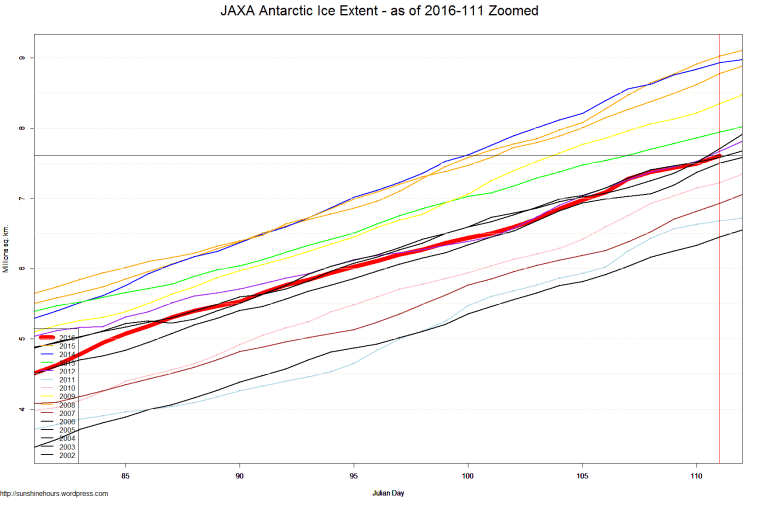
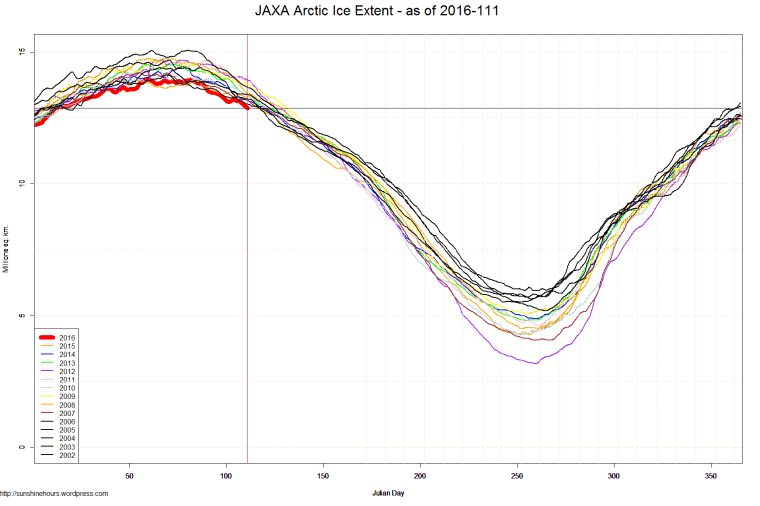
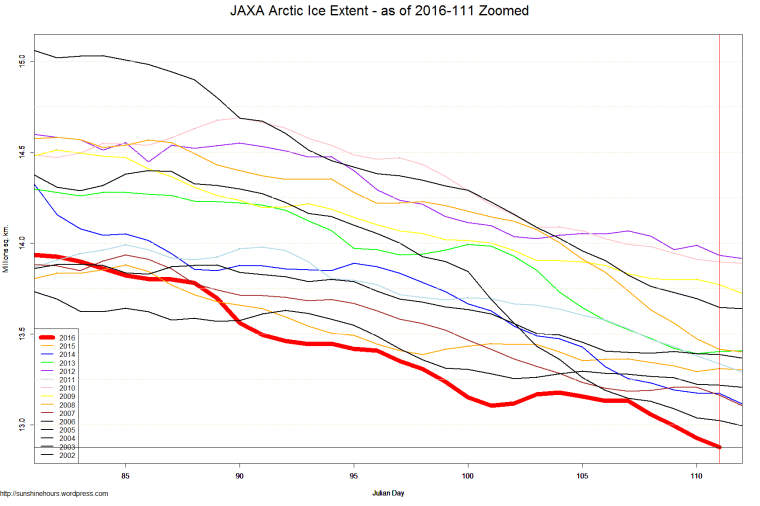
JAXA Sea Ice Extent (Antarctic and Arctic) – Day 111 – 2016

JAXA sea ice extent data from Japanese Aerospace Exploration Agency.

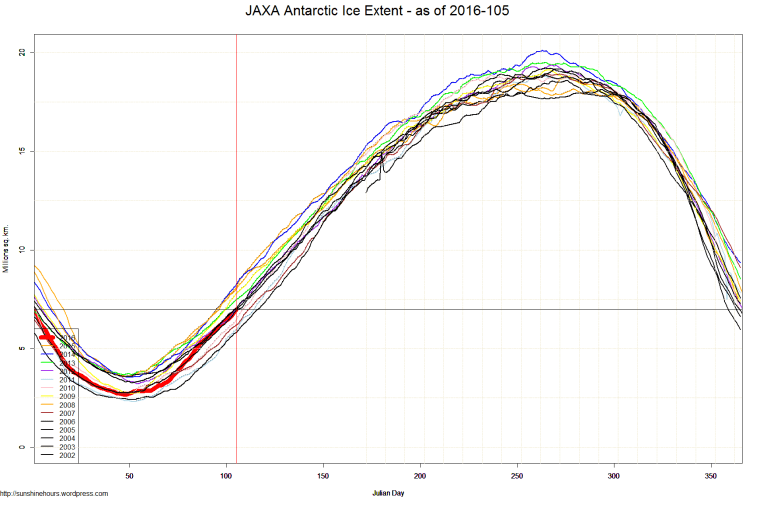
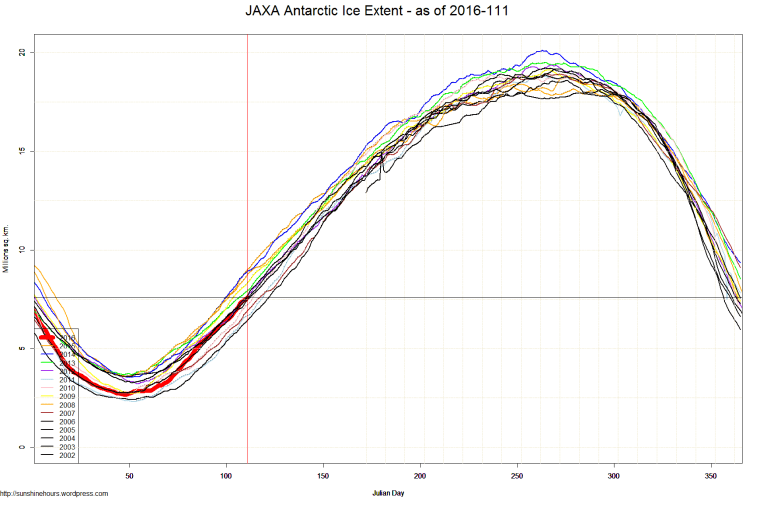
JAXA Antarctic Ice Extent - as of 2016-111

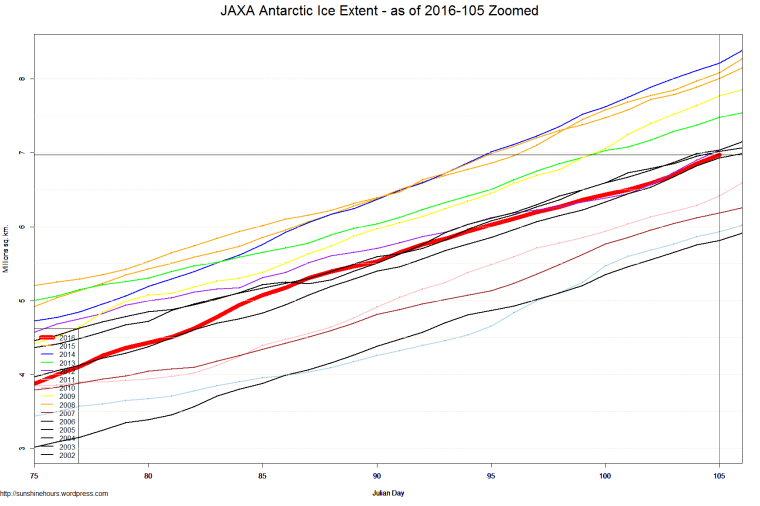
JAXA Antarctic Ice Extent - as of 2016-111 Zoomed

JAXA Arctic Ice Extent - as of 2016-111

JAXA Arctic Ice Extent - as of 2016-111 Zoomed


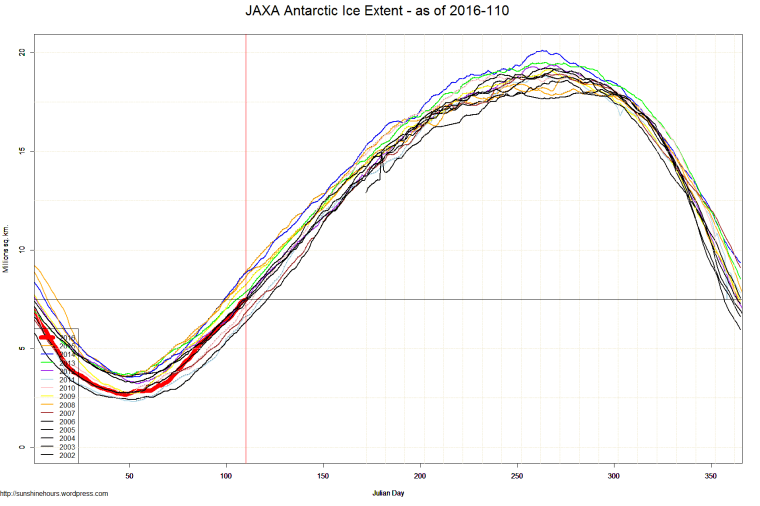
JAXA Sea Ice Extent (Antarctic and Arctic) – Day 110 – 2016

JAXA sea ice extent data from Japanese Aerospace Exploration Agency.

JAXA Antarctic Ice Extent - as of 2016-110

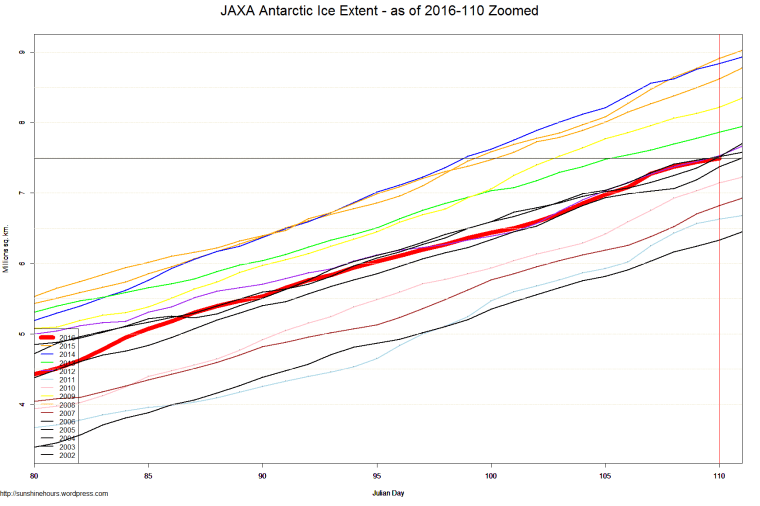
JAXA Antarctic Ice Extent - as of 2016-110 Zoomed

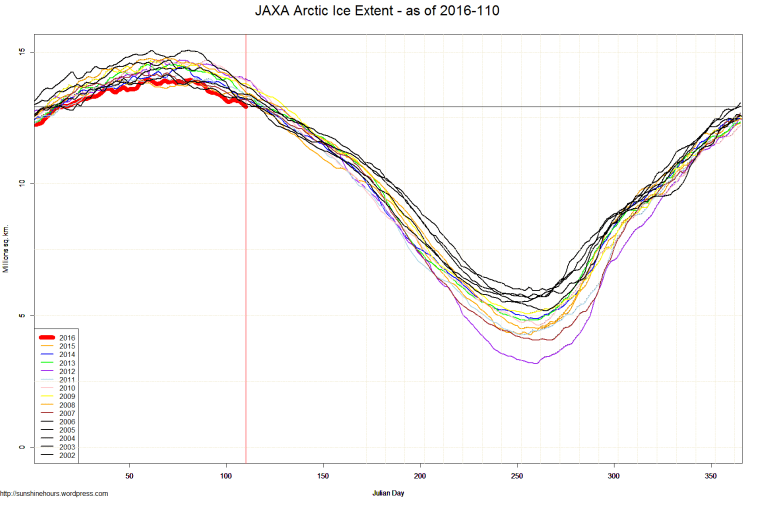
JAXA Arctic Ice Extent - as of 2016-110

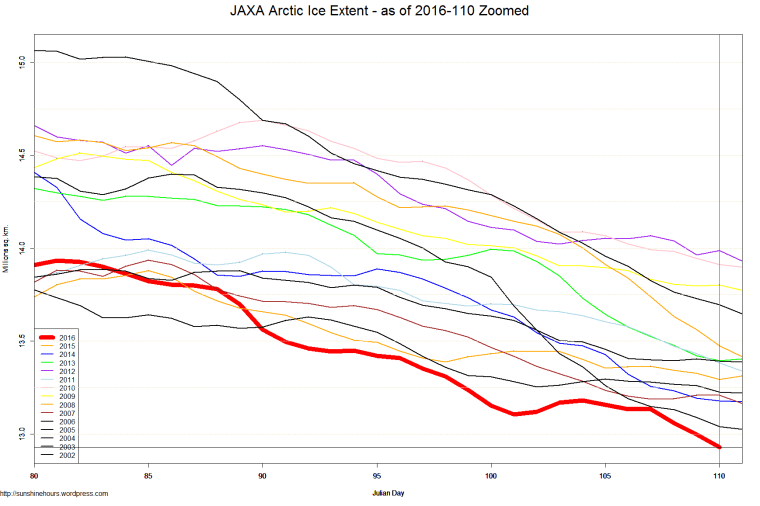
JAXA Arctic Ice Extent - as of 2016-110 Zoomed


JAXA Sea Ice Extent (Antarctic and Arctic) – Day 109 – 2016

JAXA sea ice extent data from Japanese Aerospace Exploration Agency.

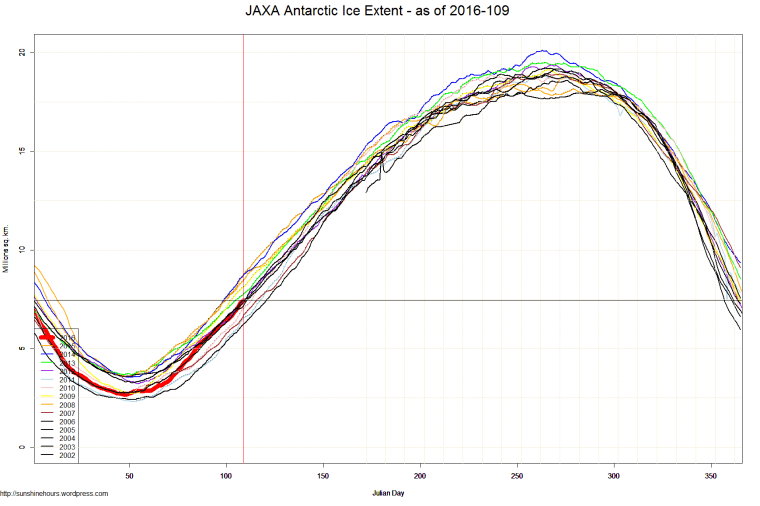
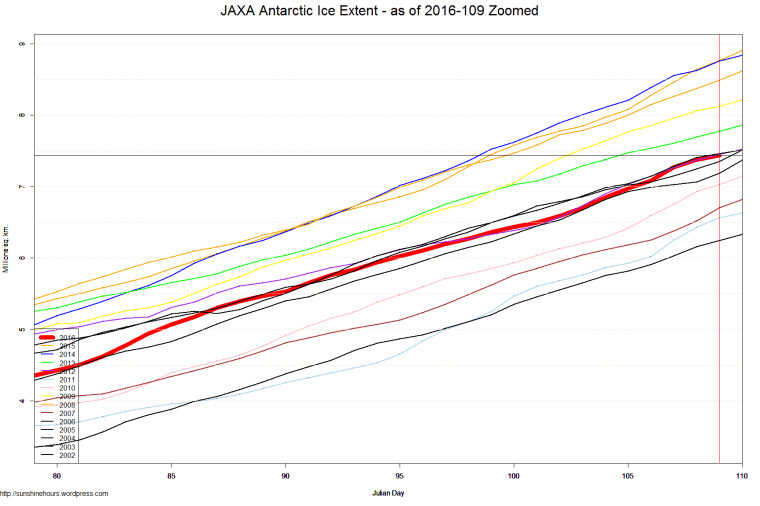
JAXA Antarctic Ice Extent - as of 2016-109

JAXA Antarctic Ice Extent - as of 2016-109 Zoomed

JAXA Arctic Ice Extent - as of 2016-109 Zoomed

JAXA Arctic Ice Extent - as of 2016-109


JAXA Sea Ice Extent (Antarctic and Arctic) – Day 108 – 2016

JAXA sea ice extent data from Japanese Aerospace Exploration Agency.

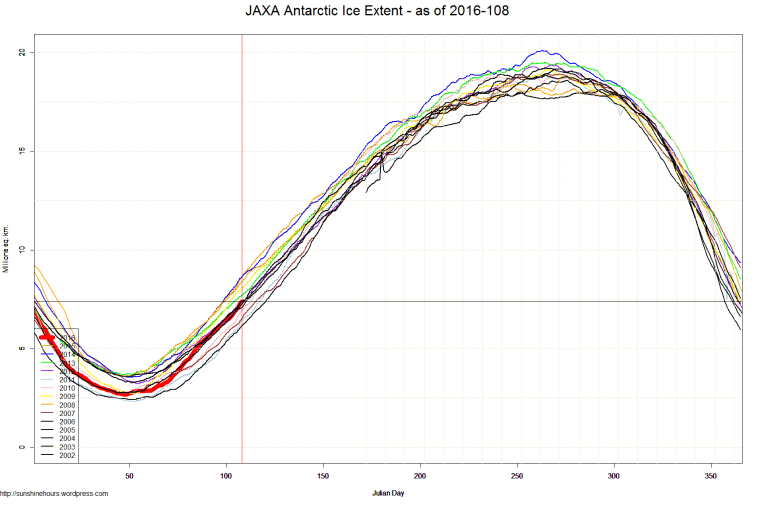
JAXA Antarctic Ice Extent - as of 2016-108

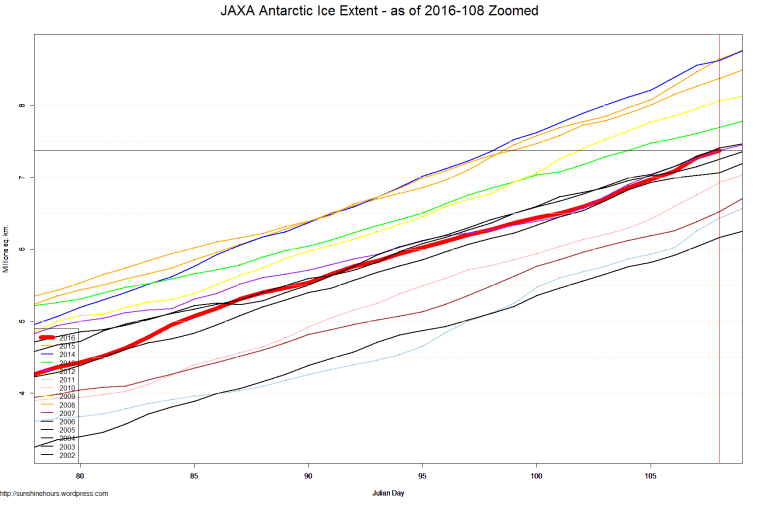
JAXA Antarctic Ice Extent - as of 2016-108 Zoomed

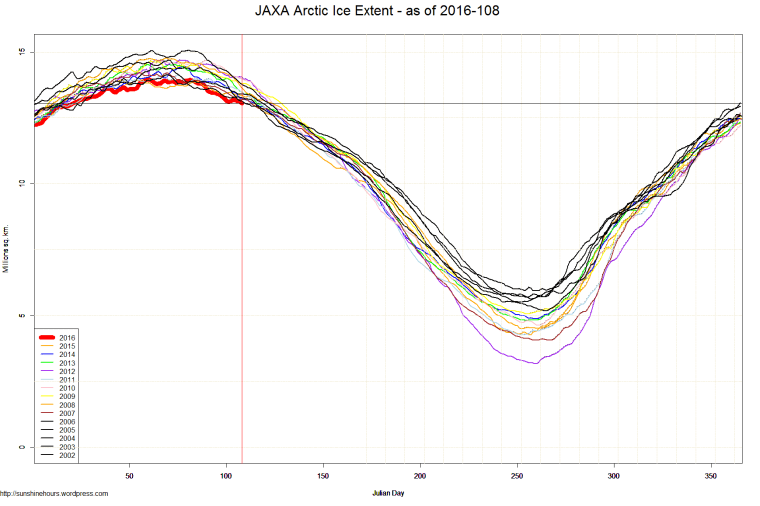
JAXA Arctic Ice Extent - as of 2016-108

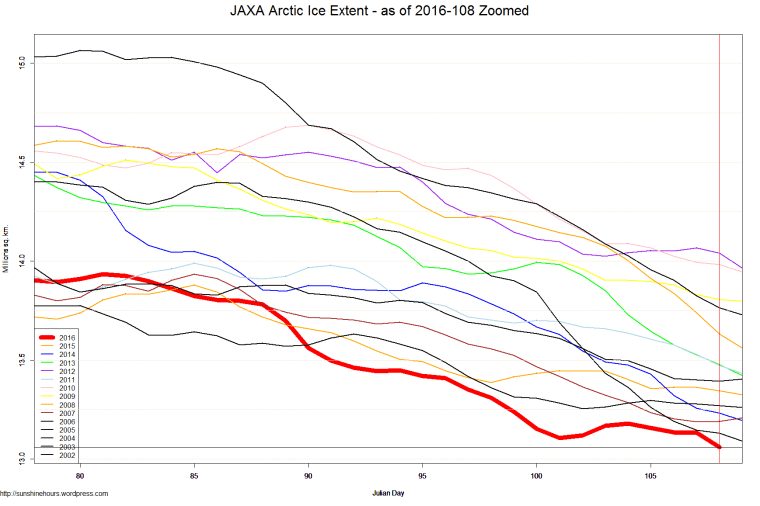
JAXA Arctic Ice Extent - as of 2016-108 Zoomed


JAXA Sea Ice Extent (Antarctic and Arctic) – Day 107 – 2016

JAXA sea ice extent data from Japanese Aerospace Exploration Agency.


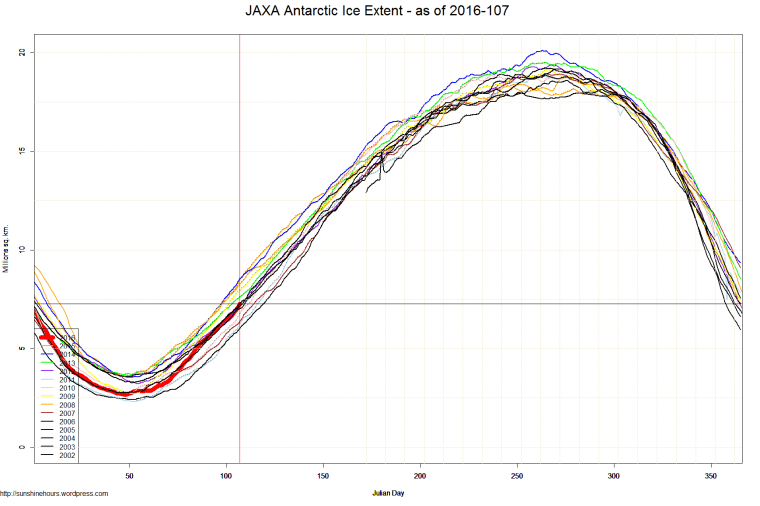
JAXA Antarctic Ice Extent - as of 2016-107

JAXA Antarctic Ice Extent - as of 2016-107 Zoomed

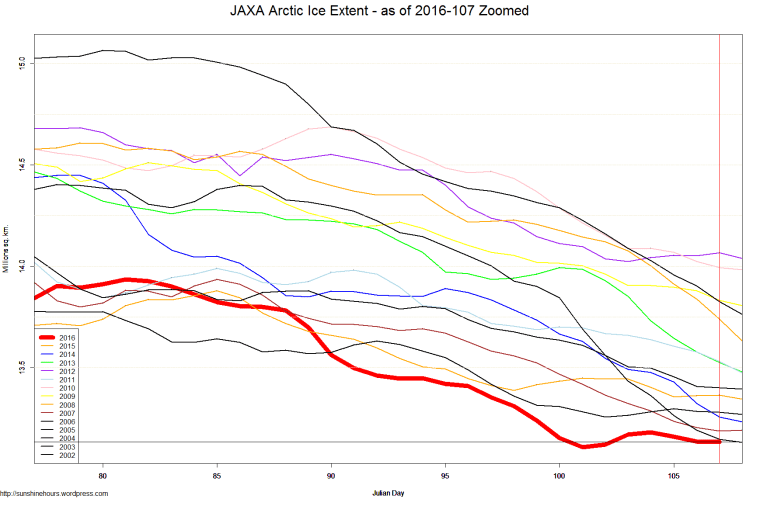
JAXA Arctic Ice Extent - as of 2016-107 Zoomed

JAXA Arctic Ice Extent - as of 2016-107


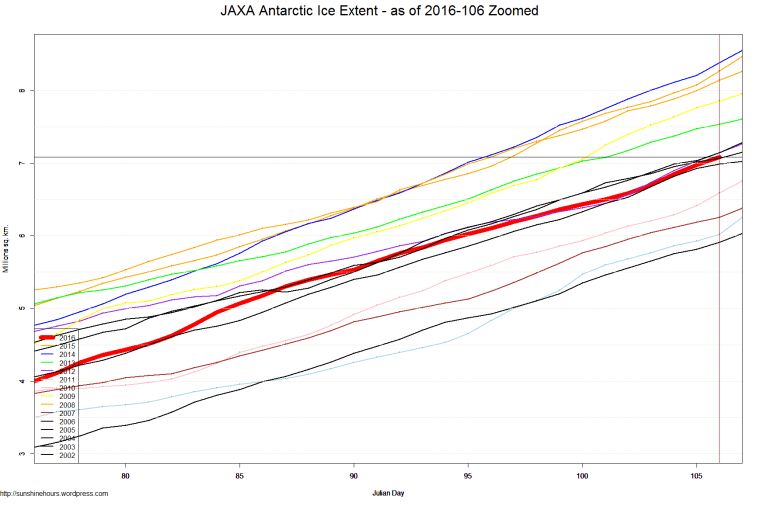
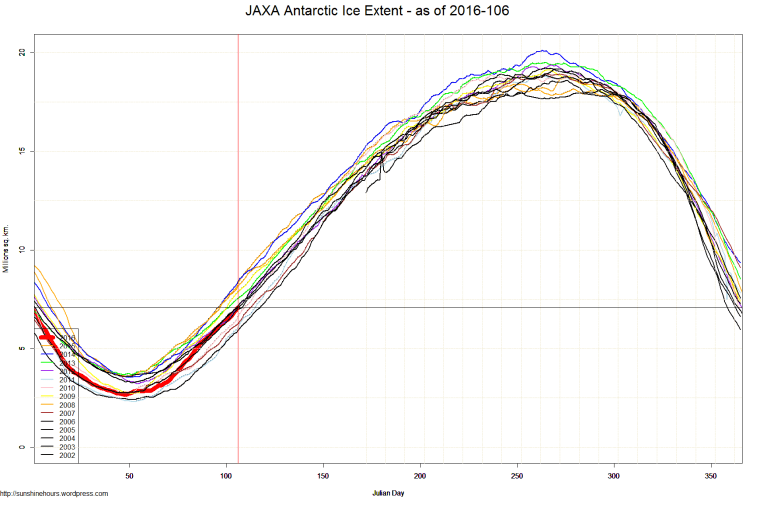
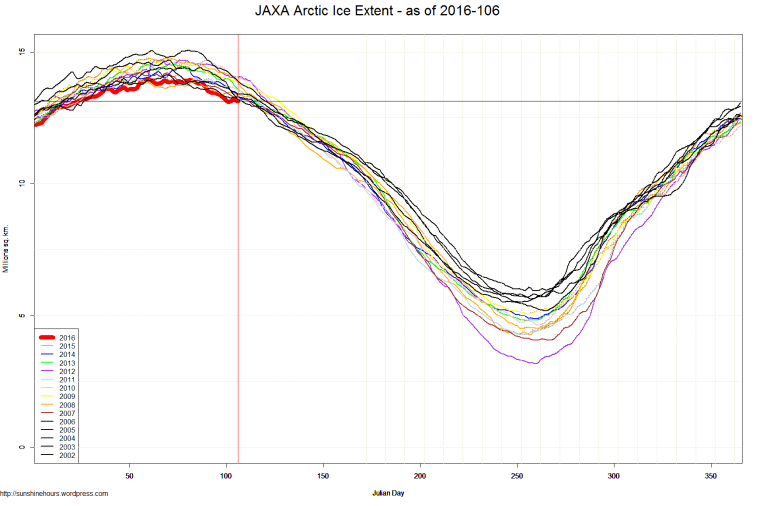
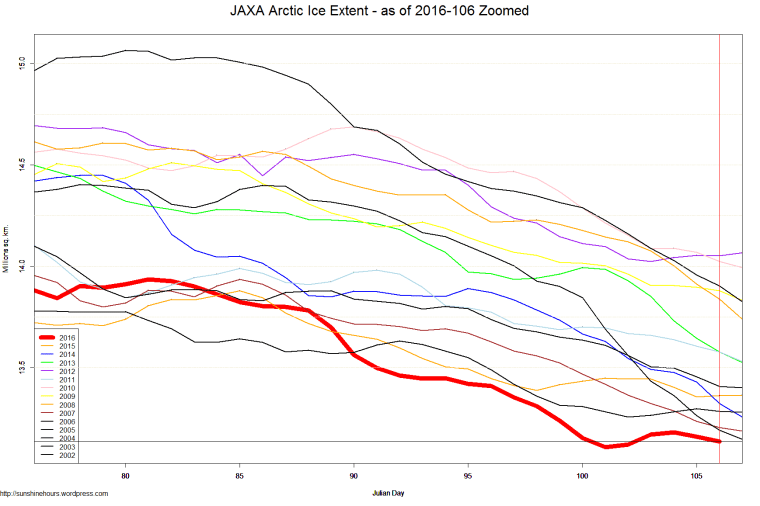
JAXA Sea Ice Extent (Antarctic and Arctic) – Day 106 – 2016

JAXA is sea ice extent data from Japan  (only goes back to 2002).

JAXA Antarctic Ice Extent - as of 2016-106 Zoomed

JAXA Antarctic Ice Extent - as of 2016-106

JAXA Arctic Ice Extent - as of 2016-106

JAXA Arctic Ice Extent - as of 2016-106 Zoomed


JAXA Sea Ice Extent (Antarctic and Arctic) – Day 104 – 2016

If you have been following this blog, you know the NSIDC satellite data has been very bad. Off by millions of sq km.


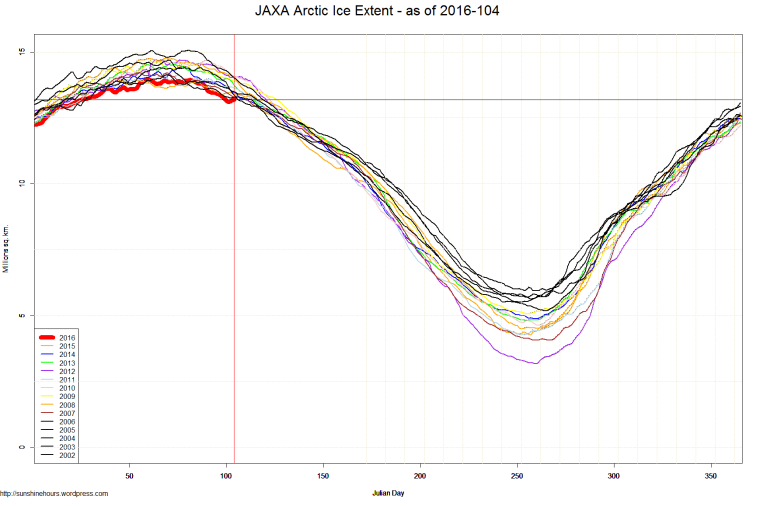
So I will be posting graphs for sea ice extent using data from JAXA (only goes back to 2002).

JAXA Antarctic Ice Extent - as of 2016-104

JAXA Arctic Ice Extent - as of 2016-104

Sea Ice Extent (Global Antarctic and Arctic) – Day 103 – 2016

If you have been following this blog, you know the NSIDC satellite data has been very bad. Off by millions of sq km.

As of this morning the data file his missing all data past March 31 2016. And NSIDC posted this:

NSIDC has suspended daily sea ice extent updates until further notice, due to issues with the satellite data used to produce these images. The vertically polarized 37 GHz channel (37V) of the Special Sensor Microwave Imager and Sounder (SSMIS) on the Defense Meteorological Satellite Program (DMSP) F-17 satellite that provides passive microwave brightness temperatures is providing spurious data. The 37V channel is one of the inputs to the sea ice retrieval algorithms, so this is resulting in erroneous estimates of sea ice concentration and extent. The problem was initially seen in data for April 5 and all data since then are unreliable, so we have chosen to remove all of April from NSIDC’s archive.

It is unknown at this time if or when the problem with F-17 can be fixed. In the event that the sensor has permanently failed, NSIDC is working to transition to either the DMSP F-18 or possibly the JAXA Advanced Microwave Scanning Radiometer 2 (AMSR2) on the Global Change Observation Mission – Water (GCOM-W) satellite. Transitioning to a different satellite will require a careful calibration against the F-17 data to ensure consistency over the long-term time series. While this transition is of high priority, NSIDC has no firm timeline on when it will be able to resume providing the sea ice time series. For background information on the challenges of using data in near-real-time, see the ASINA FAQ, “Do your data undergo quality control?