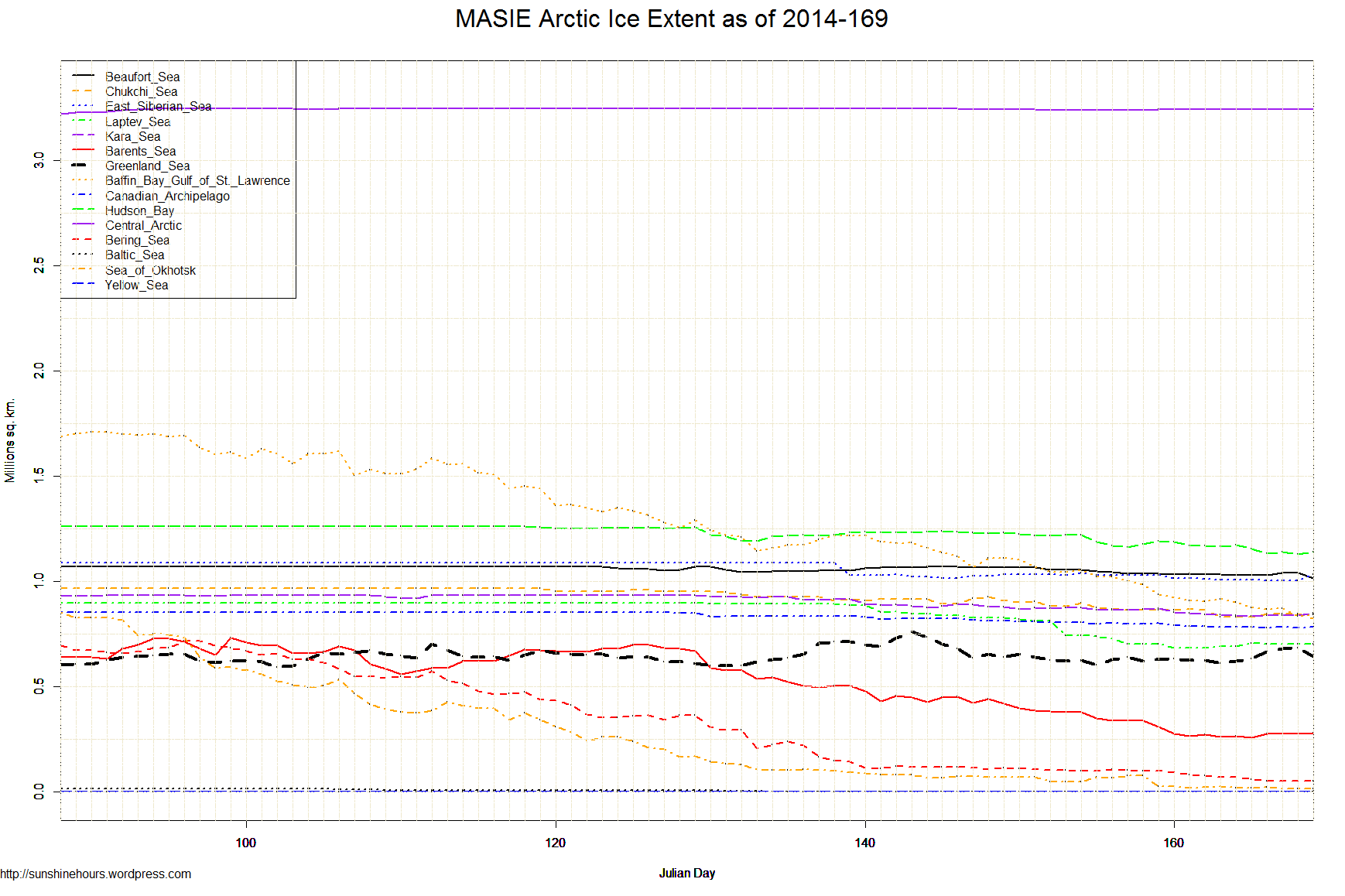
June 19 2014 MASIE Update – Only –15,526 sq km per day melt over last 7 days.
| Region | Start | End | Last81 | Last28 | Last14 | Last7 | Last3 | Last1 |
| Baffin Bay Gulf of St. Lawrence | 1,688,530 | 841,110 | -847,421 | -347,865 | -183,069 | -62,930 | -26,068 | 4,125 |
| Chukchi Sea | 966,006 | 825,412 | -140,594 | -91,509 | -51,561 | -39,216 | -21,402 | -21,402 |
| Hudson Bay | 1,260,903 | 1,141,664 | -119,240 | -90,837 | -47,369 | -28,483 | 8,623 | 12,286 |
| Bering Sea | 697,324 | 51,488 | -645,836 | -60,502 | -49,693 | -25,542 | -1,311 | -1,311 |
| Beaufort Sea | 1,070,445 | 1,015,260 | -55,185 | -50,080 | -33,773 | -19,909 | -15,150 | -25,184 |
| Sea of Okhotsk | 853,240 | 16,272 | -836,967 | -65,666 | -53,107 | -5,770 | -5,020 | 0 |
| Canadian Archipelago | 853,214 | 782,198 | -71,016 | -39,930 | -15,649 | -4,458 | 379 | 868 |
| Baltic Sea | 15,337 | 0 | -15,337 | 0 | 0 | 0 | 0 | 0 |
| Yellow Sea | 0 | 0 | 0 | 0 | 0 | 0 | 0 | 0 |
| Central Arctic | 3,221,921 | 3,242,295 | 20,374 | -4,399 | 2,599 | 597 | -1,364 | -1,364 |
| Kara Sea | 933,859 | 850,072 | -83,788 | -37,031 | -16,379 | 9,134 | 10,066 | 10,066 |
| Barents Sea | 645,917 | 281,980 | -363,937 | -149,818 | -66,439 | 10,541 | 6,163 | 6,163 |
| Laptev Sea | 897,845 | 701,571 | -196,274 | -151,947 | -38,056 | 16,358 | -2,639 | -2,639 |
| Greenland Sea | 603,416 | 645,574 | 42,158 | -47,289 | 43,468 | 19,062 | -22,097 | -37,779 |
| East Siberian Sea | 1,087,137 | 1,034,473 | -52,664 | 3,971 | 3,746 | 21,938 | 29,119 | 29,119 |
| Northern Hemisphere (Total) | 14,805,115 | 11,430,895 | -3,374,220 | -1,132,547 | -504,895 | -108,679 | -40,701 | -27,053 |
| NH (Average Loss per Day) | -41,149 | -40,448 | -36,064 | -15,526 | -13,567 | -27,053 |
 sunshine hours
Day 170-NH ice extent bounces back adding more than 60,000 Km2. Greenland Sea extent is now 91% of max the highest since day 145. Siberian Sea added also, now 96% of max, the highest since day 138.
Day 171 Whoops NH loses more than 130,000 Km2 in one day, with melting in spread evenly across almost all regions. Only East Siberian Sea gained, and Central Arctic loss was slight.
Day 172–Now the melt is on again–80,000 Km2 lost, most of it from Barents Sea, and also from Baffin Bay and Sea of Okhotsk (the latter is now ice-free). The other regions showed little change, with Central Arctic still at 99.8% of max.