Aug 10 2014 MASIE Update – Steady Melting … Central Arctic is melting.
Data here. Click for bigger.
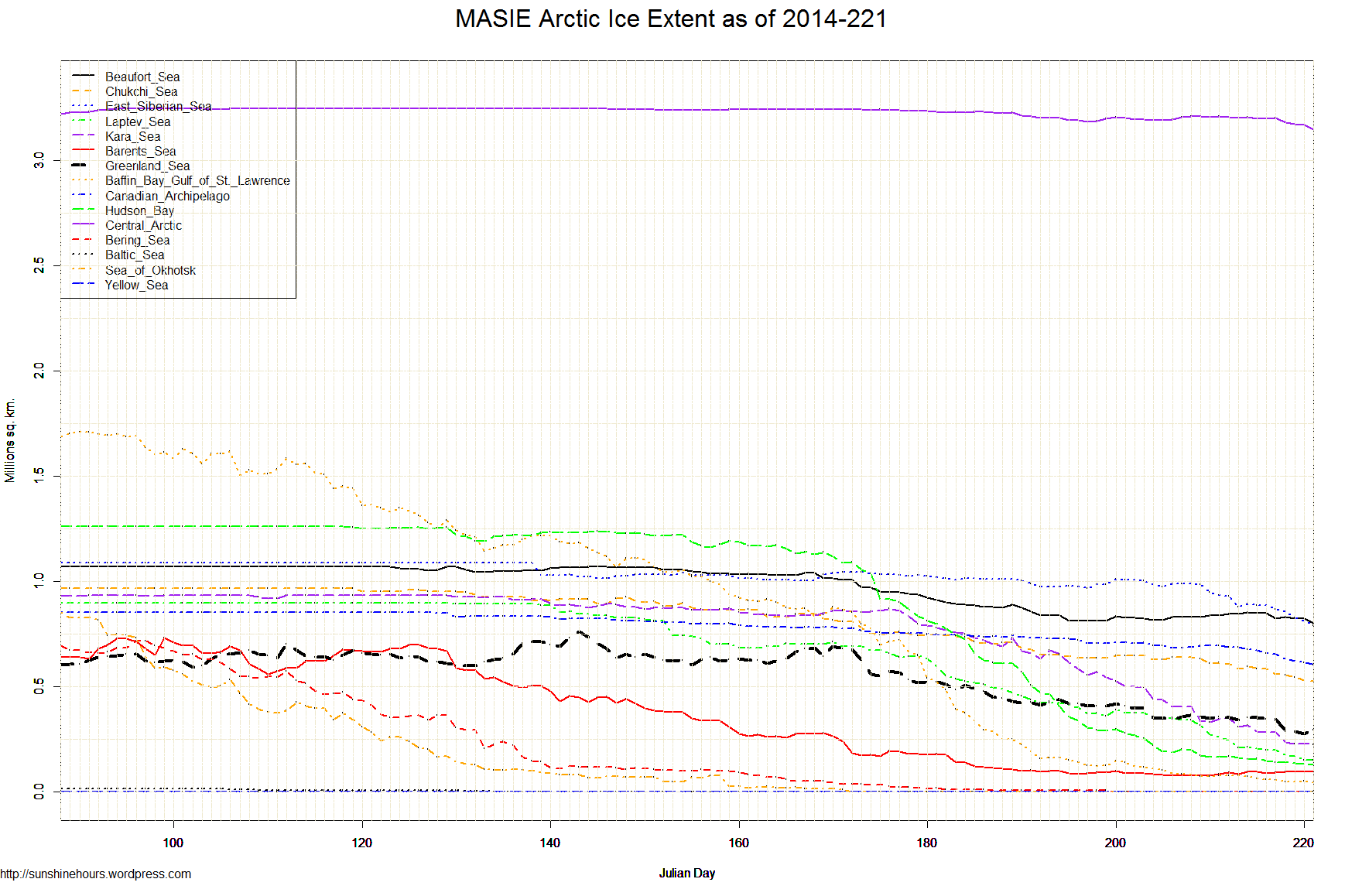


| Region | 134 days ago | End | Last 133 | Last 28 | Last 14 | Last 7 | Last 3 | Last 1 |
| Central Arctic | 3,221,921 | 3,145,737 | -76,184 | -57,678 | -59,038 | -59,251 | -34,477 | -22,901 |
| East Siberian Sea | 1,087,137 | 791,590 | -295,547 | -182,067 | -199,330 | -103,915 | -65,863 | -22,841 |
| Beaufort Sea | 1,070,445 | 803,969 | -266,476 | -36,621 | -27,781 | -49,680 | -27,006 | -20,195 |
| Canadian Archipelago | 853,214 | 604,842 | -248,372 | -123,937 | -78,833 | -73,380 | -27,803 | -10,425 |
| Baffin Bay Gulf of St. Lawrence | 1,688,530 | 46,363 | -1,642,168 | -116,552 | -38,384 | -26,186 | -3,536 | -6,523 |
| Hudson Bay | 1,260,903 | 128,016 | -1,132,887 | -337,806 | -73,619 | -26,852 | -12,132 | -5,433 |
| Chukchi Sea | 966,006 | 525,015 | -440,991 | -125,838 | -116,792 | -70,511 | -30,787 | -4,666 |
| Kara Sea | 933,859 | 224,726 | -709,133 | -447,050 | -179,922 | -91,361 | -10,154 | -4,101 |
| Barents Sea | 645,917 | 96,613 | -549,304 | -1,960 | 16,766 | 1,995 | -1,104 | 0 |
| Bering Sea | 697,324 | 0 | -697,324 | -8,658 | -15 | 0 | 0 | 0 |
| Baltic Sea | 15,337 | 0 | -15,337 | 0 | 0 | 0 | 0 | 0 |
| Sea of Okhotsk | 853,240 | 0 | -853,240 | 0 | 0 | 0 | 0 | 0 |
| Yellow Sea | 0 | 0 | 0 | 0 | 0 | 0 | 0 | 0 |
| Laptev Sea | 897,845 | 151,499 | -746,346 | -270,255 | -189,584 | -61,540 | -26,558 | 383 |
| Greenland Sea | 603,416 | 296,306 | -307,110 | -136,411 | -60,481 | -55,724 | 9,806 | 18,966 |
| Northern Hemisphere (Total) | 14,805,115 | 6,815,819 | -7,989,295 | -1,844,834 | -1,007,014 | -616,403 | -229,614 | -77,737 |
| NH (Average Loss per Day) | -59,622 | -65,887 | -71,930 | -88,058 | -76,538 | -77,737 |
 sunshine hours
Day 221–NH ice loss has been at 56% of maximum for the last 3 days.
Bear in mind that the loss by mid-September minimum usually averages 68-70%.
With today’s NH extent of 6,815,819 sq. Km., a normal further reduction of 12-14% would give a 2014 minimum in the range of 4.66M to 4.97M sqKms.
Those with minimal melt:
Central Arctic now has 97% ice left
East Siberian Sea is now at 73%
Canadian Archipelago is now at 71%
Beaufort Sea is holding at 75%,
There’s another way to look at this. In recent years, MASIE ice extent goes down 2 to 3 M sqKms in August, and loses another 0.5 to 1.5 M sqKms in September.
For 2014 to achieve an average melt season, the minimum would occur on day 255, and in the 5 weeks between now and then, the losses would need to average 2.2% of max extent each week–in other words this year would see from now on a weekly melt of 0.34 M sqKms, or a total additional loss of 1.7 M.
That scenario would result in a 2014 minimum of 5.1 M sqKms. That extent would match last year; anything higher would signify a rising trend.