Getting cooled air piped into the car while enjoying a meal at a drive-in restaurant. Houston, Texas, 1957. pic.twitter.com/faD5WSvolz
— Life in Moments (@historyinmoment) March 21, 2019
Category: Climate Change
Colorado snowpack so juiced in 2019 that they had to redo the scale
Are Climate Models Overpredicting Global Warming?
The answer is yes.
Weather forecasters know that some models work better than others in specific situations, and they tend to rely on the versions that work best, depending upon the forecast problem. When the issue is a potential big snow along the eastern seaboard, forecasters usually lean upon the model from the European Center for Medium-Range Weather Forecasting (the “Euro” model). When diagnosing shifts in jet stream patterns a week or 10 days ahead, they may place more weight on the American Global Forecast System model.
But the United Nations’ Intergovernmental Panel on Climate Change simply averages up the 29 major climate models to come up with the forecast for warming in the 21st century, a practice rarely done in operational weather forecasting. As dryly noted by Eyring and others “there is now evidence that giving equal weight to each available model projection is suboptimal.”
Indeed. The authors of the new paper show that the aggregate models are making huge errors in three of the places on earth that are critical to our understanding of climate.
…
But one of the models actually works. According to University of Alabama’s John Christy and his colleagues, only the Russian model, designated INM-CM4, gets things right. So why not weight heavily on the model that is working? Perhaps because it has less global warming in it than all the other U.N. models?
Its successor, INM-CM5, is so good that it is the only one that diagnoses the “pause” in warming from 2002 to 2014. That the “pause” was real is obvious in the global surface temperature record that the that the IPCC relies upon most heavily, from the Climate Research Unit at the University of East Anglia.
Read it all here.
Arctic Sea Ice Volume 19-Mar-2019
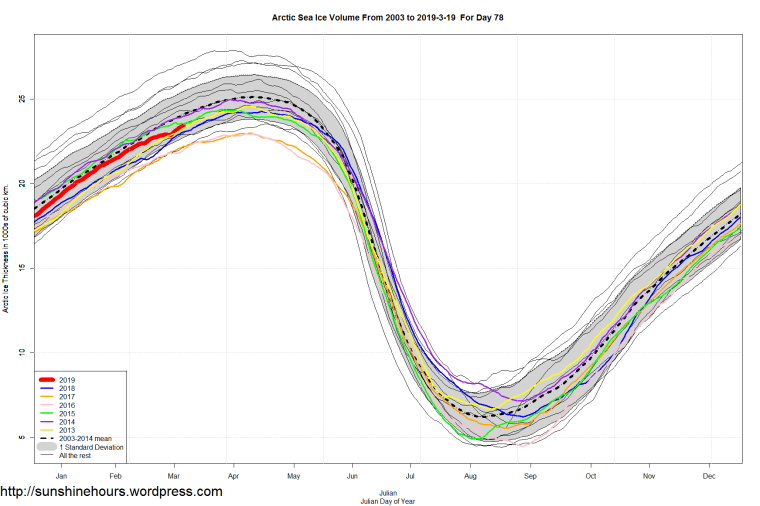
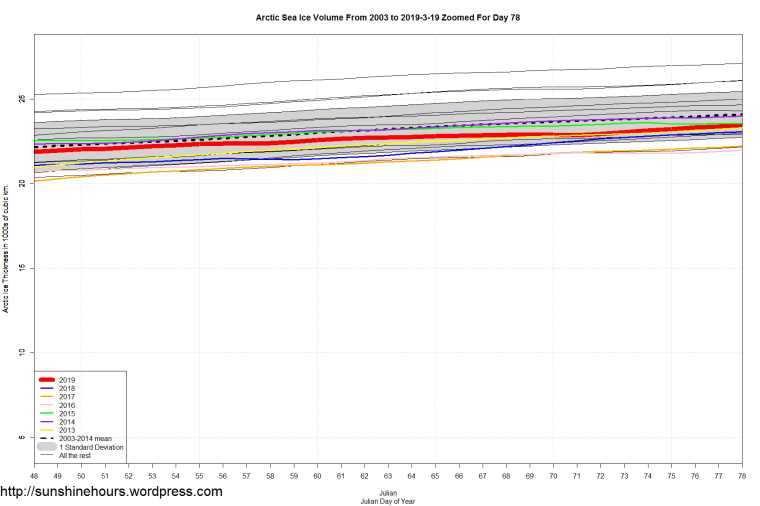
From DMI
All Icelandic Glaciers Are Expanding For The First Time In Decades
Update: This story may be based on this 3 year old story.
Expanding glaciers
According to researchers from the University of Iceland, ALL Icelandic glaciers are projected to expand this year, this would make it the first time the glaciers wouldn’t have shrunk year-on-year in a quarter of a century.
The researchers were shocked by the discovery that all of Iceland’s glaciers, including Vatnajökull, Langjökull, Hofsjökull and Mýrdalsjökull, have expanded in the last twelve months, from autumn to autumn. With Mýrdalsjökull showing a really “significant addition of ice this year.”
“[This] is unusual over the last 25 years,” said project manager Finnur Pálsson.
Langjökull had been losing around one and a half meters of ice per year for the past twenty years, “but in the last few years he has been close to zero, that is, he has neither expanded nor diminished. And that applies to this year, both for Vatnajökull and Langjökull as well,” said Pálsson.


Pálsson looks for answers.
He rambles a little about global warming, stating even though it’s cold and the glaciers are growing that that should be no reason to doubt global warming…? But then he finishes with these nuggets: “It is a fact that it has been colder the last few years. And there was more snowfall in August on the upper part of Langjökull, which is very unusual.”
Montana is -20F Below Normal For March 1st to 18th

England could run out of water by 2044, experts say
Experts keep telling us doom is coming. But the data says otherwise.
Climate change and a rising population mean that England is facing the ‘jaws of death’, where demand for water could surpass the supply available in the next 25 years.
Sir James Bevan, 59, chief executive of the Environment Agency, said that the UK could have a water shortage by 2044.
Speaking before the Waterwise conference in London, Sir Bevan added that water leakage was also to blame for the loss of water in the UK.
And yet, rainfall is up. Above the 1981-2010 average.
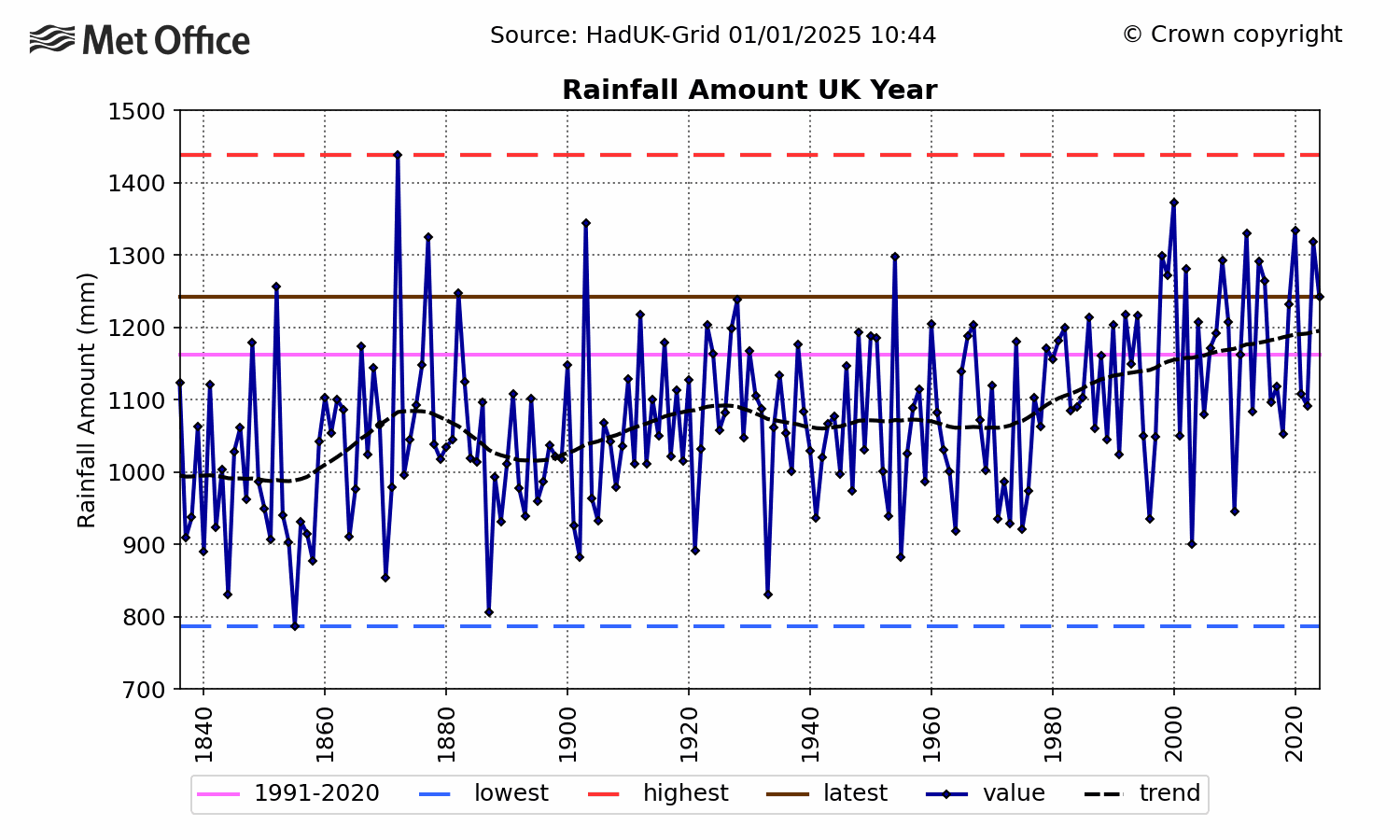
Read the rest of the doom here.
Arctic Sea Ice Volume 18-Mar-2019
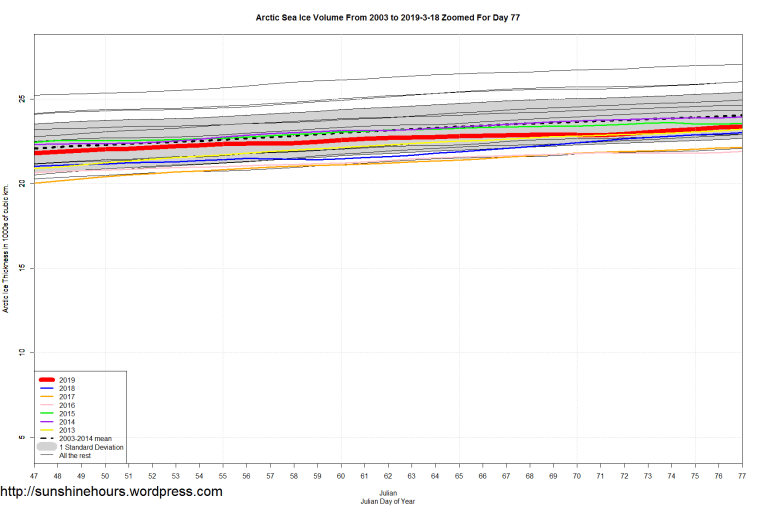
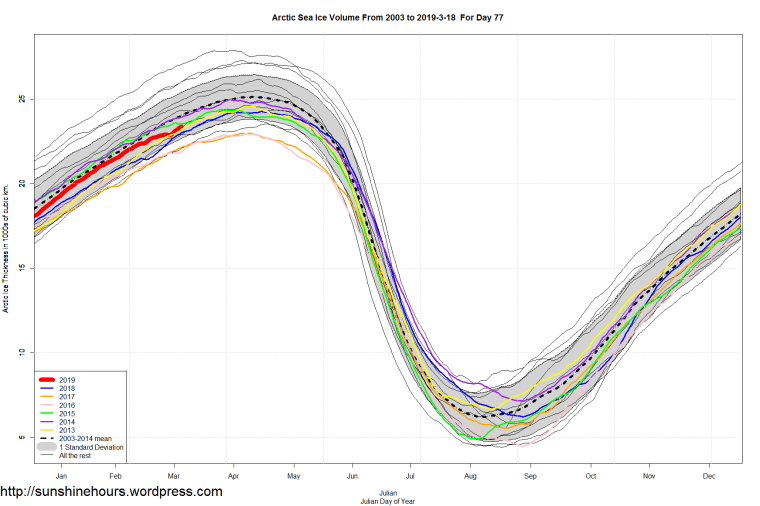
From DMI
We’re battling ice conditions that we haven’t seen in 30 years
Solar minimum anyone? Or an energy efficiency screwup where they bought a vessel with better fuel mileage to cut back on the carbon footprint? I vote for both.
The new ferry in the Strait of Belle Isle doesn’t have the same horsepower as the old Apollo, so even with an ice breaker, it’s risky to travel in this year’s ice conditions, says the Canadian Coast Guard.
But the province says this year’s severe ice conditions are unprecedented, and even an icebreaker got stuck in the thick ice.
The Qajaq W has spent numerous days tied up in the dock, with passengers waiting on either side of the strait for clear conditions to sail.
Coast guard’s Henry Larsen is en route to the area and, assuming weather conditions are suitable, will be able to break ice Friday morning.
But even with an ice breaker, it’s no guarantee the Qajaq will sail, says Brad Durnford, who is with the coast guard.
“The ice conditions are just too severe for this ferry to run. It’s a new ferry, it has less power than the Apollo, so we’re very cautious, everyone’s being very cautious, as they should be,” Durnford said.
“Don’t want to get that ferry out there and then get stuck for days with people on board, because that’s a potential that could happen in this situation.”
In January, Peter Woodward, president of the Woodward Group, said the Qajaq had half the horsepower and half the carbon footprint of the Apollo, burning half the fuel of the old ferry, but that the Qajaq had two ice-strengthened bows.
Government is defending its new 7,500-horsepower vessel, saying the new vessel is “designed and built to operate in severe sea ice conditions.”
The 48-year-old Apollo’s horsepower was rated at 9,000 — more than its new replacement — but only “operated at 6,000 horsepower in its later years,” reads a statement from the Department of Transportation and Works.
Minister Steve Crocker said even the coast guard’s icebreaker Molly Kool, with a horsepower of 18,000, got stuck in the ice this year.
“The fact that it’s a newer vessel brings more thrust, so, you know, the reality we have here right now is we’re battling ice conditions that we haven’t seen in 30 years,” Crocker said.
Also, the Qajaq has more agility and ability when compared with the Apollo, Crocker’s department said.
“The MV Qajaq W is stronger in ice, has a more durable hull, has better maneuverability,” according to the department.
The new vessel has “modern technology that makes it much more efficient and capable than its predecessor,” says the statement provided to CBC News.
The worst ice conditions in 30 years
Durnford and the government do agree on one thing — that the ice this year is incredibly thick.
Conditions are “the worst they have been in 30 years,” says the statement from the transportation department.
Durnford acknowledges the ice breakers themselves are having a hard time.
BBQ Wind Turbine
I smell smoke …
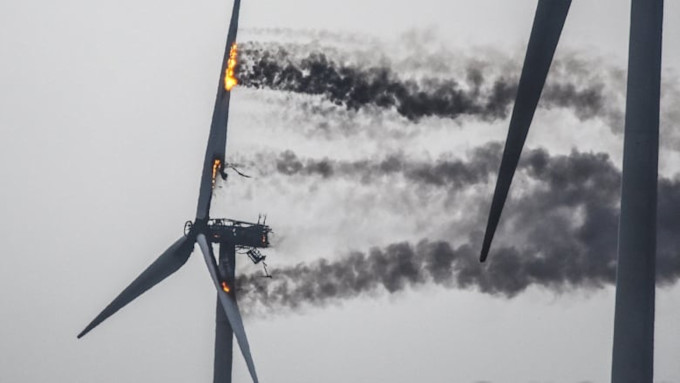
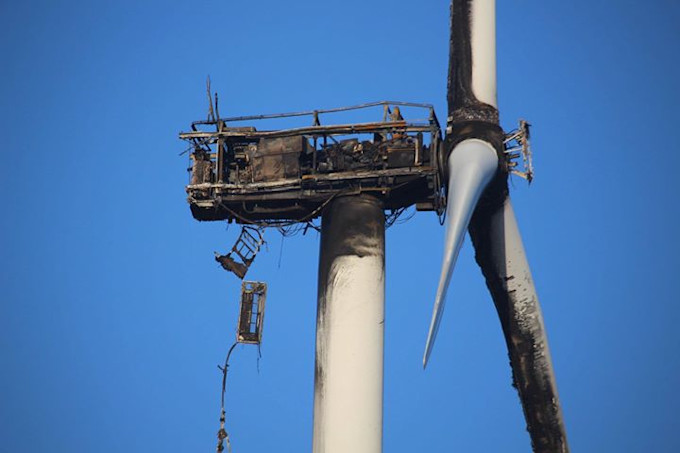
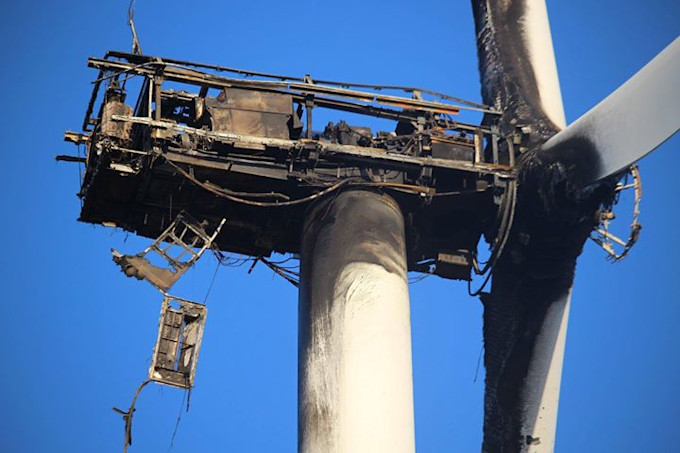
A wind turbine caught fire in West Pubnico, N.S., late Friday afternoon, throwing huge, burning pieces of material to the ground.
Firefighters were called to the scene around 5 p.m., but West Pubnico fire department Chief Gordon Amiro said there was little firefighters could do to douse the flames.
“We couldn’t get nowhere near because the blades was still turning, so, and pieces was breaking off the blades,” he said. “So if a piece was to fall off, it would go a long ways with the wind and that. So it wasn’t safe to go nowhere near the tower at all.”
No one was injured.
Amiro said when the blades turn, the tips are more than 100 metres up in the air — too high to fight the fire from the ground.
Firefighters stayed at the scene for about an hour to ensure no one got too close.
Amiro said it’s a good thing it was raining and the ground was covered with snow.
“If that would have been August, we’d still be there trying to put wood fire out,” he said Saturday morning.
 sunshine hours