“It wasn’t this way before,” admitted Edna Jaques in a soul-baring article in Chatelaine magazine

Perspective is lacking.

It wasn’t this way before,” admitted Edna Jaques in a soul-baring article in Chatelaine magazine in November 1937.
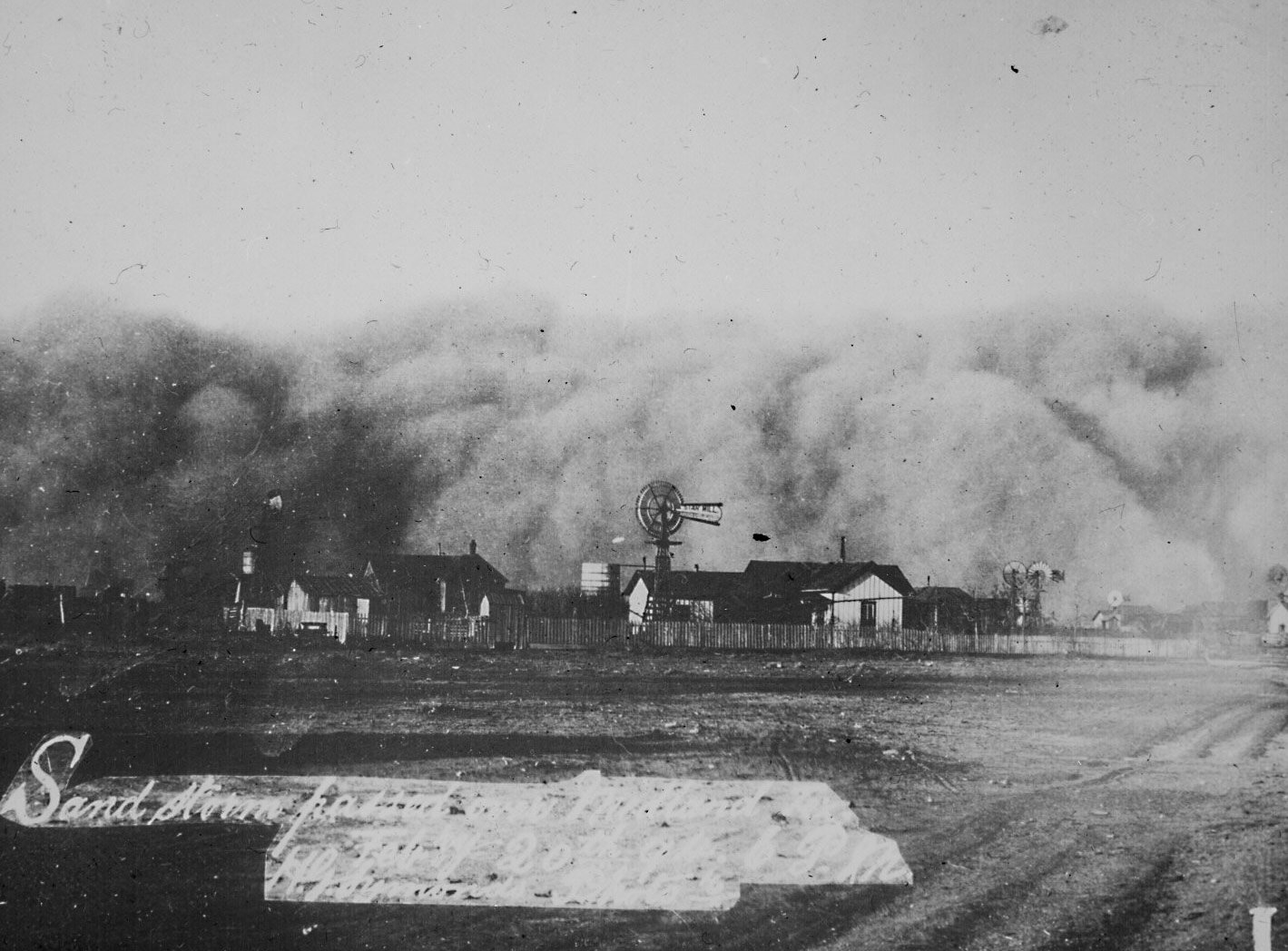
Image result for dustbowl saskatchewan

After nine consecutive years of unrelenting drought, the Briercrest Saskatchewan poet found herself “whipped” and “not ashamed any more” to admit it.

Severe dry spells had always been a feature of prairie settlement, appearing on average every 20 years or so.  The 1930s, however, were memorable for both the persistence and extent of the drought.

While other provinces, in particular Ontario and Quebec, were recovering from the Great Depression, Saskatchewan experienced its most far-reaching drought in 1937. Not even Prince Albert was spared.

Jaques, who was 11 when her family homesteaded in the Moose Jaw area in 1902, had never known the land to be so desolate. Drought had reduced Briercrest to “gray ashy wastes that once were fields, white alkali flats that once were blue simmering lakes.”

The story was the same across the scorched southern prairies. Some fields were so patchy that harvesting seemed a terrible joke.

Saskatchewan’s total wheat production dropped by a third during the 1930s even though wheat acreage increased by more than a million acres during the same period. In other words, more cropped land was actually producing less wheat. The 1937 wheat harvest was a paltry 2.5 bushels per acre.

Jaques scanned the heavens daily in search of the promise of rain, but it never came — only a few scattered drops. “Today the sky was almost a black blue,” she wrote in frustration. “You would think a million tons of water would be held in its inky depths, but it was only dust and wind.”

That was Jaque’s other lament. “Drought never comes alone.”

Hot, drying winds scooped up loose topsoil into dust blizzards that made outside activity nearly impossible. An estimated quarter of a million acres of Saskatchewan land was blowing out of control by the mid-1930s.

“The air was murky and thick … that made it hard to breathe,” Jaques recalled after one dust storm struck the community. “Your heart pounded against your ribs in a sickening thud.”

Darkness at noon was not uncommon, while churning dirt piled up in drifts along buildings, fence lines or ridges. The “driven soil” was a temporary visitor, Jaques observed, “nesting for a few days until another wind comes up to move it somewhere else.”

Homemakers faced a frustrating battle trying to keep the dust out of their homes, placing wet rags on window sills and hanging wet sheets over doorways. But it still managed to seep through, depositing a thick film on everything. Tables were often set with the cups and bowls upside down, a temporary response that became a lifelong habit for some.

The ever-present dust also affected people’s health. Jaques attended a town meeting where half the women were suffering from “dust fever.”

“Their faces were swollen and red and broken out,” she reported, “but they’d blow their noses in unison, in duets and trios and choruses and laugh about it.”

They all knew, though, that their brave front was a public mask — a way of consoling each other and finding comfort in the belief that next year would be better.

Behind closed doors, it was a different story. “They cry at home,” Jaques commiserated, “cry over shabby children and poor food and dead gardens.”

Kids continued to play on the street, seemingly oblivious to how Briercrest had been staggered by depression and drought. But as Jaques noted, children, especially the younger ones, had known nothing else — not even “what rain is.”

The experience was never forgotten. The spectre of drought haunted people for years to come. “We’ll pull through,” Jaques bravely affirmed.  “But we’ll never be the same again — the price of it had been too high.”

Her poetry bore the imprint of what she lived through.

Edna Jaques published over 3,000 poems during her lifetime — many noted for their unvarnished realism. Indeed, her verse found a receptive audience in newspapers and magazines in the 1930s and 1940s.

“The Farmer’s Wife in the Drought Area” was one of her more popular Depression poems: “The garden is a dreary blighted waste/The air is gritty to my taste.”

The lines may not have been elegant, but that was Jaques’ appeal.  There was nothing elegant about a dust storm.

Wood Instead of Coal – Political Greenwashing

I know I post a lot of these stories about burning wood instead of coal. I do it because it is one of the greatest hypocrisies in the fight against global warming climate change catastrophe.

It’s the rave in Europe: Instead of burning coal and fossil fuels to generate heat and electricity, wood chips and pellets are being fed into Europe’s boilers. In what critics consider a dangerous sleight-of-hand and act of political greenwashing, an updated set of European Union rules encourage the burning of wood in power plants and claim it’s “carbon neutral” — meaning it won’t add to the planet’s warming — under the assumption that trees grow back.

This strategy plays a big part in the EU’s plans to reduce greenhouse gas emissions. The rules allow European governments to subsidize power plants to convert from burning coal and fossil fuels to burning wood. Across Europe, governments are under pressure to close coal-fired plants.

So-called “biomass energy” is also becoming more popular in Japan and Korea, and some in the United States are pushing for greater reliance on wood-burning.

But many scientists and environmentalists say this is backward thinking that will accelerate the disastrous felling of forests and loss of biodiversity.

Power plants in Europe are increasing the burning of wood pellets from the United States, Canada and Eastern Europe. Environmentalists warn that old forests in those places are being chopped up and left to regrow, or in some cases replaced by forest plantations.

But it’s not only the loss of old forests that worries scientists. Studies have shown that wood-burning power plants emit more carbon dioxide per megawatt hour of electricity produced than plants burning fossil fuels.

Even taking forest regrowth into account, scientists warn that over decades and centuries burning wood adds more greenhouse gases to the atmosphere than producing energy the old-fashioned way by burning coal and fossil fuels does.

Full story here

Finland: Less Coal , More Trees

Burning whole forests for energy is Europe’s future.

Finland faces having to import biomass because, despite being Europe’s most densely forested country, it will be unable to meet an expected 70% rise in demand for the fuel after it phases out coal.

Finland approved in February banning the use of coal in energy production by May 2029, which means utilities will have to find alternatives to keep Finns warm as coal currently accounts for around 20% of the energy used for household heating.

As there are limited plans to use more gas to produce heat in Finland, and other sources such as solar and geothermal energy are not yet commercially viable, using more biomass is seen as the most economical way of meeting the country’s future energy needs.

Biomass includes forest wood, timber logging residues, and industry by-products such as wood chips, black liquor, and other bio-waste.

Estimates shown to Reuters by Poyry consultancy – which advises the government on energy, industry and infrastructure needs – calculate that Finland will need 64 terawatt hours (TWh) worth of biomass in 2030 just for energy production, up from 38 TWh currently.

Domestic supply of biomass, on the other hand, is forecast to grow by only 8 TWh between now and 2030, according to Poyry.

As a result, Poyry says the country will have to import biomass as well as improve forest management and ensure greater utilization of harvest residues.

Finland’s largest energy lobby group Energia also projects large increases in the use of biomass in the coming years.

“It’s slightly awkward that Finland would run an energy policy that we will make us a net importer of biomass. We are a forest country,” said its head Jukka Leskela.

CHEAPER TO IMPORT

Forests cover three-quarters of Finland’s land, but the country’s limited tree harvest quota is mostly reserved for the pulp industry and the government would be unable to add much more supply for energy use.

“The pressure is to limit the use of (domestic) wood… Ιt is normally used in the regions where there is a lot of wood and fewer people but now we are talking about towns with very little forest and many people. It is evident that we need imports,” said Riku Huttunen, head of Finland’s energy department, which is part of the ministry of economic affairs and employment.

The logistics of moving biomass from northern Finland was also a limitation, he said, as shipping from neighboring countries was cheaper for utilities.

Such imports could come from other countries around the Baltic coast, including Russia, from where Finland is already sourcing some of its biomass, said Leskela of Energia.

That is despite pressure from the European Union on its member states to reduce their energy reliance on Russia.

Energia’s estimates show biomass will account for nearly 60 percent of the fuel mix in Finland’s combined heat and power (CHP) plants in 2030, up from less than 30 percent currently.

USA Sets New No-Drought Record

They predicted a permanent drought. They were wrong.

More than 283 million Americans currently live in regions experiencing no drought. This is the most people in the history of the US to experience no drought conditions at once.

The graph above shows data for the entire period covered by the US Drought Monitor. This week marks the first time in the record that >90% of the US has experienced conditions of NO drought. Some further info:

    • Since 2000, the linear trend in the data indicates that the overall proportion of the US experiencing no drought conditions increased from about 50% to about 60%.
    • According to the Drought Monitor, more than 283 million people currently live in regions experiencing no drought. This is the most people in the history of the US to experience no drought conditions at once.

Bits and Pieces 2019 May 15

UHI studies have been popping up

Chinese UHI study finds 0.34C/century inflation effect on average temperature estimate.

Glacier stops melting and starts to grow.

Where previously this was dropping in height by 20m a year, it’s now thickening by 20m a year.

“All this is a reminder of how unpredictable glaciers can be,” she told BBC News. 

American forests are being denuded and sent overseas as wood chips to replace coal.

Critics counter that every tree should account for itself. When a tree is harvested, the carbon it once stored is eventually released — be it at the smokestack or via decomposition on the ground — regardless of whether another tree down the road has been planted. That particular tree was counted on to continue absorbing carbon, to contribute to the existing carbon sink. “In essence, it’s like saying, ‘I don’t have to go on a diet, because my neighbor has decided they’re going to cut eating their ice cream,’” says Sami Yassa, a senior scientist with the Climate & Clean Energy Program at the Natural Resources Defense Council.

UK Carbon Footprint – Adding It Up

If you outsource your manufacturing to China (where they burn massive amounts of coal) and then claim your carbon footprint is shrinking … you are being dishonest.

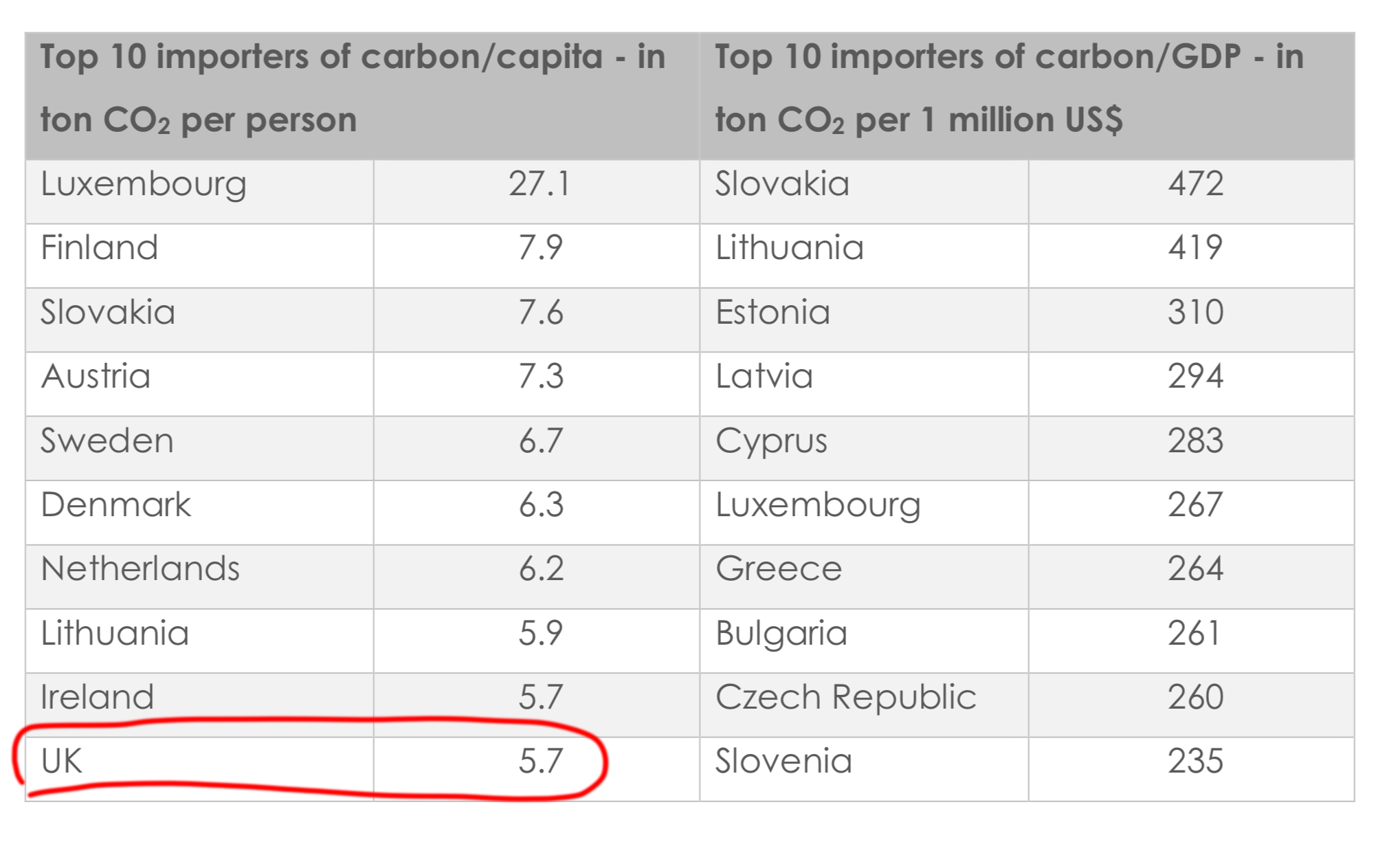
The message of the Climateworks report is that EU nations aren’t cutting emissions so much as they are exporting or outsourcing them to places like China. That is, the UK no longer manufactures its own consumer goods — it imports them from China, where the manufacturing emissions occur. If anything, emissions are actually increasing in this process since they must be shipped from China back to the UK.

According to the report, UK imports are worth 5.7 metric tons on a per capita basis.

Adding the World Bank per capita carbon footprint of the UK (6.5 tons) to the carbon footprint of UK imports (5.7 tons), the actual per capita carbon footprint of the UK is 12.1 tons — which is about 10% greater than the 1960 per capita carbon footprint of the UK of 11 tons. And this increase in per capita footprint remains despite all the improvements in efficiency made over the past 60 years.

So yes, coal can be replaced by combinations of gas, nuclear and wind — but the notion that emissions are actually being cut is fake news.

By 2030, all Canada’s efforts will be cancelled out by just 27 days’ worth of China’s increased carbon emissions.

Canada is run by idiots.

Prime Minister Justin Trudeau announced  this month his government would move to impose a minimum price on carbon (i.e., a carbon tax) on any province or territory that did not voluntarily do so by 2018. The question most Canadians are asking is: how much will this new tax cost us?

Figures will vary by household and province, but by 2022, when the tax will be a minimum of $50 a tonne, the average Canadian household could face $2,569 in new taxes. This, pro-carbon taxers insist, is necessary to reduce Canada’s carbon emissions. After all, climate change is a global issue. Surely Canadians must do their part to help solve the problem.

On the surface, this argument is extremely appealing. And sometimes, sacrifices must indeed be made in the service of an important objective. But to get a sense of just how much Canadians’ sacrifices will help in achieving the goal of fighting climate change, it’s worth unpacking the numbers.

We can start with the Trudeau government’s carbon emissions target for 2030, which would bring Canada’s total annual emissions down from 748 megatonnes (Mt) this year, to 524 Mt by 2030. Assuming we can meet that target — and that’s a big assumption — Canada’s total annual emissions would drop by 224 Mt.

Now consider the biggest contributor to global carbon emissions: China. In 2014, China’s annual carbon emissions were estimated at 10,540 Mt. China is a very large and rapidly developing country. It understandably wants to focus on raising the living standards of its people. Yet, despite strong economic growth in recent decades, the country still has hundreds of millions of people living in relative poverty, especially when compared to more developed countries like Canada. Accordingly, its climate change commitments are less stringent than Canada’s: China’s existing policy will see annual carbon emissions rise to about 13,600 Mt in 2030.

Its annual emissions will thus increase about 3,060 Mt over this period, which means that by 2030, all Canada’s efforts will be cancelled out by just 27 days’ worth of China’s increased carbon emissions.

Article here.