The Cartoon France’s Macron Ignored Until It Was Too Late

Correction: Northern Hemisphere CERES 18 Year Temperatures Trend = 0
Update: Willis made a mistake. Read about it here.
Original post below:
Willis Eschenbach is looking at the CERES satellite data trends from 2000.
While the Globe is averaging a tiny .07C per decade, the Northern Hemisphere trend is 0.
And Land is trending down -0.09C per decade.
As he says
“I’ve never seen a climate model from the turn of the century that predicted that for the first 18 years of the 21st Century the land would be cooling … and despite that, we’re supposed to believe that those same climate models can tell us what the temperatures will be doing in the year 2100 … yeah, that’s totally legit …”

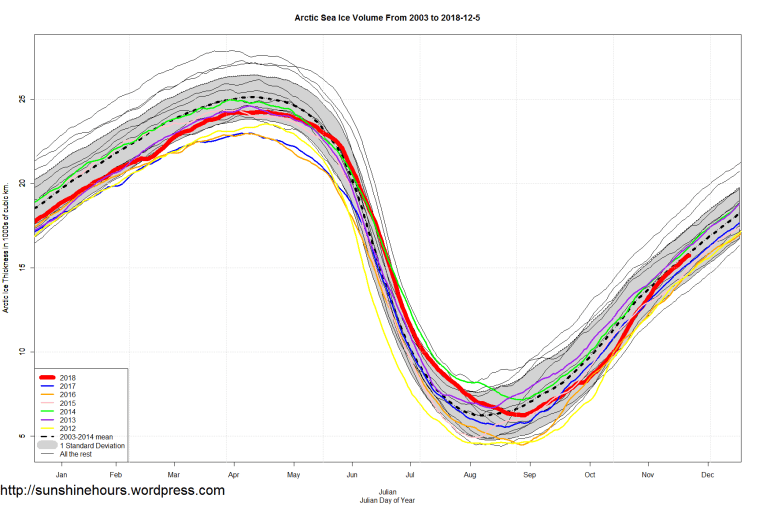
Arctic Sea Ice Volume 5-Dec-2018
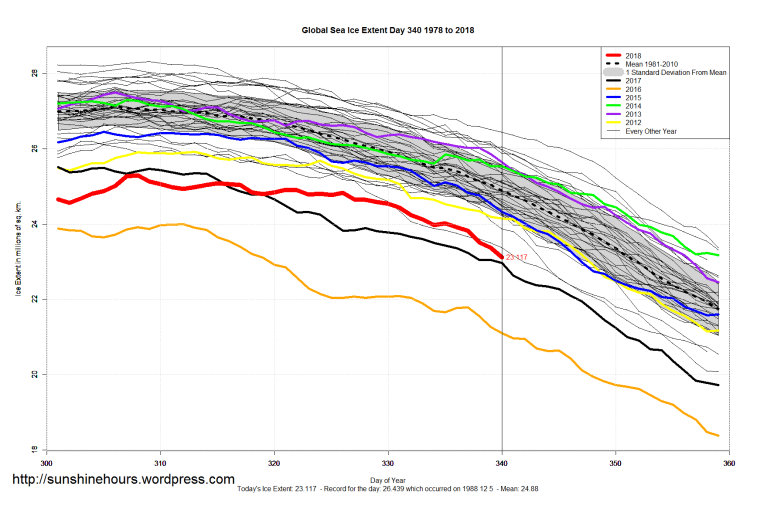
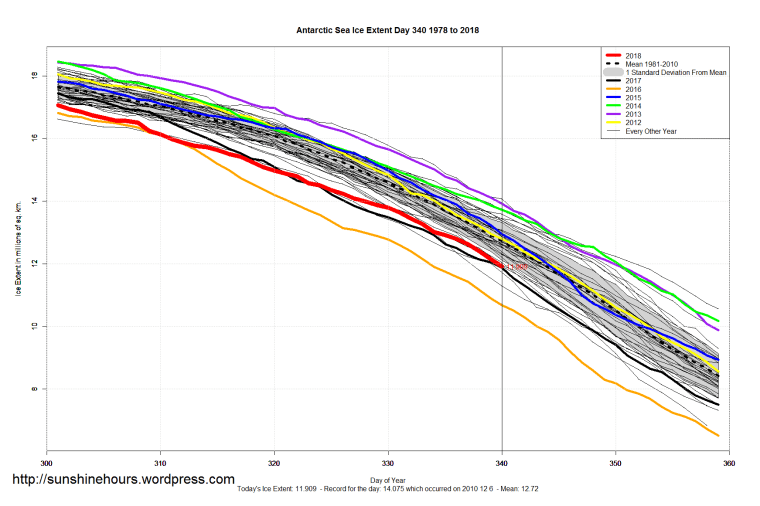
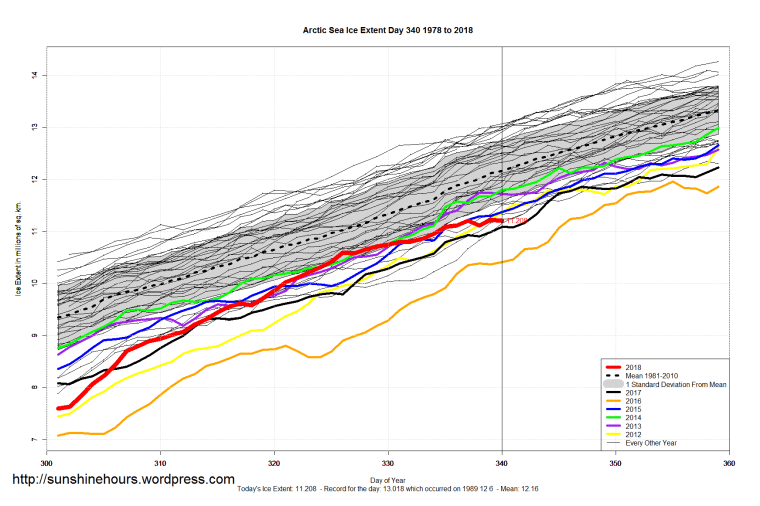
Sea Ice Extent (Global Antarctic and Arctic) – Day 339 – 2018
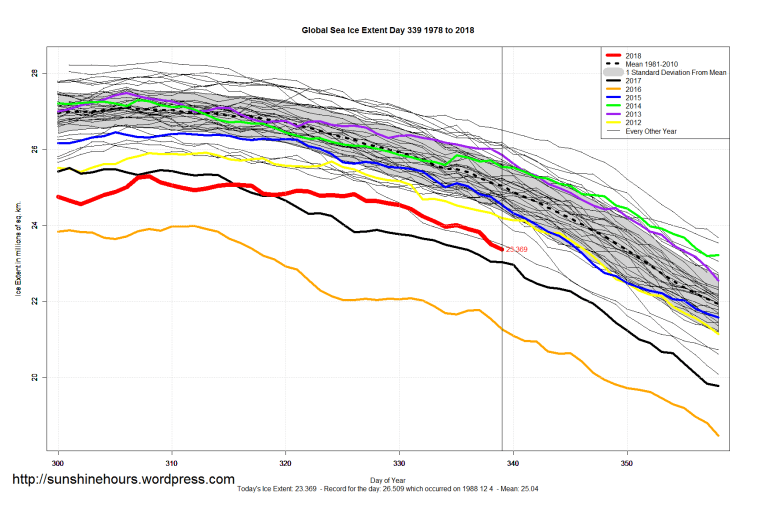
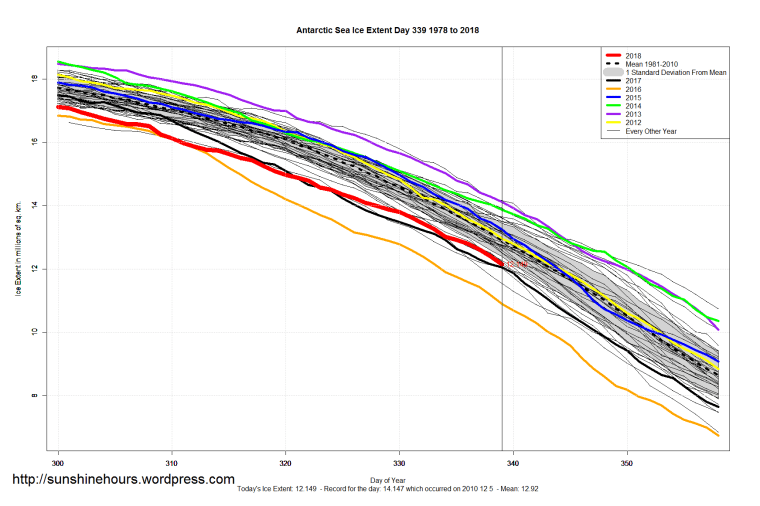
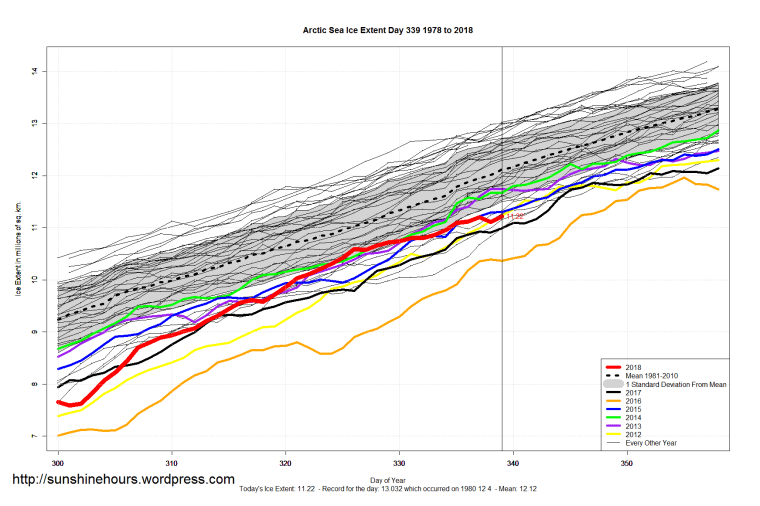
More CO2 – More Photosynthesis – More Greening
Someone decided to study plants that have grown for generations near high CO2 springs.
Normally these studies look at FACE experiments and then criticize those experiments because they are only single generation.
Guess what they found.?
In a new meta-analysis, Saban et al. took a different approach and assessed all of the data collected for plant response to high CO2 concentration from plants grown for multiple generations over many decades in naturally high CO2 springs. Such springs are found across the world – with 23 highlighted here- and many have been the focus of studies on the physiological responses of plants to rising CO2, similar to those undertaken in FACE experiment. Comparing these two approaches, plants subjected to higher CO2against plant lineages that have had time to acclimate, has never been done before.
High CO2 springs harbour a vast array of plant types and in contrast to FACE, provide critical insight into the decadal, long-term response of plants such as those likely to occur in future, where multiple generations ensure that time-travelling seed sources are no longer an issue. Remarkably, the analysis shows that many of the responses for spring plants are similar to those observed in FACE experiments. This gives us confidence that plants are likely to keep responding positively to rising CO2. They will not become acclimated and the increased global greening that is currently happening across the world, 80% of which is attributed to rising CO2 is likely to continue.
Arctic Sea Ice Volume 04-Dec-2018
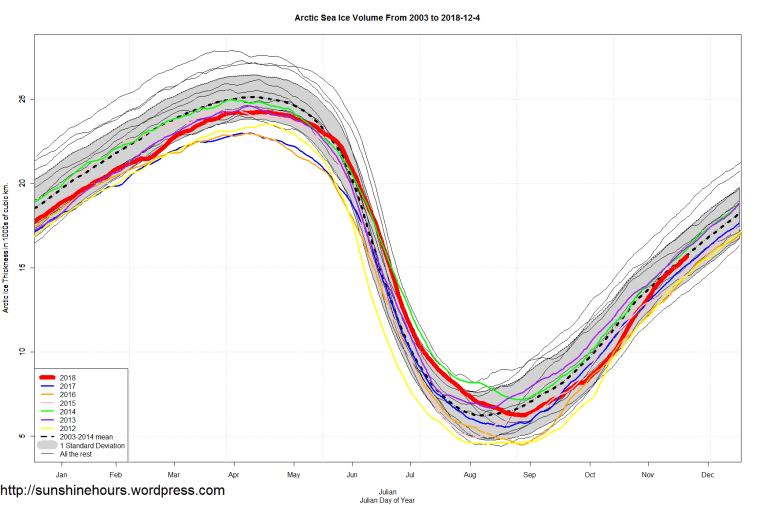
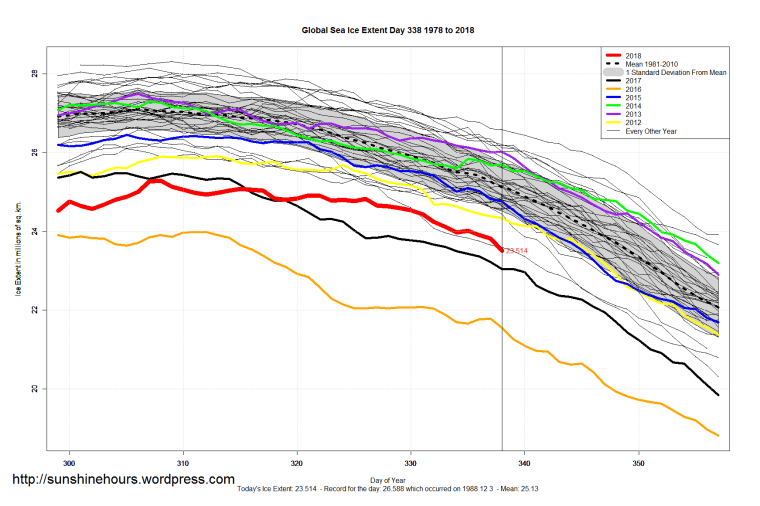
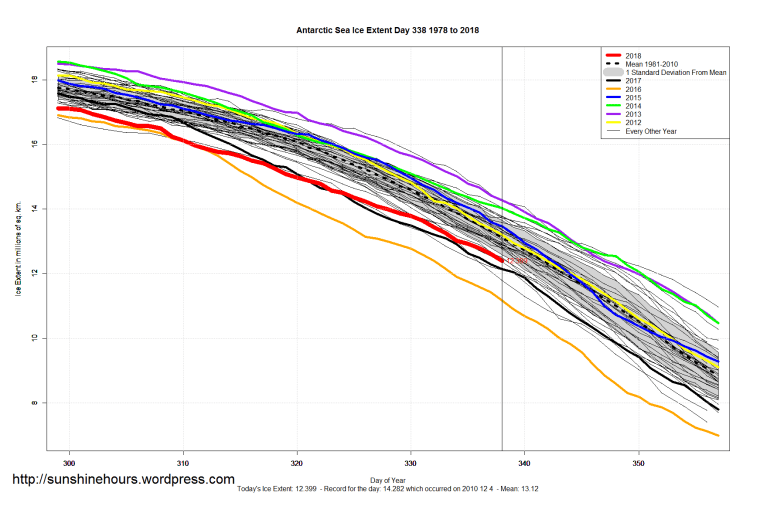
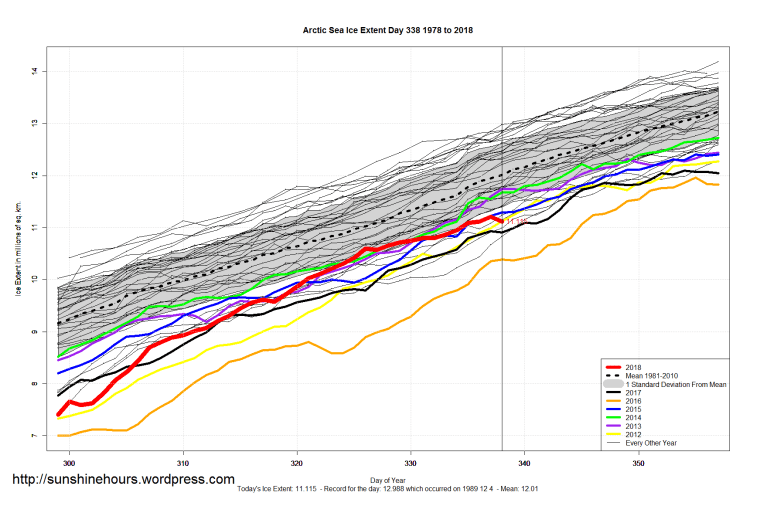
Sea Ice Extent (Global Antarctic and Arctic) – Day 338 – 2018
French government prepared to back down on carbon tax increase to €88
How do you stop a carbon tax increase? Riot. A six month reprieve.
I was listening the the CBC (Canadas left-wing state-subsidized media) and not once did they mention the actual cost of this carbon tax was going to be a jump from €55 to €88.
Canada’s carbon tax is 30$. France was going to increase their carbon tax to 132$.
Don’t be surprised if Canada’s will jump that high if Trudeau is re-elected.
After the recent riots in France at the margins of the ‘yellow vests’ movement, the carbon tax adopted under François Hollande is expected to be revised downwards. EURACTIV France reports.
Having been expected to attend COP24 in Poland on Monday 3 (December), French Prime Minister Édouard Philippe cancelled his visit and instead held an increasing number of meetings with French MPs and ministers.
This resulted in a decision to back down on the French carbon tax, which has been criticised by the ‘yellow vests’ since the movement started a month ago.
It seems that the increasing tension, demonstrations and violence, and particularly the support of the French population for the ‘yellow vests’ movement – which is still strong – are the reasons for this U-turn, which will take the form of a freeze on the tax increase scheduled for January 2019.
The tax was supposed to increase from €55 to €88 per tonne of CO2 emitted on this date.
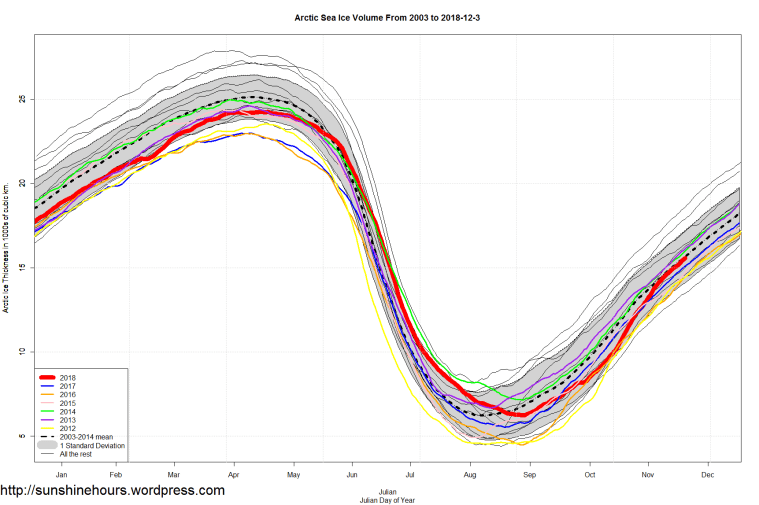
Arctic Sea Ice Volume 3-Dec-2018
From DMI
 sunshine hours