Heating with Natural Gas vs. Electricity in BC (Canada)
Update/Correction: The author of the blog post noted in one list:
BASIC CHARGE ($0.4065/day) = 148.37
And didn’t carry it the list with the total.
And the delivery charge is 4.296 per GJ = 429.60 (100GJ for the year)
- DELIVERY CHARGE = $429.60
- BASIC CHARGE ($0.4065/day) = 148.37
- STORAGE AND TRANSPORT = $75.80
- COST OF THE GAS = $154.90
- MUNICIPAL OPERATING FEE = $20.40
- CARBON TAX = $173.82
- CLEAN ENERGY LEVY = $2.64
- GST = $42.73
GAS total corrected to: 1048.26
Not quite as dramatic a difference … but still huge.
- End of Correction
- Original post below
Great blog article comparing Heating with Natural Gas vs. Electricity in BC
The conclusion: Gas Wins at 1/4 of the price.
You pay more in GST for electricity than the actual cost of the gas.
A typical home in the southern interior will use 100 GJ (or 27,778kWh) of energy to heat for a year. Smaller homes and more efficient furnaces can improve on this number, as can global warming because of warmer winters. Bigger homes or poorly insulated homes will use more.
Assuming that you require 100 GJ of heat for your home for the year, your gas costs will be:
- DELIVERY CHARGE = $42.96
- STORAGE AND TRANSPORT = $75.80
- COST OF THE GAS = $154.90
- MUNICIPAL OPERATING FEE = $20.40
- CARBON TAX = $173.82
- CLEAN ENERGY LEVY = $2.64
- GST = $42.73
TOTAL = $899.89
Using traditional baseboard heaters, the same amount of energy would cost you over $4,000/year with BC Hydro.
- 27,778 kWh at $0.13260/kWh = $3,683.34
- RATE RIDER = $184.17
- GST = 193.38
TOTAL = $4,060.88
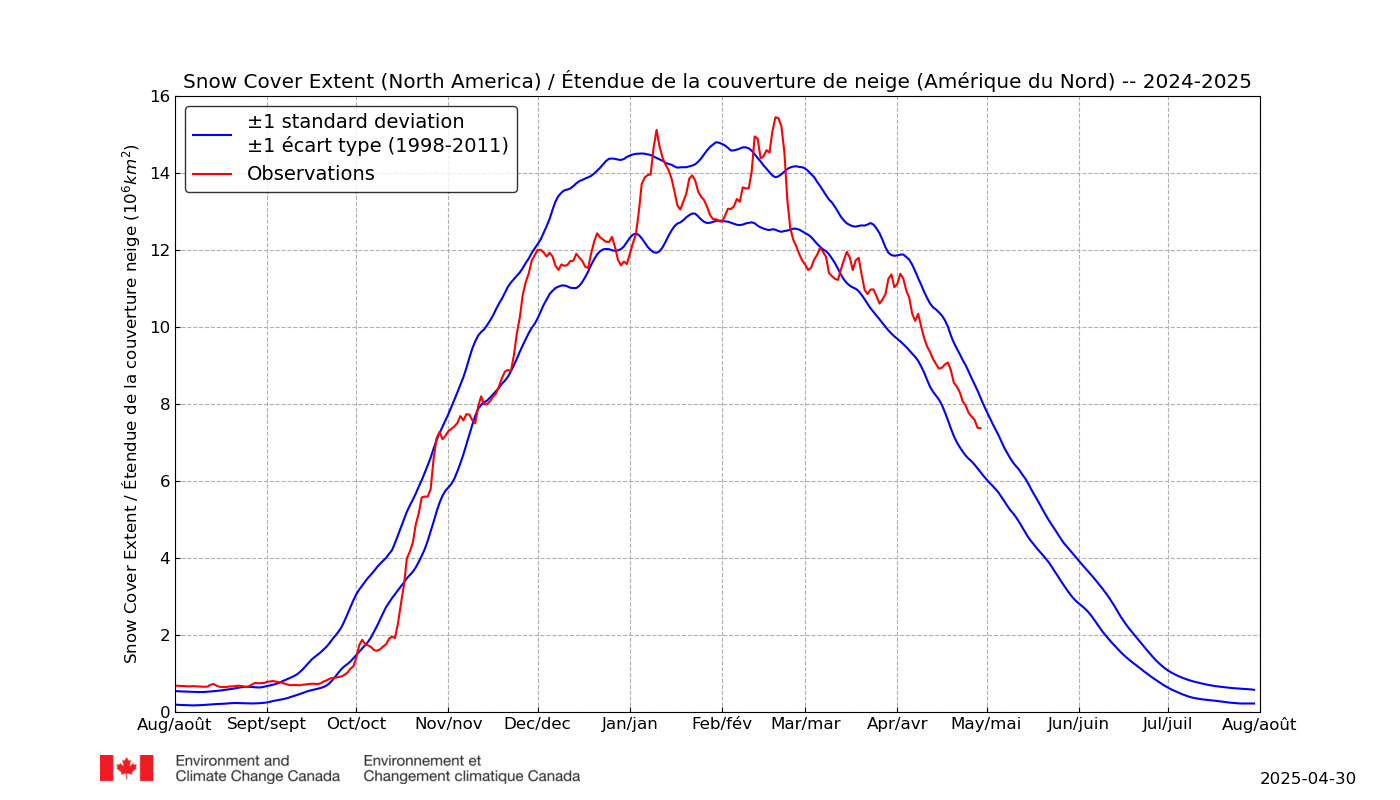
Snow Cover Extent North America 2018-11-29
No shortage of snow in North America
Arctic Sea Ice Volume 29-Nov-2018

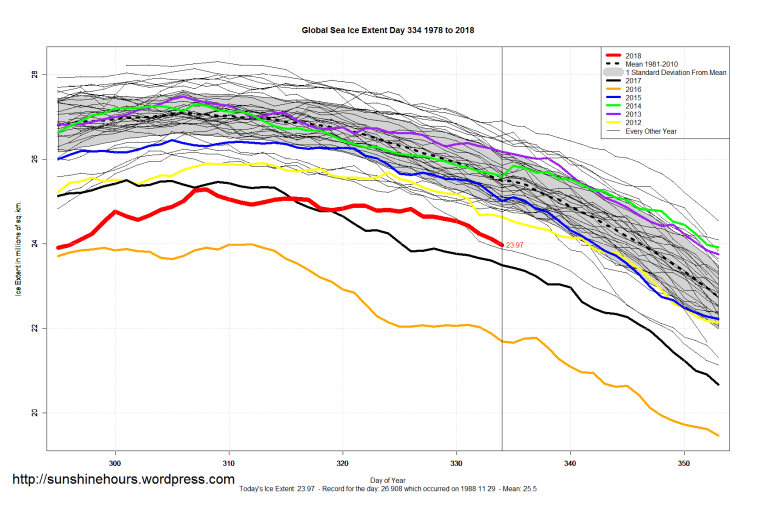
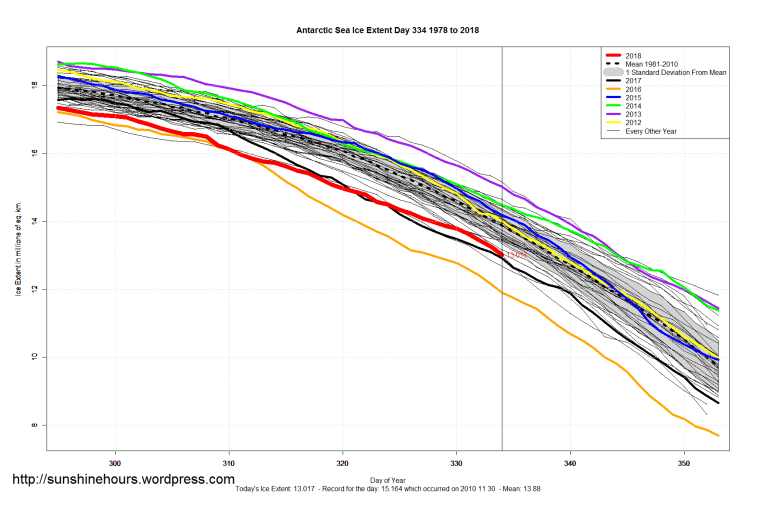
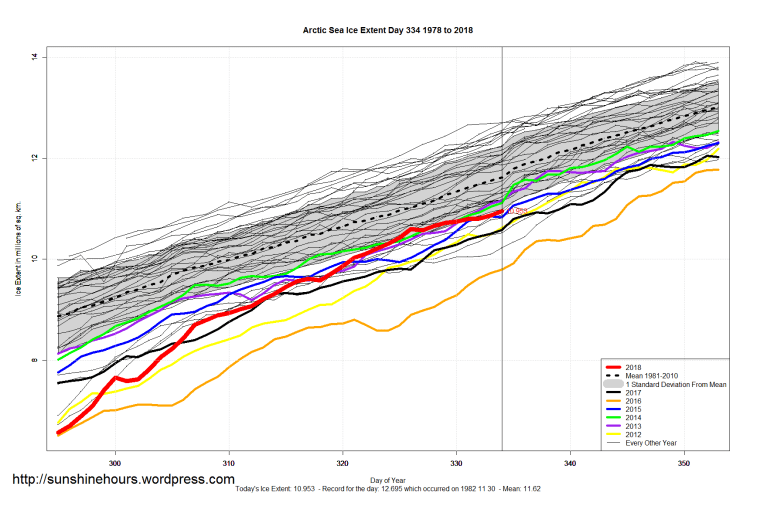
Sea Ice Extent (Global Antarctic and Arctic) – Day 333 – 2018


Bjorn Lomborg Shreds Media/Scientists Over US Climate Report
Bjorn Lomborg shreds scientists and media.
“Actually, the assessment, and science, tell a different story. “Drought statistics over the entire contiguous US have declined,” the report finds, reminding us that “the Dust Bowl era of the 1930s remains the benchmark drought and extreme heat event.”
On flooding, the assessment accepts the IPCC’s finding, which “did not attribute changes in flooding to anthropogenic [human] influence nor report detectable changes in flooding magnitude, duration or frequency.”
Even more dramatic was CNN’s headline, screaming that “climate change will shrink [US] economy” by 10 percent, a figure also repeated on The New York Times front page.
Actually, the UN’s climate scenarios envision US GDP per capita will more than triple by the end of this century, so this 10 percent reduction would come from an economy 300 percent larger than it is today. A slightly smaller bonanza, in other words.
But the 10 percent figure is itself dodgy. “
Molten Sulphur on an Airplane
Snakes Molten Sulphur on an Airplane
They are planning for a massive geoengineering project to inject sulphur into the atmosphere to combat global warming.
I think they are insane.
A program to reduce Earth’s heat capture by injecting aerosols into the atmosphere from high-altitude aircraft is possible, inexpensive, and would be unlikely to remain secret.
“We developed the specifications for SAIL with direct input from several aerospace and engine companies. It’s equivalent in weight to a large narrow body passenger aircraft. But to sustain level flight at 20 kms, it needs roughly double the wing area of an equivalently sized airliner, and double the thrust, with four engines instead of two.
“At the same time, its fuselage would be stubby and narrow, sized to accommodate a heavy but dense mass of molten sulphur rather than the large volume of space and air required for passengers.”
The team estimated the total development costs at less than $2 billion for the airframe, and a further $350 million for modifying existing low-bypass engines.
The new planes would comprise a fleet of eight in the first year, rising to a fleet of just under 100 within 15 years. The fleet would fly just over 4,000 missions a year in year one, rising to just over 60,000 per year by year 15.
Probably bigger than the plane below.

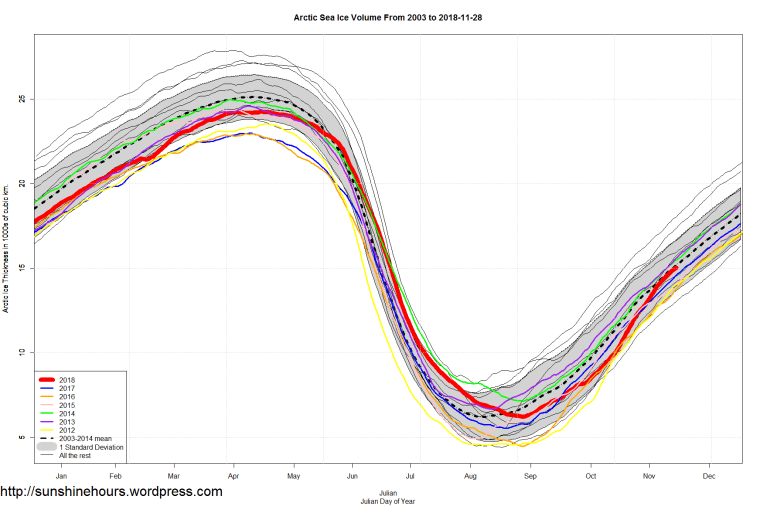
Arctic Sea Ice Volume 28-Nov-2018
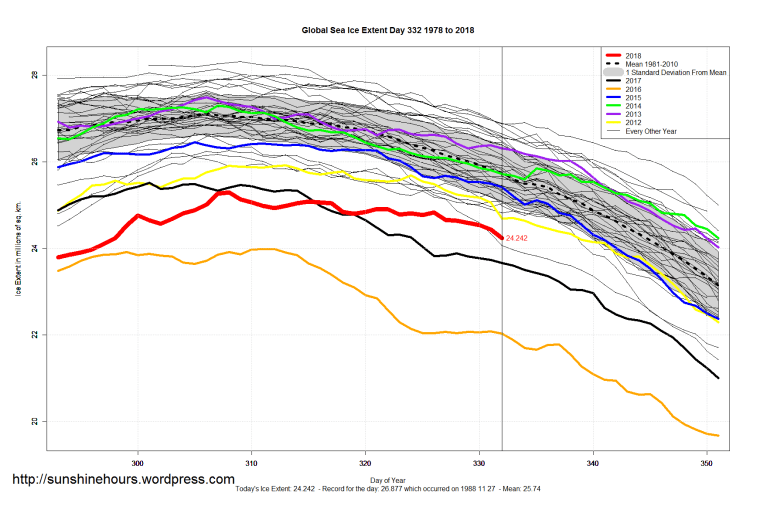
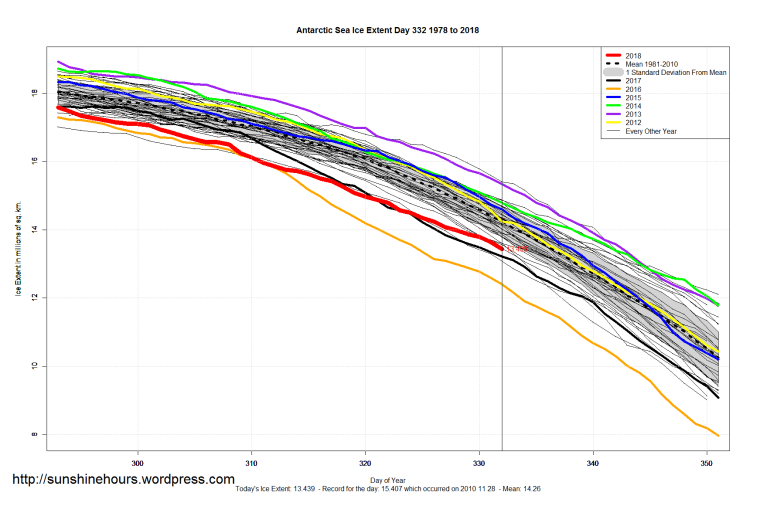
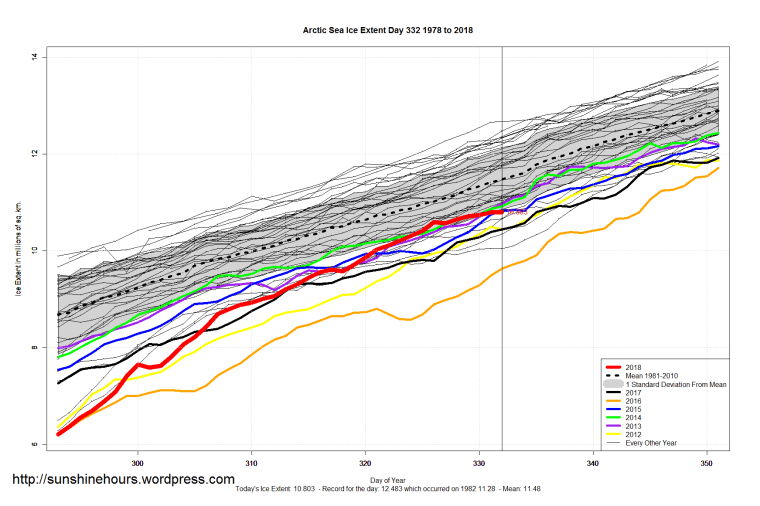
Sea Ice Extent (Global Antarctic and Arctic) – Day 332 – 2018
B.C. NDP Accidentally Admits Carbon Tax Hurts The Economy
From Spencer Fernando’s Blog
The B.C. NDP are joining a court case pitting the Trudeau government against Ontario & Saskatchewan, who are arguing the Trudeau government can’t impose the carbon tax against the will of the provinces.
But B.C. is joining on the side of the Trudeau government, saying the carbon tax needs to be imposed. And they give a very ‘interesting’ reason why.
Here’s what B.C. Environment Minister George Heyman said:
“Greenhouse gases do not respect provincial boundaries or international boundaries for that matter. We will argue that there will be harm to our competitiveness if other provinces do not put a price on carbon.”
Wait a minute…
If the carbon tax doesn’t hurt the economy, how could B.C. having one and other provinces not having one hurt the B.C. economy?
It’s almost as if applying a massive tax on everything isn’t good for the economy…
 sunshine hours