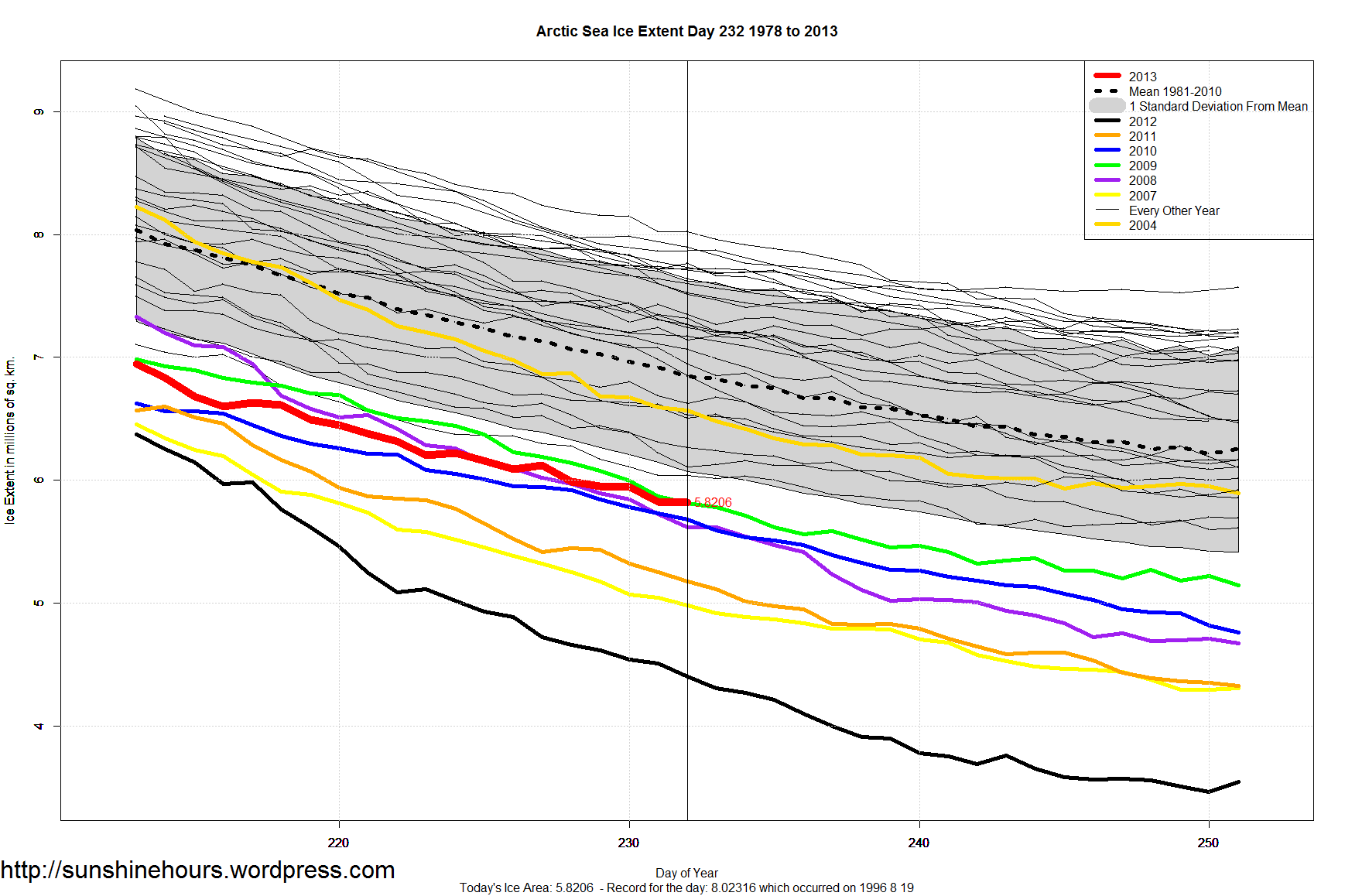
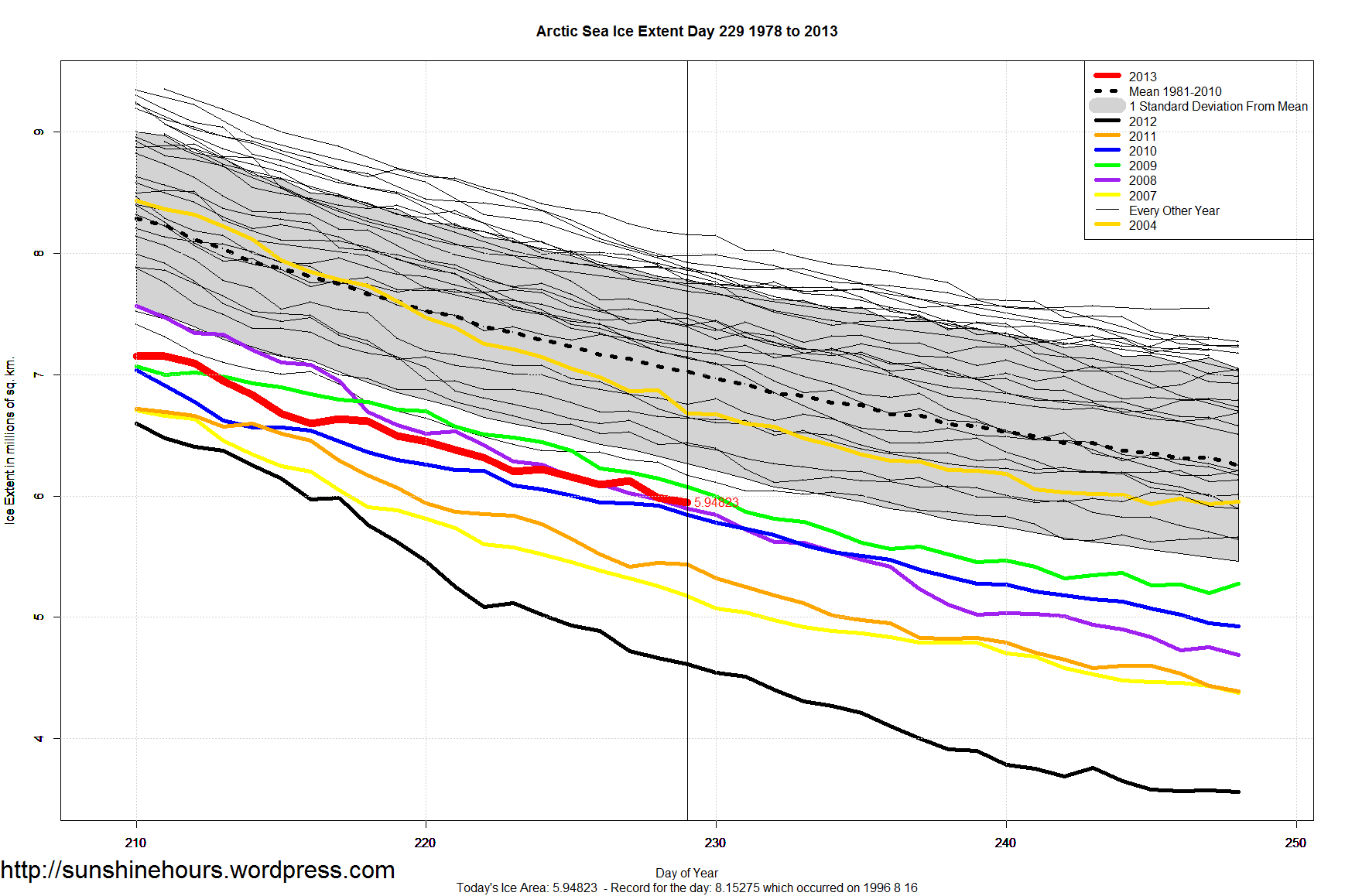
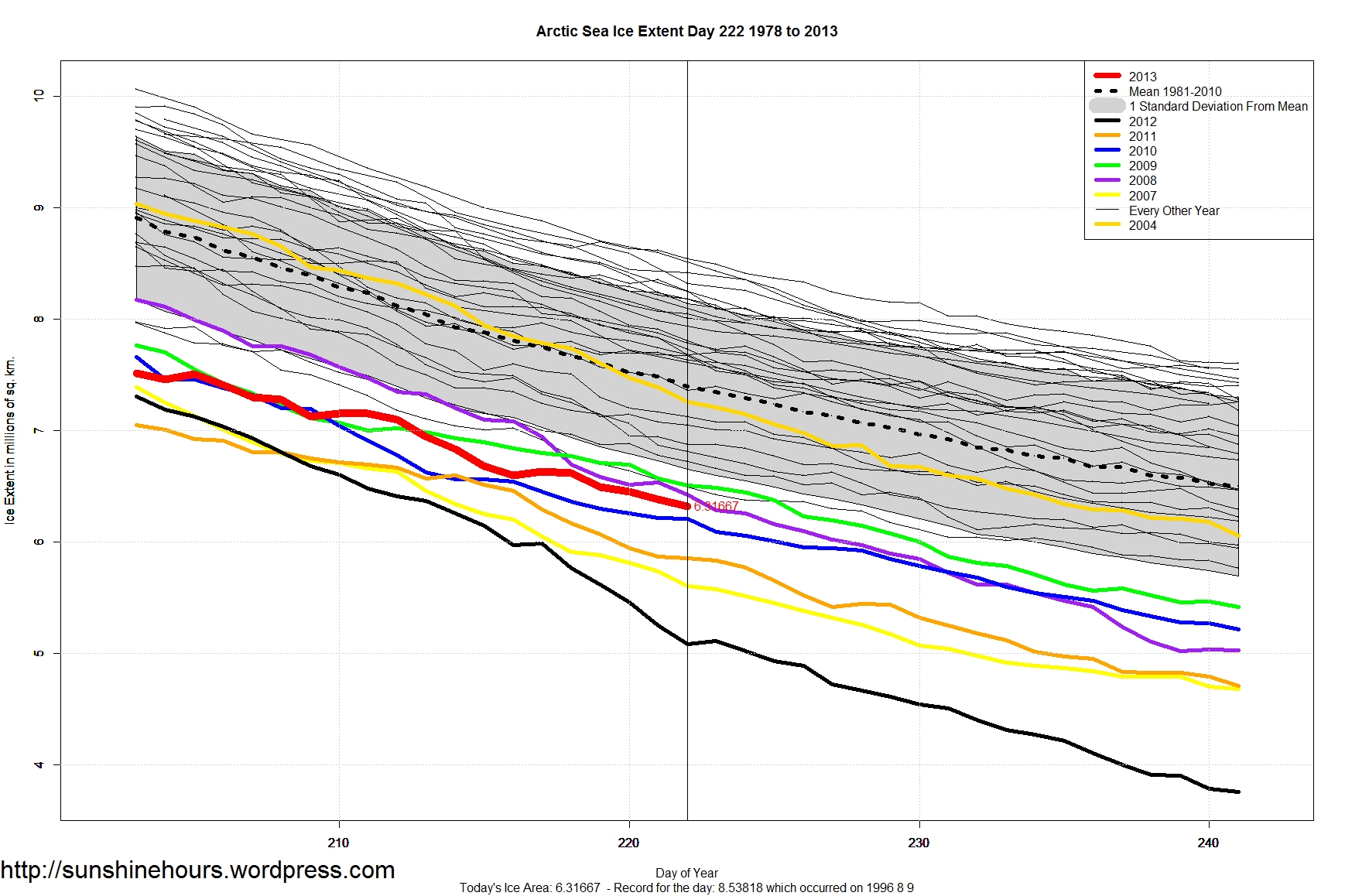
2013 Northwest Passage CLOSED without Canadian Coast Guard icebreaker escorts for transit.

“The North West Passage seems to be reversing its recent warming trend and is threatening to end the dreams of dozens of adventurous sailors.

A scattering of yachts trying to transit the legendary Passage are caught by the ice, which has become blocked at both ends and the season may be ended early. Douglas Pohl tells the story:

The passage has become blocked with 5/10 concentrated drifting sea ice at both the eastern and at the western ends of Canada’s Arctic Archipelago.

At least 22 yachts and other vessels are in the Arctic at the moment. Some who were less advanced have retreated and others have abandoned their vessels along the way. Still others are caught in the ice in an unfolding, unresolved drama.”

The real question is if and when the Canadian Coast Guard decides to take early action to help the above yachts exit the Arctic before freeze-up or will they wait until it becomes an emergency rescue operation?

Here is the detailed position, as far as it can be established:
Prince Regent Inlet in position 73.7880535N, -89.2529297W became blocked on 27th August with 5/10 ice concentration with 7/10 ice pushing.

This effectively closes the 2013 Northwest Passage without Canadian Coast Guard icebreaker escorts for transit.”


http://www.sail-world.com/Canada/North-West-Passage-blocked-with-ice—yachts-caught/113788


Thanks to commenter: “Alec aka Daffy Duck”
 

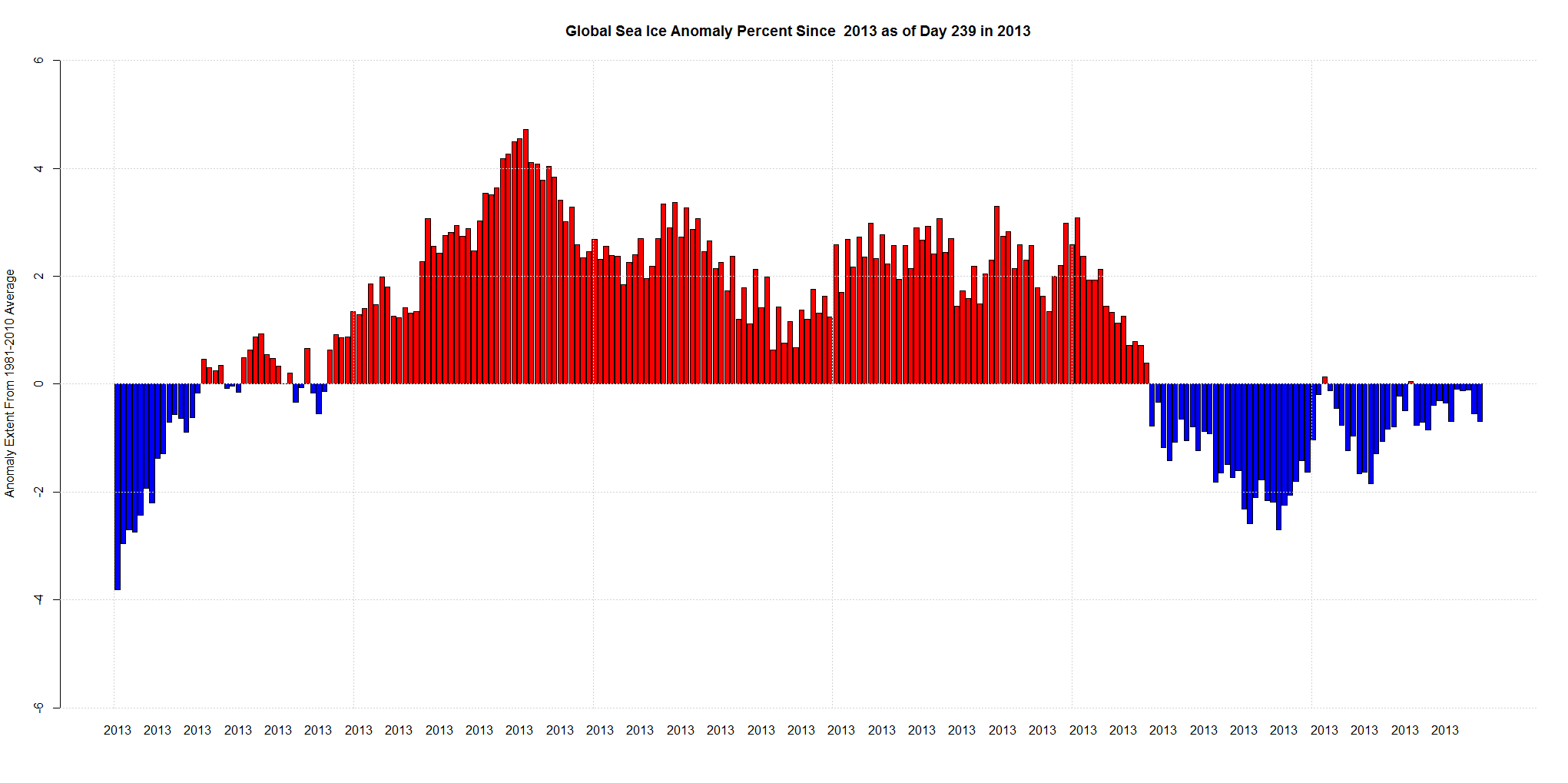
Global Sea Ice Extent Anomaly Only 170,000 sq km = 0.7%

If you add up the Antarctic  Sea Ice Extent Anomaly from the 30 year mean and the Arctic Anomaly and divide by the 30 year mean it comes to 170,000 sq km. Out of a normal mean of 24,700,000 sq km on Day 239.

That is a whole 0.7% below normal. The red part is above normal.  The blue is below normal. 

The highest anomaly for 2013 was March 14th when the anomaly was 908,000 out of a mean of 19.2 million for an anomaly percent of  4.72%.

Global Sea Ice Anomaly Percent Since  2013 as of Day 239 in 2013

Less Fresh Water in the Arctic and More Rainfall in Australia Leads To Lower Sea Level and Less Ice?

Could massive amounts of rainfall in Australia have deprived the Arctic of fresh water so there was less sea ice?

NSIDC:  “Water from the Pacific Ocean and several rivers in Russia and Canada provide fresher, less dense water to the Arctic Ocean. So the Arctic Ocean has a layer of cold, fresh water near the surface with warmer, saltier water below. This cold, fresh water layer typically allows more ice growth in the Arctic than the Antarctic.

NCAR: ” when three atmospheric patterns came together over the Indian and Pacific oceans, they drove so much precipitation over Australia in 2010 and 2011 that the world’s ocean levels dropped measurably.”

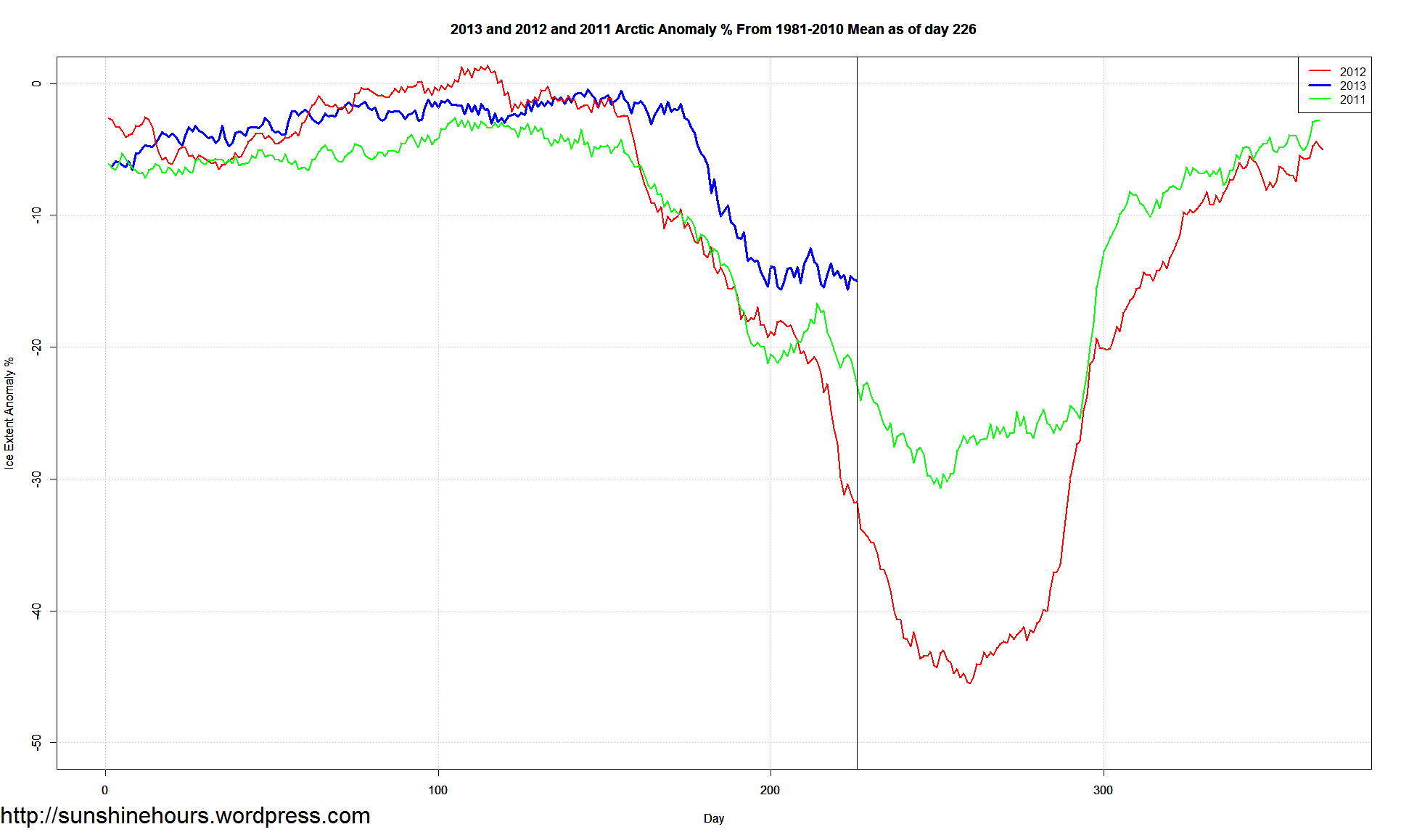
Arctic Ice Extent Anomaly 2012 compared to 2013

The difference between 2012 and 2013 is quite dramatic if you graph the anomaly % from the 30 year mean.

Until day 175 or so, the anomaly was only around -5% or so (note that the anomaly actually went positive for a few days in 2012).

While 2013 was later, both started drifting down. 2013 has stabilized at -15%. At this time last year 2012 was -30%.

Warmists must be so sad.

2013 and 2012 Arctic Anomaly % From 1981-2010 Mean as of day 224