Climate Hoaxters

I found this rant By Anthony Watts to be dead on and funny.

This current Climate Hoaxster freak-out is largely in reaction to President Trump’s tweet earlier this week mocking the Climate Hoaxsters.

“In the beautiful Midwest, windchill temperatures are reaching minus 60 degrees, the coldest ever recorded,” he tweeted. “What the hell is going on with Global Waming? [Sic] Please come back fast, we need you!

Naturally, this launched a million reactionary headlines from our oh-so objective, unbiased, not-at-all left-wing media.

“Look at This Embarrassing F*cking Moron,” screamed Esquire.

“Debunking the utter idiocy of Donald Trump’s global warming tweet,” pouted CNN.

“Here’s Why the Crazy Cold Temperatures Prove Global Warming is Real,” Forbes says reassuringly.

“What Trump keeps getting wrong about Global Warming,” the Washington Post helpfully reports.

But here is my personal favorite headline from, where else?, NBC News…. “Yes, it can be this cold outside in a time of global warming.”

There are three Party slogans in George Orwell’s 1984, his masterpiece about an all-controlling centralized government that runs on lies, terror, and propaganda. See if you can pick out which Party slogan I invented among the four:

  • War is Peace
  • Freedom is Slavery
  • Ignorance is Strength
  • Frigid Weather Means Our Planet is Getting Warmer

The Climate Hoaxsters say that this run of cold weather does not mean the planet will not warm over the course of years, which would sound reasonable if these were not the same Climate Hoaxters who told us Global Warming meant the “end of snow,” or that this winter would be “warmer-than-average,” or that a run of warm weather last winter proved the planet is warming.

That last example is interesting, no?

You see, last year our Climate Hucksters told us a run of warm weather proved the planet is warming, which means we all have to give up our freedoms to a centralized government in order to save the planet.

BUT… a run of frigid weather this year also proves the planet is warming and we all have to give up our freedoms to a centralized government in order to save the planet.

So no matter what happens, no matter how cold or warm or temperate it is, everything proves Global Warming is fer real.
The Good News: Invasive species dying off because of cold snap

The good news about the cold:

DULUTH, MN — When it’s so cold your face hurts, and it’s hard to talk, it’s easy to forget there are actually some positives that come with these extreme cold temps.

We’re all-too-familiar with the Emerald Ash Borer in our region.

We’re also familiar with the bitter January cold, which right now, may be killing off the larvae of the invasive species.

“When temperatures get to about 20 below zero Fahrenheit, we see about 50% of the Emerald Ash Borer Larvae begin to die,” said Rob Venette, director of the Minnesota Invasive Terrestrial Plants and Pests Center with the University of Minnesota.

Researchers at the U of M have been studying the effects cold weather may have on the Emerald Ash Borer for years.

Experts say at 30 below and colder, as much as 90% of the ash borer larva could be dying off.

“Once ice begins to form in their bodies, that kills the insect,” said Venette.

The insects are not impacted by wind-chill. So, the actual temperature is what must be considered, which can oftentimes be colder than where insects burrow for the winter.

“Although we may be experiencing minus 40, it may only be maybe minus 35 under the bark of a tree. So, that helps the chances of an insect to survive,” said Venette.

Venette added, even though they are expecting large amounts of Emerald Ash Borers to die off as a result of this cold snap, that won’t impact how they survey the population in the spring.

Dr. Robert Sterner, director of the Large Lakes Observatory, says the cold could be putting a dent in the aquatic invasive species in Lake Superior, as well.

“The invasive species are coming from places in the world that typically aren’t as cold as we experience in a cold winter here,” he said.

Meaning the cold could be enough of a shock to kill at least a portion of them.

“We believe there is a relationship between warming conditions and the success of invasive species. So, weather like this is only good news as far as the native species go,” said Dr. Sterner.

And when lakes are covered in ice, water evaporation dramatically decreases, and typically, the water temperature is cooler in the summer.

“The combination of reduced winter evaporation and cooler summer surface temperatures means we keep more water within the lake volume,” said Dr. Sterner.

Increased water volume can be good for the shipping industry, and ecological systems within the lake. However, it is not very popular amongst shoreline homeowners as it can contribute to shoreline erosion.

More ice can also mean ice-out occurs later than normal, meaning colder lake water in the summer, which officials say could reduce the chances of algae blooms in lakes, as well.

That is contingent on the thaw and warming cycle in the spring and early summer.


Unwashed Solar Panels Can Drop to 32.4% of Capacity

Just a followup on the 200,000 liters of water to clean solar panels post.

NREL actually tested panels in Qatar with different cleaning schedules.

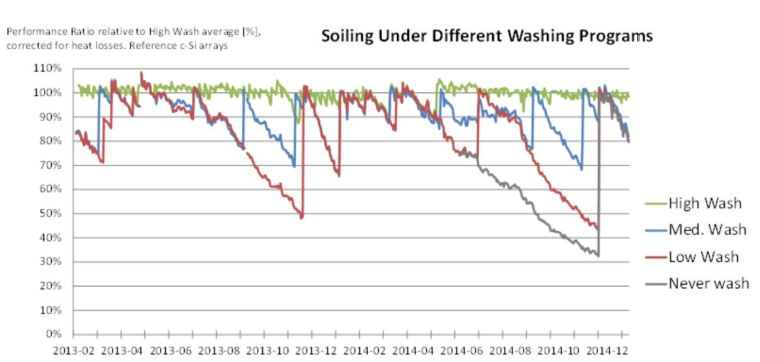
A 35,000 m2 Solar Test Facility was established at Qatar Foundation, Doha, in 2012 in order to identify solar energy technologies suitable for the local climate, and study the effects of dust and heat. Of particular concern is soiling of PV panels, causing them to lose performance. This study aims to understand long-term soiling behavior in the absence of cleaning or rain.

METHODOLOGY

Four PV arrays were set up at the Solar Test Facility. Each comprised eight polycrystalline  PV modules, connected to identical grid-tied inverters, and operated at maximum power point conditions.

The only difference between the arrays was the cleaning interval:

(i) one week (“high”), (ii) two months (“medium”), (iii) six months (“low”), and (iv) not  cleaned (“never”).

Of course, all arrays were subject to rain. The test period was two years commenced February 2013.

Energy losses of each array due to soiling are shown in Figure 1. The results are expressed as the arrays‟ PR relative to the long-term average PR of the weekly-washed array, ie. the weekly-washed array is treated as the “100%” benchmark. It is seen that:

• The soiling rates generally appear to be higher in winter than in summer, ie. The lines are steepest in the months around January-February, and relatively flat around June-July.

The greatest power loss occurred on the never-washed array, which after 234 days
produced only 32.4% of the DC power of the weekly-washed array

• The soiling rate tends to decrease the longer the time since last cleaning, as seen by
comparing the slopes of the medium, low and never-washed arrays approaching
November 2014
• However dust continued to accumulate on the never-washed array even after 234 days, ie. The line was still going down when it rained in November 2014.

Netherlands: Electric car subsidies largely benefit ‘rich’ Tesla and Jaguar drivers

No surprise.

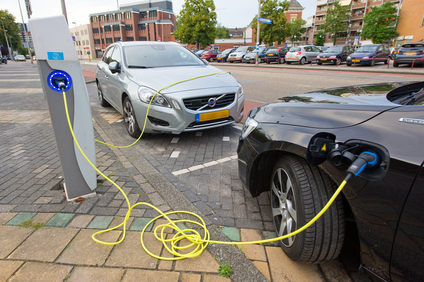
Around half the government fund to stimulate people to drive electric cars has ended up in the hands of ‘rich Tesla and Jaguar drivers’, the Volkskrant said on Wednesday.

Last year, the government said it would fund tax breaks totaling €700m for electric car drivers. But almost half the 25,000 electric cars bought in the Netherlands in 2018 were Teslas and Jaguars with a price tag of €80,000 to €120,000, the paper said. In particular, the sale of Teslas rose 260% last year.

The paper bases its claims on answers to MPs’ questions given by tax minister Menno Snel in parliament on Tuesday evening. This means that CDA leader Sybrand Buma’s comments that ‘prosecco-drinking Tesla drivers’ have profited from the tax break at the ‘expense of the ordinary man in the street’ are largely true, the paper said.

It points out that the subsidies for electric cars are mainly funded by higher taxes paid by petrol and diesel car owners.

The government had assumed 11,000 electric cars would be bought in 2018, with an average price of €43,000. Instead, 25,000 were bought for an average of €63,000 each. This, the paper says, means the subsidy scheme has overrun its budget by ‘a couple of hundred million euros’.

Read more at DutchNews.nl: