This is pretty amazing.
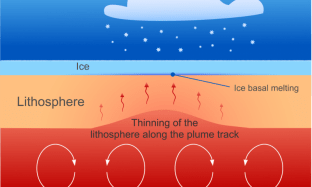 Greenland’s lithosphere has hot depths which originate in its distant geological past and cause Greenland’s ice to rapidly flow and melt from below.
To understand Greenland’s ice of today researchers have to go far back into Earth’s history. The island’s lithosphere has hot depths which originate in its distant geological past and cause Greenland’s ice to rapidly flow and melt from below. An anomaly zone crosses Greenland from west to east where present-day flow of heat from the Earth’s interior is elevated. With this anomaly, an international team of geoscientists led by Irina Rogozhina and Alexey Petrunin from the GFZ German Research Centre for Geosciences could explain observations from radar and ice core drilling data that indicate a widespread melting beneath the ice sheet and increased sliding at the base of the ice that drives the rapid ice flow over a distance of 750 kilometres from the summit area of the Greenland ice sheet to the North Atlantic Ocean.
The North Atlantic Ocean is an area of active plate tectonics. Between 80 and 35 million years ago tectonic processes moved Greenland over an area of abnormally hot mantle material that still today is responsible for the volcanic activity of Iceland. The mantle material heated and thinned Greenland at depth producing a strong geothermal anomaly that spans a quarter of the land area of Greenland. This ancient and long-lived source of heat has created a region where subglacial meltwater is abundant, lubricating the base of the ice and making it flow rapidly. The study indicates that about a half of the ice in north-central Greenland is resting on a thawed bed and that the meltwater is routed to the ocean through a dense hydrological network beneath the ice.
The team of geoscientists has now, for the first time, been able to prove strong coupling between processes deep in the Earth’s interior with the flow dynamics and subglacial hydrology of large ice sheets: “The geothermal anomaly which resulted from the Icelandic mantle-plume tens of millions of years ago is an important motor for today’s hydrology under the ice sheet and for the high flow-rate of the ice” explains Irina Rogozhina. “This, in turn, broadly influences the dynamic behaviour of ice masses and must be included in studies of the future response to climate change.”
Read more at: Physorg
 sunshine hours