As Antarctic Sea Ice approaches minimum for the year, Antarctic Sea Ice for Day 26 is the 4th largest amount behind 2008, 1995 and 2004.
The way things are tracking there is a good chance a record for most ice at minimum may be set.
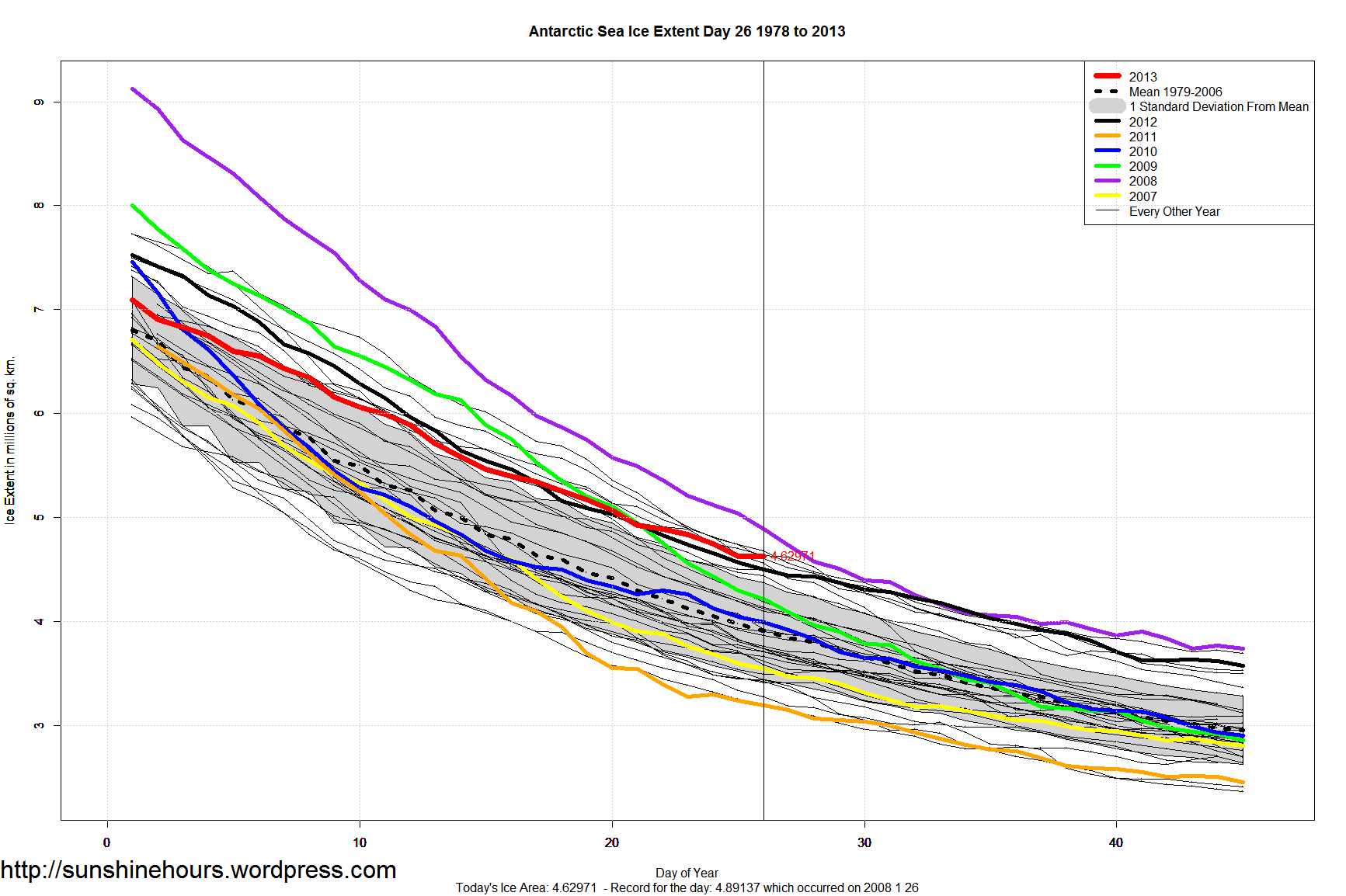
As Antarctic Sea Ice approaches minimum for the year, Antarctic Sea Ice for Day 26 is the 4th largest amount behind 2008, 1995 and 2004.
The way things are tracking there is a good chance a record for most ice at minimum may be set.
The NSIDC and many other used the ozone hole as an “excuse” for why Antarctic Sea Ice Extent broke records this year.
“Both warming and ozone loss act to strengthen the circumpolar winds in the south. This is due primarily to persistently cold conditions prevailing on Antarctica year-round, and a cold stratosphere above Antarctica due to the ozone hole. Stronger winds generally act to blow the sea ice outward, slightly increasing the extent”
Guess what, WUWT tells us it was the 2nd smallest ozone hole in 20 years.
“The average area covered by the Antarctic ozone hole this year was the second smallest in the last 20 years, according to data from NASA and National Oceanic and Atmospheric Administration (NOAA) satellites.”
What a shock. The “scientists” excuses for more Antarctic Sea Ice was bogus.
Antarctic Sea Ice Extend Maximum Trend
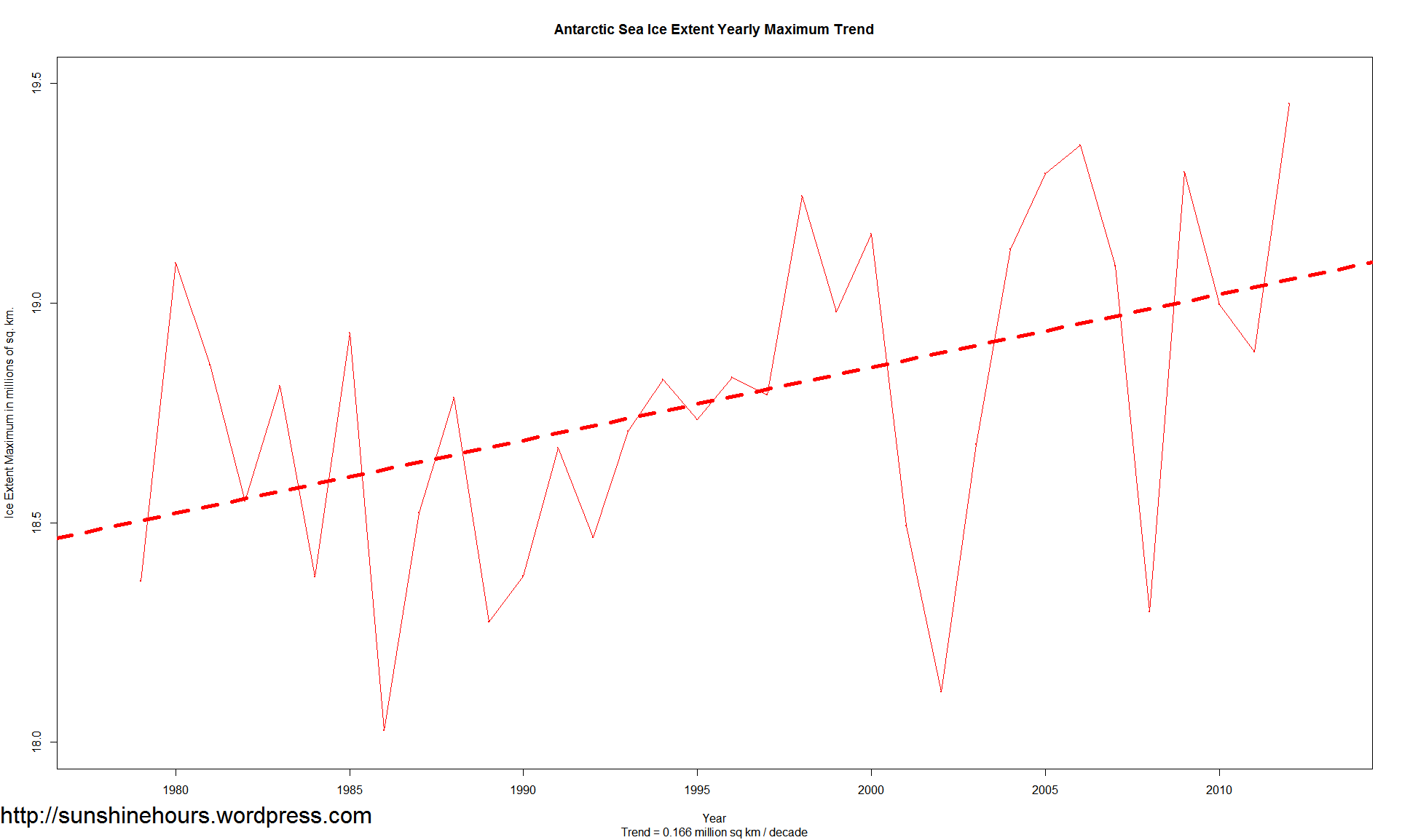
October 11 2012 (day 285) was another daily record for Antarctica Sea Ice Extent. The previous record holder for day 285 was in 2010.

Experts: Global warming means more Antarctic ice (h/t Marc Morano)
“This subtle growth in winter sea ice since scientists began measuring it in 1979 was initially surprising, they say, but makes sense the more it is studied.”
Translation: It was embarrassing us, so we’ll make something up.
“A warming world can have complex and sometimes surprising consequences,”
Translation: Antarctica is cooling, we don’t know why, so we will claim it is warming.
“”It sounds counterintuitive, but the Antarctic is part of the warming as well.”
Translation: More Ice = Warming and Less Ice = Warming. Our scam wins either way!
“But that doesn’t mean we shouldn’t be paying attention to it and shouldn’t be talking about it.”
Translation: We ignored the records in 2006 and 2012 and finally a few bloggers embarrassed us so much about 2012 that we had our buddy Seth Borenstein make up some crap.
“Antarctica’s weather peculiarities, on the other hand, don’t have much effect on civilization.”
Translation: It threatens our gravy train of grant money so we kept quiet about it.
“And the wind works in combination with the ozone hole, the huge gap in Earth’s protective ozone layer that usually appears over the South Pole”
Translation: We plan to ignore the ozone hole over the Arctic … which we never predicted either.
“Antarctic sea ice is also getting snowier because climate change has allowed the air to carry more moisture.
Guffaw.
“Winter sea ice has grown by about 1 percent a decade in Antarctica. ”
Actually, only one year before 1998 (1980 had 3) had days over 19 million sq km of Antarctic Ice. 2006 had 30 and 2012 had 28.
“computer models have long predicted that Antarctica would not respond as quickly to global warming as other places. ”
Translation; Models said it would melt too. Our models are crap.
“Scientists on the cruise with Maksym are spending eight to 12 hours a day on the ice bundled up against the fierce wind with boots that look like Bugs Bunny’s feet.”
Translation: Clown Feet would be more appropriate.
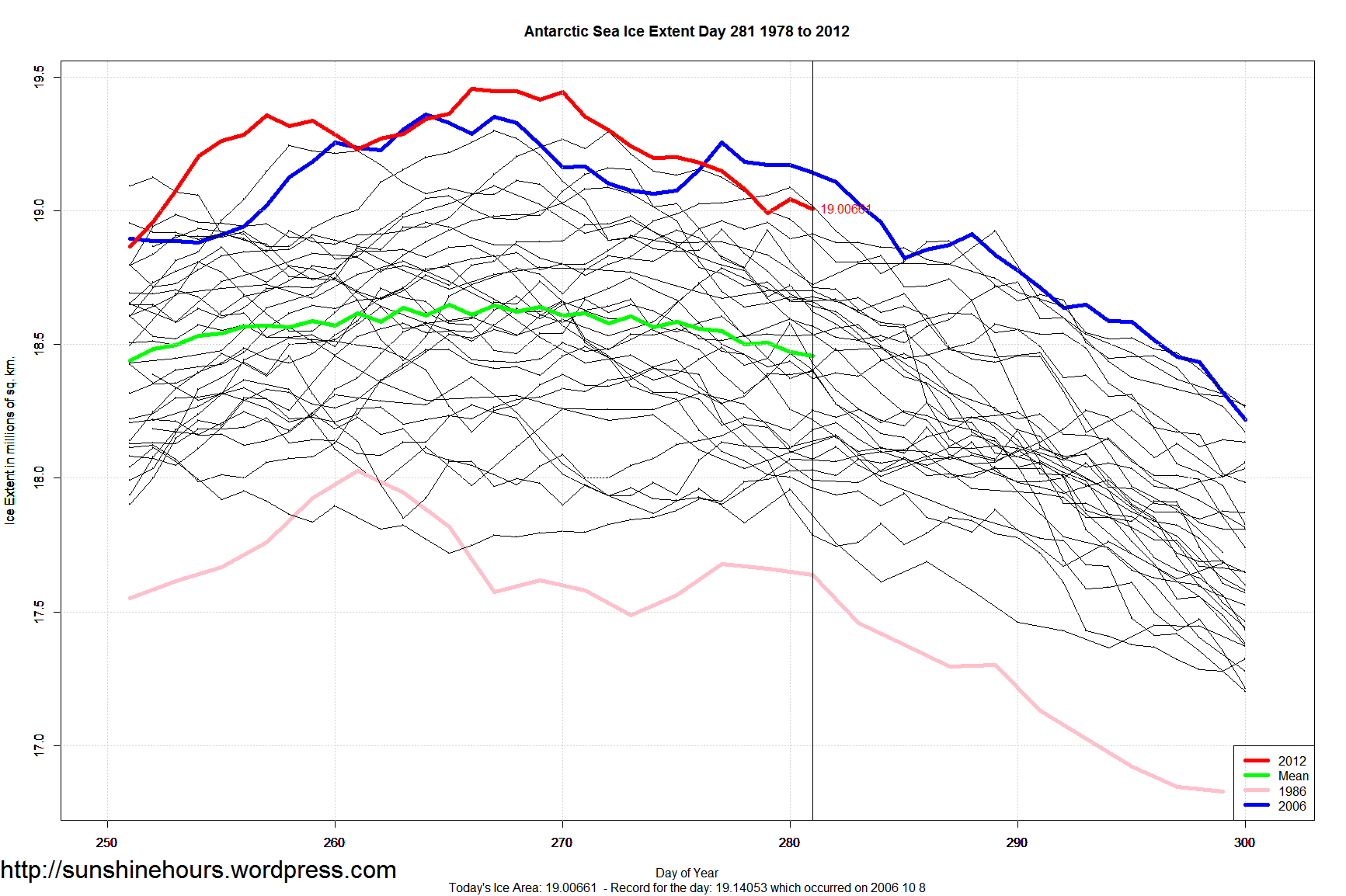
Antarctic Sea Ice Extent set an all time record in 2012. The previous record was set in 2006. In 2006 there were 30 days where the ice extent was over 19 million sq km. That record has not been broken and was 9 days more than the previous record holder (1998).
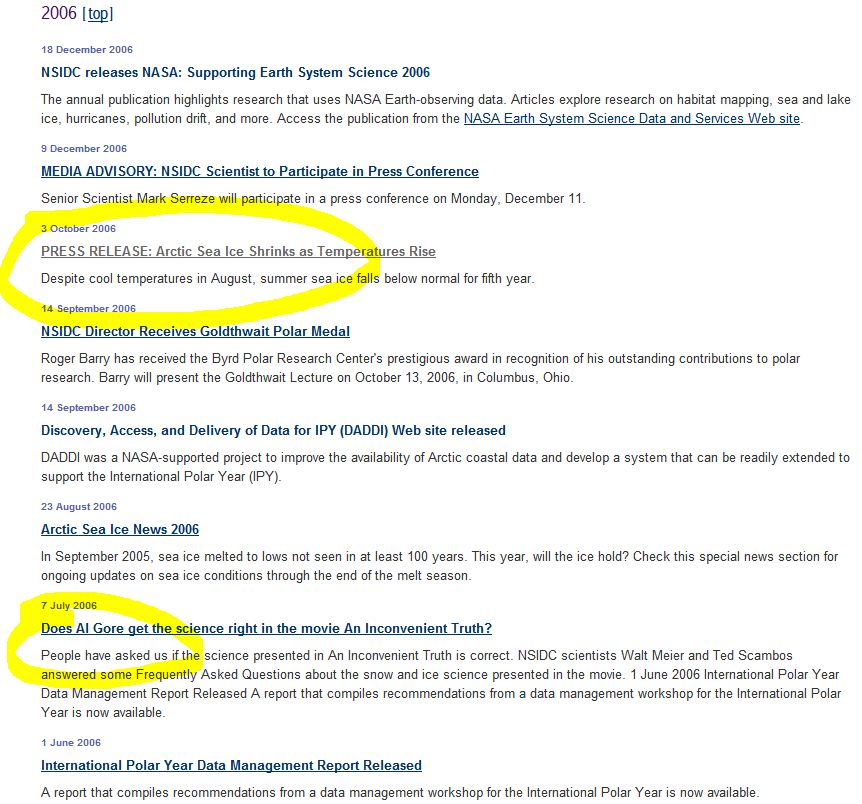
So what did the NSIDC have to say about it in 2006?
Nothing.
They mentioned the Arctic a lot. And Al Gore’s movie. And that there was going to be an open house. But they ignored Antarctica. If they were scientists and not propagandists shouldn’t they be interested in both poles and maximum records too?
Only 9 years in the satellite era have seen Antarctic Sea Ice Extent hit 19 million sq km. 2006 had 30 days. In the last 2 days 2012 has trend up again over 19 million and put it within 2 days of tying the all time record. Aside from 1980, all of those years have been since 1998 which some people claim have been the hottest years in the history of human beings. Antarctic Sea Ice Extent disagrees.
| Year | Days Above 19 million | Last Day Above 19 million |
| 2006 | 30 | 283 |
| 2012 | 28 | 281 |
| 1998 | 21 | 281 |
| 2005 | 13 | 278 |
| 2009 | 11 | 271 |
| 2007 | 9 | 275 |
| 2004 | 6 | 254 |
| 2000 | 5 | 274 |
| 1980 | 3 | 269 |
Click for larger …
| Year | Average for September (million sq km) |
| 2012 | 19.1702 |
| 2006 | 19.0932 |
| 2009 | 18.9596 |
| 2004 | 18.9184 |
| 1998 | 18.9027 |
| 2000 | 18.8872 |
| 2007 | 18.8599 |
| 1980 | 18.817 |
| 2005 | 18.8036 |
| 2010 | 18.7979 |
| 1985 | 18.7061 |
| 1999 | 18.6957 |
| 2011 | 18.6937 |
| 1996 | 18.6308 |
| 1994 | 18.6144 |
| 1981 | 18.5972 |
| 1997 | 18.5955 |
| 1983 | 18.5864 |
| 1993 | 18.5438 |
| 1995 | 18.4147 |
| 1982 | 18.3555 |
| 1991 | 18.3121 |
| 1988 | 18.3064 |
| 2003 | 18.299 |
| 1987 | 18.2454 |
| 1979 | 18.1968 |
| 1990 | 18.1924 |
| 2001 | 18.1742 |
| 1984 | 18.166 |
| 1992 | 18.1474 |
| 2008 | 18.1443 |
| 1989 | 18.1194 |
| 2002 | 17.8866 |
| 1986 | 17.6925 |
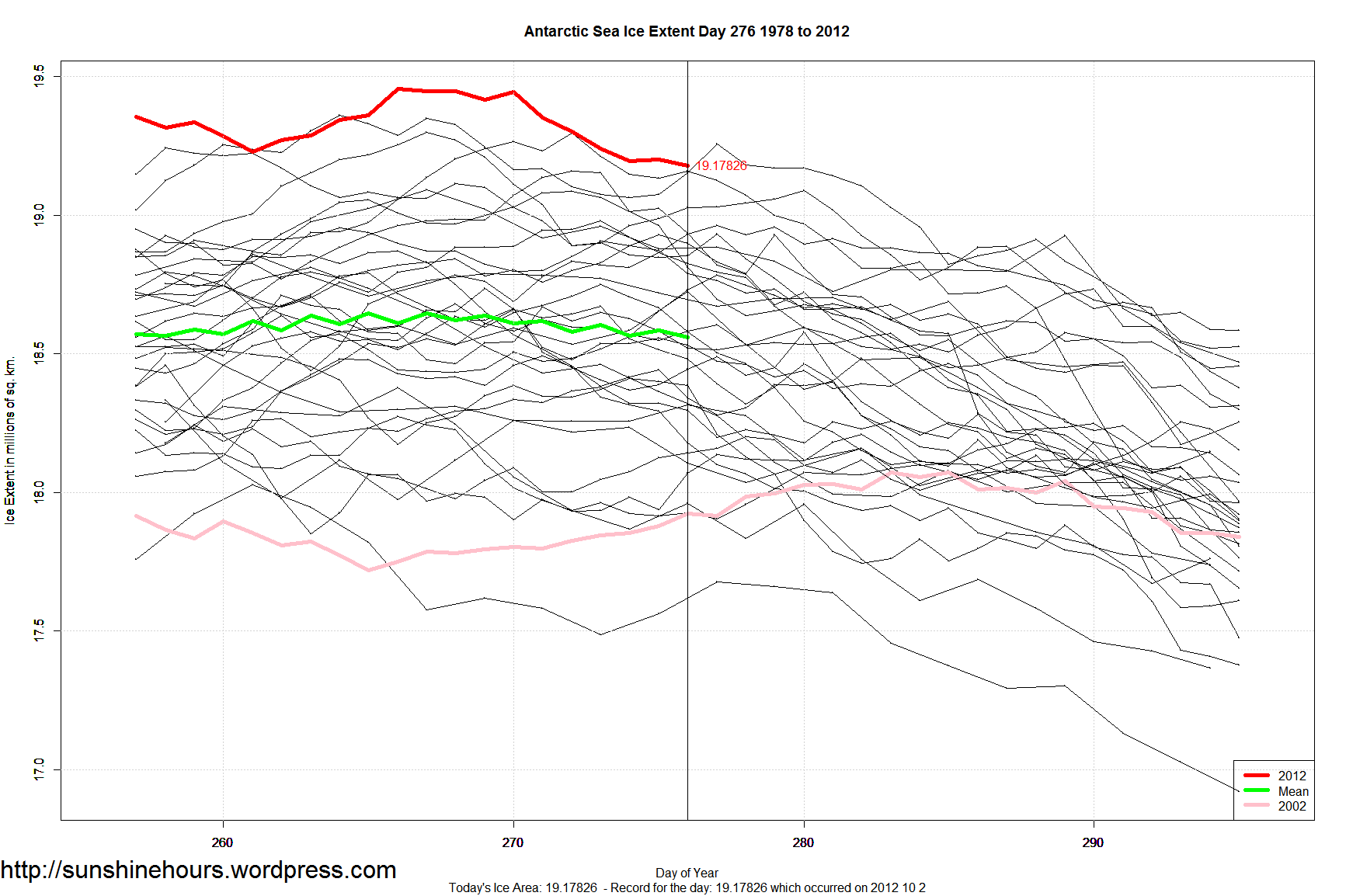
Antarctic Sea Ice Extent set another daily record yesterday (day 276 – 2012 Oct 2.). Sea ice extent was 19.17826 million sq km.
The previous day 276 record was 19.15764 million sq km and occurred on 2005 Oct 3.
This is the 23rd daily record and 12th day in a row that is a record for the day.
A few days I asked the question about the record Antarctic Sea Ice Extent in 2012 “Anyone wonder why NOAA isn’t making a fuss about this?”
One caveat is that I should have said NSIDC instead of NOAA (NOAA does partially fund NSIDC).
Today Justin Gillis took a cheap shot at bloggers (h/t Tom Nelson) and said:
“The National Snow and Ice Data Center uses a five-day moving average to track such matters, and always waits a few days before announcing a minimum or maximum in sea ice at either pole. That is to make sure the low or high point for the year has really been reached, given that sea ice can change abruptly in response to winds and other factors. The five-day averaging also helps smooth out small errors in the satellite tracking data.
.
This longstanding practice has been explained publicly many times, but that has not stopped climate-change contrarians from asserting that the snow and ice center had been trying to hide this year’s record in Antarctica by supposedly failing to make any announcement.”
I checked. The Arctic record was broken on the August 24th and NSIDC waited 3 days to call a news conference for the media on the 27th,
The Antarctic Extent record was broken on September 24th. I wrote about the Antarctic Ice Area coming close to the record on September 24th, but I was 5 days late writing about the Antarctic Ice Extent breaking the record (NSIDC uses Extent and I had not come across the NSIDC data) and did not post until September 29th.
So of course NSIDC held a news conference on September 27th to announce the new record … didn’t they?
No. No news conference.
Obviously there was a media advisory on the 27th. Nope.
If you go the press page for NSIDC you will see that Antarctic Ice Extent record is not mentioned until October 2nd, 2012.

Justin Gillis and the NY Times owes a lot of bloggers an apology.
 sunshine hours