The Recent Heat Wave In Canada

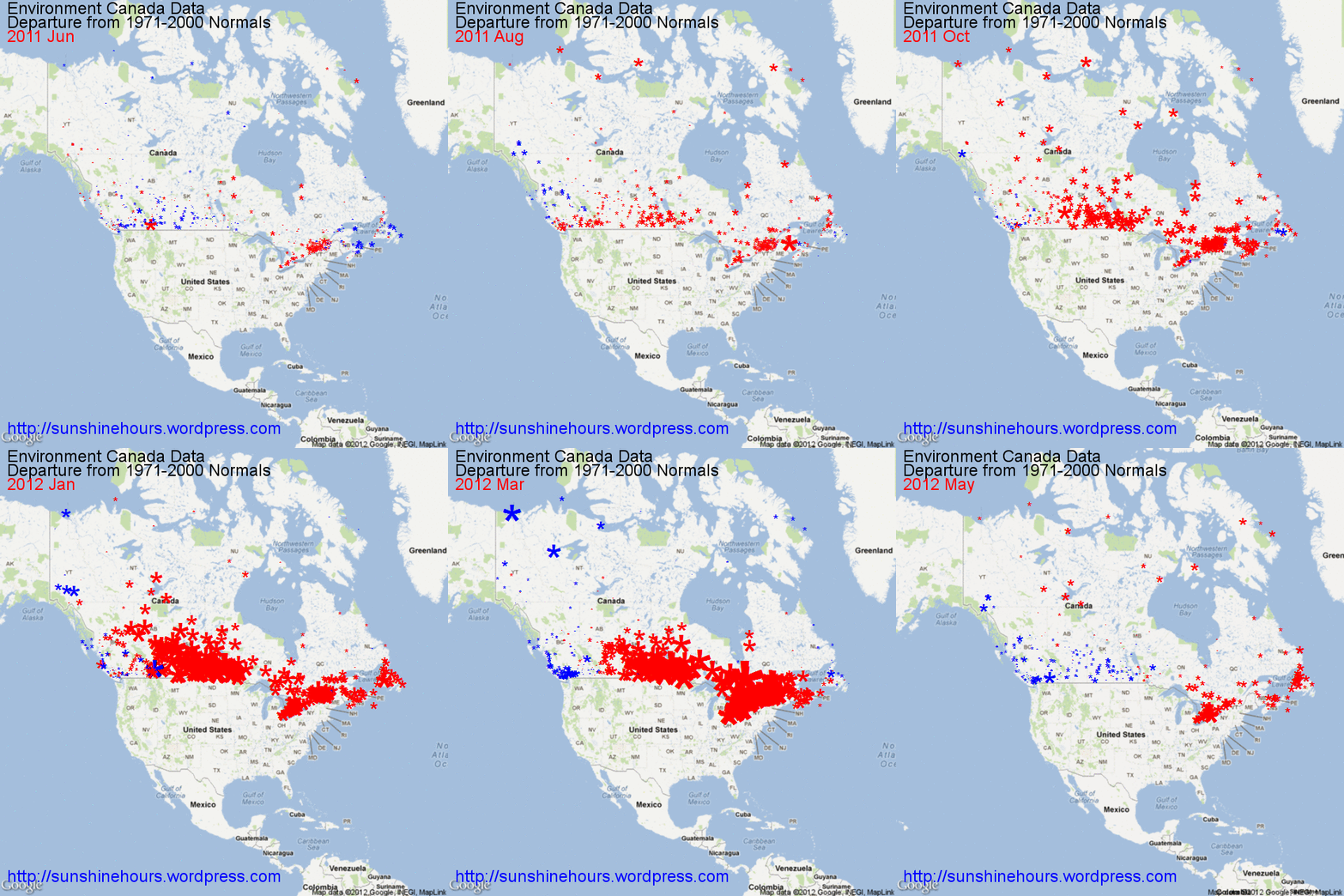
Environment Canada designates some stations with data that is the Departure from Normals 1971-2000.

This animated gif is the subset of stations with “Normals”  mapped. The size of the blue (colder than Normal) or red (warmer than Normal)  is related to the magnitude.

As you can see the recent heat wave that is making headlines is like a red wave that engulfs most of Canada and then retreats back to the north and eastern Canada.

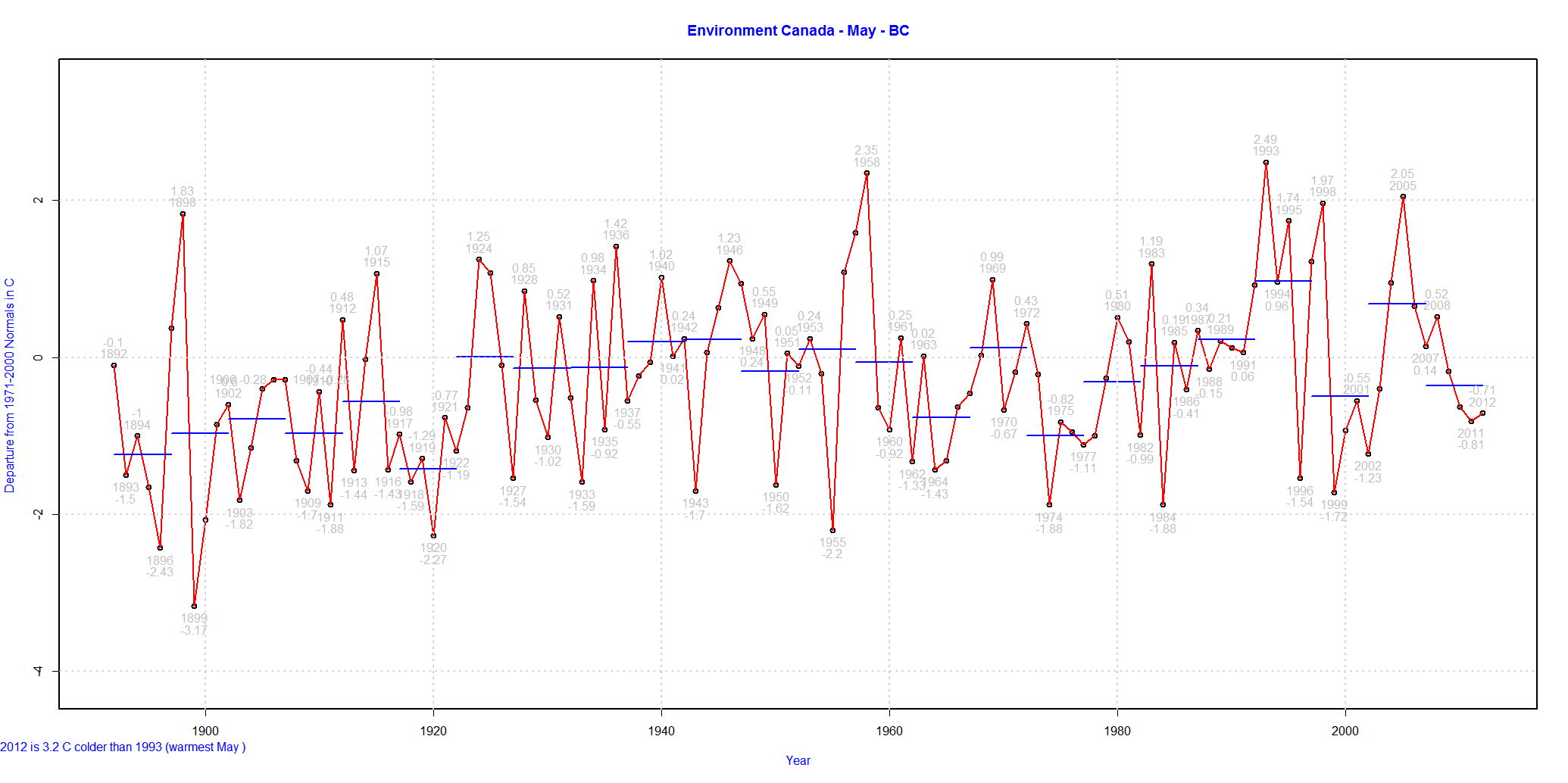
May 2012 in BC Canada was 3.2C colder than the warmest May … 1993.

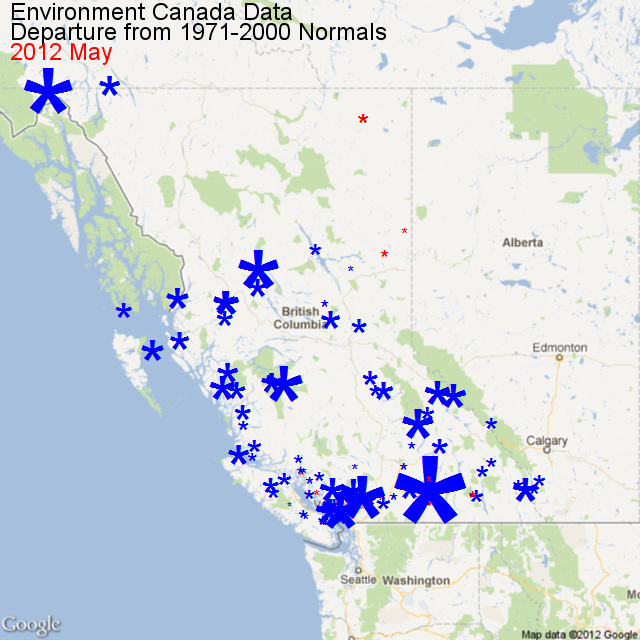
Update: See below for BC map of stations (Blue are the cold ones …) 


The stations are the ones with “Departure from 1971-2000 Normals” data (the D column) from here:

http://climate.weatheroffice.gc.ca/prods_servs/cdn_climate_summary_report_e.html?intMonth=5&intYear=2012&prov=BC&txtFormat=text&btnSubmit=Submit
Environment Canada
Monthly Values for May 2012
Stn_Name                | Lat   | Long    |Prov | Tm  |DwTm| D  | Tx  |DwTx| Tn  |DwTn| S   | DwS|S%N|  P  | DwP|P%N|S_G|Pd |BS |DwBS|BS%| HDD  | CDD  |Stn_No

CHEMAINUS               |48.935 |-123.742 |BC   | 12.7|   0|     | 24.0|   0|  3.5|   0|  0.0|   0|   | 40.4|   0|   |  0|  5|   |    |   | 166.1|   0.5|1011500
LAKE COWICHAN           |48.829 |-124.052 |BC   | 10.4|  15| -1.5| 29.5|  11|  0.0|  10|  0.0|  11|   | 50.2|  11|   |  0| 10|   |    |   | 121.9|   0.0|1012055
DISCOVERY ISLAND        |48.424 |-123.225 |BC   | 11.0|   0|     | 21.1|   0|  5.9|   0|     |    |   |     |    |   |   |   |   |    |   | 216.9|   0.0|1012475


Auditing the latest BEST and EC data for Malahat

Over the last few weeks I’ve been looking at the latest BEST data and sometimes comparing it to data from Environment Canada (EC) I scraped off their website.

To start with I am looking at one station. In BEST it is StationID 7973 – “MALAHAT, BC”.  In EC it is station MALAHAT which is Station_No 1014820.

I am comparing the BEST SV (Single Valued) data to the BEST QC (Quality Controlled) data.  The first  minor problem is that the EC data has records from the 1920s and 1930s that BEST does not have (that I have found). Thats no big deal. The next problem is that out of 166 MOnth/Year records, not one of them matched exactly. BEST SV and QC data is to 3 decimal points while EC is to 1.

For example. Jan 1992 has QC = 5.677, as does SV, while EC = 5.8. Close. But not an exact match.

However, the real problem is that  there are 5 records that have been discarded between SV and QC. Two out of the five make no sense at all, and one is iffy.

Where it says “No Row” it means BEST has discarded the record completely between SV and QC.
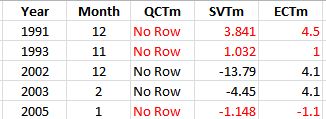
1991 is iffy. EC has it has 4.5, SV has 3.841. Close, but not that close

1993 makes no sense at all.

2002 is fine. Thats a huge error. But where the heck did BEST get the -13.79 number in the first place.

2003 is fine. But again,   where the heck did BEST get the -4.45 number in the first place.

Finally, 2005 makes no sense at all. There is little difference between -1.1 and -1.148. Certainly most records are that different.

And those are just the discarded records!

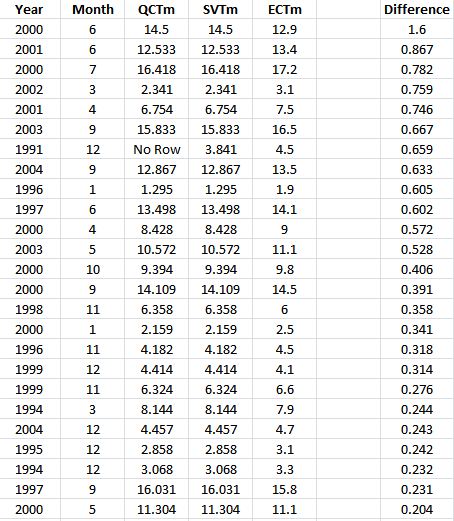
There are another 48 record with a difference of .1C or greater and  here are the greater than .2C ones.
What a mystery. 
Sunshine and Temperature in Alberta and BC Canada

I recently scraped the Environment Canada website for climate data in BC and Alberta. I’ve been learning R and I thought I would graph the mean of the sunshine hours and temperature for each month. Do remember this is only stations with BOTH bright sunshine and temperature records for the month.

In Alberta the number of stations reporting sunshine peaked in the 1980s around 24.

Alberta Stations with Temp + Sunshine July

In BC the number peaked around 64 in 1988.

BC Stations with Temp + Sunshine July