Clear Cut Forests – Burn Trees – Promise to Grow Trees = Lots of CO2

There are biomass power plants being built all over the world because the UN IPCC has promised that if you cut down a tree and burn it in a biomass power plant the CO2 doesn’t really count because someday a tree will be replanted and it will absorb CO2 for 50-100 years.  A new report warns that cutting and burning trees to make electricity may not be that good for the environment after all.

I’ve delved into some of the claims myself and discovered multiple reports that show wood pellets can produce more CO2 than coal because of all the CO2 generated by the drying of the wood into pellets and then the transportation of the pellets.

The biomass industry relies on people confusing the terms green and renewable. Green (in my opinion) means low or zero CO2. Renewable means we won’t run out.

I argue that trees are really neither. Trees are not low CO2 unless you con people. And cutting down trees could be renewable. But isn’t necessarily so.

But the other big con the biomass industry (designed to counter the renewable argument) is that they are only to use dead trees or waste wood. Here is an example of a BC biomass plant:

Another major benefit of having the power plant up and running in Fort St. James is that it will create a home for much of the dead pine that is still sitting in local forests due to the mountain pine beetle epidemic that ravaged many of the forests in northern B.C.

“We’ve had increased harvesting of the forests but we’re going to see that drop off real soon,” says Emily Colombo, economic development officer for the Fort St. James District. “Because the dead wood standing in the forest loses merchantability year after year, it’s only good for harvesting and processing for a number of years. Even though there’s lots of dead wood in the forests, it’s no longer going to be desirable by the sawmill companies. So it’s great to have the Fort St. James green energy project starting up because it gives us a purpose for our waste wood. Until now it’s been burned in the bush… it’s just releasing carbon dioxide into the atmosphere.”


Guess what. They eventually run out of waste wood. And then they start cutting down healthy trees like this biomass plant in Nova Scotia.

About 2,790 hectares. That’s a rough estimate of how much woodland will need to be cut annually to feed Nova Scotia Power’s biomass boiler at Point Tupper.

“It seems that more of the fears are coming true than the benefits we had envisioned from that facility,” said Kari Easthouse, manager of the Cape Breton Private Land Partnership.

Foresters in northern Nova Scotia are warning that the wood being burned at Nova Scotia Power’s new biomass boiler may be green, but the electricity coming out of it isn’t.

The boiler, started by now-defunct NewPage Port Hawkesbury Corp. and sold to Nova Scotia Power, opened during the summer of 2013. Running at peak capacity, which it is a bit shy of now, it burns 670,000 green tonnes of wood fibre annually to produce 60 megawatts of electricity.

They’re going after anything they can get their hands on to feed that thing,” Phil Clark, an Antigonish County sawmill operator, said Thursday.

They’re laying places to waste to feed it.

Nova Scotia Power has an obligation to its ratepayers to get wood fibre as cheaply as possible. The cheapest way is to clear land, not selectively harvest to improve the lot for the future.


Clear cutting forests … to burn for power and and produce lots of CO2.

Not green.

Not renewable.


18 Alberta Coal Power Plants May Be Shut By 2018 – Not 2030

The Alberta NDP has promised to shut down 18 coal power plants by 2030. The problem with this promise it that they  will have also started taxing carbon at 20$ per tonne in 2017 and then 30$ per  tonne in 2018. That may make every coal power plant in Alberta unprofitable by 2018.

Already several power companies have returned some PPA’s back to the government.

On March 7, 2016, TransCanada Corporation announced its plan to exit three Power Purchase Arrangements (PPAs) as a result of changing emissions laws in Alberta, which TransCanada claims have rendered the PPAs unprofitable. The decision will leave the Balancing Pool – a statutory entity created during deregulation in 1999 – in charge of the PPAs associated with the Sundance A, Sundance B and Sheerness coal plants. The announcement follows ENMAX Energy Corporation’s decision earlier this year to exit the Battle River PPA, also claiming that the plant had become unprofitable as a result of changing emissions laws. The Effective Terms of the Sundance B, Sheerness and Battle River PPAs are set to expire at the end of 2020 and the Sundance A PPA expires at the end of 2017. The collective generation capacity of these plants is 2,407 MW (about 15% of Alberta’s total installed generation capacity).

These decisions follow the Alberta Government’s announcement in June 2015 that it will increase the carbon emission reduction (or offset) requirements for industrial emitters from 12% in 2015 to 20% in 2017, in conjunction with an increase to the carbon emissions levy from $15 per tonne in 2015 to $30 in 2017.  The interim increases (15% reduction and $20 levy) took effect at the beginning of this year, at a time when Alberta was (and is) experiencing consistently low electricity prices. The Alberta Government also released an aggressive climate change leadership plan in November 2015, which includes an accelerated phase-out of coal by 2030, with much of the excess capacity to be filled by renewable power (see our prior Osler Update here).

The ENMAX and TransCanada PPA terminations are the first of their kind in Alberta. That fact, along with the significant number of MW affected, demonstrates that the policy and legislative changes imposed by the Notley Government in 2015 are beginning to have tangible impacts on the industry. These termination decisions further suggest that a large portion of Alberta’s electricity supply may no longer be economic to produce. In that case, Alberta could find itself in a situation where much of the coal-fired capacity – which provides a very reliable and stable power source – will be taken offline much sooner than the Government planned. This may have implications for system reliability if these large-capacity plants cannot be replaced with lower emitting alternatives before they go offline. These factors are all likely to play a role in the ongoing negotiations between the Alberta Government and coal plant owners regarding compensation for the premature closure of the affected plants.


Wood Pellets Generate Way More CO2 Than Coal

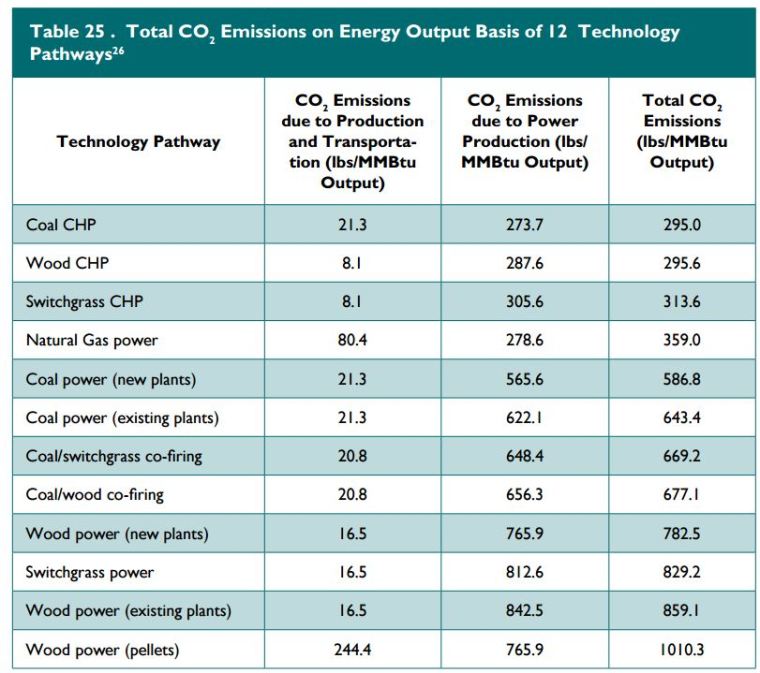
So they did a study called “Biomass Supply and Carbon Accounting for Southeastern Forests”

And they came up numbers for a bunch of technologies and broke out the CO2 emissions for transport and for power production using lbs/MMBtu.

CHP power plants are most efficient. “CHP involves the use of a steam turbine which is designed not only to drive a generator, but also to produce steam or hot water.”

So the top choice would be Coal CHP where the waste water is used in a central district heat type situation.

Next choice would be Natural Gas. Then New coal power plants.

The absolute worst choice is wood pellets because transporting those pellets generates a lo of CO2.

Which is what they are shipping to the UK (and many other places) to burn in DRAX.

CO2emissions

NSIDC: why does the Antarctic sea ice trend resist decline?

One of the stupidest lines ever to come out of the AGW cult

NSIDC news release.

“Antarctic sea ice extent continues to make headlines because it has grown even as much of the globe, and Antarctica itself, is warming. Arctic sea ice, in contrast, is showing a marked decline. Warmer air and ocean waters are bathing both poles, so why does the Antarctic sea ice trend resist decline?

First, Antarctic Sea Ice is NOT resisting decline. Antarctic Sea Ice set records in 2012, 2013 and 2014 for most ice ever. There is no decline! And it is not resisting. It is exuberantly going in the opposite direction!

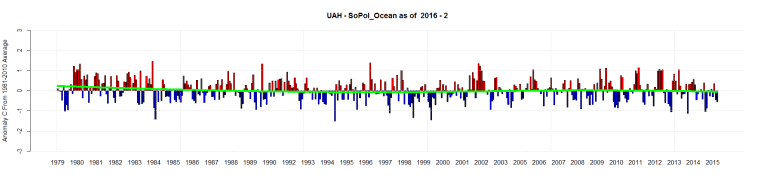
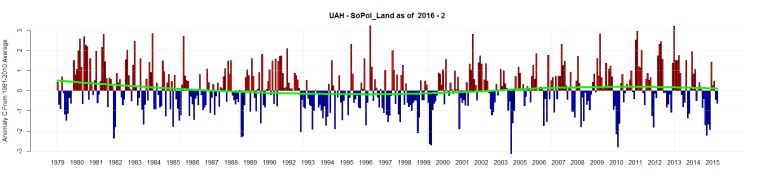
Second, the oceans around Antarctica are not warming. and neither is the actual land according to UAH. Click twice for big versions.

UAH - SoPol_Ocean as of  2016 - 2 UAH - SoPol_Land as of  2016 - 2

They also said:

Despite what some might think, high ice extent in Antarctica does not balance out low ice extent in the Arctic.

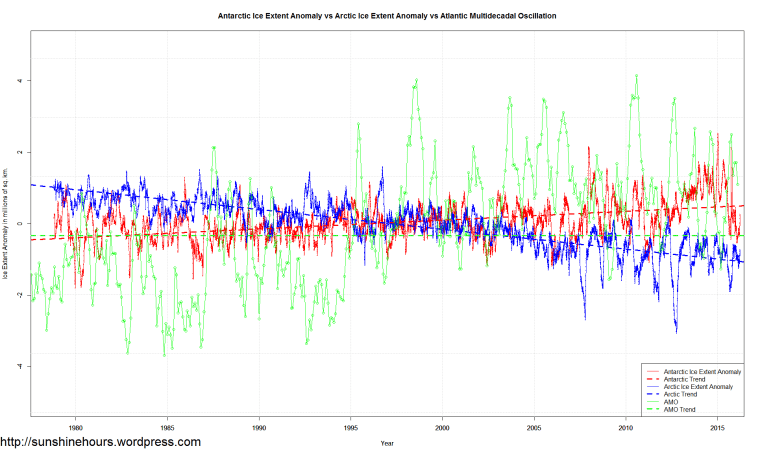
It does if you know what the AMO is.When the AMO is negative arctic ice is high and antarctic low. When the AMO goes positive the opposite occurs.

It is no surprise that the crossover point in the graph below is right when the AMO turned positive (around 1996).

Sea_Ice_Extent_Trends


German Electricity March 7 2016

Lets say its March 7th 2016 9am in Germany and there is about 70GW of demand to keep the country functioning and you are a greenie looking forward to a day when there is no more nuclear or CO2 producing power plants..

Ooops. 0.03GW from solar. 1.09GW from wind. 10.7GW from nuclear.  51.5GW from CO2 producing power plants (gas, coal, biomass, oil)


Capture_March_7_2016_Germany

China’s Smog Clouds May Prevent Global Warming

I’ve posted articles in the past linking the clean air legislation in the west with more sunshine and therefore more warming. Here is a paper arguing the opposite: the lack of clean air in China is cooling the globe.

China is responsible for just 10 per cent of man-made global warming, despite emitting more than one quarter of the world’s greenhouse gases, a new study claims.

The study found sulphate and nitrate aerosols emitted by burning fossil fuels had a cooling effect that offset much of the warming caused by greenhouse gas emissions of carbon dioxide, methane and black carbon.

As a result, while China’s consumption of fossil fuels and its carbon emissions had increased significantly over the past decades, a corresponding increase in aerosol emissions meant its contribution to man-made climate change had remained largely unchanged since the pre-industrial period.

The study was led by Professor Li Bengang at Peking University and published in Nature.

http://www.scmp.com/news/china/policies-politics/article/1929306/chinas-smog-clouds-have-silver-lining-they-may-help

Antarctica GAINING 82 to 112 gigatons of Ice per Year

“According to the new analysis of satellite data, the Antarctic ice sheet showed a net gain of 112 billion tons of ice a year from 1992 to 2001. That net gain slowed   to 82 billion tons of ice per year between 2003 and 2008.”

“Zwally’s team calculated that the mass gain from the thickening of East Antarctica remained steady from 1992 to 2008 at 200 billion tons per year”

The good news is that Antarctica is not currently contributing to sea level rise, but is taking 0.23 millimeters per year away,” Zwally said.


http://www.nasa.gov/feature/goddard/nasa-study-mass-gains-of-antarctic-ice-sheet-greater-than-losses