You can’t be a climate leader and burn trees for electricity

It appears the UK has realized that biomass (imported wood pellets) produces more CO2 than coal.

“Recently, the UK government tightened its carbon intensity requirement for any biomass-burning power plants seeking future support from its Contracts for Difference subsidy program. This was a crucial first step, as my colleague and I described in detail here.

The new emission limit is now set at 29 kg of CO2 equivalent per MWh. This effectively rules out the use of imported wood pellets for electricity production for new UK biomass plants. In justifying the change, the UK government says that “continuing to apply the existing GHG [greenhouse gas] threshold would lead to GHG emissions [for biomass electricity] significantly above the projected UK grid average.”

Translation: burning wood pellets for electricity is bad for the climate and is not part of a credible solution to decarbonizing electricity grids. Coming from the world’s largest importer of biomass, and a country that spent over $1 billion last year alone subsidizing this industry, this is a big deal.

Unfortunately this is not retroactive and DRAX keeps burning massive amountsof imported wood pellets.

Don’t get me wrong. I’m not a big fan of wind/solar. I just think it is a giant con to think wood pellets are “carbon neutral”.
Laughable Claim That Canada Could Run 100% on Wind Water and Sunlight by 2050

There is a good blog post on how laughable it was to suggest that Canada could rely solely on wind, water and sunlight to meet our future energy needs by 2050.

Read it.

I plan to just talk about the number of facilities necessary to do this. The blue # is the necessary count. The red at the end is the # needed to be built by 2050.

  • Onshore wind: 34,993 – 5 MW units ( 2240 units currently installed) – ~33,000
  • Offshore wind: 27,242 – 5 MW units (currently no units in Canada) 27,242
  • Solar PV plant: 1690 – 50 MW facilities (currently 13 similar facilities) 1677
  • Solar CSP plants 450 – 100 MW facilities (currently 1 in operation) 449
  • Solar CSP plants for storage 275 – 100 MW facilities 275
  • Hydroelectric: Uses currently built facilities with efficiency gains
  • Wave energy: 26,227 – 0.75 MW installations (currently no unit in Canada) 26,227
  • Residential rooftop solar: 12,992,080 units (currently <2% of units installed) ~ 12,750,000
  • Commercial/govt rooftop solar: 1,383,183 units (currently <2% of units installed) ~1,360,00
  • Geothermal: 50 – 100 MW facilities (currently no such facility in Canada) 50
  • Tidal turbine: 2000 – 1 MW units (currently no units in Canada) 2000

“Lets look at the offshore wind platforms. As one of the two southern coasts, British Columbia would be responsible for close to half of the 27, 242 offshore units needed to achieve our national 100% WWS goal.  As of today, we have zero offshore wind facilities. “

This is laughable. Canada can’t even build a pipeline to carry oil from Alberta to tidewater in many years.

Imagine the regulatory approval … the lawsuits … the lack of skilled trades.

Its a joke.

But do read the blog post for more info.


Canada: Virtually No Change in July/August Highs Since 1939

Ross McKitrick analyzed Canadian weather records. Summers aren’t any hotter.

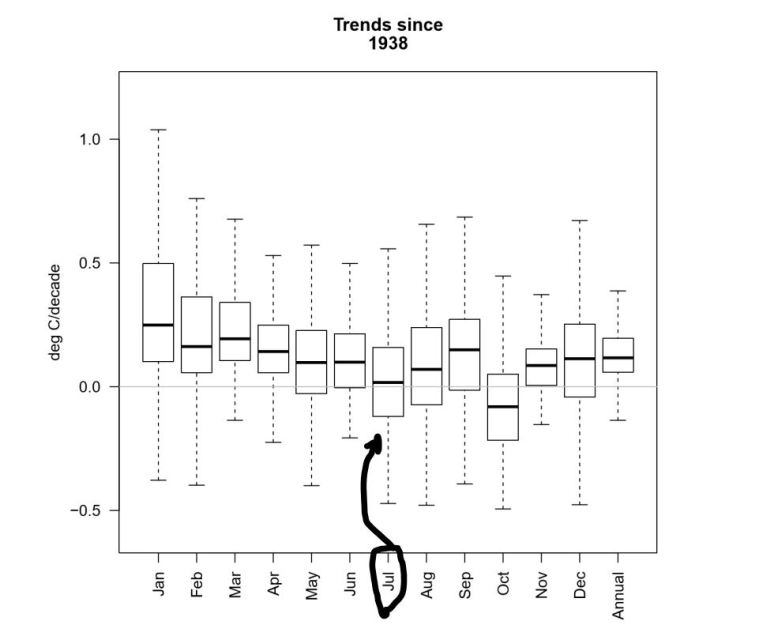
Since 1939 there has been virtually no change in the median July and August daytime highs across Canada, and October has cooled
slightly

If people knew that summers won’t get an hotter and winters would get a little warmer, would anyone mind?


SUMMARY
Here are a few points that you might notice in the graphs and tables that follow.
1. There is a tradeoff between the number of available stations and the length of record. There are 30 stations with data back to 1888
and 267 stations with data back to 1978.
2. Over the past 130 years the median warming rate in the average daytime high is about 0.1 degrees per decade or 1 degree per
century.
3. Over long samples there is little polar amplification (increased warming with latitude) but it does appear in fall and winter months
in more recent subsamples.
4. Over the past 100 years, warming has been stronger in winter than summer or fall. October has cooled slightly. The Annual
average daytime high has increased by about 0.1 degrees per decade. 72 percent of stations did not exhibit statistically significant
warming or cooling.
5. Since 1939 there has been virtually no change in the median July and August daytime highs across Canada, and October has cooled
slightly.
6. There are 247 stations with data back to 1958. However as the time span decreases the range of observed trends greatly expands.
All months exhibit median warming but with much wider variability.
7. Post-1958 Arctic coverage is much better than earlier. There is little indication of polar amplification.
8. Post-1978 the range of trends grows dramatically. The median trend in March and April is slightly negative.
9. Some polar amplification is observed in the post-1978 annual trend, mainly due to the late fall and early winter months.