According to the NOAA May 2017 Tmax was ranked 70th out of 123 May’s (123 = warmest , 1 = coldest) .
It was only .31F above the 1901-2000 average.
The top 2 were 1934 and 1936. 1934 was 6.29F above the mean.
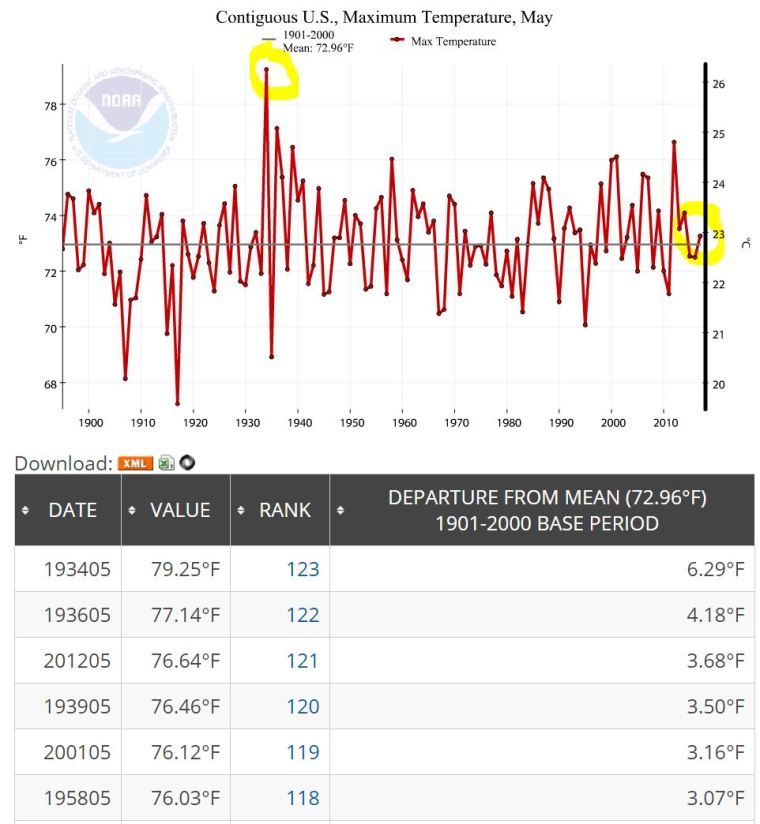
According to the NOAA May 2017 Tmax was ranked 70th out of 123 May’s (123 = warmest , 1 = coldest) .
It was only .31F above the 1901-2000 average.
The top 2 were 1934 and 1936. 1934 was 6.29F above the mean.
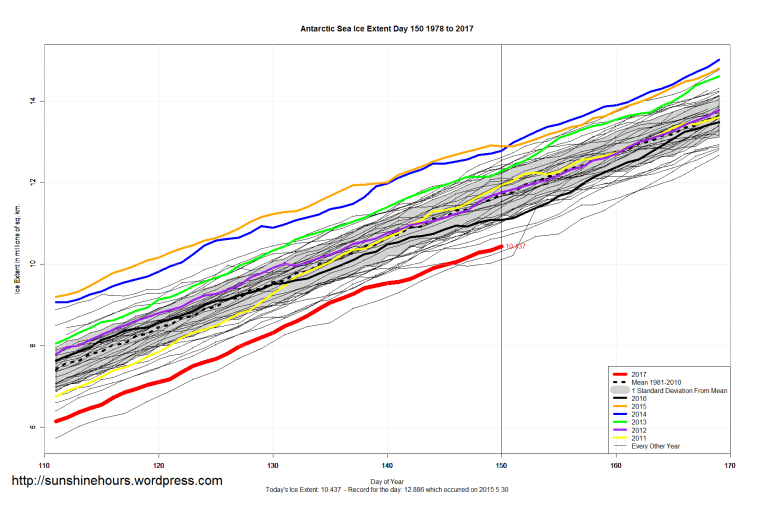
I was reading this article on the Larsen Ice Shelf rift.
I came to this paragraph:
“The team say they have no evidence to link the growth of this rift, and the eventual calving, to climate change. However, it is widely accepted that warming ocean and atmospheric temperatures have been a factor in earlier disintegrations of ice shelves elsewhere on the Antarctic Peninsula, most notably Larsen A (1995) and Larsen B (2002).
They point out that this is one of the fastest warming places on Earth, a feature which will certainly not have hindered the development of the rift in Larsen C.”
And suddenly I remember this article.
The Antarctic Peninsula (AP) is often described as a region with one of the largest warming trends on Earth since the 1950s, based on the temperature trend of 0.54 °C/decade during 1951–2011 recorded at Faraday/Vernadsky station. Accordingly, most works describing the evolution of the natural systems in the AP region cite this extreme trend as the underlying cause of their observed changes. However, a recent analysis (Turner et al., 2016) has shown that the regionally stacked temperature record for the last three decades has shifted from a warming trend of 0.32 °C/decade during 1979–1997 to a cooling trend of − 0.47 °C/decade during 1999–2014.
It is not warming in the Antarctic Peninsula! It is cooling!

 sunshine hours