


Fuel Efficient GDI Engines Are Dirtier
Oh no … what a surprise …
Researchers at the University of Toronto’s Faculty of Applied Science & Engineering looked at the emissions from gasoline direct injection (GDI) engines, which are smaller and more efficient than traditional petrol engines.
Car manufacturers have adopted GDI engines in models to satisfy demand for more miles per gallon, and increased power output. According to the team, the number of GDI engines found in new cars between 2009 and 2015 has jumped to from five per cent to 46 per cent.
But their analysis revealed while carbon dioxide emissions were lower in GDI engines, they pumped out more soot and harmful organic compounds such as benzene and toluene.
‘The whole motivation for creating these engines in the first place was fuel efficiency. But what we haven’t considered are the other climate-related emissions,’ explained Professor Greg Evans, an engineer and applied chemist at Toronto.
‘If a vehicle emits a small amount of soot, it can completely negate the lower amount of CO2 that it’s emitting.‘
Sea Ice Extent (Global Antarctic and Arctic) – Day 194 – 2016

Biomass is a Filthy Con
You know … I don’t agree with Henry A Waxman on much. At all in fact until I read this. But I do on part of this recent article.
And I don’t agree with Waxman that there is urgency on CO2 or climate change.
I only obliquely agree with him because the hypocrisy of a “green” that hates clean natural gas while supporting biomass burning is breathtaking.
Anyway … here is what he has to say:
… the House bill includes a little-known provision that would altogether ignore the carbon pollution emitted by burning biomass—trees and other wood products—to generate power.
Logging companies claim that biomass burned for power is “carbon neutral” – thus, not yielding a net pollution increase. They claim that growing new trees absorbs enough carbon pollution to offset the emissions created by burning mature trees. In effect, they assert that wood power is as clean as solar or wind electricity. This is simply not true. The reality is that burning biomass to generate electricity can produce more carbon pollution than it saves by replacing coal.
This biomass loophole would increase carbon pollution at a time when it is imperative that we reduce it. New trees require up to a century of growth to absorb enough carbon dioxide to offset pollution from mature tree combustion. Worse, there is no guarantee that replacement trees planted today to offset the pollution will survive that long. And even if the new trees eventually offset this pollution after a century, climate change is happening now. We can’t wait.
Notice the BS he is trying to peddle that only “logging companies” want biomass. Almost every greenie wants biomass. There is tremendous amounts of money involved in biomass and biomass subsidies.
Governments around the world are exempting the CO2 and pollution biomass is producing. Its a giant con. As is most of the subsidy farming and green anti-CO2 hysteria.
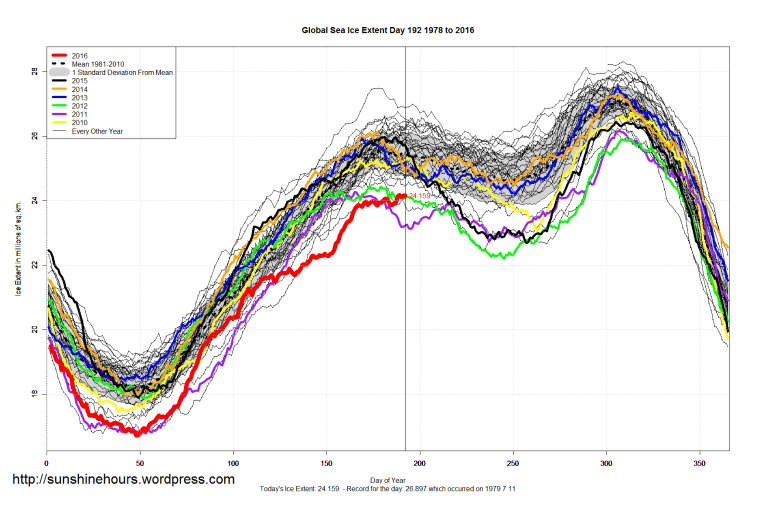
Sea Ice Extent (Global Antarctic and Arctic) – Day 192 – 2016


UK Winter Blackouts Possible – Only 0.1% Spare Capacity
The UK is in a bad way for this coming winters electricity supplies.
Britain may have to rely on costly emergency measures to keep the lights on this winter after spare capacity in the power market fell to the lowest level on record.
Power stations operating under normal market conditions will produce barely enough electricity to meet peak demand following a series of coal plant closures, National Grid analysis shows.
The “spare margin” between peak electricity demand and the supplies likely to be available in the market has fallen to just 0.1pc, the lowest on record.
As a result, National Grid has been forced to intervene and bolster supplies by paying 10 power plants £123m to stay open through an emergency scheme, the costs of which will be passed on to consumers through their energy bills.
It will then make additional payments to these back-up power plants to fire up, if they are needed as a “last resort” to prevent blackouts. These costs, which could easily run to tens of millions of pounds in a cold snap, will also be passed on to consumers.
The emergency scheme will bring the UK’s overall spare power margin up to 5.5pc, a “manageable” level to keep the lights on, the company said.
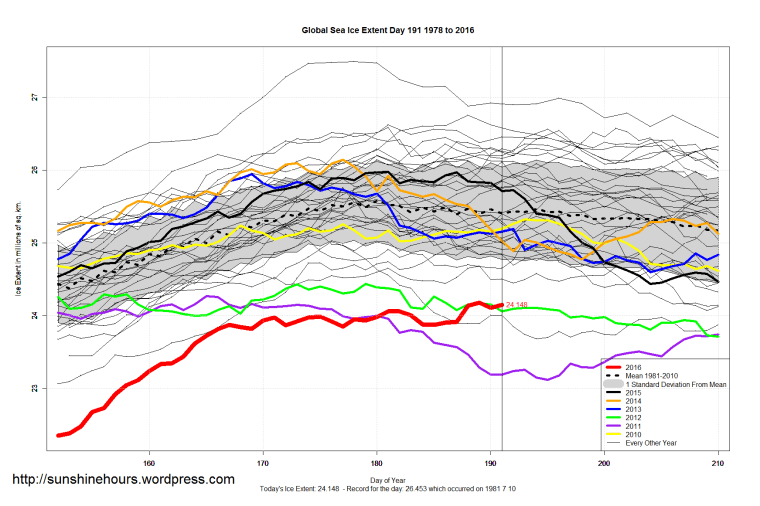
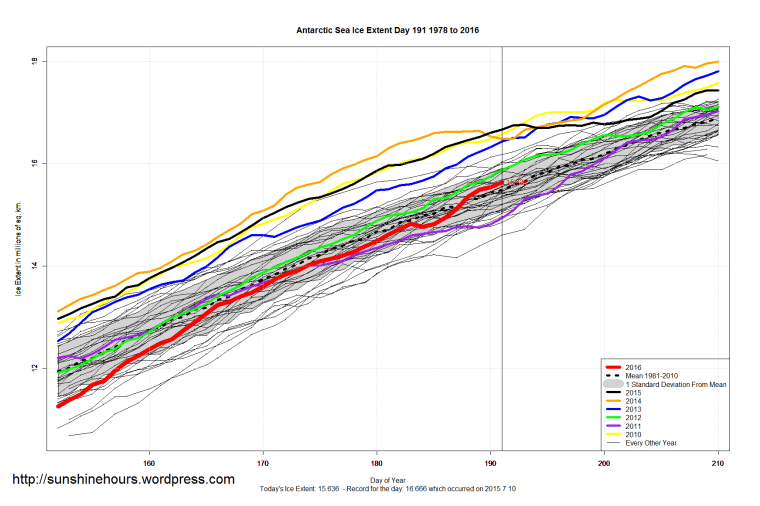
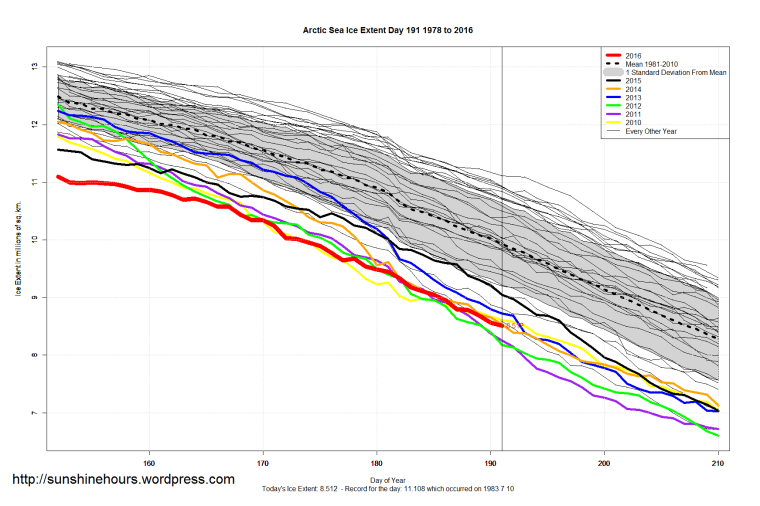
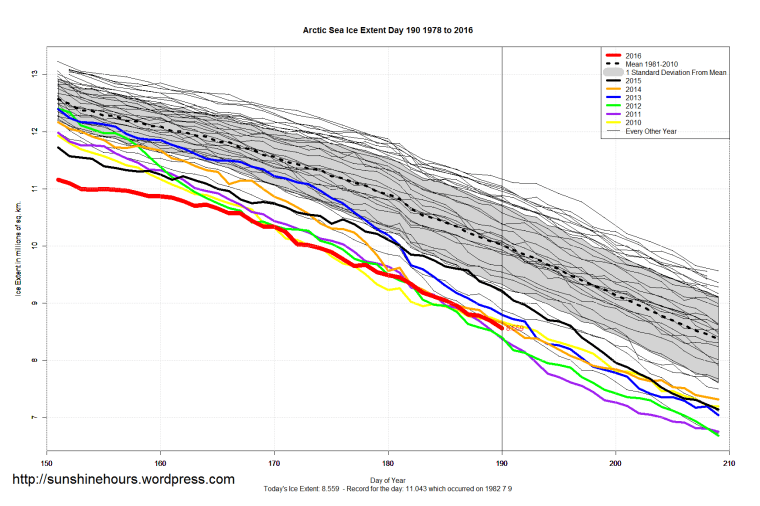
Sea Ice Extent (Global Antarctic and Arctic) – Day 191 – 2016
USA NOAA June 2016 Tmin versus Tmax – UHI?
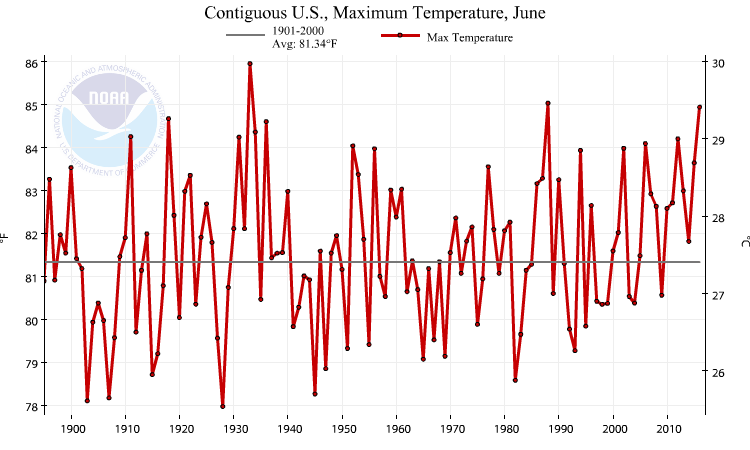
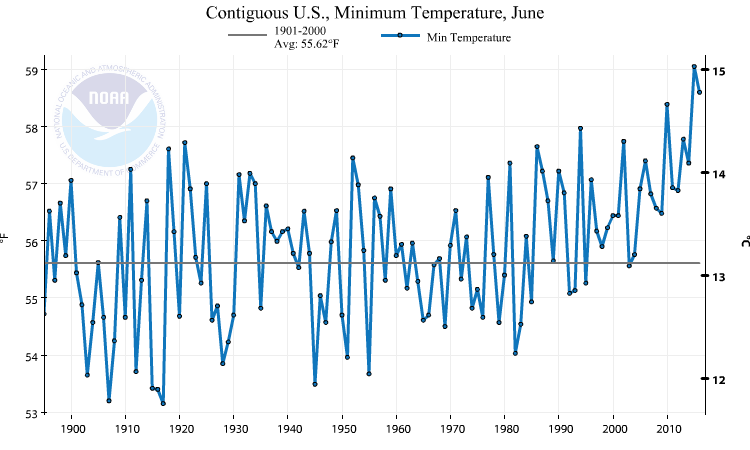
NOAA just put out the USA temperature for June 2016.
Lets compare Tmin (minimum) versus Tmax (maximum)
Wow. Tmin has been skyrocketing since 1980. Tmax has just gone up and down.
I suggest UHI (Urban Heat Islands) not “Global Warming”.
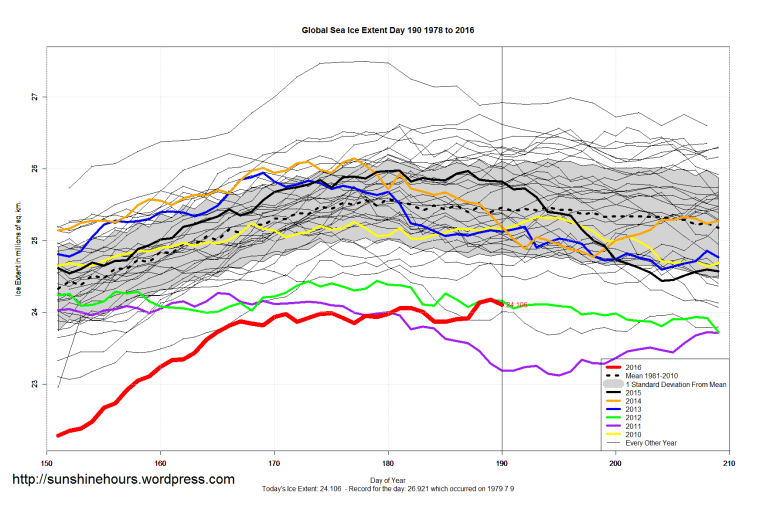
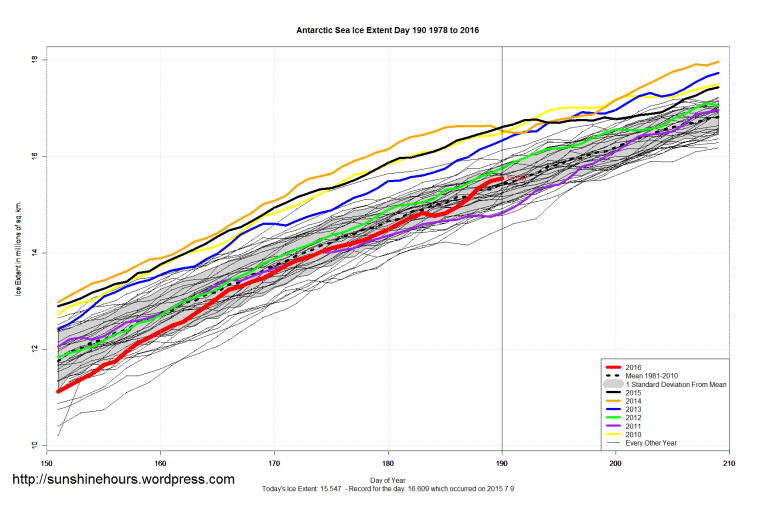
Sea Ice Extent (Global Antarctic and Arctic) – Day 190 – 2016
Fracking Retractions
Fracking is evil says a ‘scientific’ study… oh wait. The conclusions have been reversed. And the paper retracted. Read more here.
The authors of two environmental papers, including one about the effects of fracking on human health, have retracted them after discovering crucial mistakes.
One of the studies reported an increased level of air pollution near gas extraction sites, and the other suggested that 2010’s Deepwater Horizon oil spill in the Gulf of Mexico contributed to air contamination.
According to the corresponding author of both papers, Kim Anderson at Oregon State University, the journal plans to publish new versions of both papers in the next few days. In the case of the fracking paper, the conclusions have been reversed — the original paper stated pollution levels exceeded limits set by the U.S. Environmental Protection Agency (EPA) for lifetime cancer risk, but the corrected data set the risks below EPA levels.
The fracking paper received some media attention when it was released, as it tapped into long-standing concerns about the environmental dangers of hydraulic fracturing (fracking), which extracts natural gas from the earth. A press release that accompanied the paper quoted Anderson as warning:
Air pollution from fracking operations may pose an under-recognized health hazard to people living near them.
Both papers, published in Environmental Science and Technology, were retracted on the same day (June 29), both due to mistakes in reported levels of polycyclic aromatic hydrocarbons (PAHs), pollutants released from burning oil, gas, and other organic matter.
 sunshine hours