Trees Can Seed Clouds!

This discovery is huge. Trees can seed clouds.

Molecules released by trees can seed clouds, two experiments have revealed. The findings, published on 25 May in Nature1, 2 and Science3, run contrary to an assumption that the pollutant sulphuric acid is required for a certain type of cloud formation — and suggest that climate predictions may have underestimated the role that clouds had in shaping the pre-industrial climate.

If the results of the experiments hold up, predictions of future climate change should take them into account, says Reto Knutti, a climate modeller at the Swiss Federal Institute of Technology (ETH Zurich). For 20 or more years, clouds have been the largest source of uncertainty in understanding how manmade emissions affect the atmosphere, he says.

In addition to releasing carbon dioxide, burning fossil fuels indirectly produces sulphuric acid, which is known to seed clouds. So, climate scientists have assumed that since pre-industrial times, there has been a large increase in cloud cover, which is thought to have an overall cooling effect by reflecting sunlight back into space. And they have assumed that this overall cooling effect has partially masked the climate’s underlying sensitivity to rising carbon dioxide levels. The latest experiments suggest that it may have been cloudier in pre-industrial times than previously thought.

If this is so, then the masking effect, and in turn the warming effects of carbon dioxide, might have been overestimated, says Jasper Kirkby, a physicist at the CERN, Europe’s particle-physics laboratory near Geneva, Switzerland, who led one of the experiments.
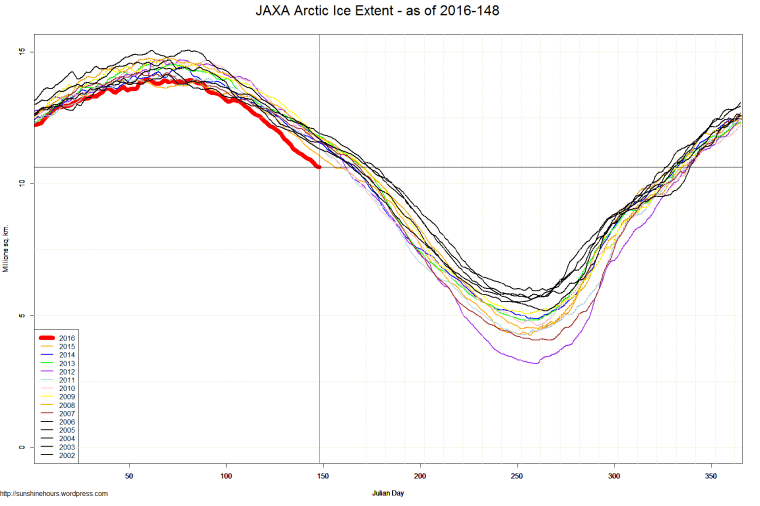
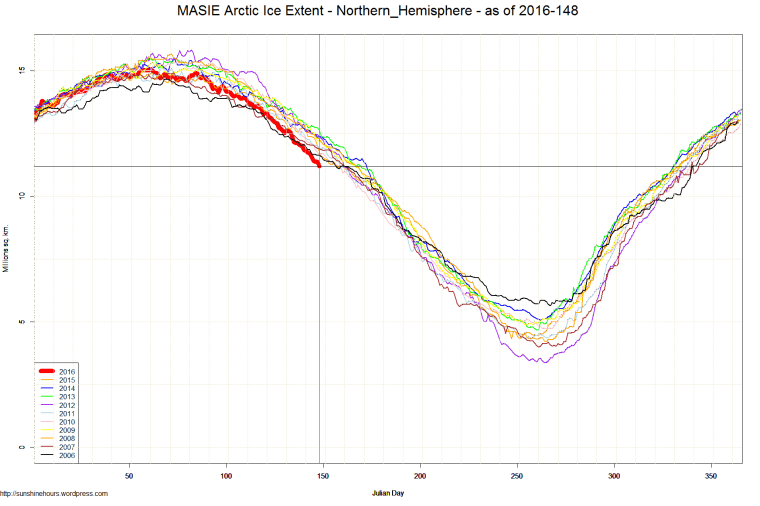
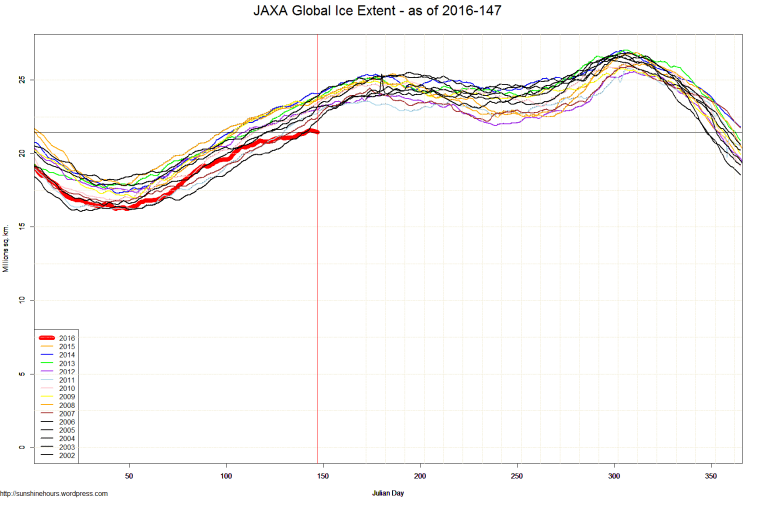
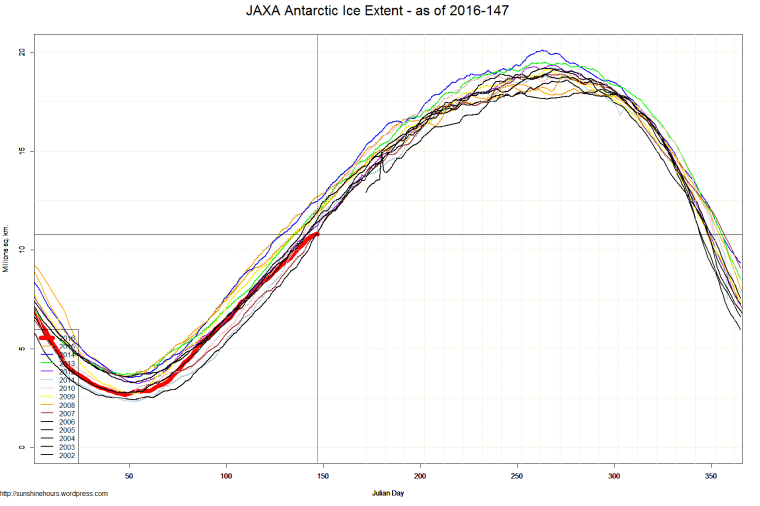
JAXA/MASIE Sea Ice Extent (Antarctic and Arctic and Global) – Day 148 – 2016

JAXA sea ice extent data from Japanese Aerospace Exploration Agency.

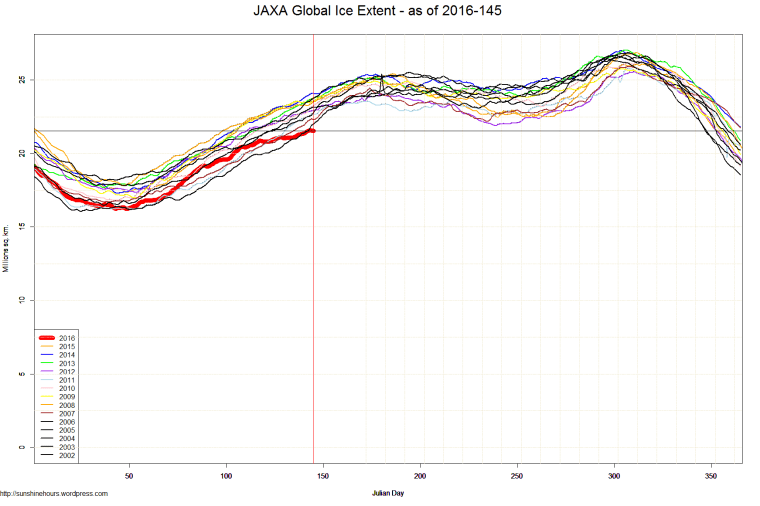
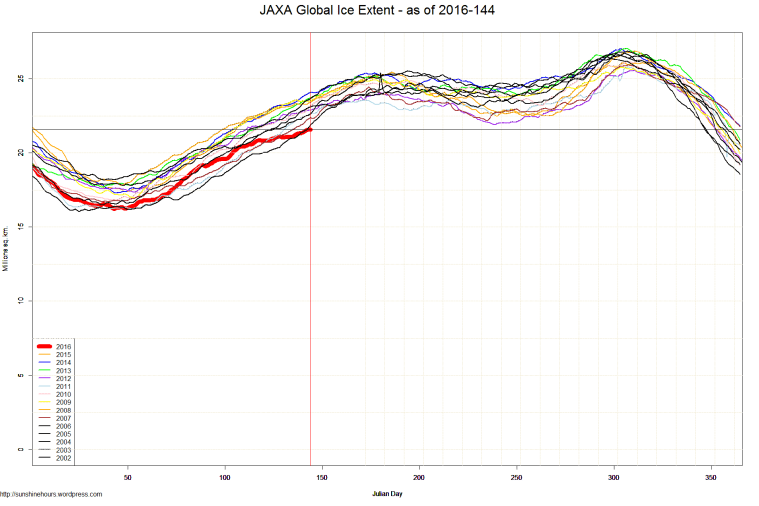
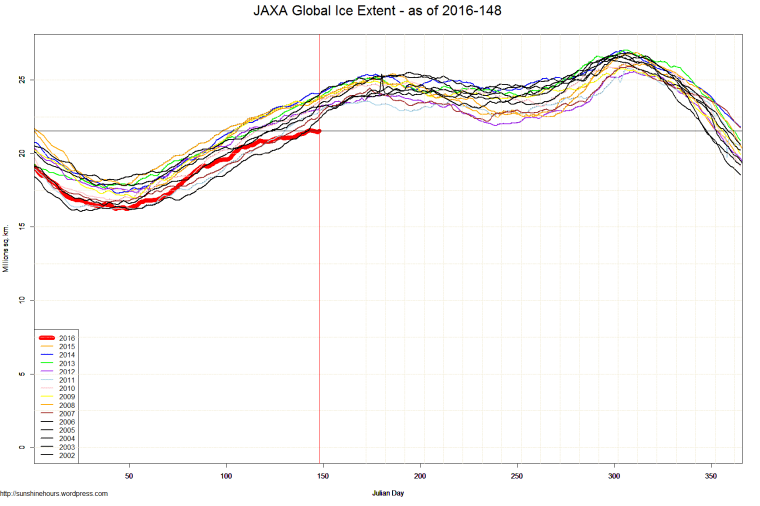
JAXA Global Ice Extent - as of 2016-148

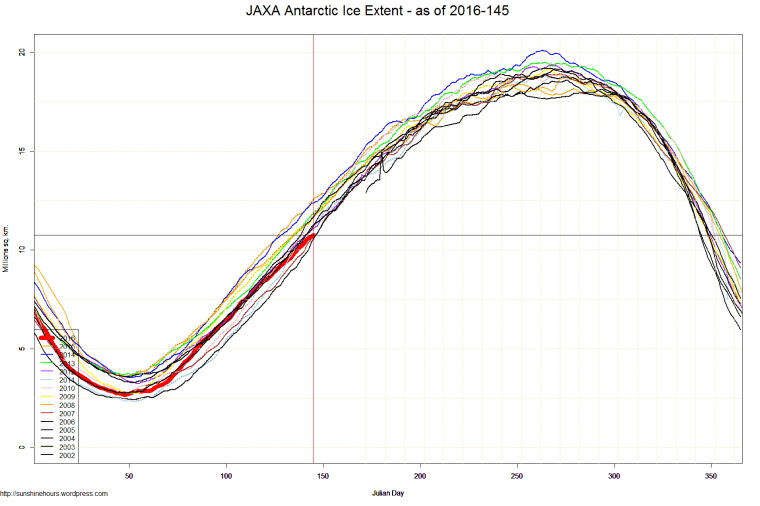
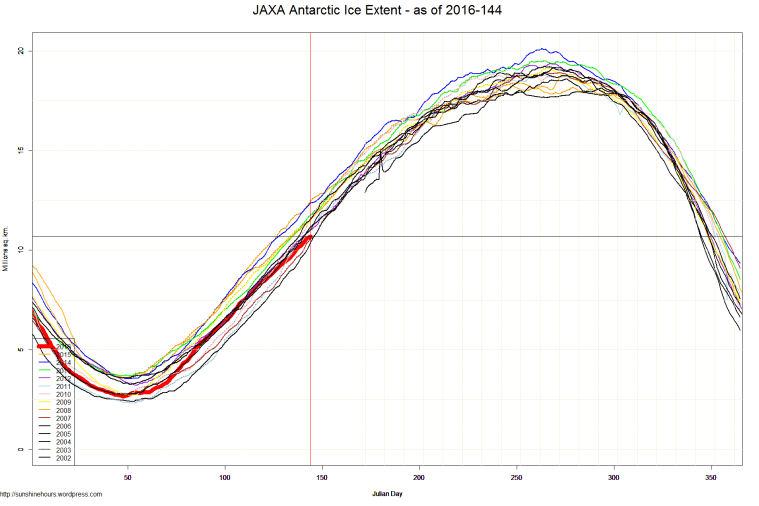
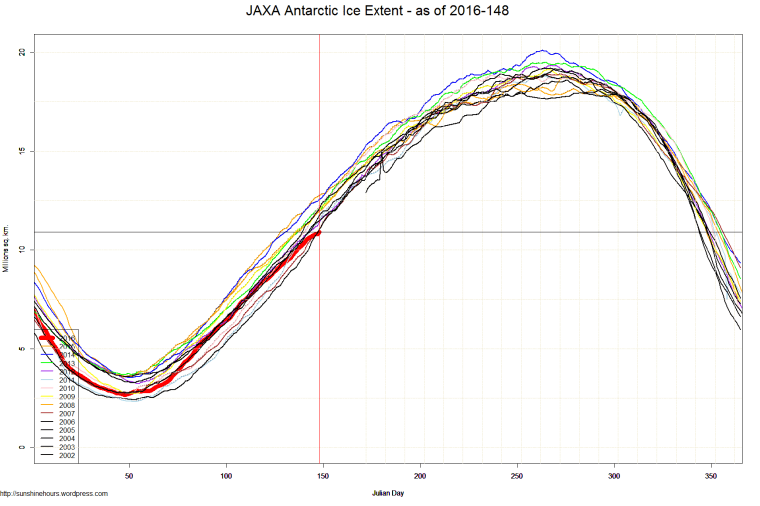
JAXA Antarctic Ice Extent - as of 2016-148

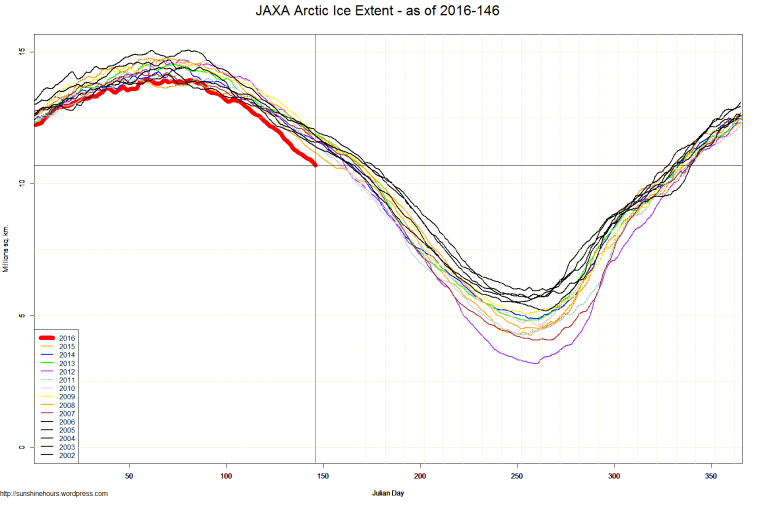
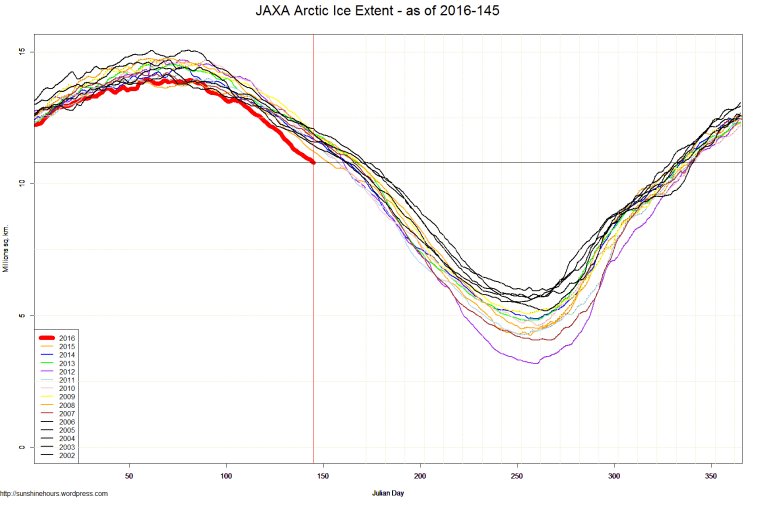
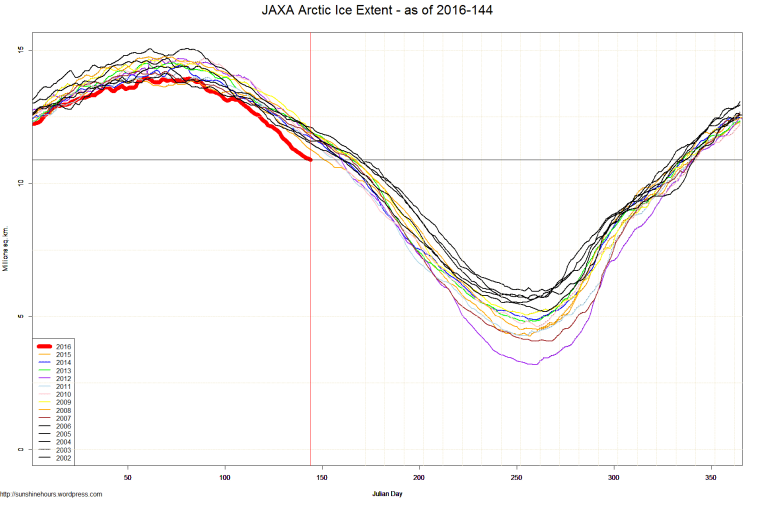
JAXA Arctic Ice Extent - as of 2016-148

MASIE Arctic:


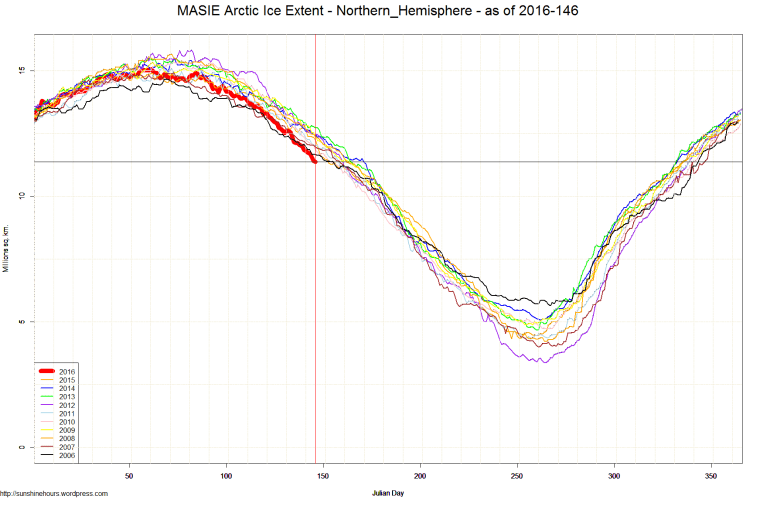
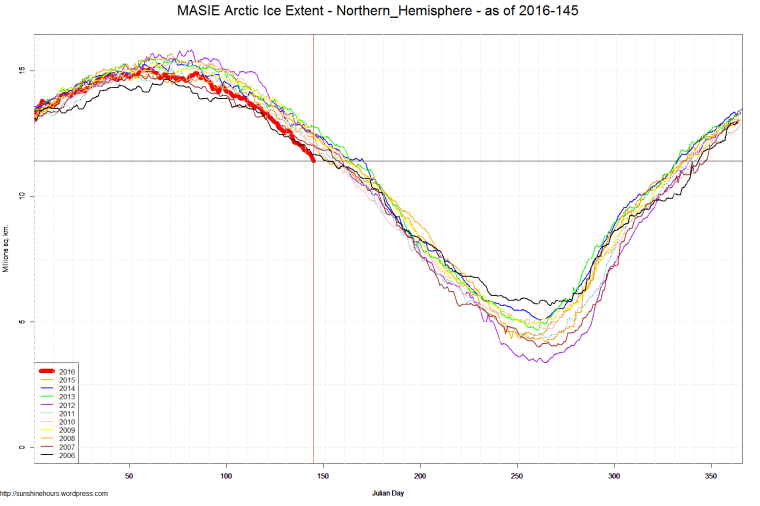
MASIE Arctic Ice Extent - Northern_Hemisphere - as of 2016-148

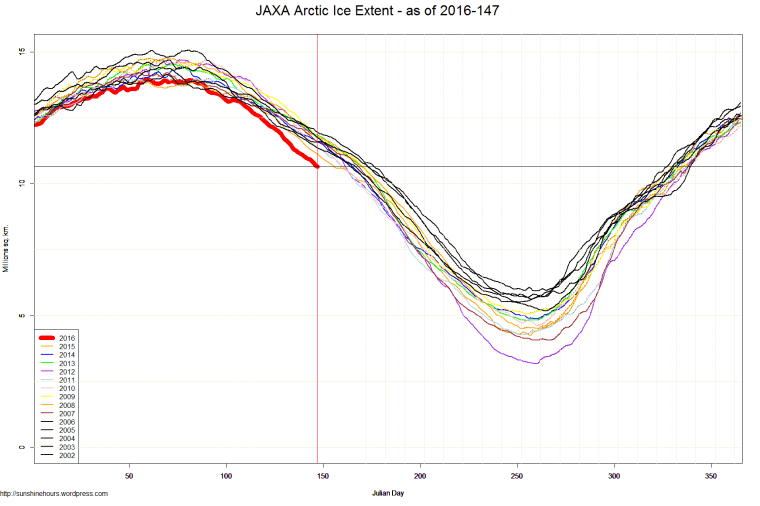
JAXA/MASIE Sea Ice Extent (Antarctic and Arctic and Global) – Day 147 – 2016

JAXA sea ice extent data from Japanese Aerospace Exploration Agency.

JAXA Global Ice Extent - as of 2016-147

JAXA Antarctic Ice Extent - as of 2016-147

JAXA Arctic Ice Extent - as of 2016-147


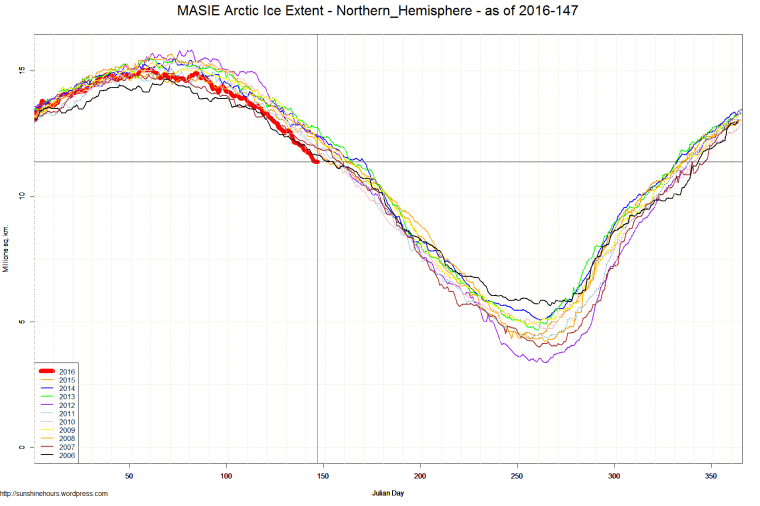
MASIE shows a very low Arctic as well. But not as low as JAXA.

MASIE Arctic Ice Extent - Northern_Hemisphere - as of 2016-147

Joke of the Day : Galactic Warming

I think this is a joke. Or a plea for more grant money.

Astronomers are warning that galaxies across the Universe are being destroyed by “galactic warming” – and ours COULD be next.

The scientists behind a new study claim that, over the last few billion years, many galaxies have been turned into barren deserts unable to harbour life.

Experts at the Sloan Digital Sky Survey believe that they have discovered a new kind of supermassive black hole which they have called “red geysers”.

The new discovery can make galaxies too hot and energetic to form stars – and form an unstable and destructive atmosphere for planets and stars already there.

Black hole swallowing Earth

JAXA/MASIE Sea Ice Extent (Antarctic and Arctic and Global) – Day 145 – 2016

JAXA sea ice extent data from Japanese Aerospace Exploration Agency.

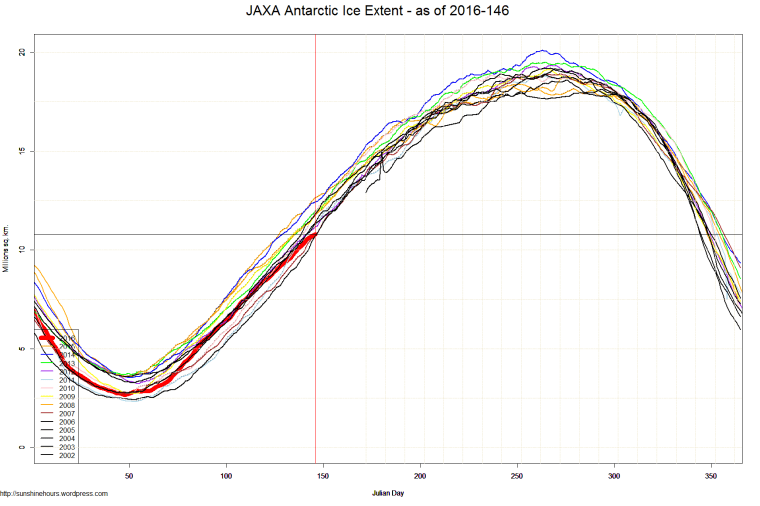
JAXA Antarctic Ice Extent - as of 2016-146

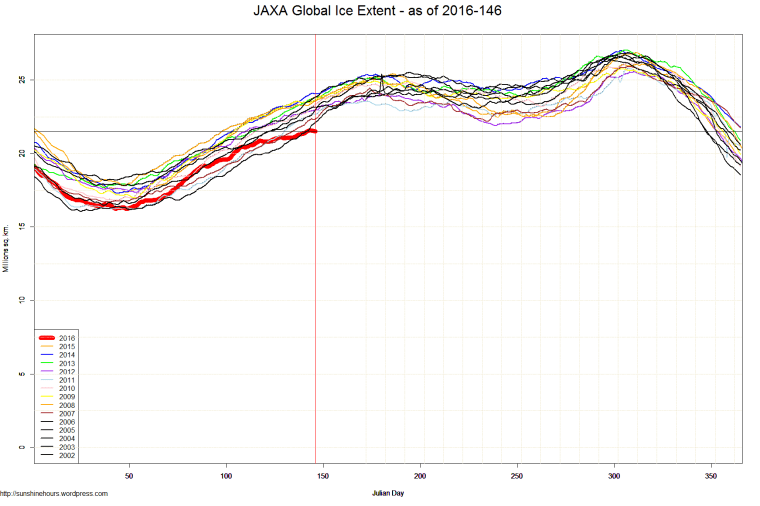
JAXA Global Ice Extent - as of 2016-146

JAXA Arctic Ice Extent - as of 2016-146

MASIE shows a very low Arctic as well. But not as low as JAXA.
MASIE Arctic Ice Extent - Northern_Hemisphere - as of 2016-146


JAXA/MASIE Sea Ice Extent (Antarctic and Arctic and Global) – Day 145 – 2016

JAXA sea ice extent data from Japanese Aerospace Exploration Agency.

JAXA Global Ice Extent - as of 2016-145

JAXA Antarctic Ice Extent - as of 2016-145

JAXA Arctic Ice Extent - as of 2016-145

MASIE shows a very low Arctic as well. But not as low as JAXA.

MASIE Arctic Ice Extent - Northern_Hemisphere - as of 2016-145


More Plant Life = More CO2

Lets parse a couple of statements from this article:

April’s carbon dioxide level of 407.42 was a record 2.59 ppm rise from March.

More plant life caused by warmer weather caused by El Nino. OK.

Carbon dioxide levels are cyclical, peaking in May and then dropping until fall.

OK. More vegetation in the Northern Hemisphere (which has more land mass) dominates the annual cycle.

That’s on top of a steady 2.5 to 3 ppm yearly increase from the burning of fossil fuels, which means each year the world sets new record for levels of heat-trapping gas in the air.

Wait!

What if more vegetation = more plant life which means more CO2?

How much of that 2.5 to 3 ppm is more plant life?


AGW Plan: Plunging into Poverty, Destitution or Starvation

The AGW Cult has a plan.

In his peer-reviewed article, Lessons from technology development for energy and sustainability, Kelly considers the lessons from global decarbonization projects, and concludes that all combined actions to reduce carbon emissions so far will not achieve a serious reduction. In some cases, these efforts will actually make matters worse.

Central to his thesis, which is supported by examples, is that rapid decarbonization will simply not be possible without a significant reduction in standards of living. The growing call to decarbonize the global economy by 80% by 2050 could only foreseeably happen alongside large parts of the population plunging into poverty, destitution or starvation, as low-carbon energy sources do not produce enough energy to sustain society. According to Kelly, “It is clear to me that every further step along the current pathway of deploying first-generation renewable energy is locking in immature and uneconomic systems at net loss to the world standard of living.”

As Kelly notes, it has been 40 years since the modern renewable energy developments began, and yet the fraction of world energy supplied by renewables (wind, solar and cultivated biomass sources combined) has hardly increased. The BP Statistical Review of World Energy 2015 reports 3 % for wind, solar and cultivated biomass sources combined, for 2014.

Kelly’s argument is that weaning off fossil fuels will take much longer than postulated by some experts. He suggests that a more viable option is to employ another generation of fossil fuels—during which economic conditions of humankind can be improved and alternate solutions can be explored and developed.


JAXA/MASIE Sea Ice Extent (Antarctic and Arctic and Global) – Day 144 – 2016

JAXA sea ice extent data from Japanese Aerospace Exploration Agency.

JAXA Global Ice Extent - as of 2016-144

JAXA Antarctic Ice Extent - as of 2016-144

JAXA Arctic Ice Extent - as of 2016-144


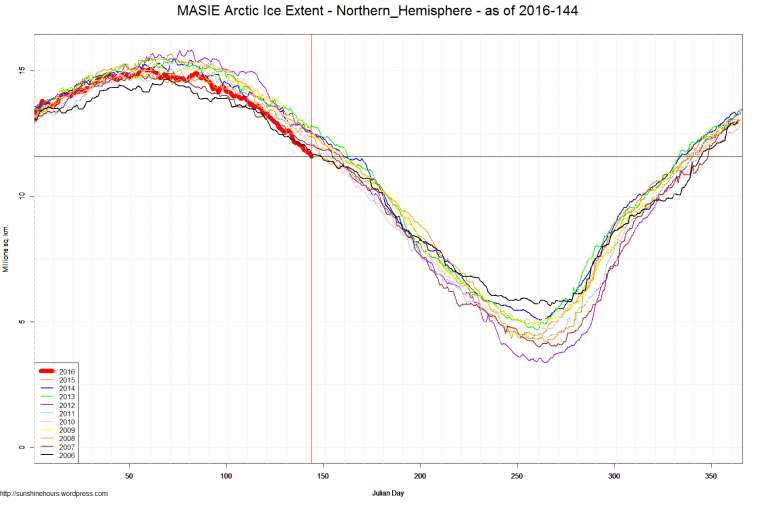
MASIE shows a very low Arctic as well. But not as low as JAXA.


MASIE Arctic Ice Extent - Northern_Hemisphere - as of 2016-144