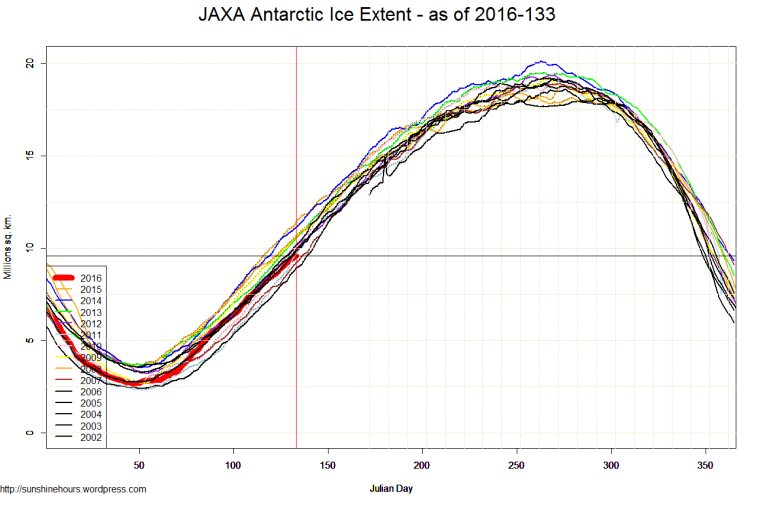
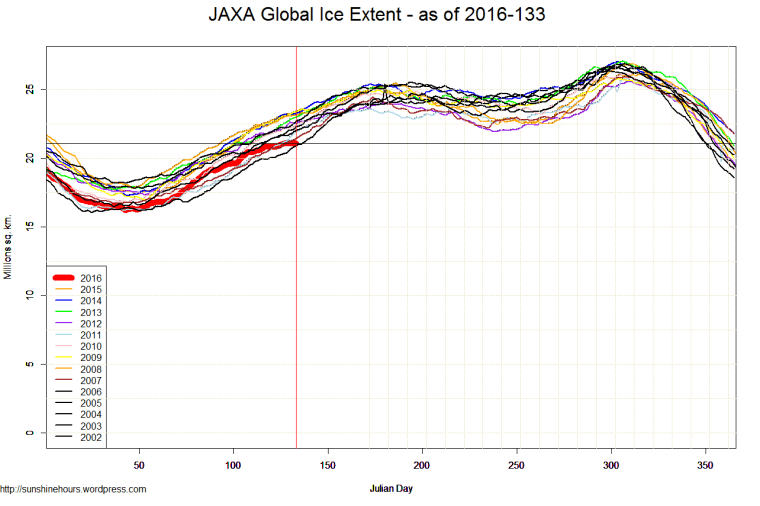
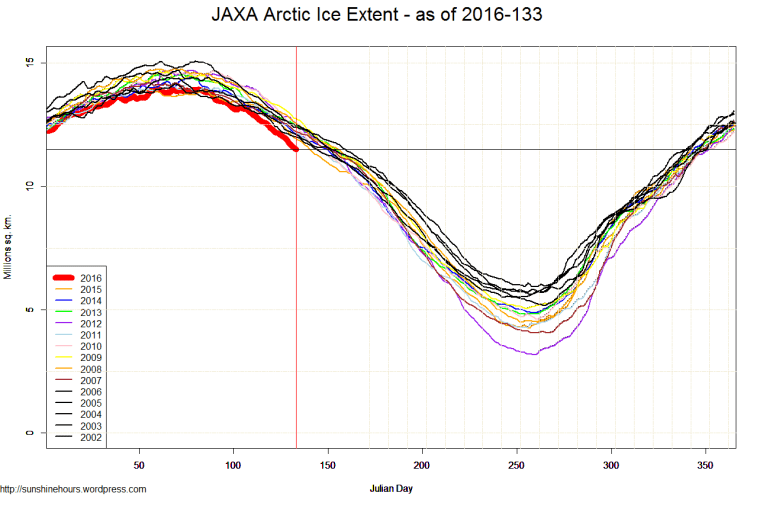
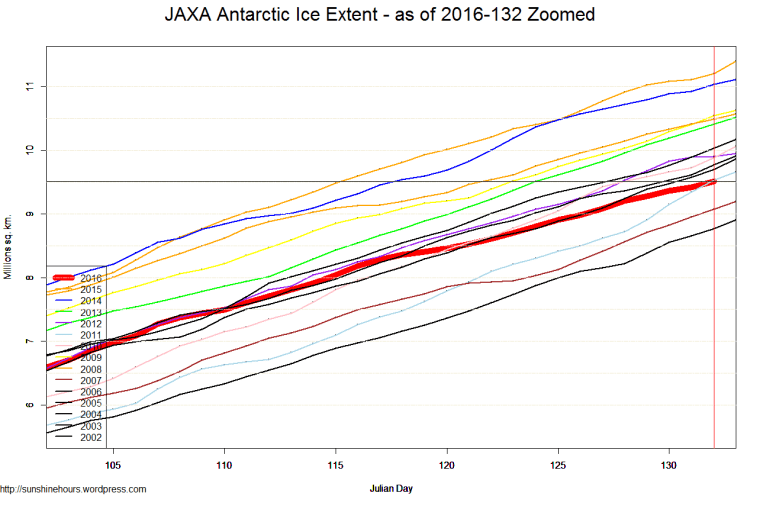
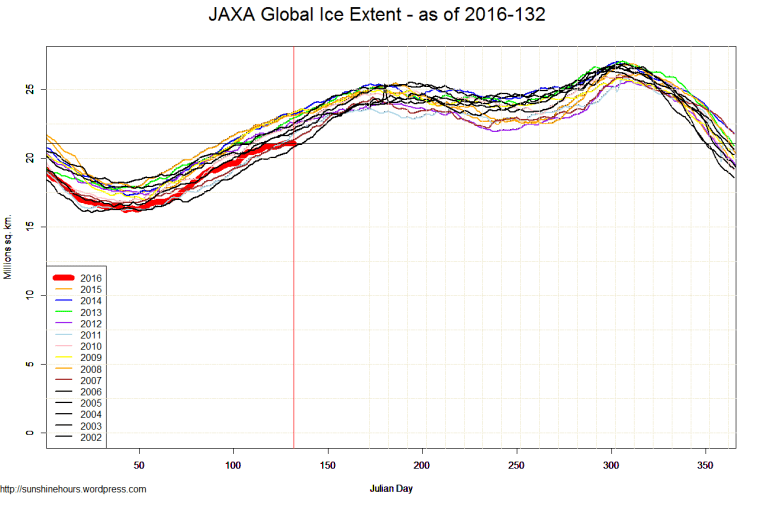
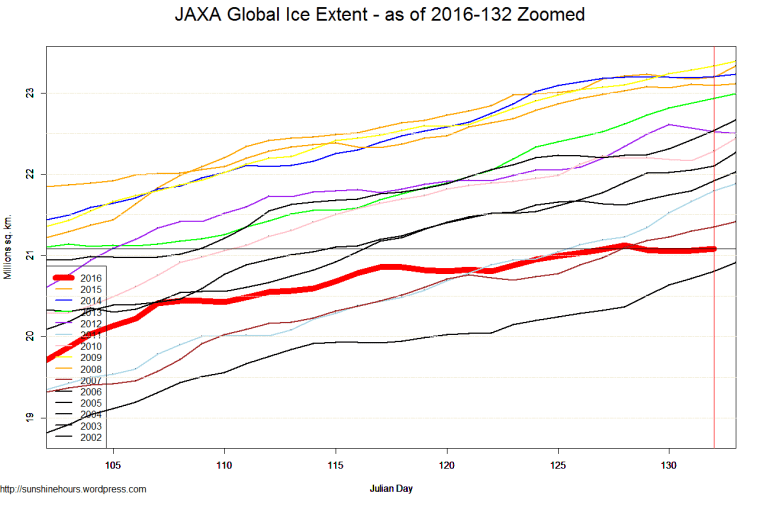
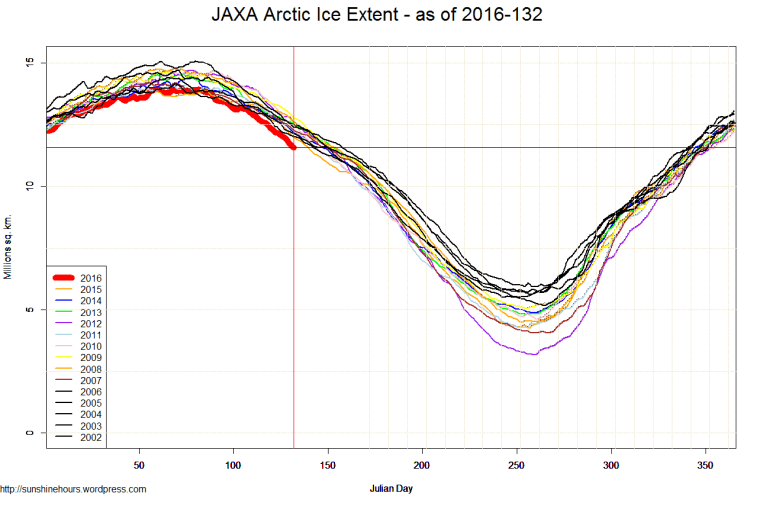
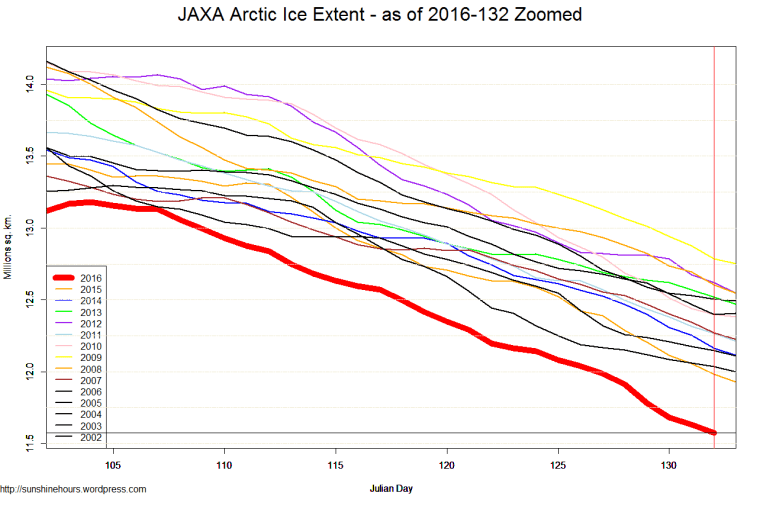
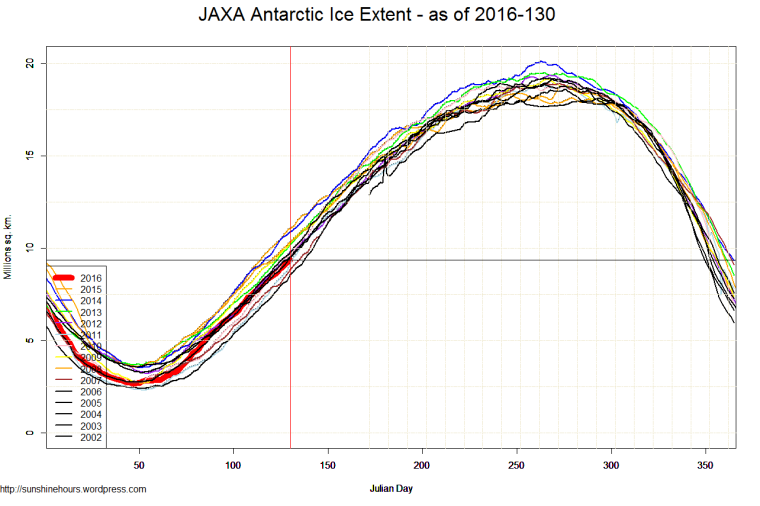
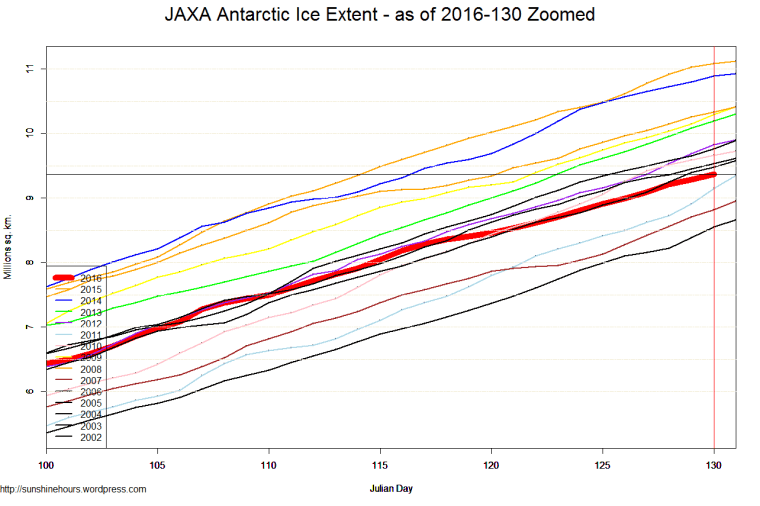
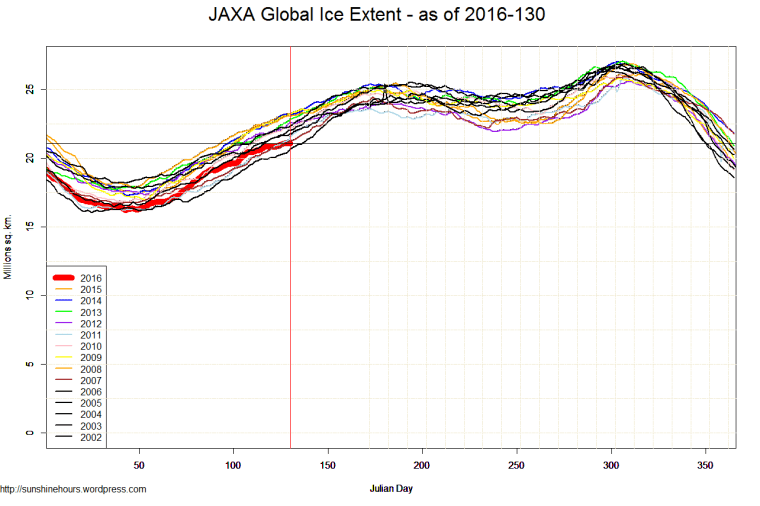
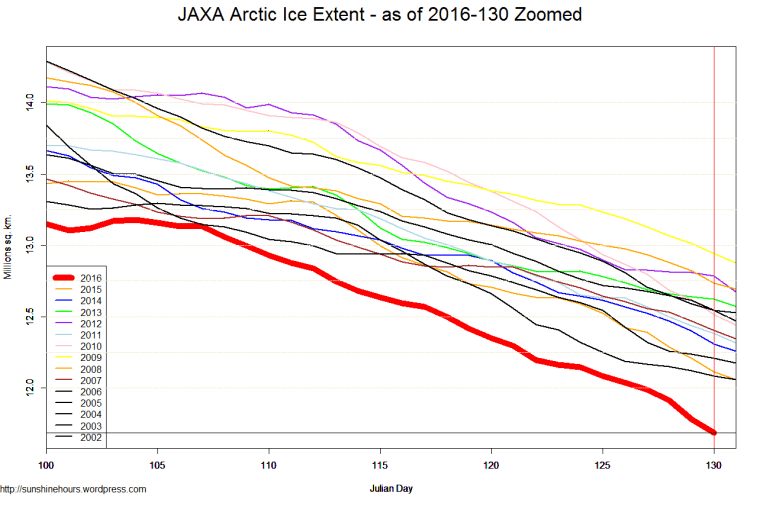
JAXA sea ice extent data from Japanese Aerospace Exploration Agency.
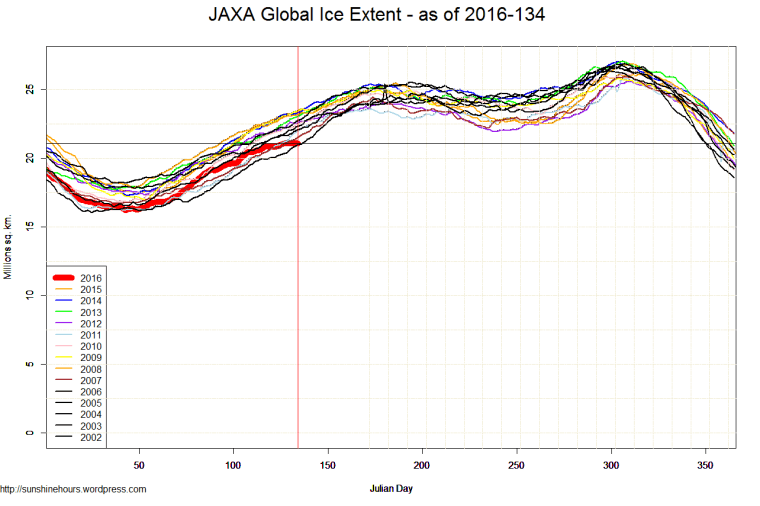
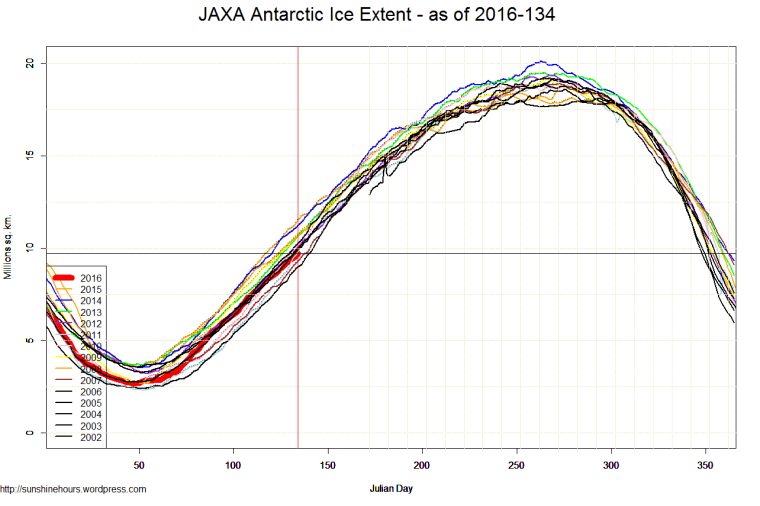
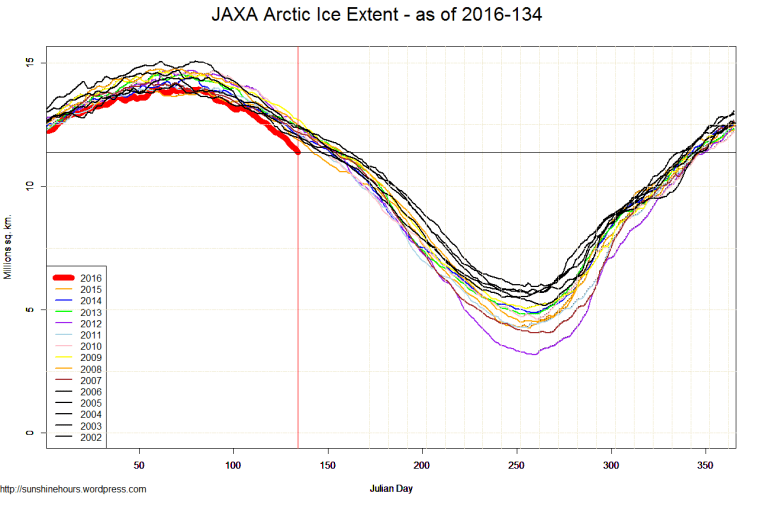
JAXA sea ice extent data from Japanese Aerospace Exploration Agency.
As some of you my have noticed I like to mock the idea that wind can take over for fossil fuels.
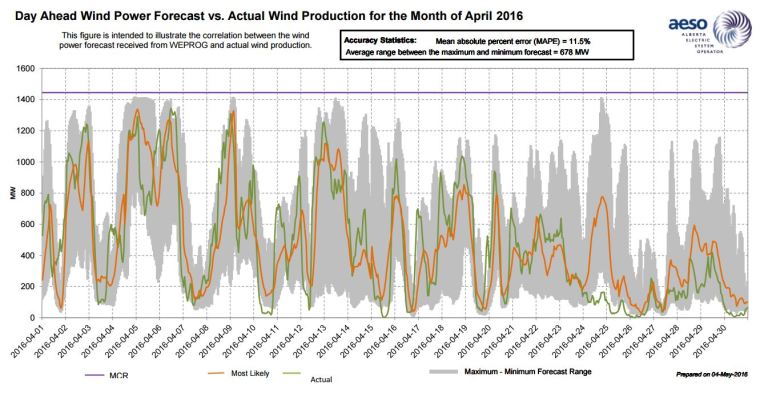
Here is the Actual Wind Production versus the day ahead prediction.
Purple is the the 1450MW of power wind could generate (and never does).
Green is actual. Notice it goes to zero several times and under 200MW a bunch of times.
And several of those low stretches last a whole day!
The other day I was crossing the harbor near where I live in a small ferry. I noticed numerous fresh jet contrails  crisscrossing the sky. And then I noticed that many of the cirrus-like clouds were just older contrails that had dissipated. And I realized that it would have been a clear blue sky if it wasn’t for the jet traffic.
And today I looked up the term contrails and climate change on google.
From 2011:
In a recent study published in Nature Climate Change, Dr. Ulrike Burkhardt and Dr. Bernd Karcher from the Institute for Atmospheric Physics at the German Aerospace Centre show that the contrails created by airplanes are contributing more to global warming that all the CO2 that has been caused by the entire 108 years of airplane flight. Airplane contrails are the white clouds that we see in the sky spreading behind jets.
These cirrus clouds are created when the hot, moist air released from the plane freezes in the colder and drier air. These clouds then trap the long-wave radiation from Earth and create a warming of the atmosphere. In their study, Burkhardt and Karchar utilized satellite imagery of these spreading contrails to create a computer model which estimates how the contrails affect the Earth’s temperature. They have discovered that aviation contrails play a huge role in the impact on the climate and an even greater impact than that created by the CO2 emissions produced.
While the CO2 emissions from airplanes account for around three percent of the annual CO 2emissions from all fossil fuels and change the radiation by 28 milliwatts per square meter, the aviation contrails are responsible for a change of around 31 milliwatts per square meter.
From 2005:
Is this atmospheric graffiti a problem? Research by Penn State geography professor Andrew Carleton suggested it could be. Contrails “can extend the natural cirrus cover,” Carleton explained, and unlike most clouds, cirrus tend to warm the surface overall because they trap heat more than they reflect the sun’s radiation. “This is a concern to climate scientists because it could mean that a lot more contrails would make global warming worse.”
Although scientists had suspected that contrails affect regional temperatures, there was no way to truly test the idea until the terrorist attacks on Sept. 11, 2001. In the enforced no-fly period following the collapse of the World Trade Center, air traffic was completely stopped for three days and scientists were able to directly compare temperatures logged in the presence of contrails against temperature data collected with contrail-free skies.
“I remember walking to and from my office (during that time) and thinking how incredibly clear the skies were,” recalled Carleton. He mentioned this to a colleague and former doctoral-degree student of his, David Travis of the University of Wisconsin, who had noticed the same thing. “Then we started thinking that we should look at the temperature conditions” during those days in September and compare them to years past, Carleton said.
Looking at daytime highs and nighttime lows, Carleton and Travis found the average daily temperature range across the no-fly period to be almost 2 degrees Fahrenheit larger than when jets do fly. This implies, Carleton explained, that contrails lower daytime maximum temperatures and increase nighttime low temperatures — probably in the same way that cirrus clouds do, by blocking some solar radiation from reaching earth’s surface during the day and insulating against heat loss at night.
JAXA sea ice extent data from Japanese Aerospace Exploration Agency.
It appears that fracking is causing a split in the green movement. Its about time.
If you are sane and you read the studies you know that fracking and cheap natural gas has actually lowered CO2 emissions in the USA by a significant amount by replacing coal.
“In 2015, U.S. energy-related carbon dioxide emissions were 12% below the 2005 levels, mostly because of changes in the electric power sector.
Energy-related CO2 emissions can be reduced by consuming less petroleum, coal, and natural gas, or by switching from more carbon-intensive fuels to less carbon-intensive fuels. Many of the changes in energy-related CO2 emissions in recent history have occurred in the electric power sector because of the decreased use of coal and the increased use of natural gas for electricity generation.”
Back to the green war …
Anti-fracking environmentalists, led by 350.org, Greenpeace and The Sierra Club, claim that natural gas is actually accelerating global warming more than coal due to methane emissions, even if it does cut carbon dioxide (CO2) emissions. These activists heavily doubt the official Environmental Protection Agency (EPA) figures on methane leaks, largely because of an article published by Bill McKibben, the leader of 350.org.
Pro-fracking environmentalists, led by The Breakthrough Institute, point out that McKibben misrepresented the scientific research on methane emissions to attack fracking. These environmentalists point out that a study published in the journal Science in March blames agricultural practices, not oil and natural gas, for increasing methane emissions. The same study points out that the American greenhouse gas emissions that cause global warming are declining largely due to fracking.
The split in the environmental movement has led to a green civil war over proposed EPA regulations intended to lower methane emissions from fracking. These regulations, however, would only lower the temperature by 0.0047 degrees Celsius by the year 2100, according to the EPA’s own data.
The anti-fracking zealots have done so much harm in most of Europe. In Canada and the USA fracking took off before the anti-frackers could get organized. The UK may (if it is lucky) win its fracking war (many years late).
JAXA sea ice extent data from Japanese Aerospace Exploration Agency.
A month ago I blogged about the big risk for blackouts in the UK.
Yesterday the grid got into trouble :
A series of power plant breakdowns and the partial failure of a key electricity import cable forced National Grid to issue an urgent call for more power to keep the lights on on Monday night.
One power plant was paid more than 30 times the usual price of power after the Grid issued the “Notification of Inadequate System Margin” (Nism) requesting more electricity be generated.
A Nism alert has not been issued in summer months since 2008 as the warm weather means power demand is normally lower.
But the combination of a large number of power plants being shut down for maintenance, the series of unplanned shutdowns and wind power being lower than expected together forced Grid to take the unusual step.
Experts said the multiple breakdowns – believed to be primarily old coal and gas plants – showed the urgent need for more investment in reliable new power plants.
National Grid said about 1,700 megawatts of capacity was unexpectedly taken off the system yesterday.
In addition, a problem forced the part closure of a National Grid-owned interconnector cable importing power from France, with the loss of another 500 megawatts.
At the same time, Britain’s wind farms generated about 500 megawatts less power than expected.
National Grid issued an alert at 7pm calling for 1,500 megawatts of power plant capacity to start generating between 7pm and 9.30pm.
National Grid said the highest price it paid to a plant to help it through the crunch was £1,250 per megawatt-hour of power. It is understood this was to E.On’s Connah’s Quay power plant.
Nism alerts used to be relatively common but had barely been used in the last few years due to a healthy surplus of power plants on the electricity grid. However, that surplus is being eroded as old coal plants are mothballed and shut.
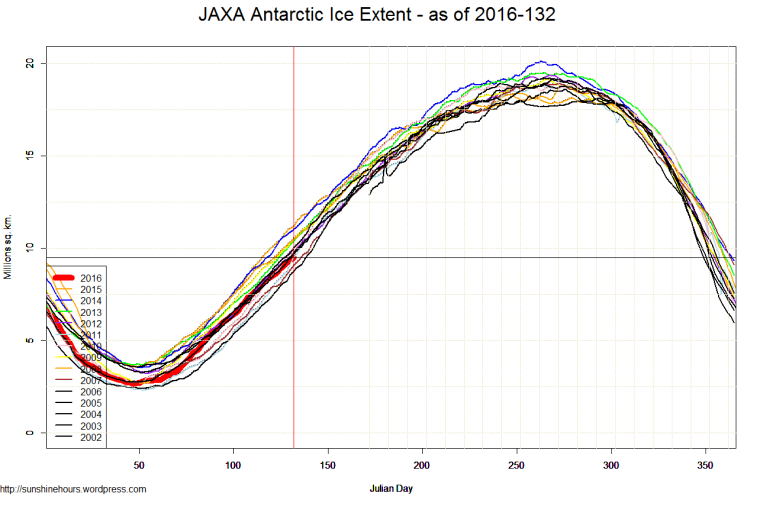
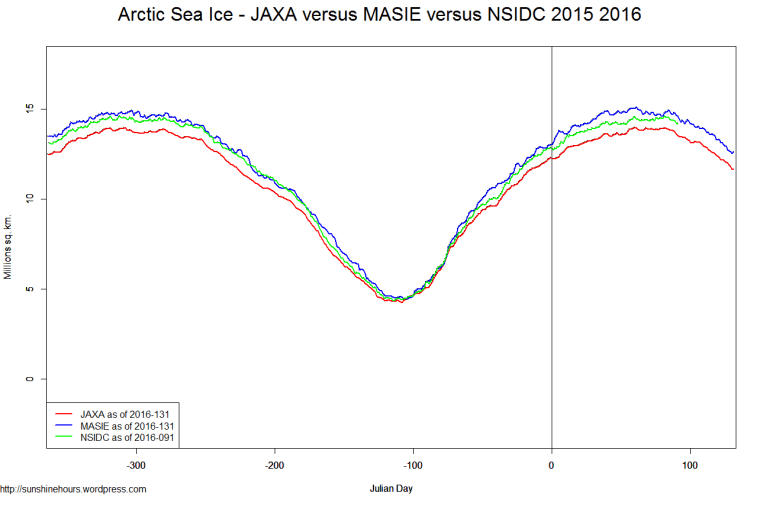
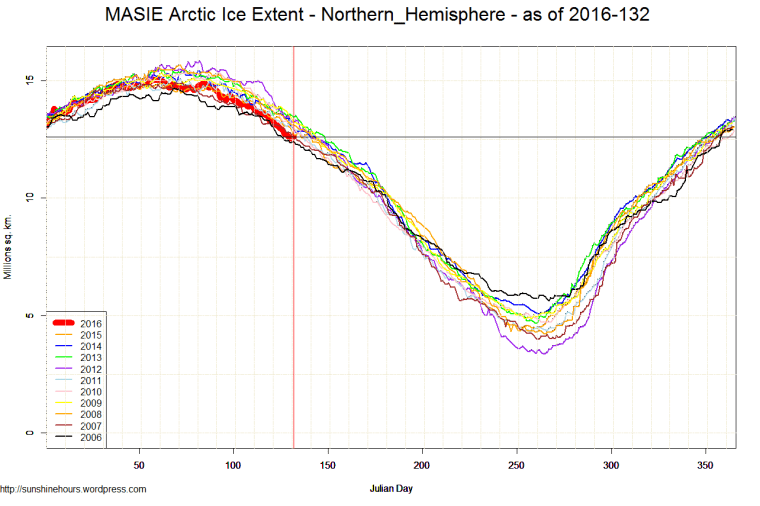
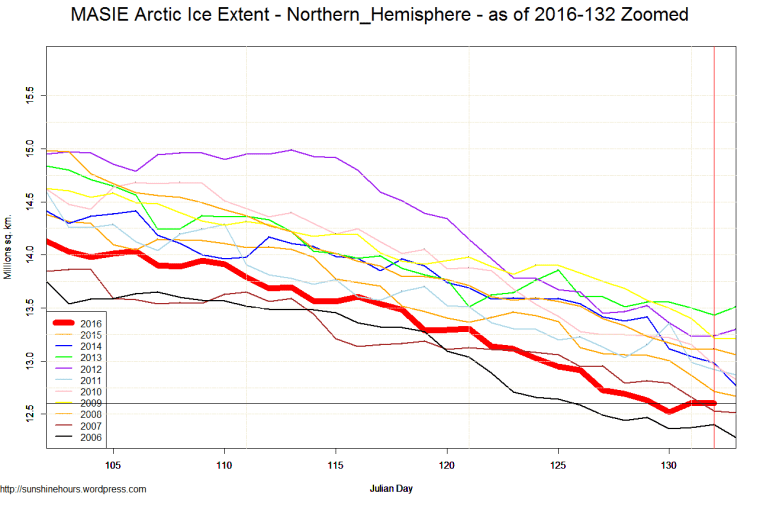
NSIDC is truncated at day 91 due to satellite problems. But they are updating the ftp site. Maybe in preparation of going live again.
JAXA always runs lower than NSIDC. AND NSIDC mostly runs lower than MASIE.
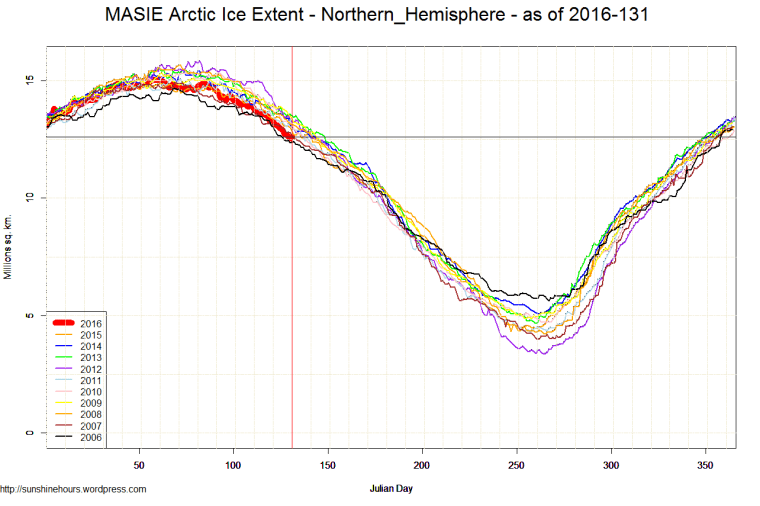
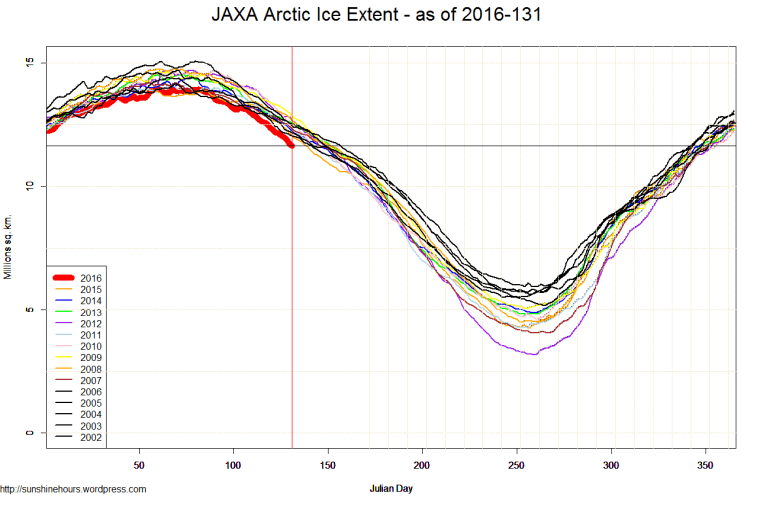
JAXA sea ice extent data from Japanese Aerospace Exploration Agency.


 sunshine hours