Month Long Cold Wave in Morocco

I am not much of a MSM viewer. But I’m curious. Did a month long cold wave in Morocco make the news?20160331-Morocco-ColdWave-Main1
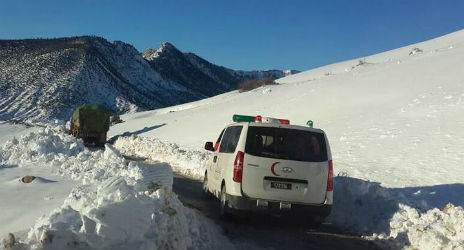
In late February, a cold wave swept across Morocco, bringing strong winds and freezing temperatures to several regions of the country. The Middle Atlas, north of the High Atlas, the Rif and the eastern highlands saw heavy snowfall, while the neighbouring plains faced severe thunderstorms. More than 750,000 people were affected by the unseasonable weather conditions, with many left in urgent need for food, warm clothes and shoes, blankets, medicines, heaters and other winterization items.

As soon as the first weather warnings were issued, the Moroccan Red Crescent mobilized its branches and volunteers to provide affected communities with relief aid, health assistance and psychosocial services. More than 80 Red Crescent volunteers and 10 staff were involved during the first days of urgent action. Branches in Figuig, Taza, Azilal and Guercif provided continuous feedback to the society’s headquarters as conditions changed in the field, ensuring a coordinated response to the emergency.

The organization continues distributing relief food and non-food items and medicines, and is providing first aid, psychosocial and medical services through its health posts that are serving community members round the clock.

The Moroccan Red Crescent has conducted an assessment of the situation and will support up to 1,500 families until the end of April. At least 700 families have benefitted from Moroccan Red Crescent aid so far. Each day, Red Crescent relief reaches more communities – a further 80 families will receive food assistance in Guercif this weekend. The organization will buy blankets and first aid kits to replenish its stocks, in order to continue caring for vulnerable people.

As a result of the exceptional weather conditions, several illnesses have been recorded among affected communities including rheumatism, flu, cough, throat pain, and skin conditions – mainly caused by the lack of suitable clothes to protect from the cold. Moroccan Red Crescent has been offering medical consultations at its health posts and so far, more than 3,000 people have benefited from these services.

Dr. Ben Elmamoune Taoufik, President of the Moroccan Red Crescent’s Guercif branch said: “The cold wave-hit governorates face medication shortages and lack of proper health care equipment. The Red Crescent, as an auxiliary body to state institutions, tries to fill in these gaps by distributing medicines and holding medical check-ups, in collaboration with the regional representatives of the ministry of health.”

The National Society has also carried out hygiene promotion campaigns in the aftermath of the cold wave. These community-level activities have focused on encouraging behaviour change with the aim of reducing the possibility of simple diseases like skin infections being spread.


“Science” Funding Runs Out Because Fracking Wasn’t Evil

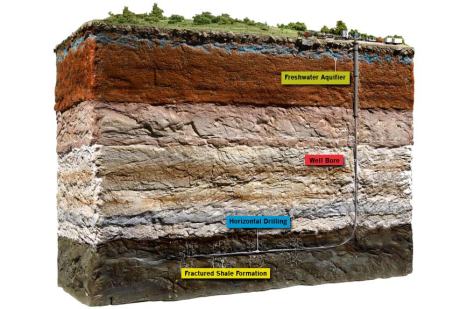
They were researching fracking in Ohio and trying to find evidence of contaminated ground water.

They didn’t find any evidence.

The donors who were are all in favor of the research when it looked like they could demonize fracking stopped the funding.54ca55cf14c93_-_fracking-myths-01-0911-xln-73259275

However, Townsend-Small said in an email Monday to The Daily Signal, those decisions not to donate more might be because the study didn’t establish a relationship between hydraulic fracturing, or fracking, and water contamination in Carroll County and other areas that include the Utica Shale deposit.

Townsend-Small also said the results “show that fracking does not always lead to groundwater contamination, but that continuous monitoring is needed to ensure contamination has not occurred.”

“The left likes to continually talk about settled science, but often it’s settled on a predetermined outcome,” Nick Loris, a research fellow at The Heritage Foundation who studies energy issues, told The Daily Signal. “Politicians use that predetermined outcome to justify policies that drive up the costs of affordable, reliable energy—even though those policies have little to no environmental benefit.”

The Daily Signal sought comment from the Deer Creek Foundation on why it decided to stop funding the fracking study in Ohio, but its executive director did not respond.


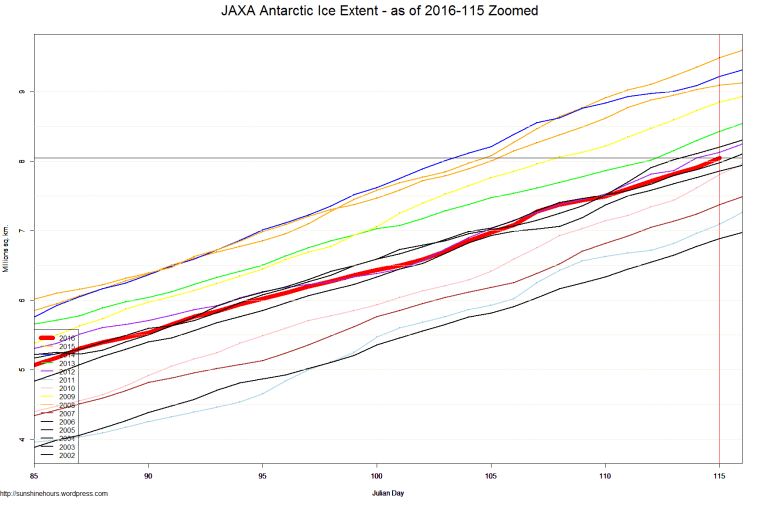
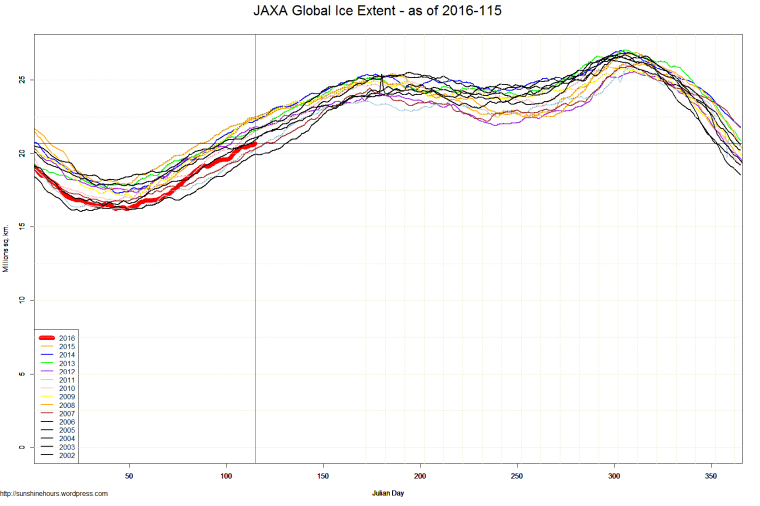
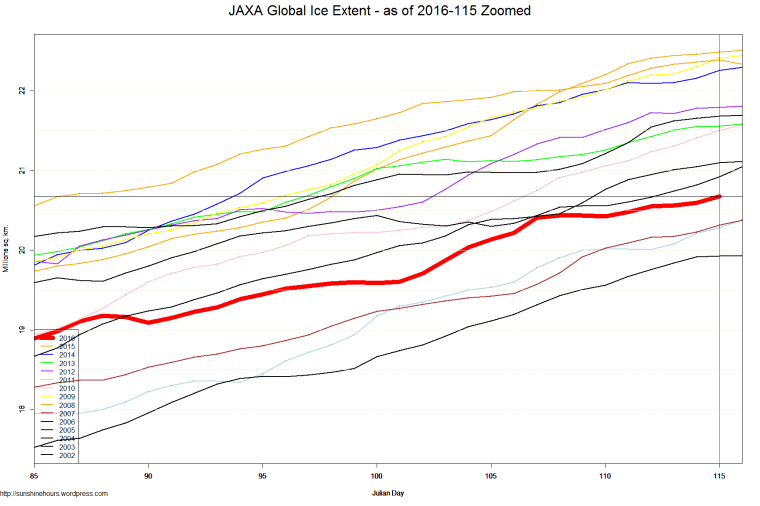
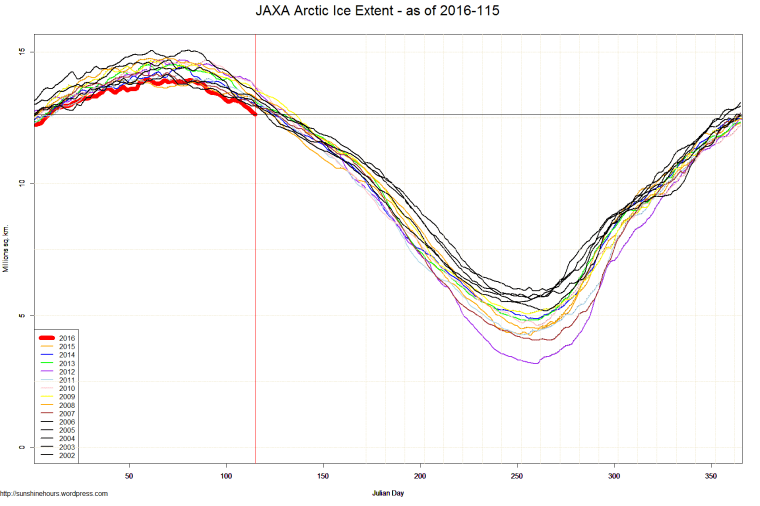
JAXA Sea Ice Extent (Antarctic and Arctic) – Day 115- 2016

JAXA sea ice extent data from Japanese Aerospace Exploration Agency.

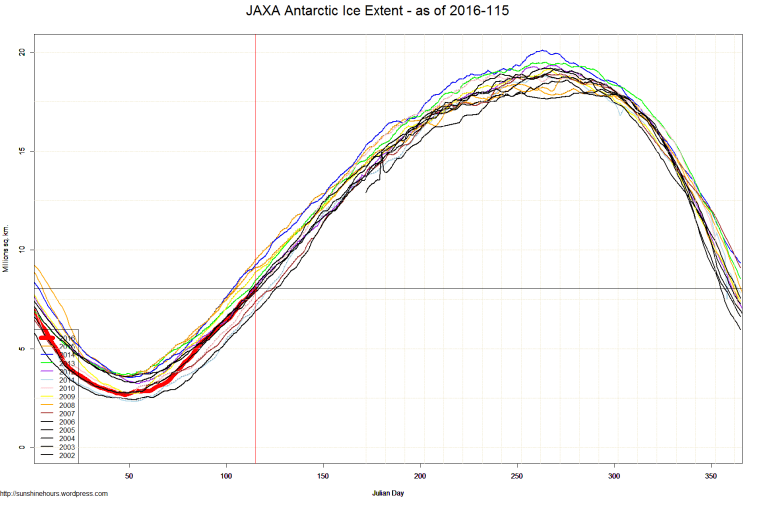
JAXA Antarctic Ice Extent - as of 2016-115

JAXA Antarctic Ice Extent - as of 2016-115 Zoomed

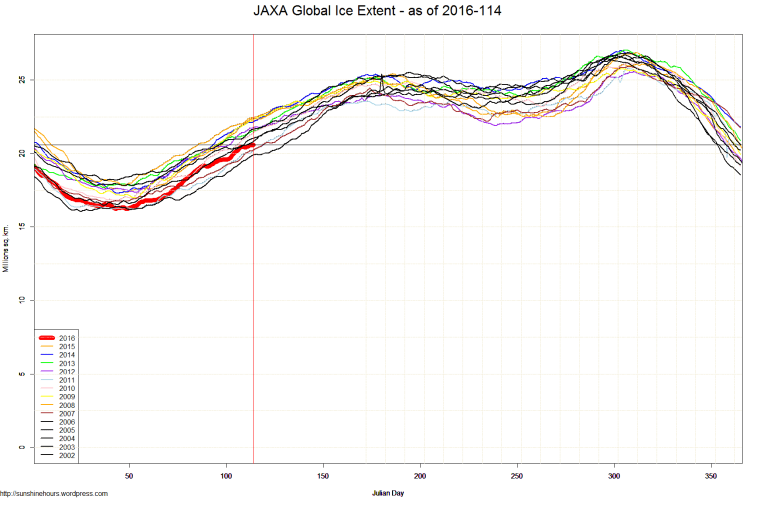
JAXA Global Ice Extent - as of 2016-115

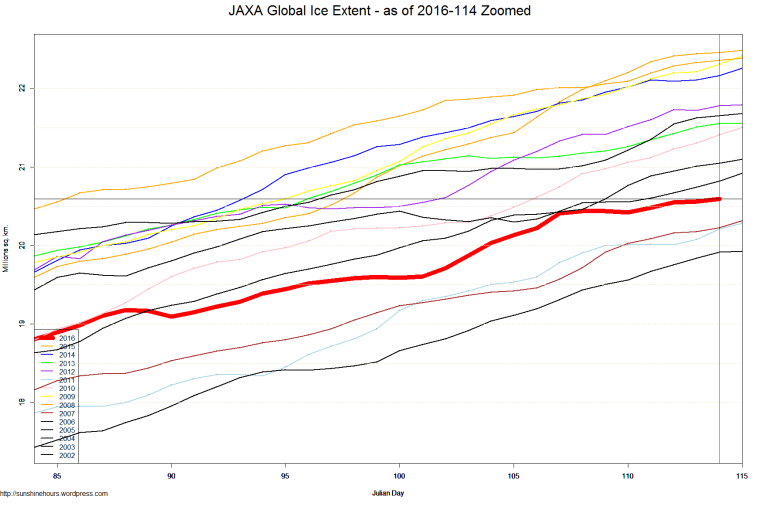
JAXA Global Ice Extent - as of 2016-115 Zoomed

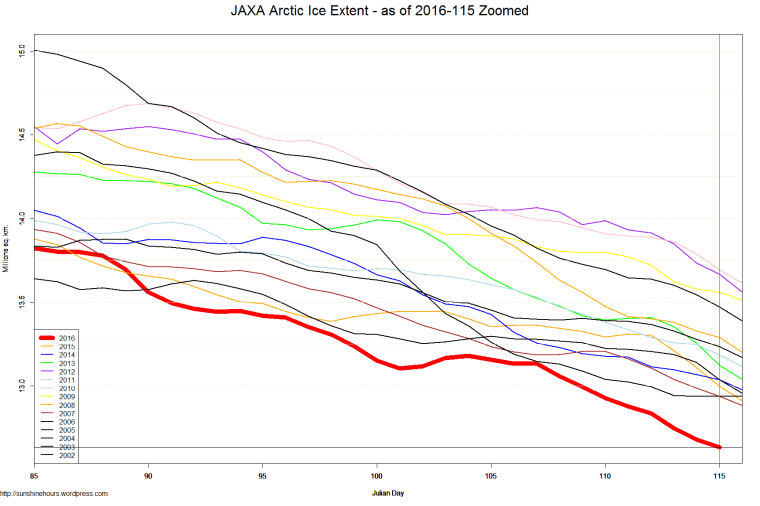
JAXA Arctic Ice Extent - as of 2016-115

JAXA Arctic Ice Extent - as of 2016-115 Zoomed


JAXA Sea Ice Extent (Antarctic and Arctic) – Day 114 – 2016

JAXA sea ice extent data from Japanese Aerospace Exploration Agency.

JAXA Antarctic Ice Extent - as of 2016-114 Zoomed

JAXA Global Ice Extent - as of 2016-114

JAXA Global Ice Extent - as of 2016-114 Zoomed

JAXA Antarctic Ice Extent - as of 2016-114

JAXA Arctic Ice Extent - as of 2016-114

JAXA Arctic Ice Extent - as of 2016-114 Zoomed


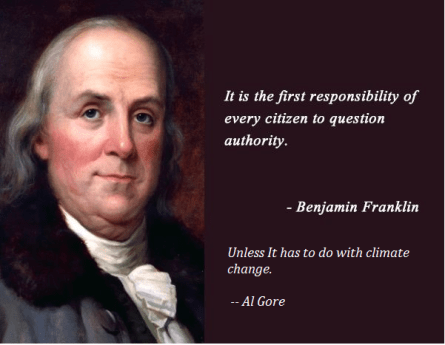
Question Authority

I’m making this a sticky post for the day. Its important.

Question Authority?AlGore

With seven state attorneys general and Al Gore sharing a New York City stage , there was no doubt about it: It was showtime for a whodunit. The crime being investigated? Dissent.

The March 29 news conference unveiled, according to New York Attorney General Eric T. Schneiderman, an “unprecedented” coalition to fight not only climate change but also allegedly deceptive speech about climate change. The group, which dubbed itself AGs United for Clean Power, promised to “use all the tools at our disposal” to battle for progress on “the most consequential issue of our time.”

Schneiderman was blunt about his goal of shutting down debate: “You have to tell the truth. You can’t make misrepresentations of the kinds we’ve seen here.”

This isn’t a law-and-order drama. It’s politics clothed in messianic garb, and its primary tools are censorship and intimidation.

The AGs are following a familiar script here: target an unpopular, deep-pocketed business, harass that business’s potential allies with overly broad investigations, run roughshod over the target’s First Amendment protections and settle once the politically weakened company tires of fighting the endless resources of the state.

ExxonMobil was singled out by name at the news conference, but the coalition appears to be following the script perfectly. Now it’s on to the fishing-expedition stage.

On April 7, our organization, the Competitive Enterprise Institute, was subpoenaed by coalition member and U.S. Virgin Islands Attorney General Claude Walker for all CEI material on climate change and energy policy, as well as information on our supporters, over 10 years beginning in 1997. The subpoena’s purported focus is on our contacts with ExxonMobil, a former CEI donor that publicly ended its support for us after 2005. Nonetheless, the subpoena calls for practically all of our material on climate change and energy policy, as well as information on any donors who directly or indirectly supported that work.

Read the rest

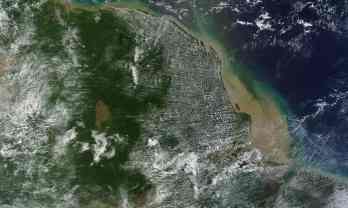
Huge coral reef discovered at Amazon river mouth

Yup. Science is settled.

6321

Scientists astonished to find 600-mile long reef under the muddy water in a site already marked for oil exploration

Scientists were ‘flabbergasted’ to discover the Amazon reef as coral usually thrives in clear, sunlit tropical waters.

A huge 3,600 sq mile (9,300 sq km) coral reef system has been found below the muddy waters off the mouth of the river Amazon, astonishing scientists, governments and oil companies who have started to explore on top of it.

The existence of the 600-mile long reef, which ranges from about 30-120m deep and stretches from French Guiana to Brazil’s Maranhão state, was not suspected because many of the world’s great rivers produce major gaps in reef systems where no corals grow.

In addition, there was little previous evidence because corals mostly thrive in clear, sunlit, salt water, and the equatorial waters near the mouth of the Amazon are some of the muddiest in the world, with vast quantities of sediment washed thousands of miles down the river and swept hundreds of miles out to sea.

But the reef appears to be thriving below the freshwater “plume”, or outflow, of the Amazon. Compared to many other reefs, the scientists say in a paper in Science Advances on Friday, it is is relatively “impoverished”. Nevertheless, they found over 60 species of sponges, 73 species of fish, spiny lobsters, stars and much other reef life.

Promiscuity May Help Some Corals

They try and say the “science is settle”. It never is. Corals adapt. Otherwise they wouldn’t have survived.

Researchers have shown for the first time that some corals surviving bleaching events can acquire and host new types of algae from their environment, which may make the coral more heat-tolerant and enhance their recovery.

The research, published in The ISME Journal, was led by Southern Cross University postgraduate student Ms Nadine Boulotte and included scientists from SCU’s Marine Ecology Research Centre, the University of Melbourne, the Australian Institute of Marine Science (AIMS) and the University of Hawai’i.

“This new study will cause a paradigm shift in our understanding of corals that build reefs,” Ms Boulotte said.

“Most corals were previously believed to only acquire microalgae in their juvenile stage, and to house the same algae types for their lifetime.

“Our study shows for the first time that some adult corals can be promiscuous, and swap their algal partners later in life.

“This algae partner-swapping could help corals to better adapt to climate change and survive bleaching events if they can acquire more heat-tolerant microalgae.”


JAXA Sea Ice Extent (Antarctic and Arctic) – Day 113- 2016

JAXA sea ice extent data from Japanese Aerospace Exploration Agency.


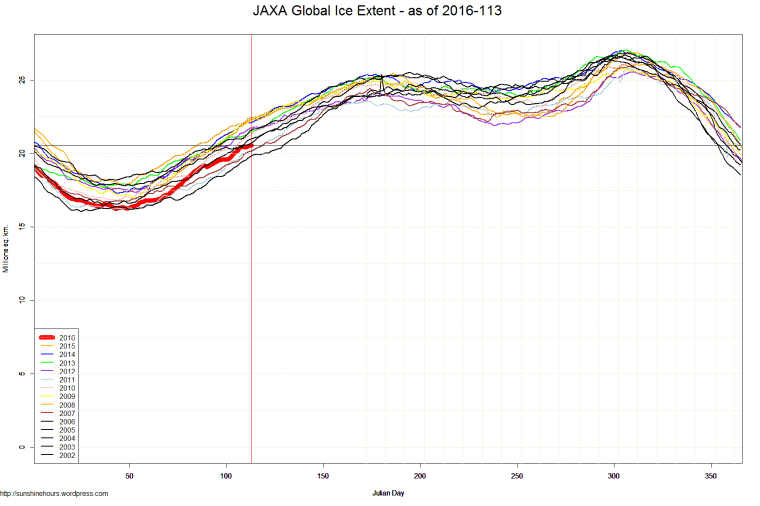
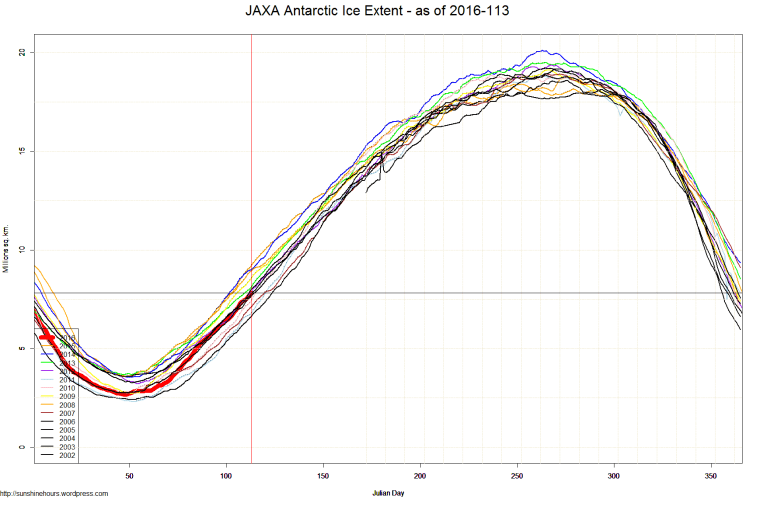
JAXA Global Ice Extent - as of 2016-113

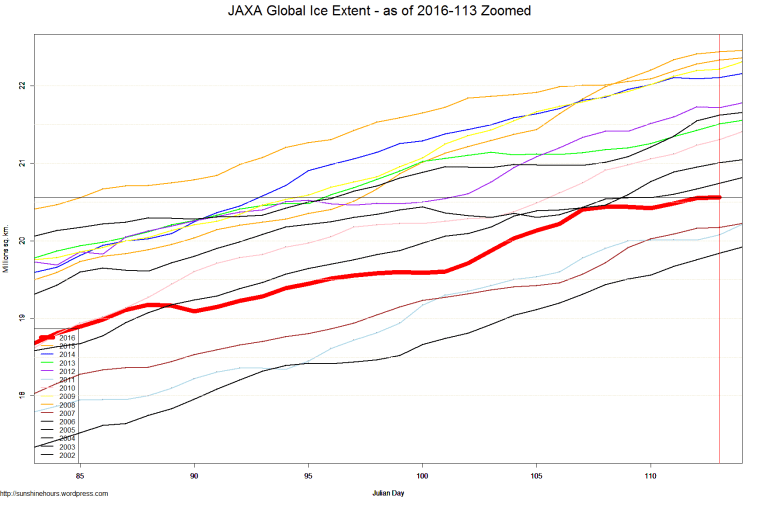
JAXA Global Ice Extent - as of 2016-113 Zoomed

JAXA Antarctic Ice Extent - as of 2016-113

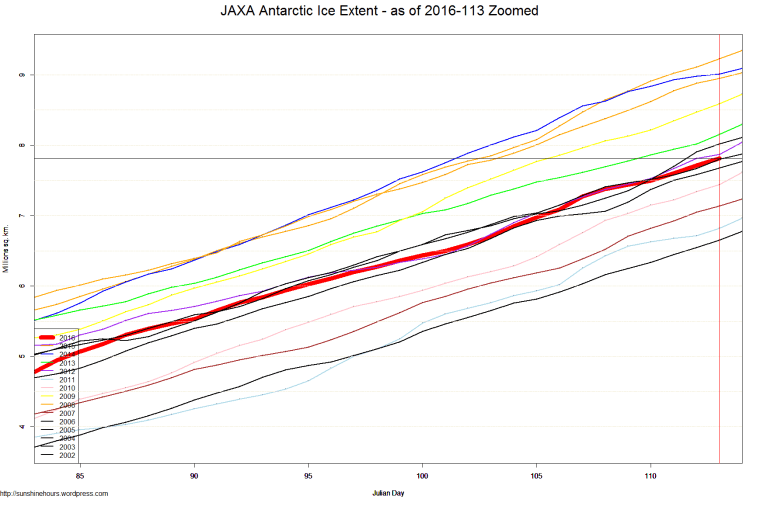
JAXA Antarctic Ice Extent - as of 2016-113 Zoomed

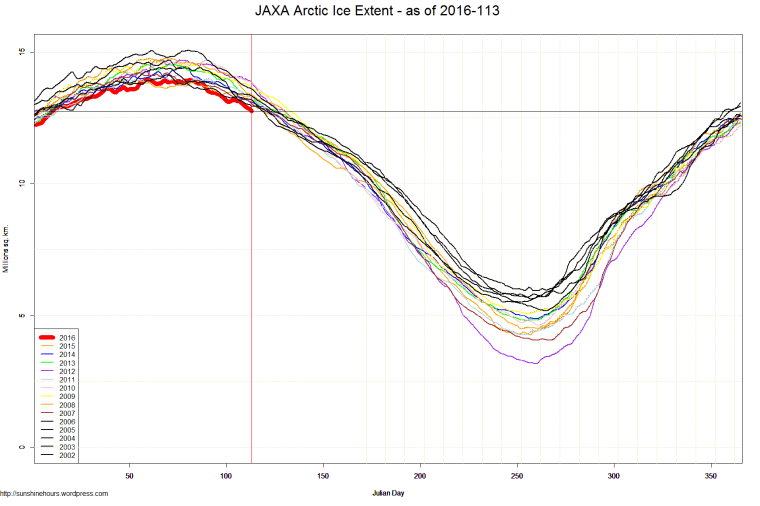
JAXA Arctic Ice Extent - as of 2016-113

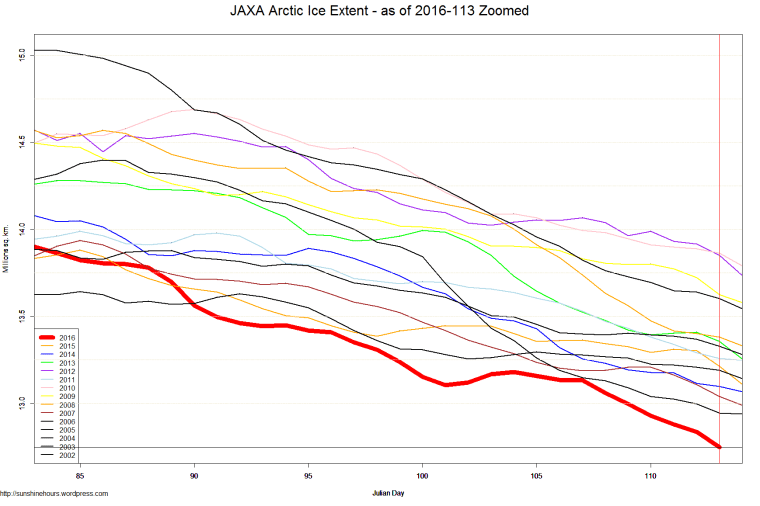
JAXA Arctic Ice Extent - as of 2016-113 Zoomed


Earth Day 1970 Predictions

Earth day 1970 predictions didn’t come true.

1. Harvard biologist George Wald estimated that “civilization will end within 15 or 30 years unless immediate action is taken against problems facing mankind.”

2. “We are in an environmental crisis which threatens the survival of this nation, and of the world as a suitable place of human habitation,” wrote Washington University biologist Barry Commoner in the Earth Day issue of the scholarly journal Environment.

3. The day after the first Earth Day, the New York Times editorial page warned, “Man must stop pollution and conserve his resources, not merely to enhance existence but to save the race from intolerable deterioration and possible extinction.”

4. “Population will inevitably and completely outstrip whatever small increases in food supplies we make,” Paul Ehrlich confidently declared in the April 1970 Mademoiselle. “The death rate will increase until at least 100-200 million people per year will be starving to death during the next ten years.

5. “Most of the people who are going to die in the greatest cataclysm in the history of man have already been born,” wrote Paul Ehrlich in a 1969 essay titled “Eco-Catastrophe! “By…[1975] some experts feel that food shortages will have escalated the present level of world hunger and starvation into famines of unbelievable proportions. Other experts, more optimistic, think the ultimate food-population collision will not occur until the decade of the 1980s.

6. Ehrlich sketched out his most alarmist scenario for the 1970 Earth Day issue of The Progressive, assuring readers that between 1980 and 1989, some 4 billion people, including 65 million Americans, would perish in the “Great Die-Off.

7. “It is already too late to avoid mass starvation,” declared Denis Hayes, the chief organizer for Earth Day, in the Spring 1970 issue of The Living Wilderness.

8. Peter Gunter, a North Texas State University professor, wrote in 1970, “Demographers agree almost unanimously on the following grim timetable: by 1975 widespread famines will begin in India; these will spread by 1990 to include all of India, Pakistan, China and the Near East, Africa. By the year 2000, or conceivably sooner, South and Central America will exist under famine conditions….By the year 2000, thirty years from now, the entire world, with the exception of Western Europe, North America, and Australia, will be in famine.

9. In January 1970, Life reported, “Scientists have solid experimental and theoretical evidence to support…the following predictions: In a decade, urban dwellers will have to wear gas masks to survive air pollution…by 1985 air pollution will have reduced the amount of sunlight reaching earth by one half….

10. Ecologist Kenneth Watt told Time that, “At the present rate of nitrogen buildup, it’s only a matter of time before light will be filtered out of the atmosphere and none of our land will be usable.”