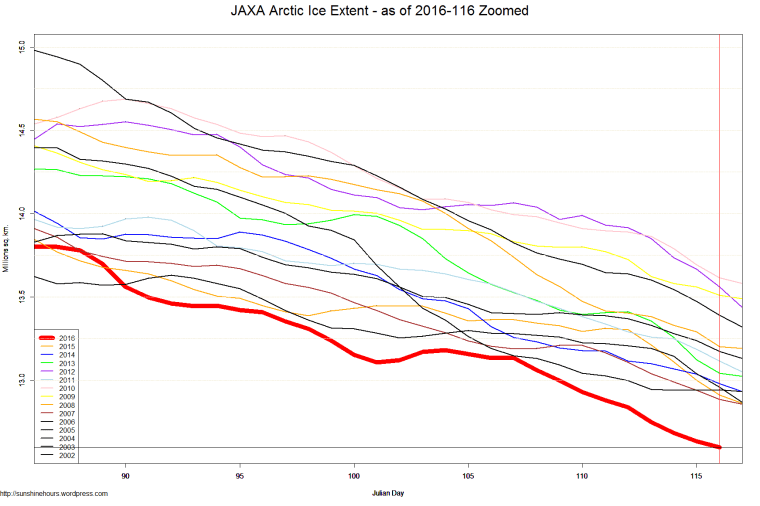
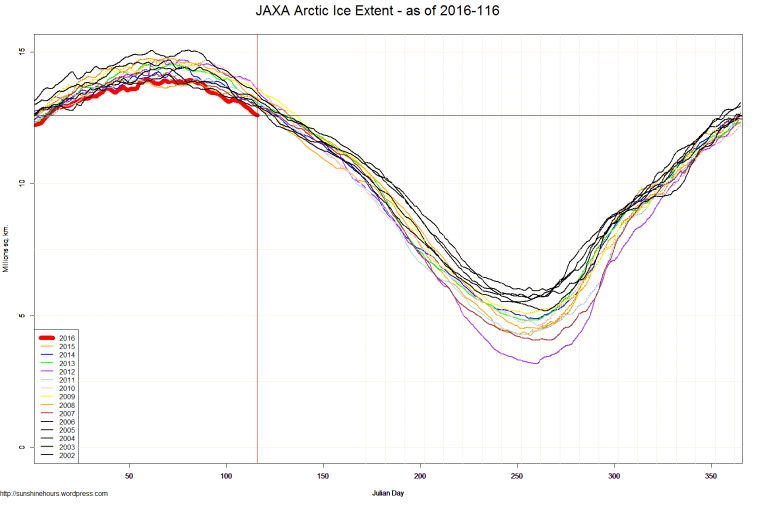
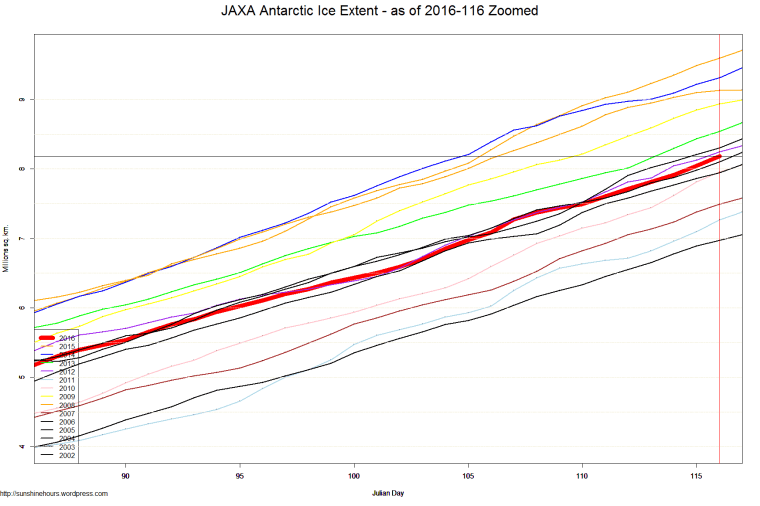
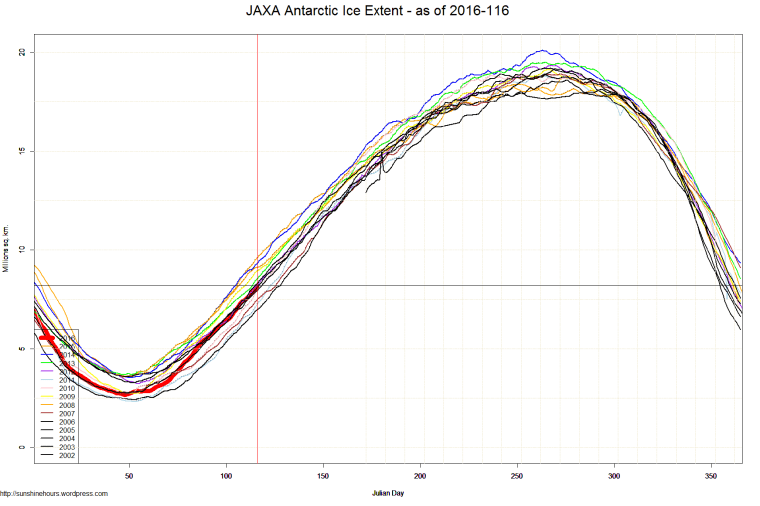
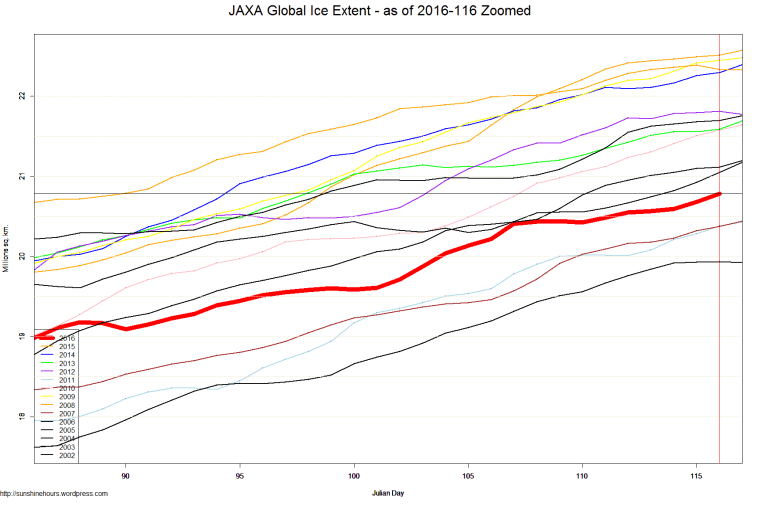
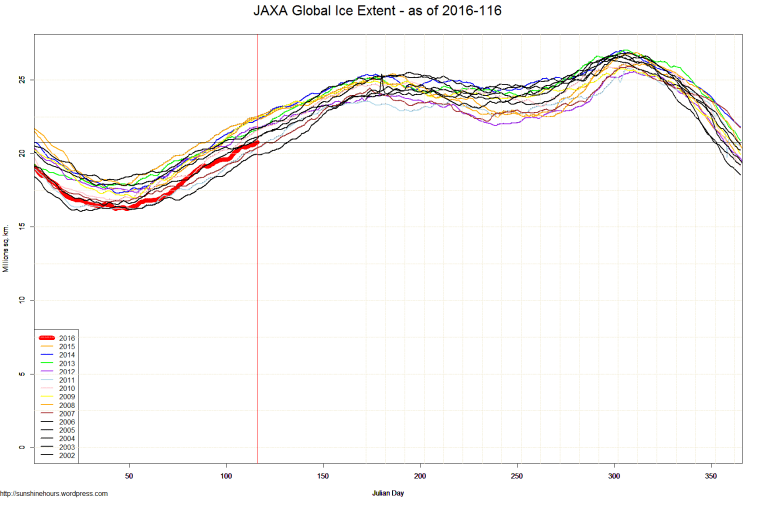
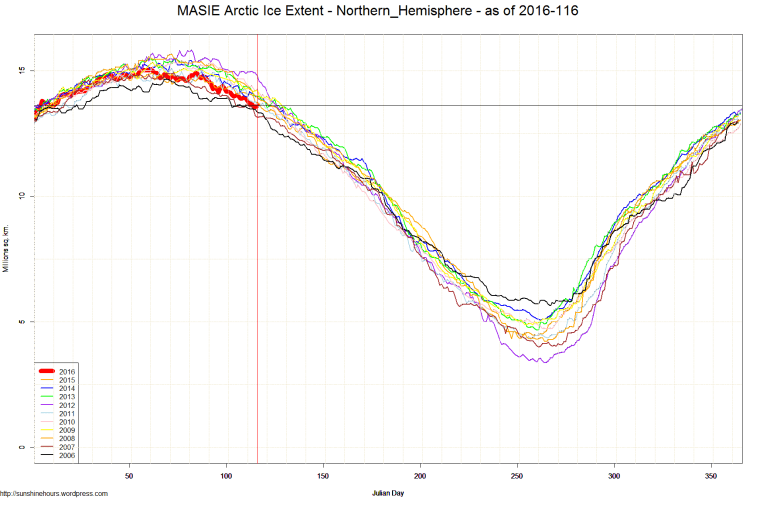
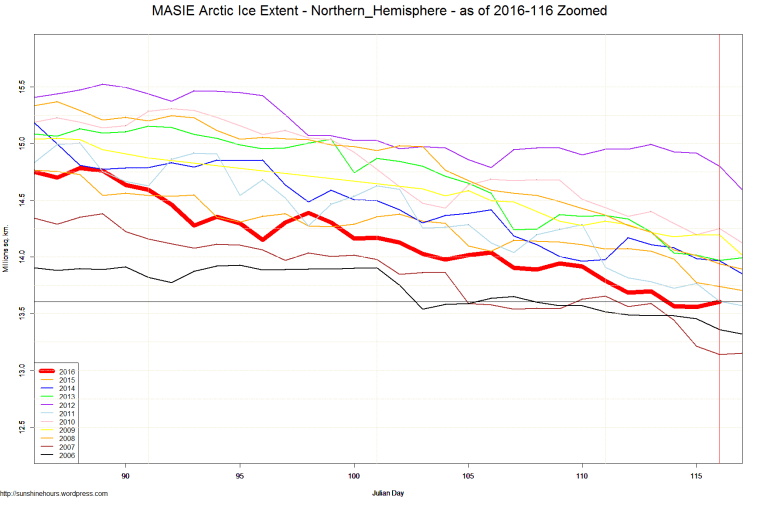
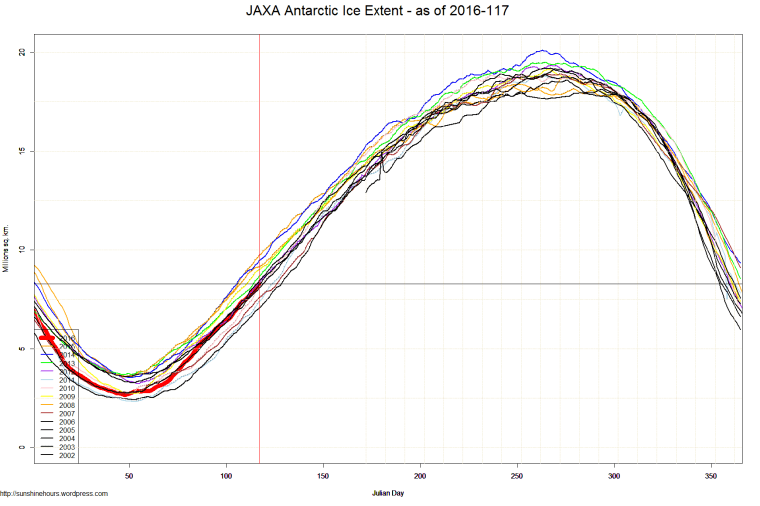
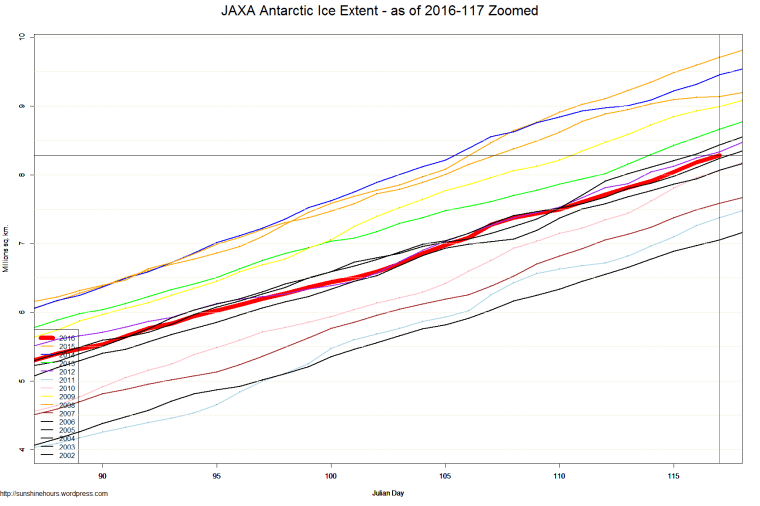
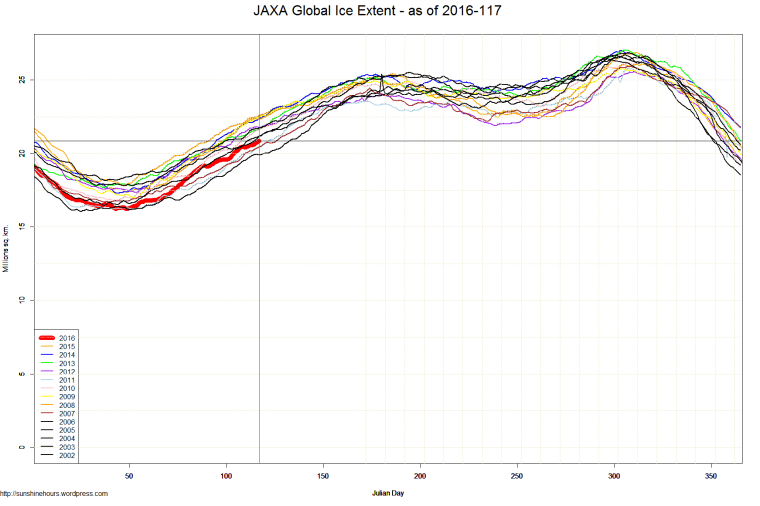
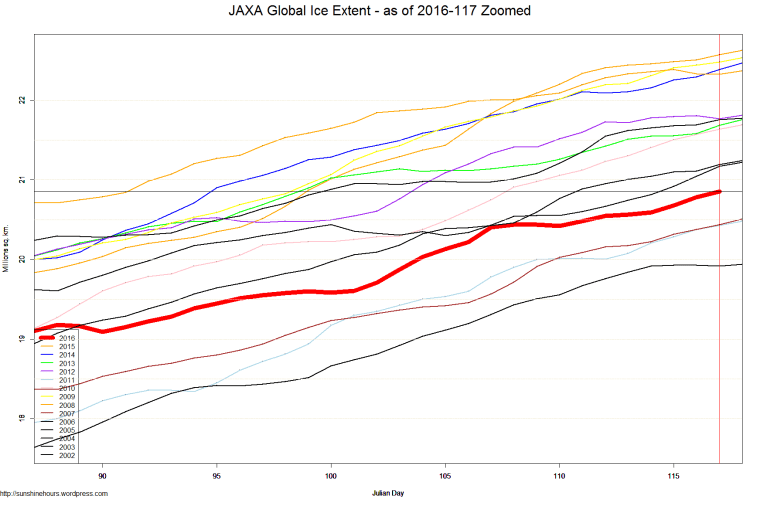
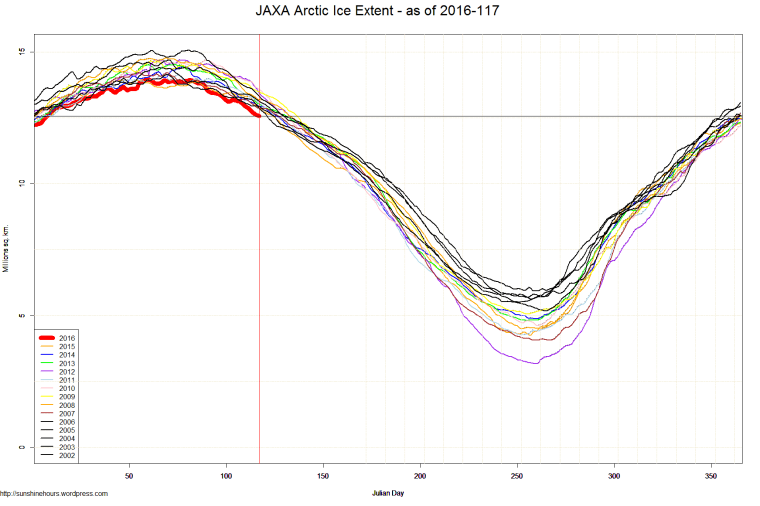
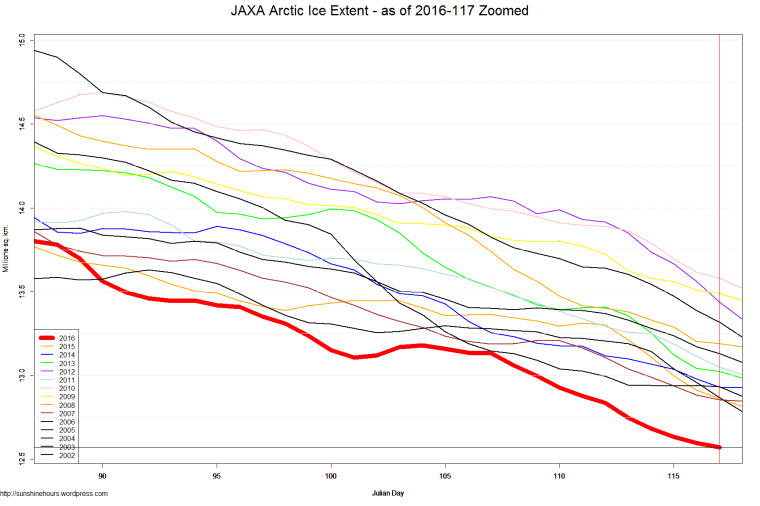
JAXA sea ice extent data from Japanese Aerospace Exploration Agency.

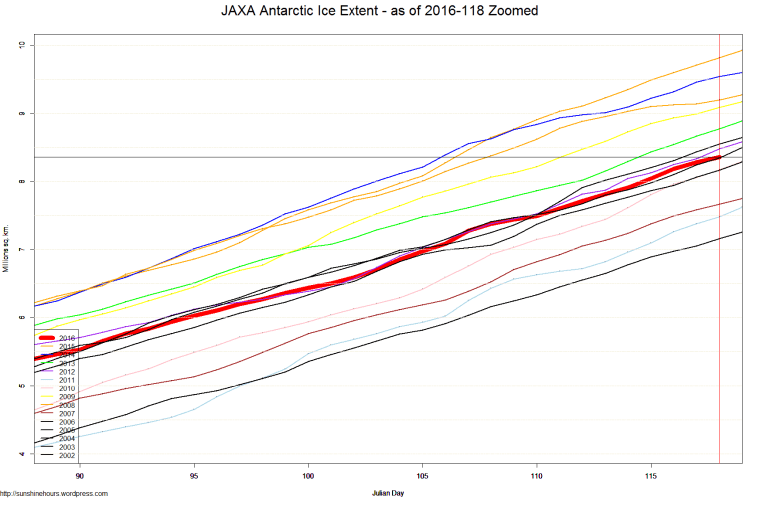

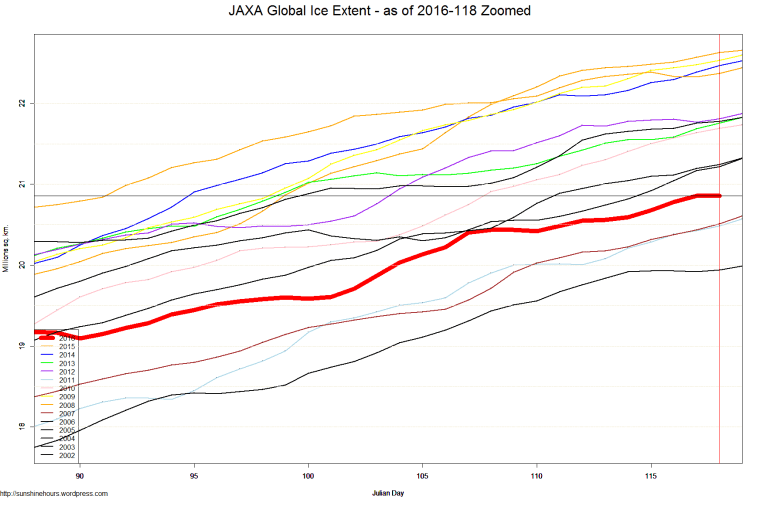
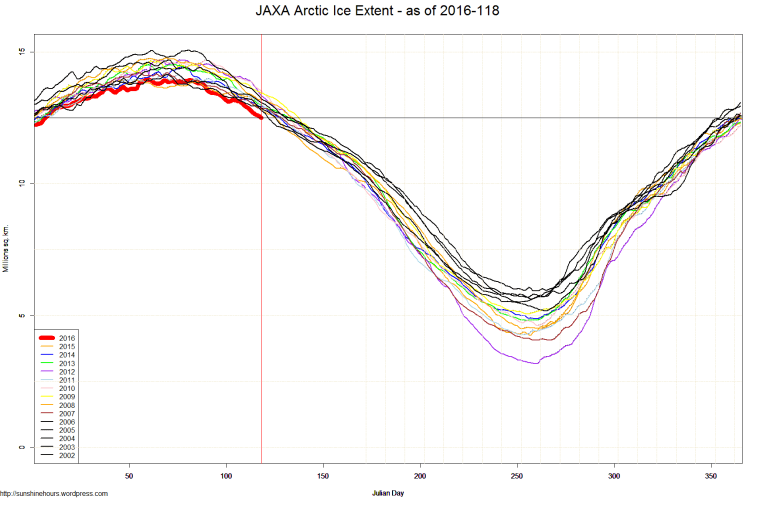

JAXA sea ice extent data from Japanese Aerospace Exploration Agency.
Calmest Since 1970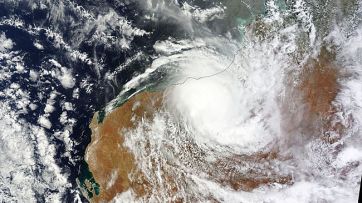
With the official end of the Australian tropical season only days away, the calmest season in decades will come to an end.
The season, which officially runs from 1 November through 30 April, has endured only three named cyclones originating within the Australian Tropical Basin.
Having only three named storms of Category 1 strength or higher in the basin would be the fewest dating back to 1970, according to the Australian Bureau of Meteorology (BOM).
According to Senior Meteorologist Jason Nicholls, “El Niño played an important role in the low activity of the tropical season as tropical development flourished closer to Fiji and Vanuatu and away from Australia.” El Niño occurs when ocean water temperatures rise above normal across the central and eastern Pacific, near the equator which influences global weather patterns.
I came across this NASA website dedicated to freaking kids out educating kids about climate change.
It reminds me of the short movie called “Bambi versus Godzilla” …. lots of images cute baby deer to set you up and then crunch!
Godzilla = Climate Change
Here is a few excerpts from NASA’s site.
Bambi:
“For the past 30 years or so, spring temperatures have been coming one day earlier each year. That gives the marmots one more month to eat and get fatter before going back into hibernation in the fall. With more food stored in their bodies, more marmots are surviving the winters.
Also, marmot babies are being born sooner in the spring. That means the babies have more time to fatten up too. So more of the babies are surviving their first winter.
So not only are the marmots getting fatter, but there are lots more of them.”
Godzilla:
However, as their environment continues to warm, summer drought will dry up the food before the marmots are ready to hibernate again. Then, the earlier spring and longer summer will not help them at all.
Bambi:
While the marmots are getting fatter, the wild Soay sheep on islands near Scotland have been shrinking! Large animals have an easier time staying warm in cold weather than do smaller animals. However, as the sheep’s environment has warmed, the smaller sheep are surviving just fine too. Smaller lambs that often did not survive are now surviving. Also, younger and smaller mother sheep (who often did not survive the winter) are giving birth to smaller lambs. And smaller sheep eat less,
Godzilla:
Climate change may seem to be helping these animals. But this help probably will not last. As their environments continue to warm, the animals may find that drier conditions make food scarce.
JAXA sea ice extent data from Japanese Aerospace Exploration Agency.
Another shocker. AGW predicts brown …. and green happens.
A new study just gave people another reason to be skeptical of climate models relied upon by scientists to predict the future impacts of global warming.
Climate models have long predicted man-made global warming would cause the western U.S. to become more arid and brown, but that’s not what happened. A new study examining three decades worth of satellite data found the western U.S. — indeed, the world in general — is greening because of increased carbon dioxide emissions.
It’s another prediction failure from climate models, according to Chip Knappenberger, a scientist at the libertarian Cato Institute. Knappenberger pointed out on Twitter that climate models predicting “browning” in the western U.S. were dead wrong.
How much CO2 does wood produce versus coal?
The results of our analysis shows that wood is generally about the same
or slightly lower in CO2 emissions on a dry basis,
but both wood and coal do not naturally have zero moisture content (MC).

The typical moisture content of coal is:
Anthracite Coal : 2.8% - 16.3% by weight
Bituminous Coal : 2.2% - 15.9% by weight
Lignite Coal : 39% or more by weight
It is the water that causes CO2 emissions to increase over the dry weight.
The underlying cause that drives this is “the enthalpy of vaporization.”
In simple terms, it takes energy to evaporate the water in wood or coal
and convert it to vapor, and all of that energy is sent out the chimney
and into the atmosphere in the form of water vapor, unless a condensing
boiler is used which may claim part of the escaping energy.
To get a million BTUs of useful energy from the fuel,
a larger mass of wood or coal is necessary to compensate for the losses
from vaporizing all that water. And more wood/coal burned means more CO2 produced.

With coal, the higher water content grades also have lower carbon content
and higher volatiles. The net effect of this is that, on average, CO2
outputs are relatively consistent across grades (see Table 2).

At 45 percent, the combustion of wood yields about 9.0 percent
more CO2 per unit of useful energy than an average of the coal
grades’ outputs.
What a shocker.
The use of supposedly ‘green’ biodiesel to hit EU renewable energy targets has actually significantly increased greenhouse gas emissions, a new study finds.
By 2020, continued use of biodiesel derived from vegetable oil will increase total EU transport emissions by almost four per cent compared with using its fossil fuel alternative, according to analysis by Transport & Environment, a green group.
That is roughly equivalent to putting an extra 12 million cars to the road, it says.
Countries across Europe have blended small percentages of biofuels into petrol and diesel in recent years in an attempt to cut emissions and to hit the EU’s renewable energy directive (RED), which requires 10 per cent of transport energy to come from renewable sources by 2020.
But Transport & Environment says the EU’s own studies show that producing biodiesel from food crops – in particular soy and palm oil – is significantly worse for the environment than producing regular diesel.
JAXA sea ice extent data from Japanese Aerospace Exploration Agency.