UK at Risk of Blackouts For Next Four Years

This is what “green” means. No more security of energy supply. Blackouts. 100s of thousands of jobs gone (transferred to China/India so they can use cheap energy from coal)

The former boss of one of Britain’s biggest energy suppliers has warned that the safety buffer separating Britain from power cuts will be uncomfortably slim for up to four years.

Experts had already warned this winter that Britain was at its highest risk of blackouts in more than a decade before the announcement of a succession of closures of coal-fired power stations.

Paul Massara, a former chief executive of npower, warned yesterday that the tight supply would last for up to four winters, in contrast with rosier forecasts from the regulator that the safety buffer between capacity and peak electricity

http://www.thetimes.co.uk/article/britain-on-the-brink-of-blackouts-for-four-winters-h55qpbv3z


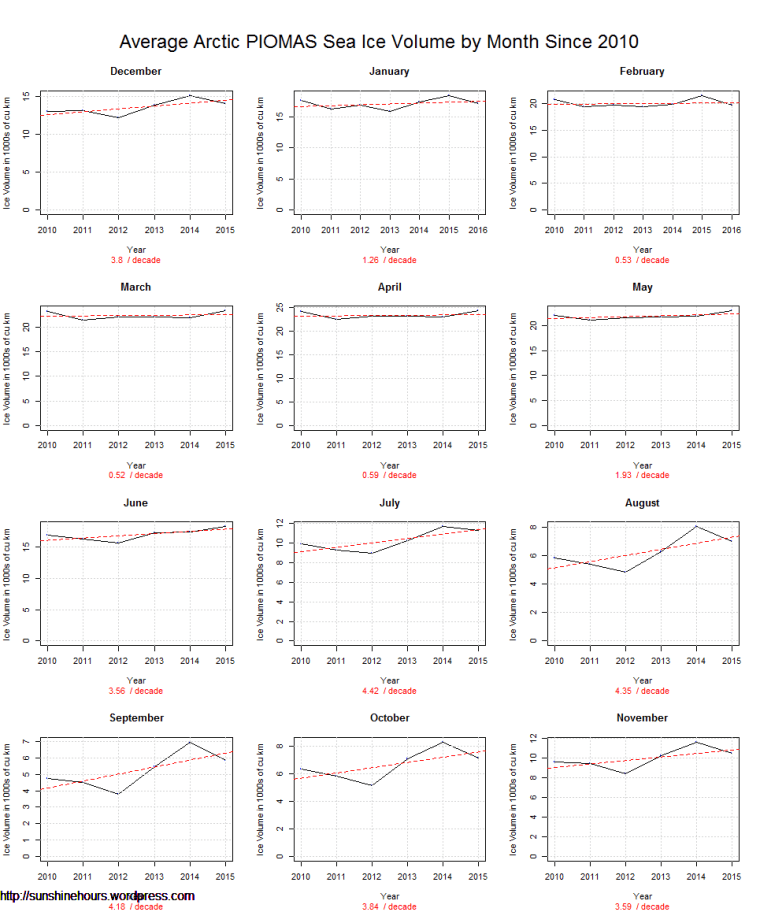
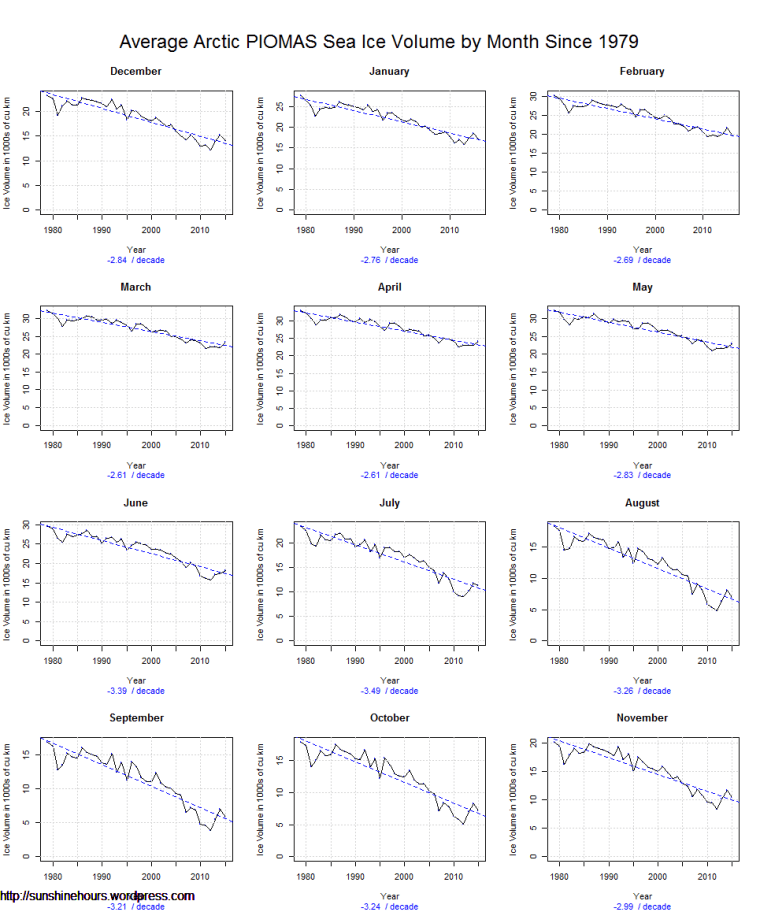
PIOMAS – Arctic Sea Ice Volume Up From 2010

PIOMAS is: “Sea Ice Volume is calculated using the Pan-Arctic Ice Ocean Modeling and Assimilation System (PIOMAS, Zhang and Rothrock, 2003) developed at APL/PSC.  Anomalies for each day are calculated relative to the average over the 1979 -2014 period for that day of the year to remove the annual cycle.”

The PIOMAS daily data is up to the end of February 2016.

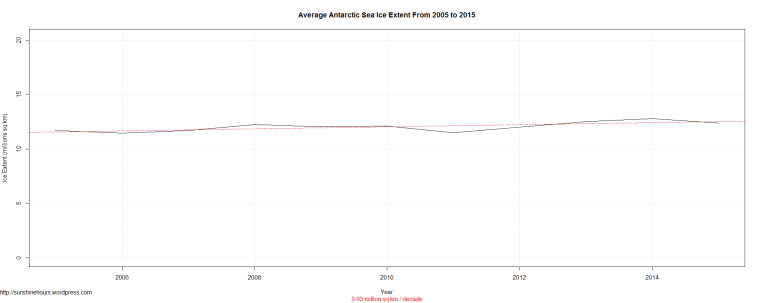
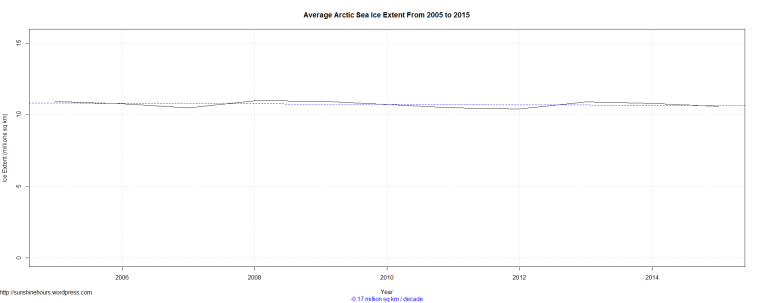
I post a lot of graphs about sea ice area and extent. Some of them show all the data. Some of them show data from 2005 because thats when the arctic sea ice extent trends levelled out.

PIOMAS also shows a leveling out, but not until 2010. I will show both the monthly graphs from 2010 and from 1979. (Click twice for larger) (Graph corrected due to incorrect units)


Average Arctic PIOMAS Sea Ice Volume by Month Since 2010


Average Arctic PIOMAS Sea Ice Volume by Month Since 1979


References:

Volume time series and uncertainties:
Schweiger, A., R. Lindsay, J. Zhang, M. Steele, H. Stern, Uncertainty in modeled arctic sea ice volume, J. Geophys. Res., doi:10.1029/2011JC007084, 2011

Model details:
Zhang, J.L. and D.A. Rothrock, “Modeling global sea ice with a thickness and enthalpy distribution model in generalized curvilinear coordinates“, Mon. Weather Rev., 131, 845-861, 2003


Are Wind Turbines Killing Whales?

Acoustic pollution harms humans on land and whales in the ocean.

“Between January 9 and February 4 this year, 29 sperm whales got stranded and died on English, German and Dutch beaches. Environmentalists and the news media offered multiple explanations – except the most obvious and likely one: offshore wind farms.

Indeed, that area has the world’s biggest concentration of offshore wind turbines, and there is ample evidence that their acoustic pollution can interfere with whale communication and navigation.”

“researchers at the University of St. Andrews have found that the noise made by offshore wind farms can interfere with a whale’s sonar, and can in tragic cases see them driven onto beaches where they often die,” a UK Daily Mail article observed.

It is certainly possible that permanent damage to the cetaceans’ middle and inner ears, and thus to their built-in sonar, can result from large air guns used during seismic surveys and from violent bursts of noise associated with pilings being rammed into the rock bed. Wind promoters themselves admit that their pile-driving can be heard up to 50 miles (80 kilometers) underwater, and can be harmful to whales that happen to be nearby. But unless these injuries cause external bleeding, they are very difficult to detect.”

Read more here.


Arctic Sea Ice Extent Since 2005 With 0 Shown on Y Axis

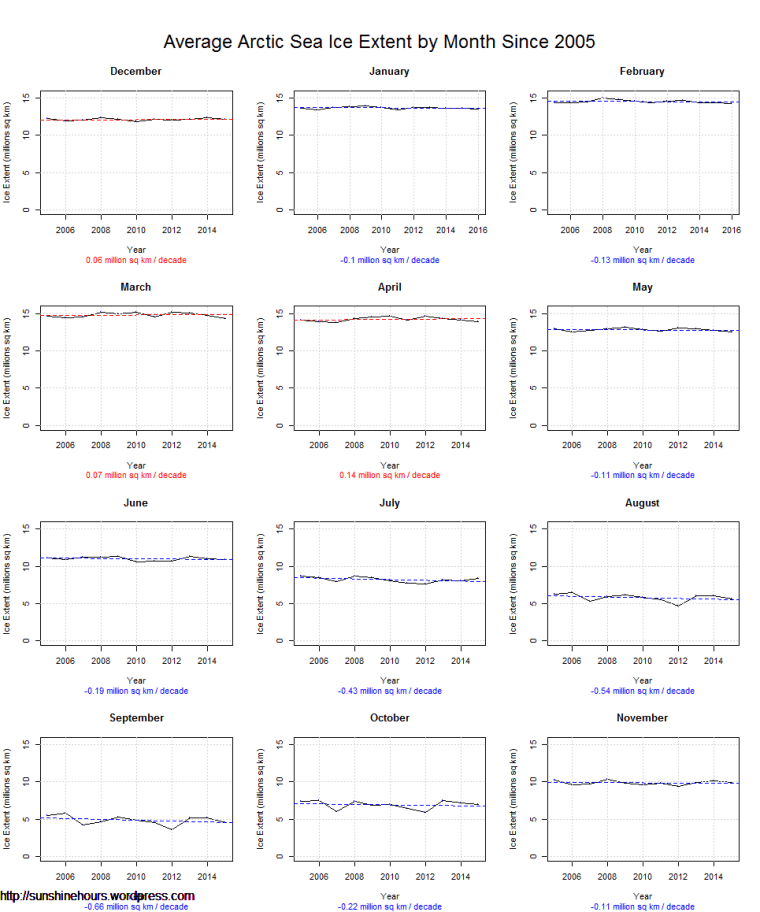
Arctic Sea Ice Extent By Month from 2005 with 0 shown on the Y axis. Red line shows an increasing ice trend.

Does this look like doom for the Arctic to you?

Average Arctic Sea Ice Extent by Month Since 2005


The latest South / North

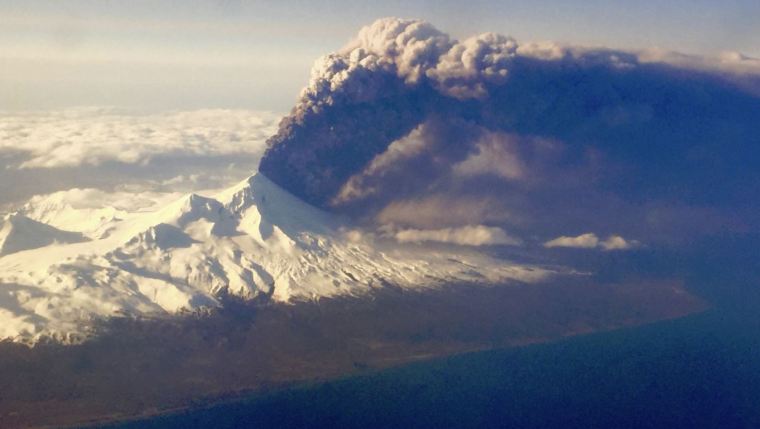
Pavlof Alaska Volcano Erupts

VOlcano_Alaska_Capture

A “massive” ash cloud that erupted from an Alaskan volcano disrupted flights operating on flight paths in the region on Monday, The Associated Press reports.

The ash cloud spewed from the Pavlof Volcano – one of the most-active in the state – that sits about 625 miles southwest of Anchorage.

http://www.wkyc.com/news/nation-now/volcano-ash-cloud-disrupts-flights-over-alaska/108262623


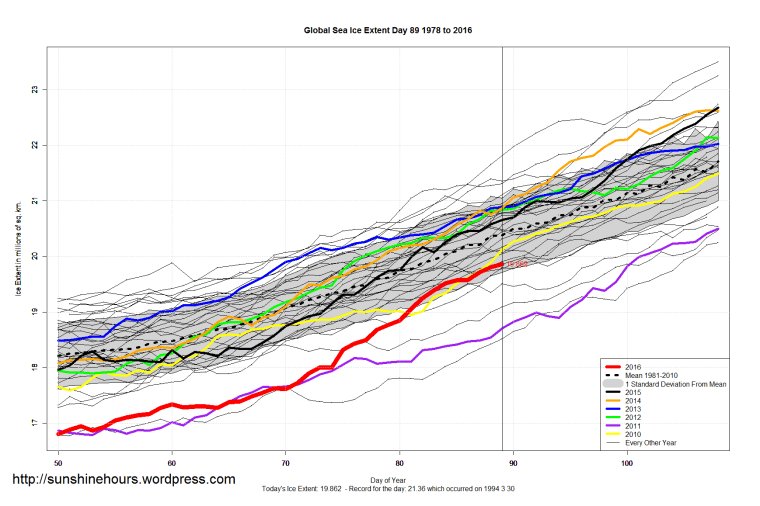
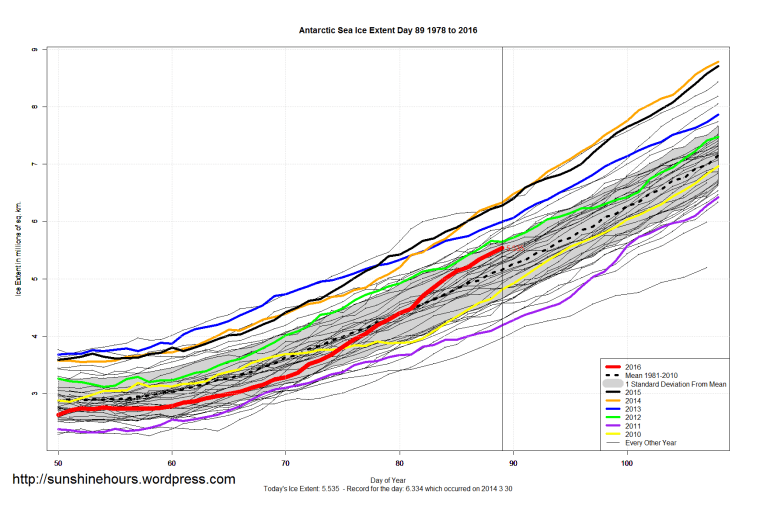
Sea Ice Extent (Global Antarctic and Arctic) – Day 88 – 2016

Global Sea Ice is inside the one standard deviation mark.

Antarctic Sea Ice is approaching the above one standard mean mark.

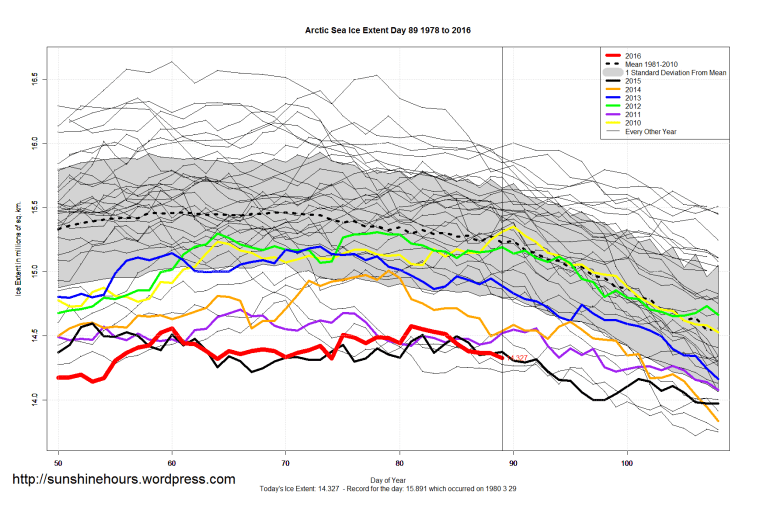
I’m pretty sure Arctic Sea Ice no longer has any chance of changing the maximum for 2016 and therefore will set the record for lowest maximum (NSIDC) by about 20,000 sq km (MASIE disagrees).

Global_Sea_Ice_Extent_Zoomed_2016_Day_88_1981-2010 Antarctic_Sea_Ice_Extent_Zoomed_2016_Day_88_1981-2010 Arctic_Sea_Ice_Extent_Zoomed_2016_Day_88_1981-2010

South / North