UK Green Taxes Killing the Steel Industry


Green taxes are killing the UK steel industry.

The U.K.’s steel crisis – worsened by Tata Steel Ltd.’s decision to sell its plant in Port Talbot, South Wales – has been exacerbated by three green taxes that the government implemented to boost clean energy, according to the manufacturers’s association EEF.

The three levies are the Carbon Price Floor, Renewables Obligation and Feed-In Tariff policies. Each works differently. Together, they increase steelmakers’ energy costs by about 30 pounds ($43) per megawatt-hour this year, Richard Warren, senior energy and environment policy adviser for EEF, said in an interview.

Electricity is an enormous cost for steel companies. The U.K.’s seven steel plants used about 3.2 million megawatt-hours of power in 2014, according to the EEF, not including what they generated themselves.

The German solution is to exempt industries and pass the cost of those exemptions onto the poor and then kill them.

Europe’s suicidal green energy policies are killing at least 4o,000 people a year.

That’s just the number estimated to have died in the winter of 2014 because they were unable to afford fuel bills driven artificially high by renewable energy tariffs.

But the real death toll will certainly be much higher when you take into account the air pollution caused when Germany decided to abandon nuclear power after Fukushima and ramp up its coal-burning instead; and also when you consider the massive increase in diesel pollution –  the result of EU-driven anti-CO2 policies – which may be responsible for as many as 500,000 deaths a year.



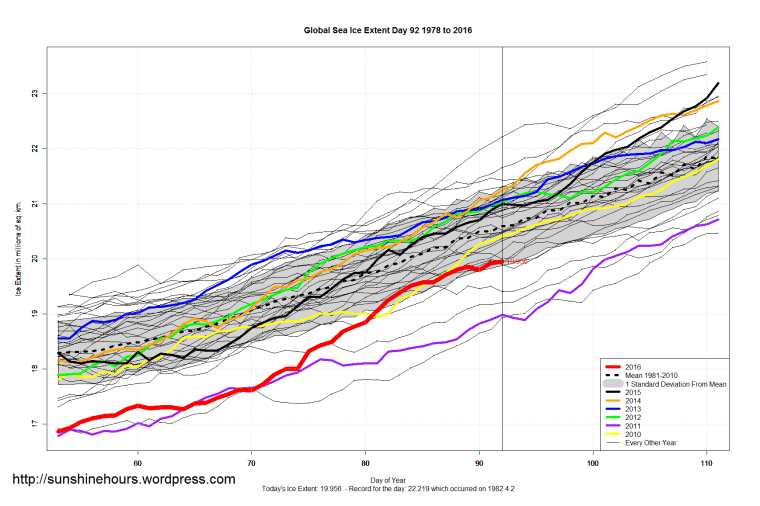
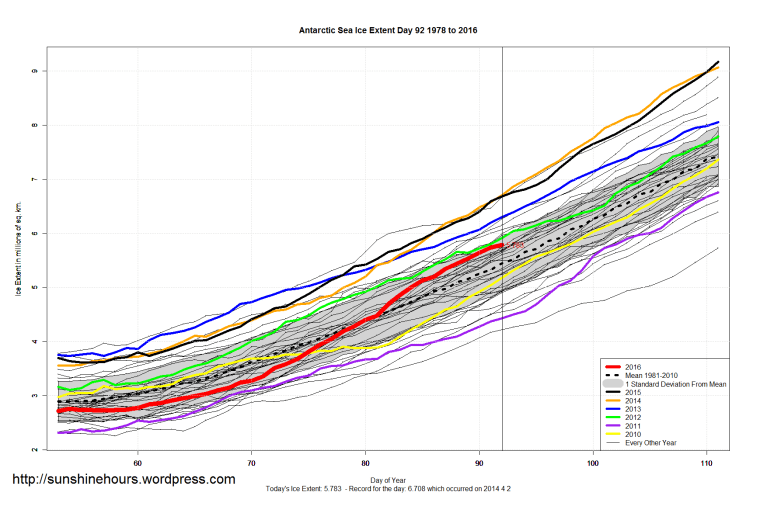
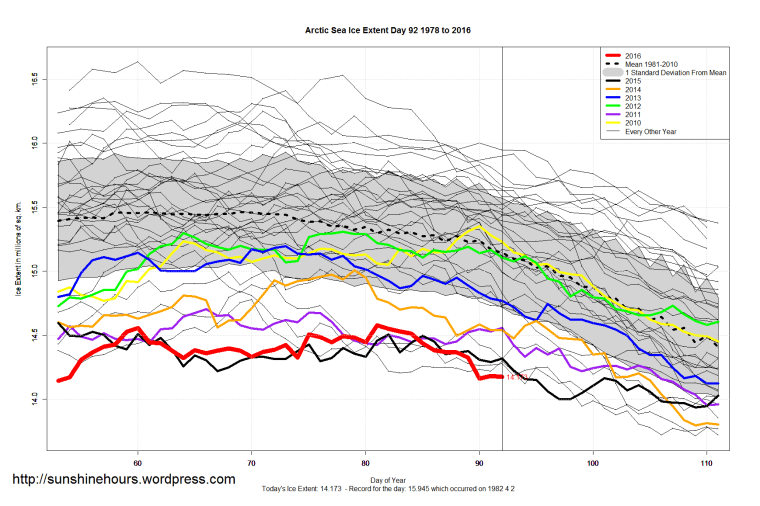
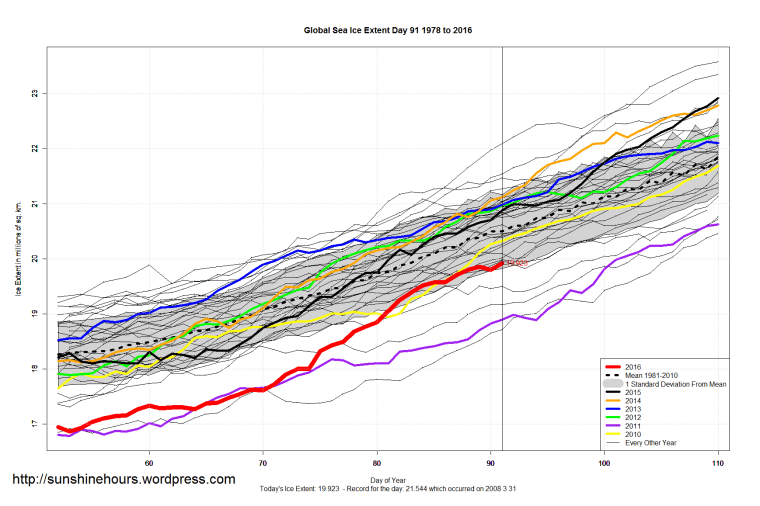
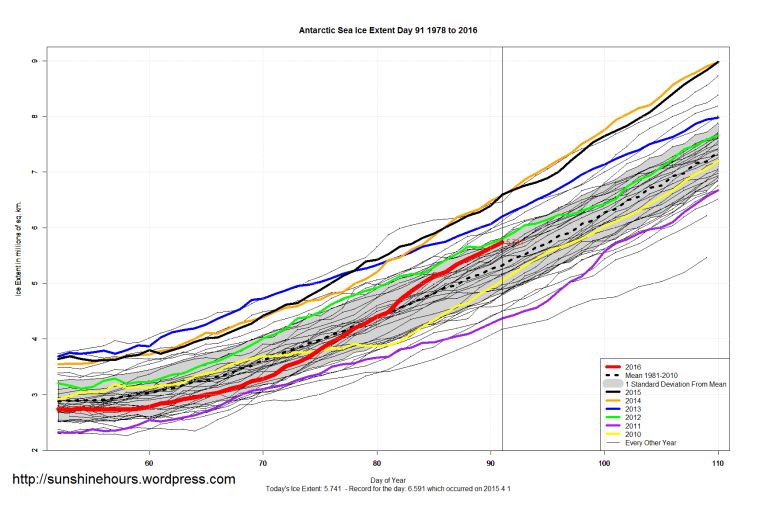
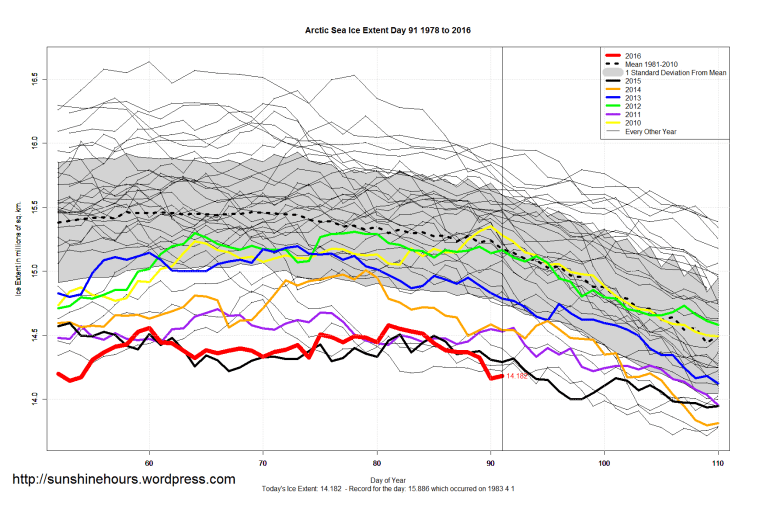
Sea Ice Extent (Global Antarctic and Arctic) – Day 93 – 2016 (No Data Yet)

The data for day 93 has not been uploaded to the website. It is late.


South / North

Climate “Scientists” off by a factor of 5.

Another study proving the science isn’t settled and the previous assumptions about catastrophic climate change just aren’t true.

Until now, most scientists have thought that a warming planet would cause plants to release more carbon dioxide into the atmosphere, which in turn would cause more warming.

But in a study published Wednesday in Nature, scientists showed that plants were able to adapt their respiration to increases in temperature over long periods of time, releasing only 5 percent more carbon dioxide than they did under normal conditions. Based on measurements of short-term temperature responses in this study and others, the scientists expected that the plants would increase their respiration by nearly five times that much.


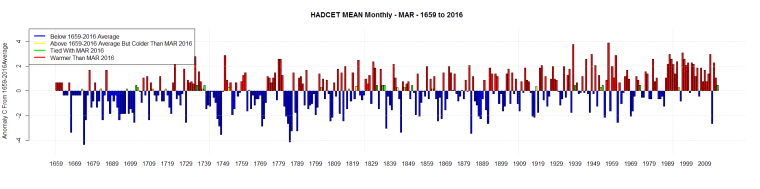
HADCET March 2016 Mean Temperature – Tied For 143rd Warmest out of 355

 HADCET (Central England Temperature) Longest temperature record in existence.

HADCET March 2016 was tied for 143th warmest out of 355 at 5.8C. 

The warmest March was 1957 at 9.2C.

The barplot is the Marches since 1659. The temperature is the anomaly from the 1659 to 2016 average.

The yellow bars are the years warmer than March 2016. Green bars indicate a tie with March 2016. Click twice for bigger.

HADCET MEAN Monthly - MAR - 1659 to 2016


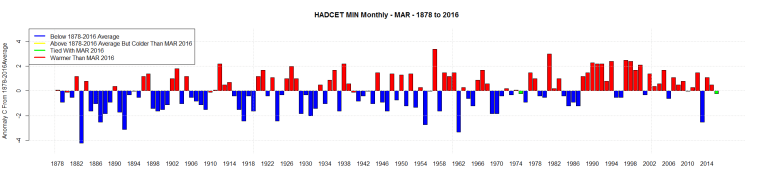
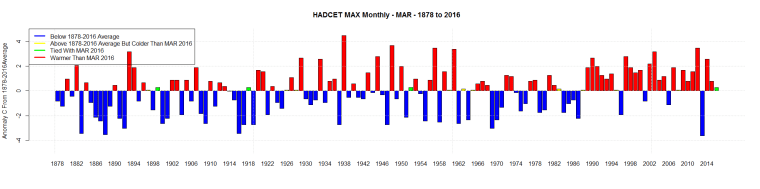
HADCET only goes back to 1878 for MIN and MAX. Here are those graphs.


HADCET MIN Monthly - MAR - 1878 to 2016

HADCET MAX Monthly - MAR - 1878 to 2016


Alberta NDP Coal Phaseout Could Triple Power Bills

If you live in Alberta Canada, get ready for a possible tripling of electricity costs.

“Whether you’re in oil and gas, forestry, agriculture, tourism, we need good, affordable, dependable power to be successful,” Coal Association of Canada president Robin Campbell said. “It’s one of the things we have in this province that allows us to compete globally and we’re about to lose that.”

The NDP says phasing out coal is necessary not only to reduce green house gases but also to improve air quality.

Campbell says all those concerns could be addressed through investing in clean coal technologies without jeopardizing base-load power.

New coal power plants generate more CO2 than natural gas but they generate way less CO2 than wood pellets.

Another study:

It found that the boost in renewables and the end of coal would mean a 45 per cent reduction in emissions, or 18.5 million fewer tonnes of carbon released into the atmosphere a year.

However, under the province’s privatized utility system, prices would have to be between $60 to $85 per megawatt hour to justify wind power construction.

And if solar power were to make up 50 per cent of the renewables mix “it would cost between $200 and $300 per megawatt hour,” the study found.

Alberta Energy Companies are bailing on contracts and leaving Alberta taxpayers to pay and pay and pay  for the NDP’s stupidity.

The NDP now have a “coal phaseout negotiator” for getting rid of coal. It will cost billions. And will make Alberta a have not province.


UK Going Green By Shutting Down Industry

This is insane. And cruel to the formerly employed in the UK.

A fortnight ago, the energy minister, Andrea Leadsom, declared grandly that Britain, alone in the world, would commit to a target of reducing net carbon emissions to zero. ‘The question is not whether but how we do it,’ she told Parliament. It is now becoming painfully clear how this target will be reached: not by eliminating our carbon emissions but by exporting them, along with thousands of jobs and much of our manufacturing industry.

This week, Tata Steel announced that its entire UK business is to be put up for sale. That came after Stephen Kinnock, whose South Wales constituency includes Tata’s giant plant at Port Talbot, joined a union delegation to the headquarters of Tata Steel in India to beg the company to keep the plant open. Some 750 job losses have already been announced there; more than 1,000 jobs, including these, will be lost across Britain as our steel industry struggles to compete with lower-cost producers overseas.

Britain has the highest energy costs in Europe, thanks to decisions taken not in Brussels but in Whitehall. Crusaders like Ms Leadsom have, over the years, made sure that our manufacturers feel the force of green levies, unlike Germany, which exempts its own industry. The idea is that by making energy more expensive, people are encouraged to use less of it. This is working very effectively, as the soon-to-be-unemployed Welsh steelworkers will attest. If the plant closes, carbon emissions in Port Talbot will fall dramatically.

All European producers face much higher costs than Chinese steelmakers thanks to the EU Emissions Trading System. But Britain imposes its own green taxes on top of this in the form of the Carbon Price Floor and the Renewables Obligation — an epic act of self-harm. Tata points out that its energy costs for running steel plants in Britain are 25 per cent more than they would be in Germany and 50 per cent more than they would be in France. This is due to decisions by the UK government to spread the pain of green tariffs so that businesses are hit as hard as consumers.

The odds are that the steel being bought from China produces more CO2 than the steel bought from Tata in the UK.

Green offshoring is the suicidal act of idiots. They send the jobs and CO2 production overseas and do nothing for the people who lose their jobs.


Wild Bees Threatened By Biofuels!!!

Wild Bees are in trouble according to the this article. They trot out the usual blame (climate change) but then get to the real culprit.

Pesticides, climate change, and diseases threaten wild bees—but the new study also shows that their decline may be caused by the conversion of bee habitat into cropland. In eleven key states where the new study shows bees in decline, the amount of land tilled to grow corn spiked by two hundred percent in five years—replacing grasslands and pastures that once supported bee populations. “These results reinforce recent evidence that increased demand for corn in biofuel production has intensified threats to natural habitats in corn-growing regions,” the new study notes.

Ethanol increased tilling of marginal land for corn because of the ethanol subsidies.

This was the first-ever attempt to simultaneously map the trends in wild bee abundance based on recent land conversion and the demand for pollination of different crops across the nation.

Researchers from University of Vermont conducted the first national study for mapping wild bees and found that wild bees are disappearing rapidly from US major farmlands including California’s Central Valley, which is known for its almond production, the Midwest’s corn belt, and the Mississippi River valley. If the trend continues, it will cost farmers heavily and may ruin crop production in US.

Study suggests that more than $3 billion of US agricultural economy depends upon pollinators like wild bees for the reproduction of their crops and around 39% US crop regions rely on these native pollinators and spend millions of dollars annually to rent beehives.

But researchers have found there is a mismatch between the rising demand for pollination and availability of wild bees. They estimate that wild bee population has declined 23% from 2008 to 2013.