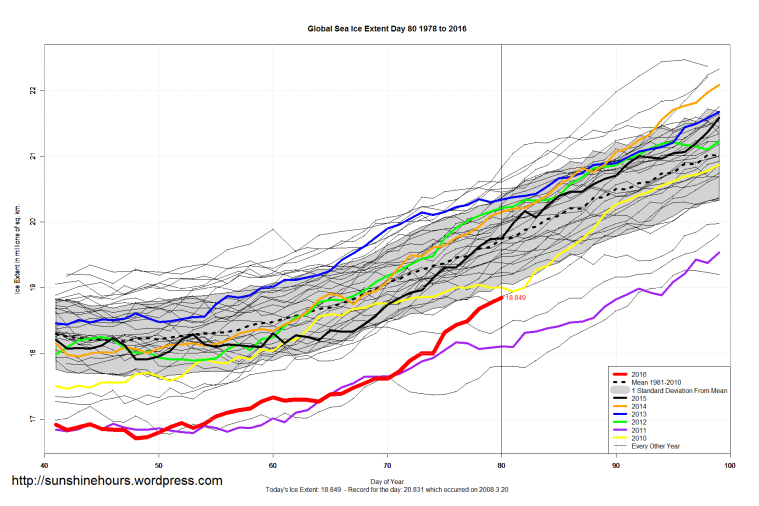
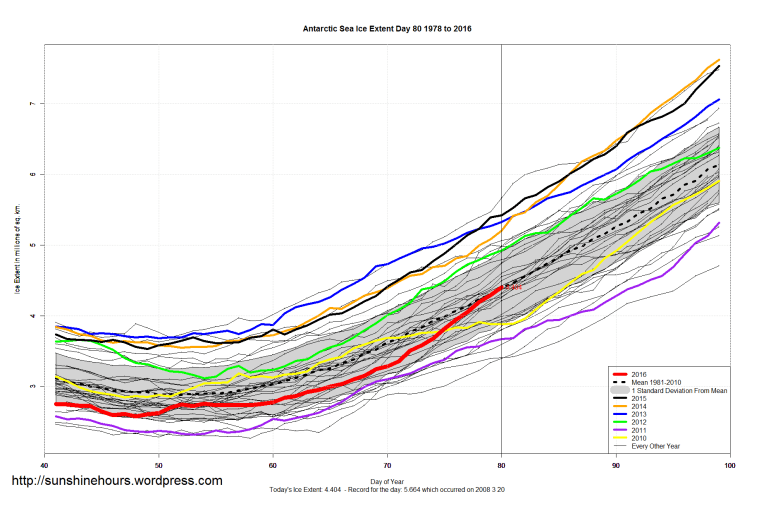
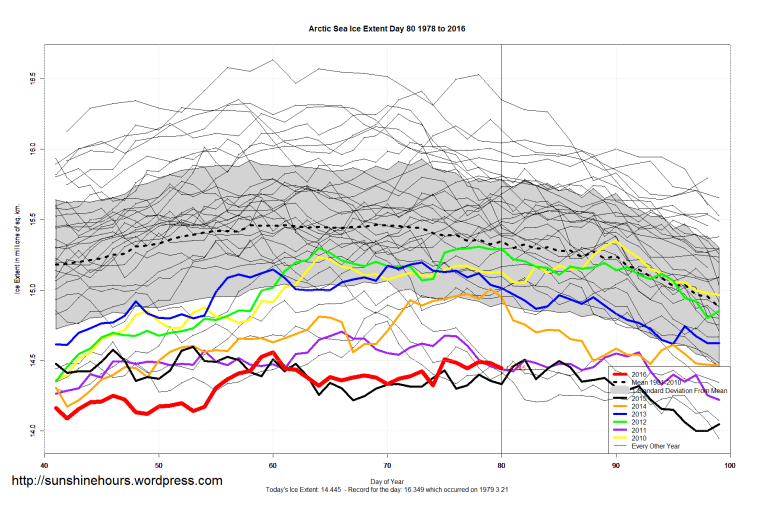
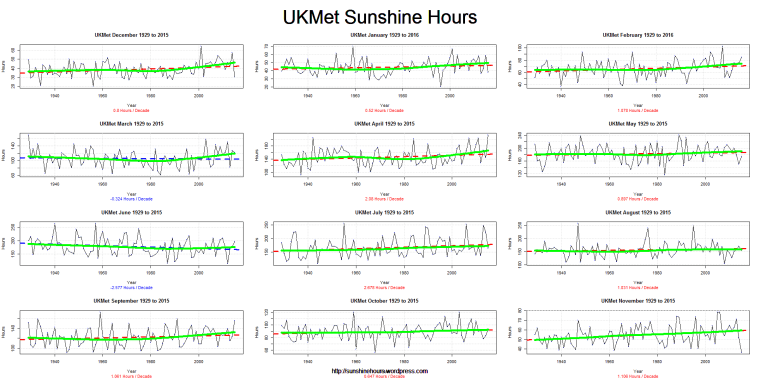
UKMet Sunshine Hours 1929 to 2016
Only 2 out of 12 months in the UK show a downward trend in sunshine hours. March and June.
The trend values (red for increasing) are in hours per decade.
Sea Ice Extent (Global Antarctic and Arctic) – Day 79 – 2016
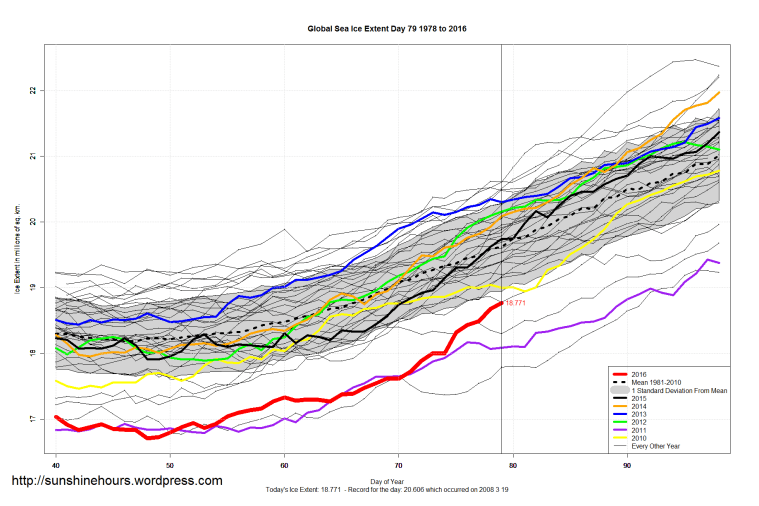
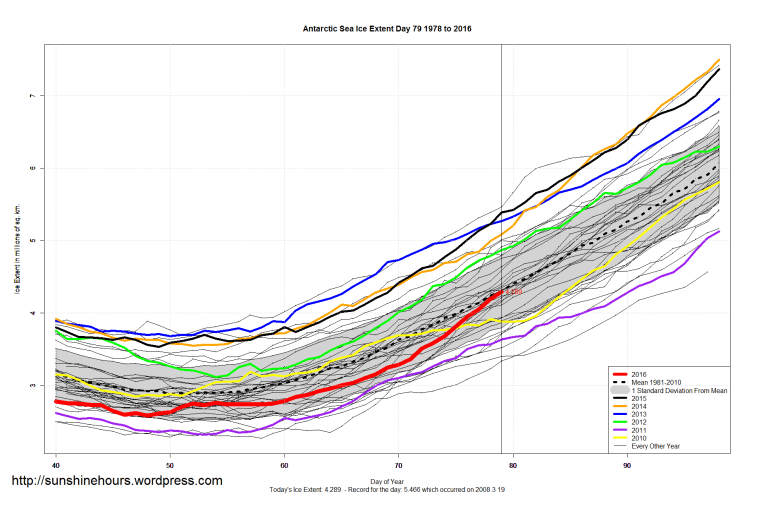
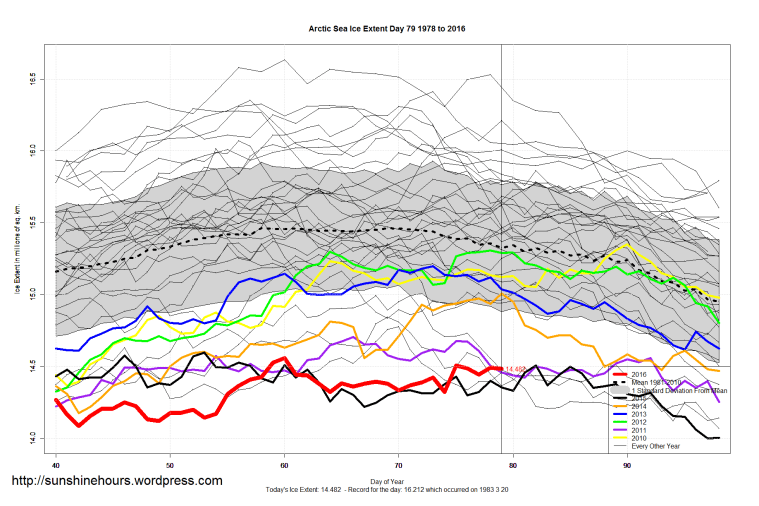
Sea Ice Extent (Global Antarctic and Arctic) – Day 78- 2016
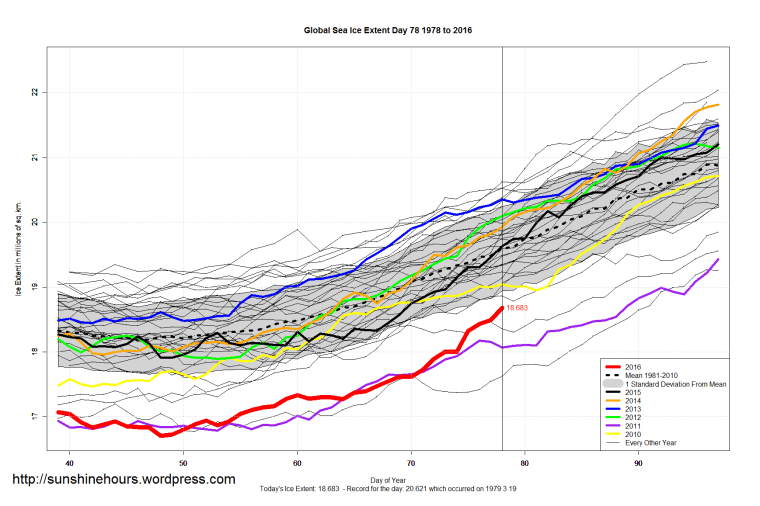
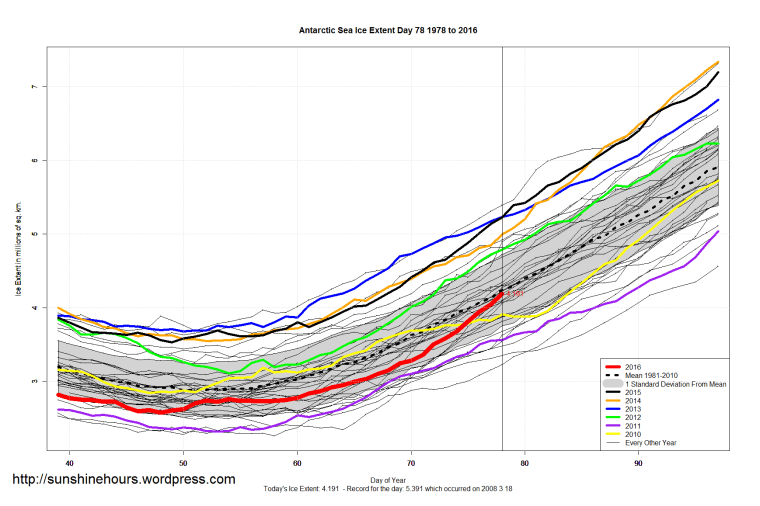

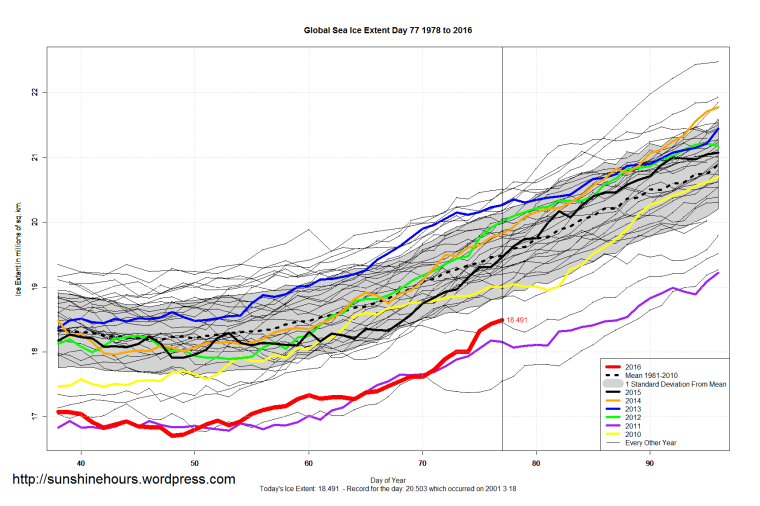
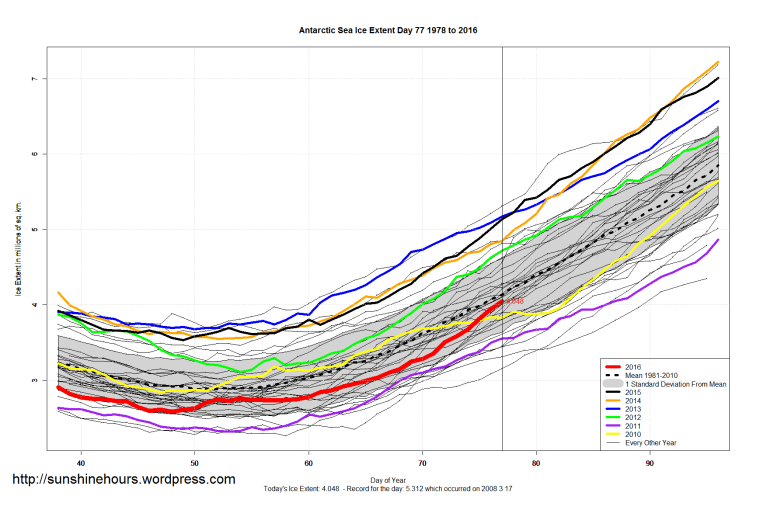
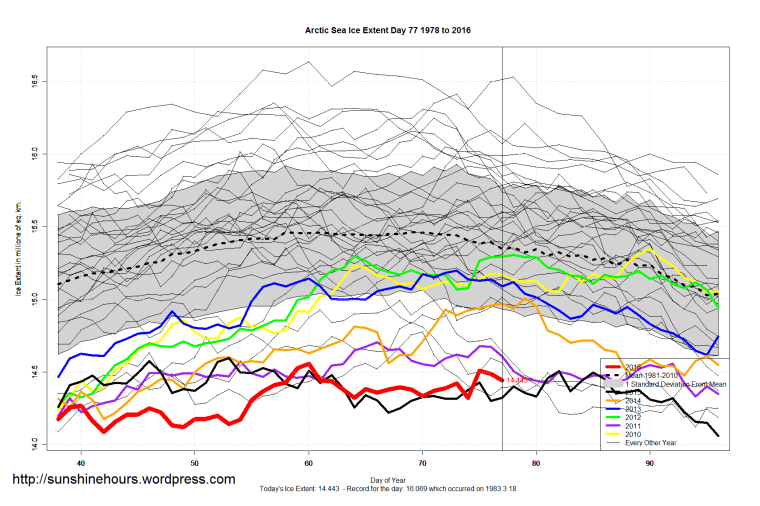
Sea Ice Extent (Global Antarctic and Arctic) – Day 77 – 2016
Plastic Water Bottle Bans Cause Diabetes
The City of Montreal wants to ban plastic water bottles because they hate water … or something … and want to save the world.
The University of Vermont banned selling water bottles in 2013 after a student-led campaign to reduce waste on campus. Seems like a good idea, right?
Two years after the bottle ban went into effect, the results are in, and they are … not great.
NPR reports that a study by UVM professor Rachel Johnson found that banning bottled water actually made the total number of bottles on campus increase. “When we compared the spring of 2012 to the spring of 2013,” Johnson told Vermont Public Radio’s Tyler Dobbs, “the number of bottles shipped per capita or per person to the UVM campus actually went up by 6 percent.”
That’s right — less access to bottled water meant more bottles wasted. The university replaced bottled water with filtered water stations, but apparently students skipped right past those and went for other bottled drinks like sodas and juices instead. Turns out, it’s not so easy to get college students to make the healthiest choices, especially when you forgot your Nalgene at home and the vending machine is right there.
So we took away the healthiest beverage.
Plastic water bottle ban leads to unexpected results
Plastic water bottle bans cause diabetes.
Disposable Coffee Cups: If You Care About the Environment Make Coffee At Home!
There is a big kerfuffle about the billions of disposable coffee cups thrown away when people drink coffee out.
If you care about the environment:
Make Coffee At Home!
Put it in a thermos!
Wash the non-disposable cup when done!

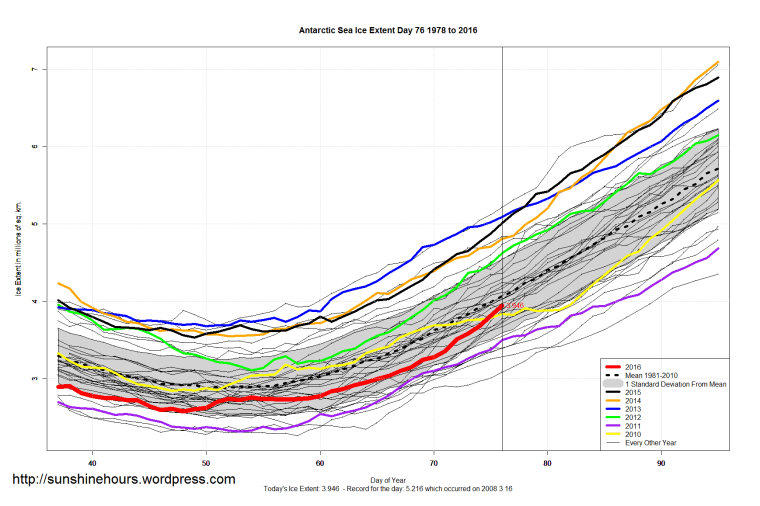
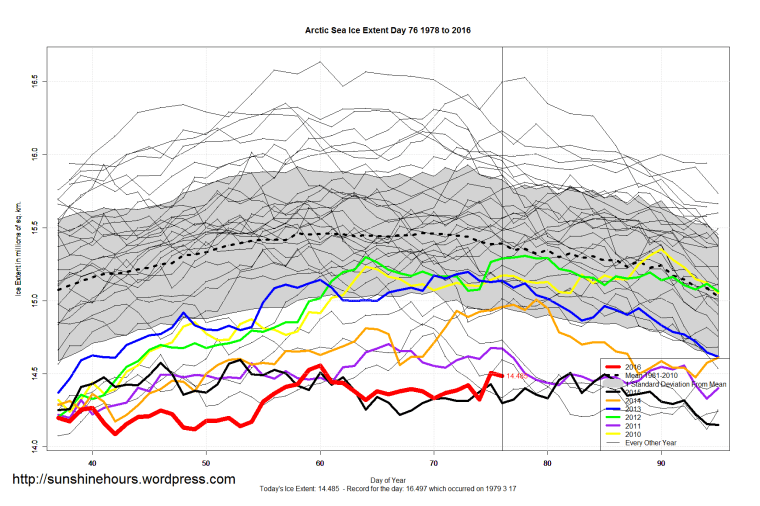
Sea Ice Extent (Global Antarctic and Arctic) – Day 76 – 2016

Wood Pellets are 3x to 4x More Expensive Than Coal And Produce More CO2.
UPDATE: See 1.5 year old numbers for coal versus wood in USA at bottom
I’m not a big fan of coal. But I do oppose stupidity. Switching from coal (which produces CO2 and particulate matter when burned) with wood pellets (which produces CO2 and particulate matter when burned) that kill forests seems kind of dumb.
How much CO2 and particulate matter is hard to find out. This post suggests wood pellets produce more CO2 than coal when you account for all of the transportation costs.
This article suggests wood pellets costs 150 to 200 a ton when coal is going for 51$ a ton.
“Wood pellets are much more expensive, about $150 to $210 a ton, compared to about $51 for coal in Newcastle, Australia, the global benchmark. Lyra wouldn’t provide a price for sugar-cane pellets, though he said they’re “competitive” with wood.
“These products don’t compete on price,” said Lyra. “Companies that are looking to use renewables as a replacement have assets fueled by coal that has a deadline to disappear.”
It would make sense ( in the green stupidity way) to replace coal with trees and then pay 4x the cost and still produce lots of CO2.
As for CO2, the above referenced article says:
“Bagasse pellets emit about one-16th the carbon dioxide of coal, when burned in Brazil“
That is the key. If you transport the pellets (whether wood or sugar cane) it produces a lot more CO2.
This article is interesting.
“Burning wood pellets releases as much or even more carbon dioxide per unit of energy as burning coal, so in order for burning pellets to be carbon-neutral the carbon emitted into the atmosphere has to be recaptured in regenerated forests, Abt says. Residual wood, such as tree thinnings and unused tree parts left over at timber mills, is the best material for wood pellets, says Abt. But he and others say that not enough of such waste wood exists to feed the growing demand for wood pellets.
So the industry has turned to whole trees.”
Ouch!
“The accounting now used for assessing compliance with carbon limits in the Kyoto Protocol and in climate legislation contains a far-reaching but fixable flaw that will severely undermine greenhouse gas reduction goals (1). It does not count CO2 emitted from tailpipes and smokestacks when bioenergy is being used, but it also does not count changes in emissions from land use when biomass for energy is harvested or grown. This accounting erroneously treats all bioenergy as carbon neutral regardless of the source of the biomass, which may cause large differences in net emissions. For example, the clearing of long-established forests to burn wood or to grow energy crops is counted as a 100% reduction in energy emissions despite causing large releases of carbon.”
http://science.sciencemag.org/content/326/5952/527.summary
UPDATE:
“The cost of a unit of electricity consumed within the U.S. ranged between $171 and $175.40 per MWh, depending upon the pine rotation age. The cost of pulpwood procurement (stumpage, logging, and pulpwood transportation) was about 26 percent of the overall cost across rotation ages. Manufacturing of wood pellets and generation of electricity at the power plant contributed about 30 and 40 percent, respectively, toward the overall cost of a unit of electricity across rotation ages. The average unit cost was $173 per MWh, which was 73 percent and 157 percent higher than the average obtained from coal, at $100 per MWh, and natural gas, at $67 per MWh, respectively.
This cost differential is the main reason U.S. electric utilities show little interest in utilizing wood pellets. Therefore, special policy incentives will be needed to promote wood pellets as a potential feedstock, instead of coal and natural gas.”
Institutions Are Biased
Interesting paper coming out that may demolish Psychology. And other pseudo sciences like climate science.
“How could hundreds of peer-reviewed studies possibly be so wrong? There may be a way to explain it, and it’s shaking researchers to their cores.
Every time scientists conduct an experiment, there’s a chance they’ll find a false positive. But here’s the scary thing: Psychologists are now realizing their institutions are structured so it’s more likely that false positives will make it through to publication than inconclusive results.
“We’re now learning that there’s so much bias in the published literature that the meta-analyses can’t be trusted,” Simine Vazire, a professor of psychology and the editor in chief of the journal Social Psychological and Personality Science, tells me.”

