HADCET Feb 2016 Mean Temperature – Tied For 106th Warmest out of 354

You remember  HADCET (Central England Temperature)? Longest temperature record in existence!.

You remember the hoopla about February 2016 being the hottest of all time?

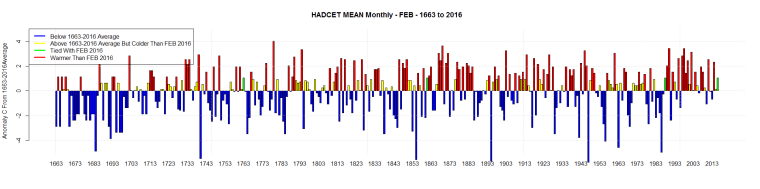
HADCET February 2016 was tied for 106th warmest out of 354.

The barplot is the Februaries since 1663. The temperature is the anomaly from the 1663 to 2016 average.

The yellow bars are the years warmer than February 2016. Green bars indicate a tie with February 2016. Click twice for bigger.

HADCET MEAN Monthly - FEB - 1663 to 2016

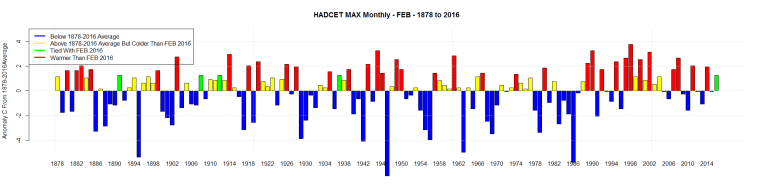
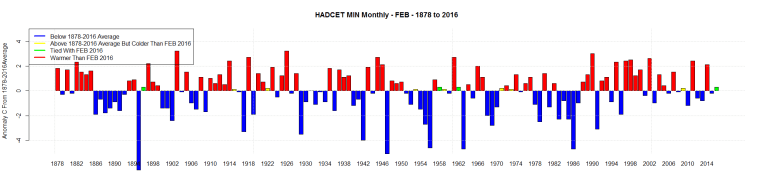
HADCET only goes back to 1878 for MIN and MAX. Here are those graphs.

HADCET MAX Monthly - FEB - 1878 to 2016 HADCET MIN Monthly - FEB - 1878 to 2016

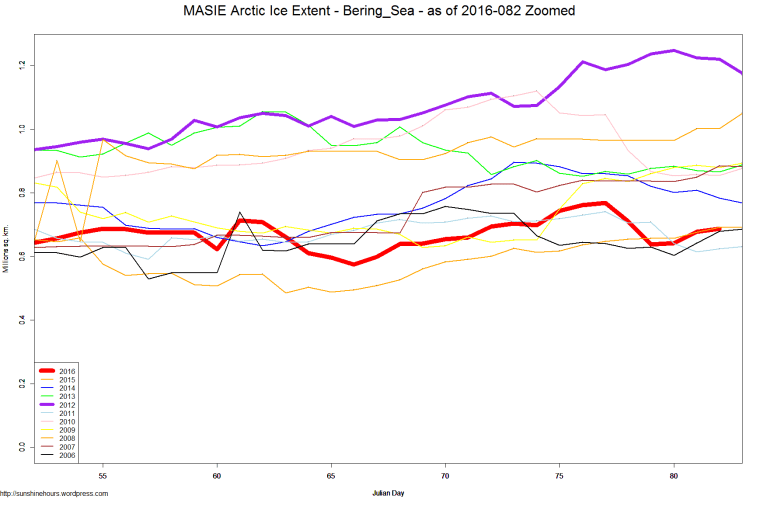
MASIE Day 82 2016 – Bering Sea

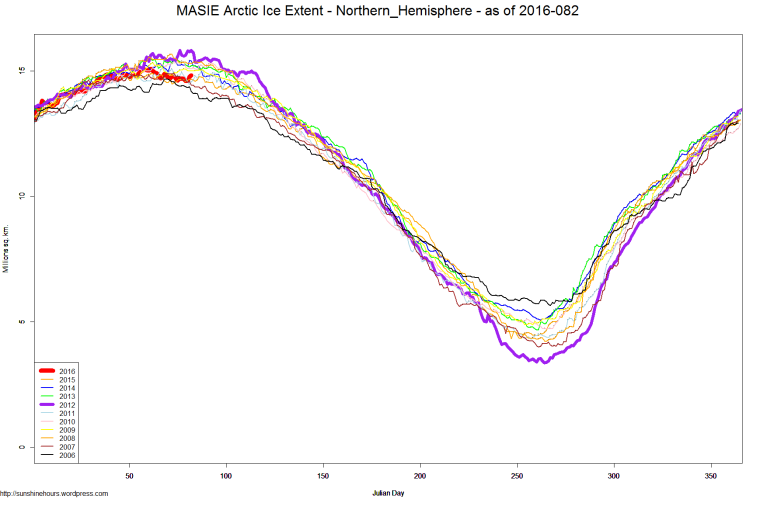
MASIE and NSIDC are two different sea ice indexes. The difference between the two methodologies is here.


Right now MASIE is running about 1,000,000 sq km lower than 2012. The Bering Sea region is running over 500,000 sq km lower than 2012.

2012 was the highest MASIE maximum (data only goes back to 2006)  and also the lowest minimum in the summer.


MASIE Arctic Ice Extent - Bering_Sea - as of 2016-082 Zoomed

MASIE Arctic Ice Extent - Northern_Hemisphere - as of 2016-082


Sea Ice Extent (Global Antarctic and Arctic) – Day 82 – 2016

Arctic Sea Ice is within 45,000 sq km of avoiding a new record of lowest maximum. (It was closer yesterday)

Global Sea Ice is now just inside the one standard deviation mark.

Antarctic Sea Ice is above the mean.

Arctic_Sea_Ice_Extent_Zoomed_2016_Day_82_1981-2010 Antarctic_Sea_Ice_Extent_Zoomed_2016_Day_82_1981-2010 Global_Sea_Ice_Extent_Zoomed_2016_Day_82_1981-2010

South / North

Word of the Day: Cofiring and more CO2

Cofiring: the combustion of two different types of materials at the same time.

This word may not be new to many of you (or some of you) but it was to me. Or course I have mocked the idea of replacing coal with wood since burning wood from the USA creates more CO2 than coal. The DRAX post from the other day points out that even DRAX’s own study showed more CO2 from wood pellets than from coal.

And destroying forests to produce more CO2 in the atmosphere seems to me to be amazingly stupid.

So I’ve been investigating to see what kind of cofiring goes on and how much CO2 is produced. The really important terms are Total CO2 and Net CO2 and CO2 neutral.

Total CO2 refers to the gross emissions of CO2 from this power plant.

Net CO2 refers to the emissions of CO2 from the fossil fuel used in this power plant, since biomass is assumed to be CO2 neutral. Gross CO2 and net CO2 will be the same where only fossil fuel is used.

In my opinion the concept of CO2 neutral is bogus. CO2 is CO2. If you generate 600MW of power and you care about CO2 then it shouldn’t matter whether you use coal or sewage sludge or any other biomass. It should be total CO2. (Not completely true because other things are produced from coal power plants like SO2 etc but today we talk CO2)

I came across this paper: A Techno-economic assessment of the reduction of carbon dioxide emissions through the use of biomass co-combustion

The paper claims:

Using sustainably-grown biomass as the sole fuel, or co-fired with coal, is an effective way of reducing the net CO2 emissions from a combustion power plant. There may be a reduction in efficiency from the use of biomass, mainly as a result of its relatively high moisture content, and the system economics may also be adversely affected.

Notice the term net CO2 is used. Their conclusions are based on the fallacy that the CO2 produced by burning the biomass is zero. But they were nice enough (honest enough?) to show the figures for total CO2.

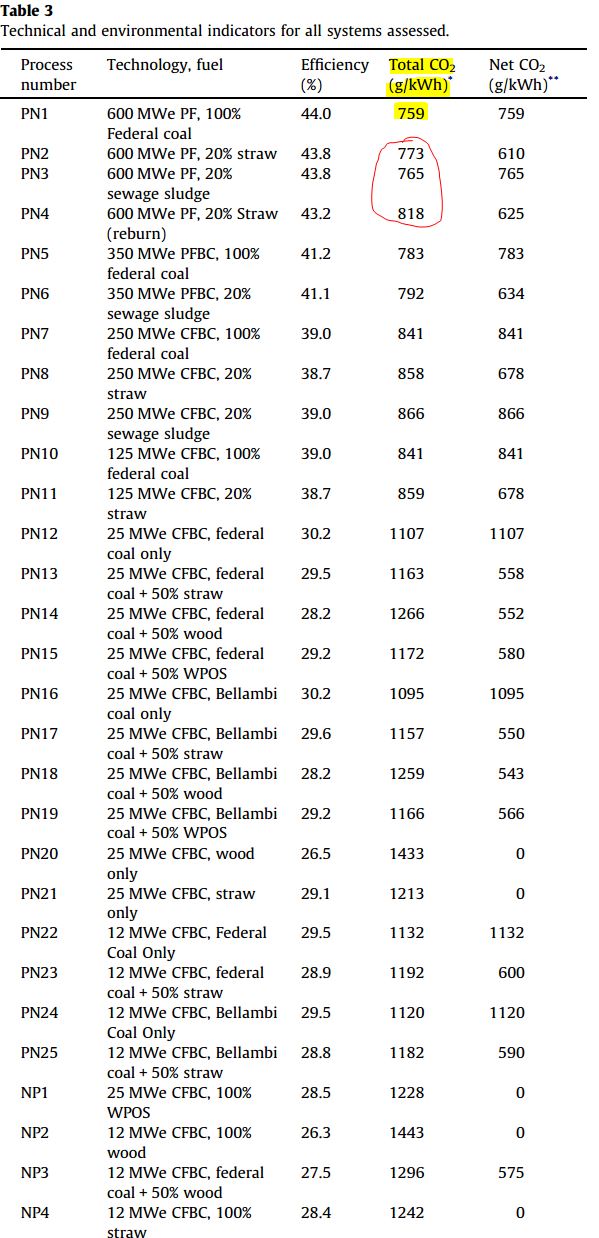
The table shows the result of the experiments. The one I highlighted has 4 sections:

PN1: a 600MW power plant burning 100% coal. CO2 = 759 g/kWh
PN2: a 600MW power plant burning 80% coal and 20% straw. 773 g/kWh
PN3: a 600MW power plant burning 80% coal and 20% sewage sludge. 765 g/kWh
PN4: a 600MW power plant burning 80% coal and 20% straw (reburn). 818 g/kWh

In all cases biomass+coal cofiring produces more CO2. And the CO2 numbers don’t take into account transportation of coal or biomass. So locally sourced biomass isn’t a disaster. But wood pellets from the USA produce a lot of CO2 just in transport costs.
Capture


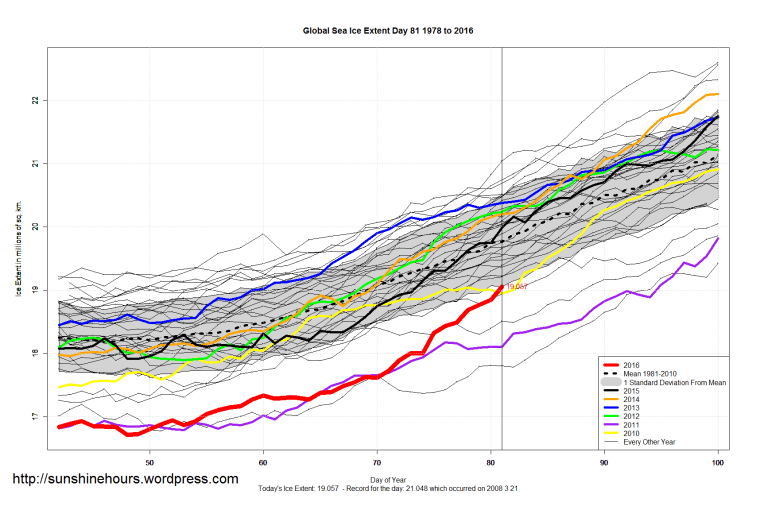
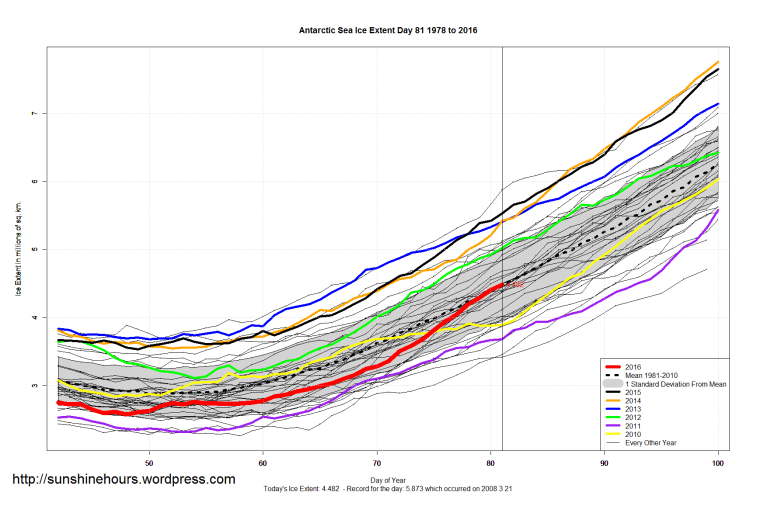
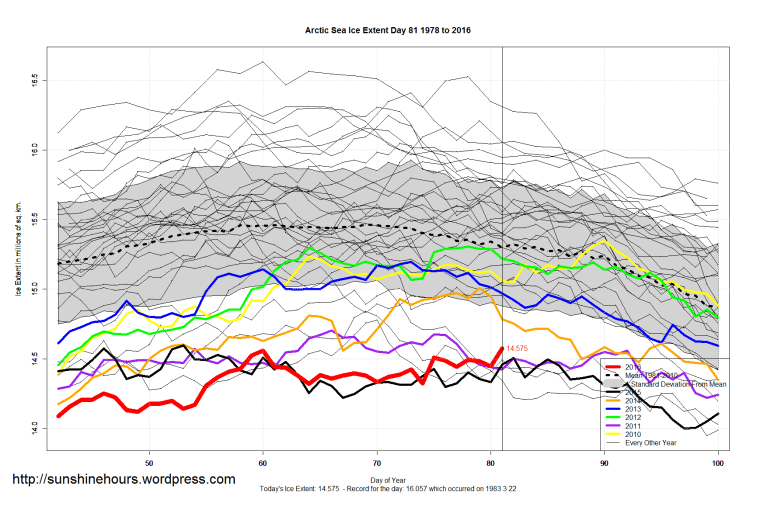
Sea Ice Extent (Global Antarctic and Arctic) – Day 81 – 2016

Arctic Sea Ice is back to within 20,000 sq km of avoiding a new record of lowest maximum.

Global Sea Ice is now just inside the one standard deviation mark.

Global_Sea_Ice_Extent_Zoomed_2016_Day_81_1981-2010 Antarctic_Sea_Ice_Extent_Zoomed_2016_Day_81_1981-2010 Arctic_Sea_Ice_Extent_Zoomed_2016_Day_81_1981-2010

South / North

Germany Will Need 3,000 Wind Turbines To Replace One Nuke Plant

Insane: Germany Will Need 3,000 Wind Turbines To Replace This Workhorse Nuke Plant

“Germany’s Grohnde nuclear power plant in Lower Saxony has just become the single most productive power plant in history. It just passed its 350 billion kWh production milestone, the most of any nuclear plant, and the most of any plant of its size in the world.”

“Unfortunately, Grohnde is scheduled to close in 2021, decades ahead of its useful life, like all of Germany’s nuclear plants, and the positive and negative affects of that policy are still being debated.

In 2001, Gerhard Schröder’s government decided to get rid of nuclear power from the country as fast as possible. In 2010, Merkel actually decided to extend the lives of nuclear power plants another ten years beyond Schröder’s limit. But the Fukushima disaster in 2011 forced her politically to revert back to the original plan, closing eight nuclear plants immediately and planning to close the rest in the following 10 years.”

http://www.forbes.com/sites/jamesconca/2016/03/21/the-little-reactor-that-could-germanys-grohnde-nuclear-plant/

German power companies have been forced to set aside 39 billion Euros for the nuke decommissioning.

And most likely Germany will still be burning huge amounts of brown coal long after the last nuke is shutdown.


Chesapeake Energy and Sierra Club and Aubrey McClendon

Three weeks ago, Aubrey McClendon, co-founder of Chesapeake Energy Corp (a major player in shale gas) was accused of rigging bids for oil- and gas-drilling rights. McClendon slipped away from his security team and climbed into his 2013 Chevy Tahoe. He sped north along a lonesome two-lane stretch of Midwest Boulevard, toward the prairie-scrub city edge, where he drove his SUV into a wall at high speed.

I’m assuming suicide. When I read about this I was reminded of the huge (well .. it should have been huge) scandal discovered by Time Magazine in 2012.

“between 2007 and 2010 the Sierra Club accepted over $25 million in donations from the gas industry, mostly from Aubrey McClendon, CEO of Chesapeake Energy—one of the biggest gas drilling companies in the U.S. and a firm heavily involved in fracking—to help fund the Club’s Beyond Coal campaign.”

The problem with the “Beyond Coal”  campaign is that it wants to replace coal with super-expensive renewables (instead of cheap natural gas)  despite the bribes from McClendon.

China has 150 new coal power plants planned “a capacity of 123GW, more than twice Germany’s entire coal fleet”.

Not only will killing coal in the USA put 10s of thousands of people out of work (many of whom will probably vote Trump) … replacing coal with renewables will make manufacturing and home electricity even less competitive.

And even more coal will be burned in China (and India etc) than is not burned in the USA.

McClendon was an idiot to fund the Sierra Club.


Greenpeace May Be In Trouble in Canada

I’m sure the shredders will work overtime, but Greenpeace could be in trouble.

Any day now a Canadian court could force the radical environmental group Greenpeace to open up its records world-wide to scrutiny from attorneys for Resolute Forest Products. The progressive green bullies may have picked on the wrong business.

Standard operating procedure for many companies faced with a protest campaign is to write a check and hope it goes away. But not at Montreal-based Resolute. CEO Richard Garneau tells us, “If you believe you’re on firm ground, you stand firm.”

In 2012 Greenpeace claimed that Resolute was violating forestry practices that the company had agreed to follow. Resolute threatened legal action and so Greenpeace retracted its claims. But Resolute says that even after the retraction the environmental outfit kept publishing and broadcasting the same false claims, along with some new ones. According to the company, one Greenpeace tactic is to show video footage of trees damaged by an insect outbreak hundreds of miles away but pretend it is the forest harvested by Resolute. Greenpeace denies this.

In 2013 Resolute sued Greenpeace for “defamation, malicious falsehood and intentional interference with economic relations” and sought $7 million Canadian in damages. The company has clearly been harmed by Greenpeace’s fact-challenged denunciations of logging in Canada’s vast boreal forest. As a result of the green media campaign, Resolute says it has lost U.S. customers including Best Buy. Greenpeace says in its court filings that its publications on Resolute “present fair comment based on true facts” and that the company is “engaged in destructive forest operations.”

But Greenpeace may be forced to defend those comments. In January 2015 an Ontario court refused to consider an appeal of its motion to dismiss the lawsuit. Then last June Superior Court Justice F. B. Fitzpatrick rejected Greenpeace’s motion to strike part of the Resolute complaint that details the environmental group’s activities around the world.

It’s a greatest hits collection of green distortions. One paragraph reads: “In 2006, Greenpeace USA mistakenly issued a press release stating ‘In the twenty years since the Chernobyl tragedy, the world’s worst nuclear accident, there have been nearly [FILL IN ALARMIST AND ARMAGEDDONIST FACTOID HERE]’.”

[…] Greenpeace has tried to contain the Resolute case and ensure it only affects its Canadian operations, but Justice Fitzpatrick wisely understood that it is one global organization. Now the Divisional Court in Ontario is considering the issue and if Greenpeace loses again, the outfit could soon be coughing up the internal documents behind its various campaigns of fear and intimidation world-wide.”

http://www.thegwpf.com/pushing-back-against-green-bullies/