The last 150 days of Ice Loss or Gain.
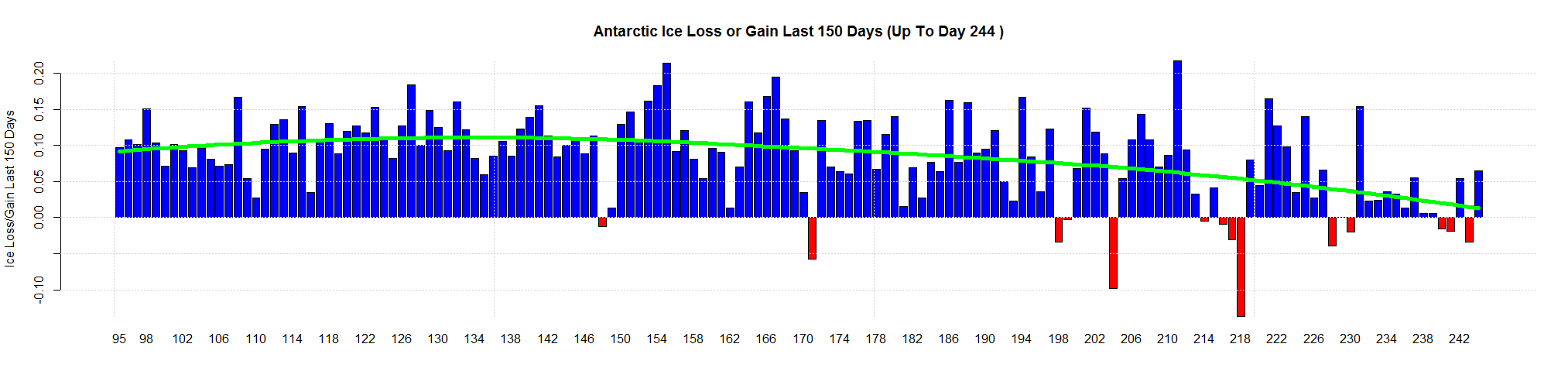

The last 150 days of Ice Loss or Gain.
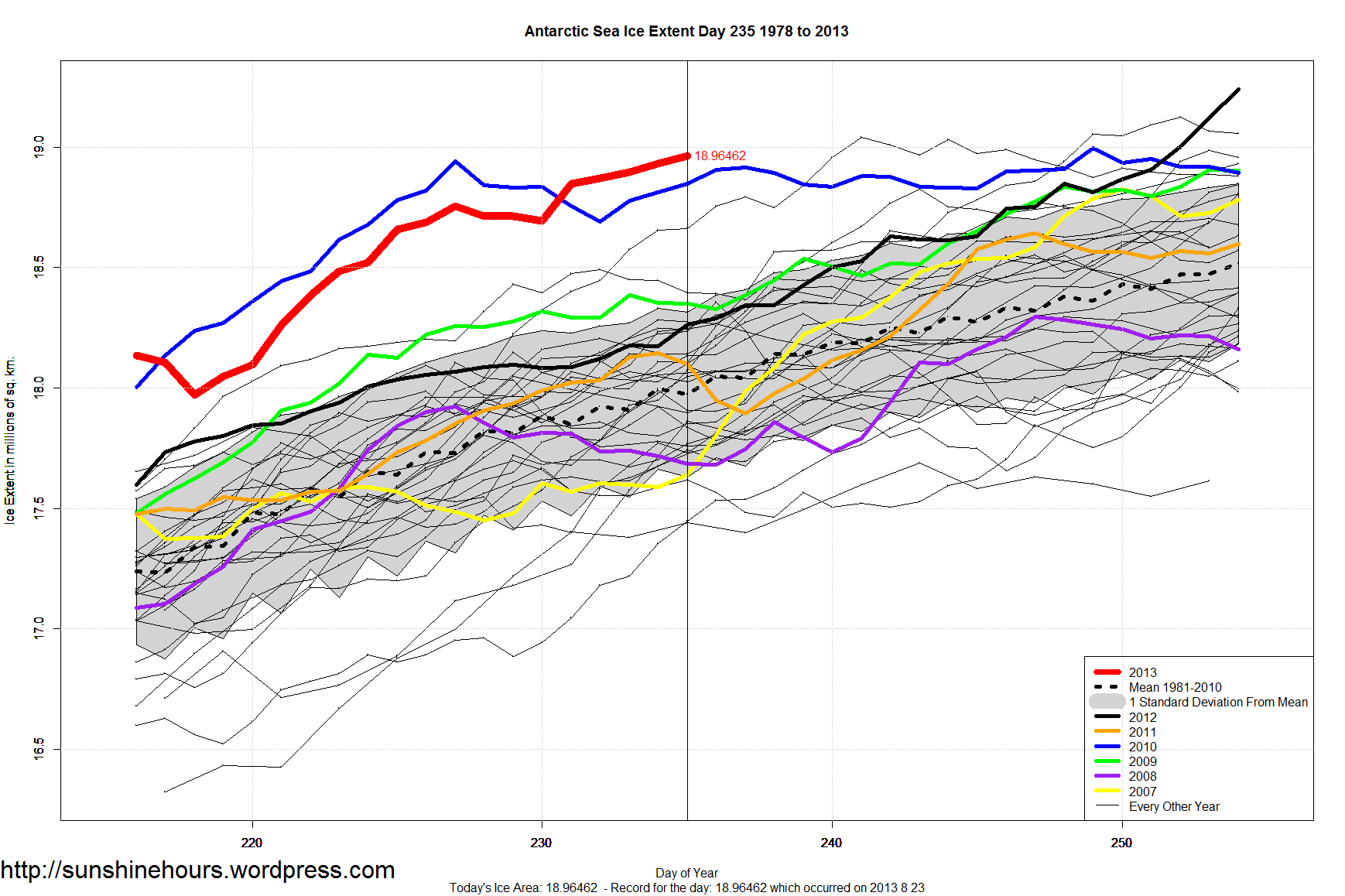
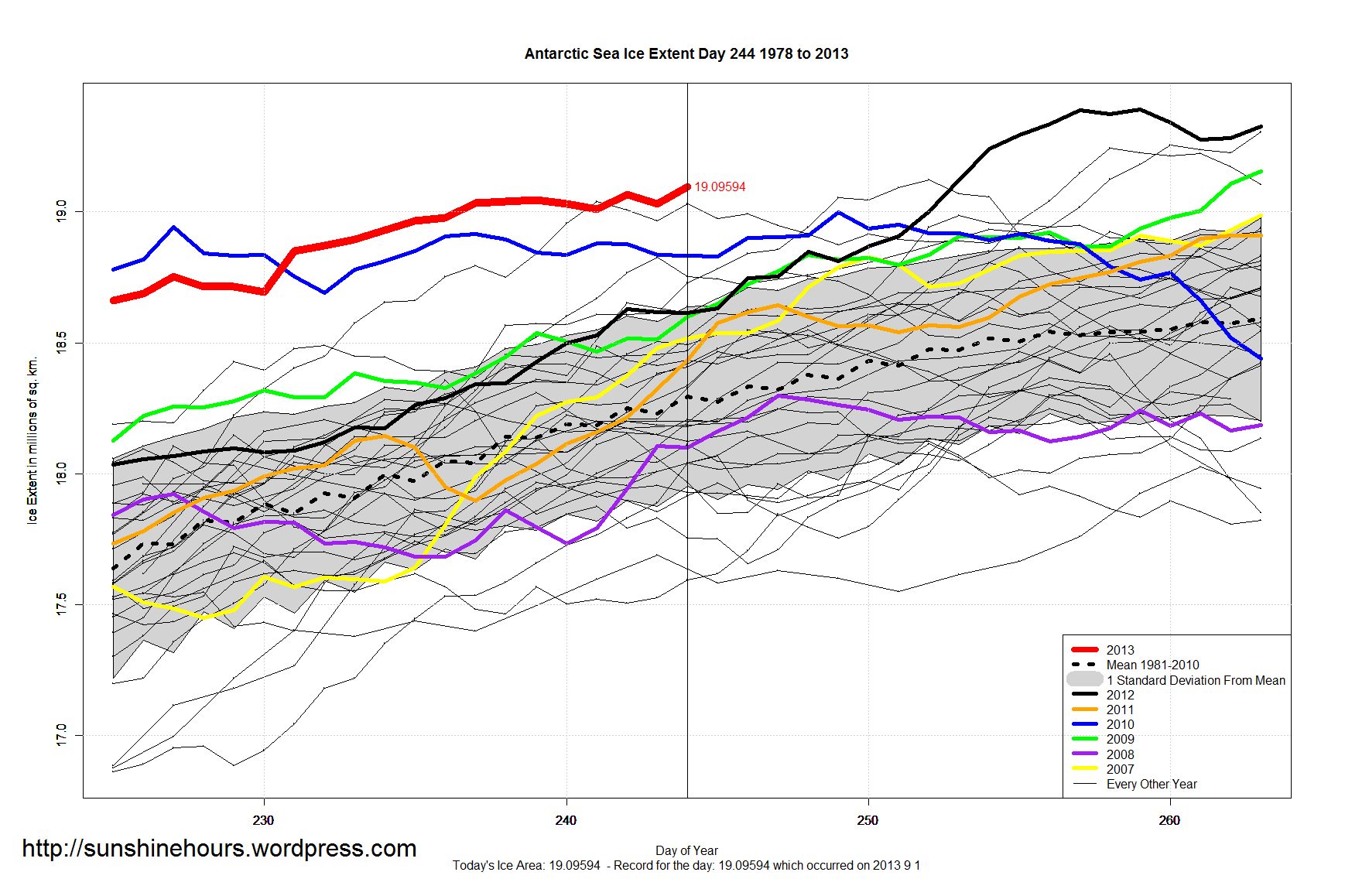
September 1 (Day 244) saw the 36th Daily Record of the Year for Antarctic Sea Ice Extent.
Antarctic Sea Ice Extent is 19.09 million sq km which is 800,000 sq km above the 30 year average.
Click graph for bigger. Data is here.
“Cold weather leads to more heart attacks, according to research presented at ESC Congress 2013 today by professor Marc Claeys from Belgium. The multifactorial study of nearly 16,000 patients found no relationship between heart attacks and air pollution.”
“AMI counts were correlated with average weekly meteorological data obtained from daily measurements in 73 meteorological sites, equally distributed in Belgium. The following meteorological measures were investigated: air pollution expressed as particulate matter both less than 10µM (PM10) and less than 2.5µM (PM2.5), black smoke, temperature and relative humidity.”
“Multivariate analysis showed that only temperature was significantly correlated with AMI, which increased by 7% for each 10°C decrease in minimal temperature (odds ratio [OR]=1.07, 95% confidence interval [CI]=1.04-1.11), and that there was no significant effect of air pollution (OR=1.01, 95%CI=1.00-1.02).”
http://medicalxpress.com/news/2013-09-cold-weather-heart.html
(h/t Tom Nelson)
August 31 (Day 243) saw the 35th Daily Record of the Year for Antarctic Sea Ice Extent.
Antarctic Sea Ice Extent is 19.03105 million sq km.
Click graph for bigger. Data is here.
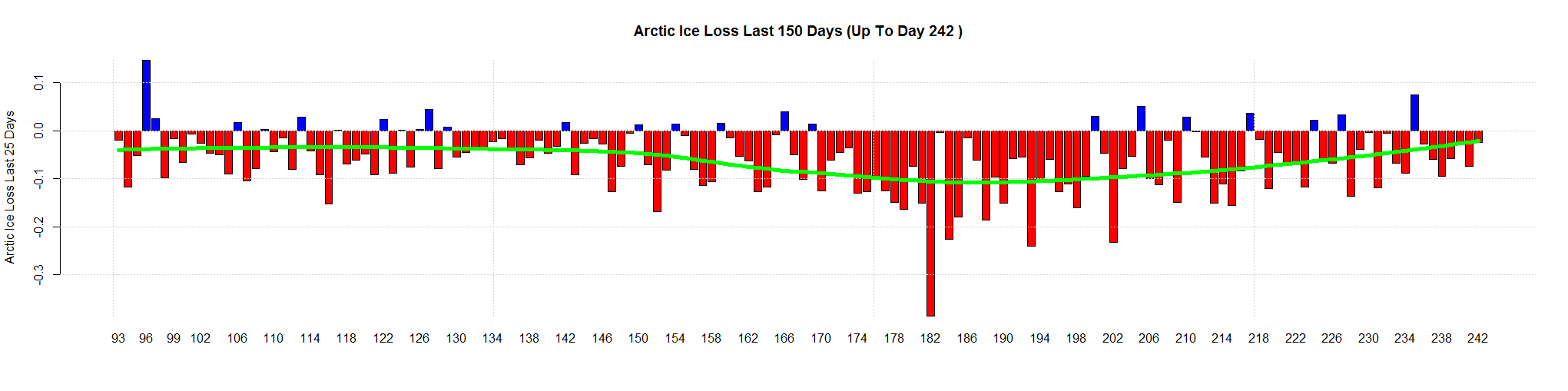
Arctic Sea Ice melt is rapidly approaching zero and it is only day 242.
Yesterday Arctic Sea Ice Extent only lost 24,000 sq km. (Red is ice loss, blue is ice gain. Click for bigger)
By my calculations, the earliest Arctic minimum was day 245 in 1987. The latest minimum was day 265 in 1989 and 2005. in 2012 it was day 260.
August 30 (Day 242) saw the 34th Daily Record of the Year for Antarctic Sea Ice Extent.
Antarctic Sea Ice Extent is 19.06 million sq km.
Click graph for bigger. Data is here.
The Canadian side of the Northwest Passage appears closed due to ice at both ends. Read about it here.
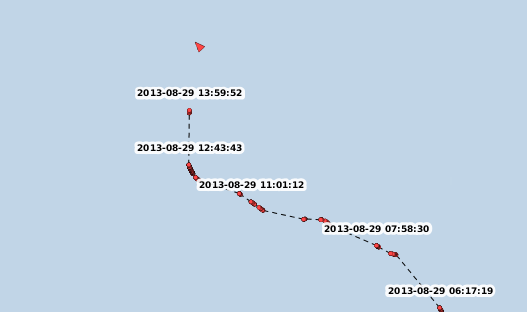
I checked on the Yong Sheng (famously trying to take cargo via the Northwest Passage).
It appears to be “confused” as to what to do next. It made a strange northwards turn.
I wonder if the same conditions are occurring on the Russian side causing trouble for the Yong Sheng?
“The North West Passage seems to be reversing its recent warming trend and is threatening to end the dreams of dozens of adventurous sailors.
A scattering of yachts trying to transit the legendary Passage are caught by the ice, which has become blocked at both ends and the season may be ended early. Douglas Pohl tells the story:
The passage has become blocked with 5/10 concentrated drifting sea ice at both the eastern and at the western ends of Canada’s Arctic Archipelago.
At least 22 yachts and other vessels are in the Arctic at the moment. Some who were less advanced have retreated and others have abandoned their vessels along the way. Still others are caught in the ice in an unfolding, unresolved drama.”
The real question is if and when the Canadian Coast Guard decides to take early action to help the above yachts exit the Arctic before freeze-up or will they wait until it becomes an emergency rescue operation?
Here is the detailed position, as far as it can be established:
Prince Regent Inlet in position 73.7880535N, -89.2529297W became blocked on 27th August with 5/10 ice concentration with 7/10 ice pushing.
This effectively closes the 2013 Northwest Passage without Canadian Coast Guard icebreaker escorts for transit.”
http://www.sail-world.com/Canada/North-West-Passage-blocked-with-ice—yachts-caught/113788
Thanks to commenter: “Alec aka Daffy Duck”
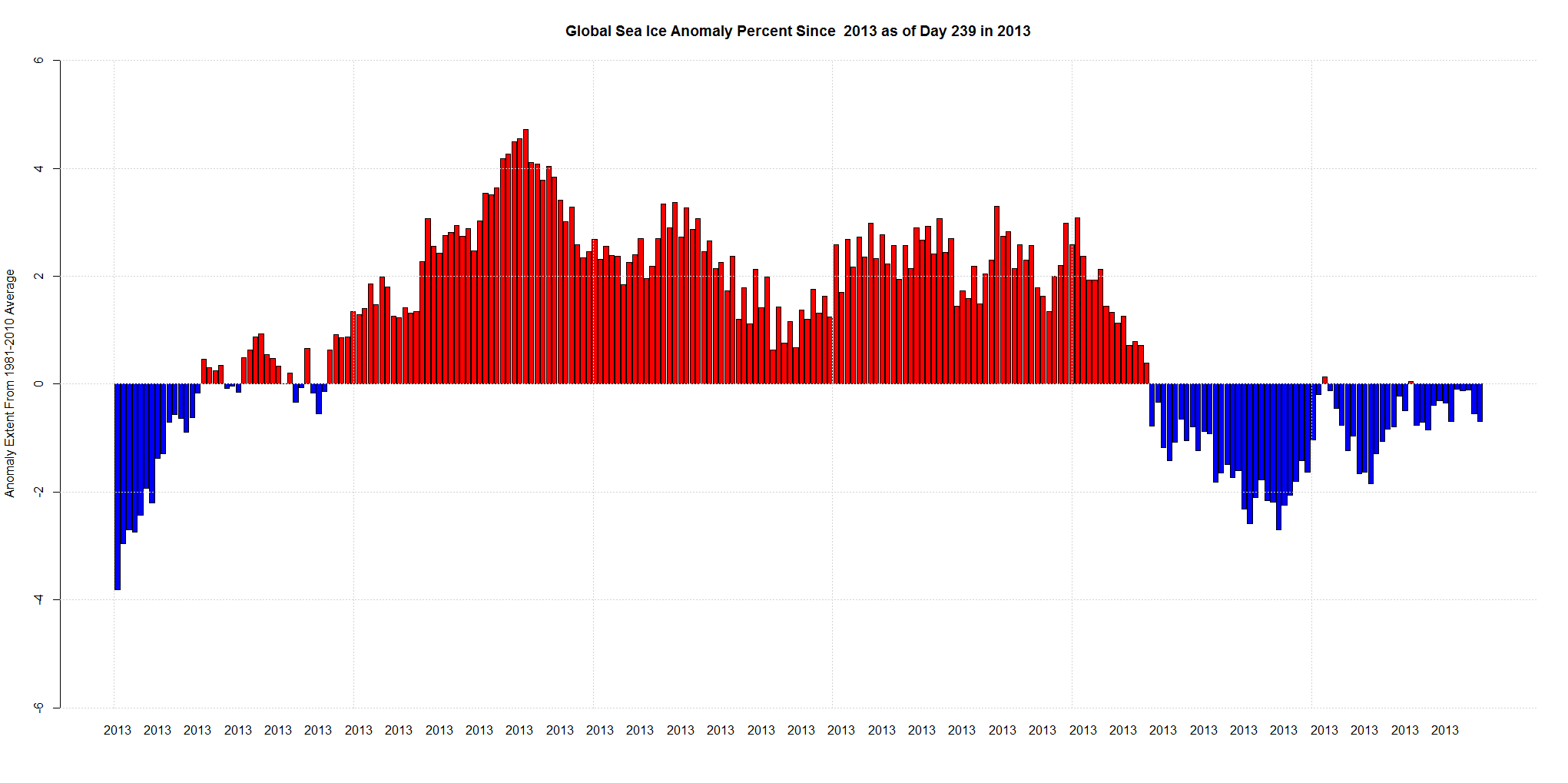
If you add up the Antarctic Sea Ice Extent Anomaly from the 30 year mean and the Arctic Anomaly and divide by the 30 year mean it comes to 170,000 sq km. Out of a normal mean of 24,700,000 sq km on Day 239.
That is a whole 0.7% below normal. The red part is above normal. The blue is below normal.
The highest anomaly for 2013 was March 14th when the anomaly was 908,000 out of a mean of 19.2 million for an anomaly percent of 4.72%.
Could massive amounts of rainfall in Australia have deprived the Arctic of fresh water so there was less sea ice?
NSIDC: “Water from the Pacific Ocean and several rivers in Russia and Canada provide fresher, less dense water to the Arctic Ocean. So the Arctic Ocean has a layer of cold, fresh water near the surface with warmer, saltier water below. This cold, fresh water layer typically allows more ice growth in the Arctic than the Antarctic.”
NCAR: ” when three atmospheric patterns came together over the Indian and Pacific oceans, they drove so much precipitation over Australia in 2010 and 2011 that the world’s ocean levels dropped measurably.”


 sunshine hours