You can download the UK Met data for Heathrow here.
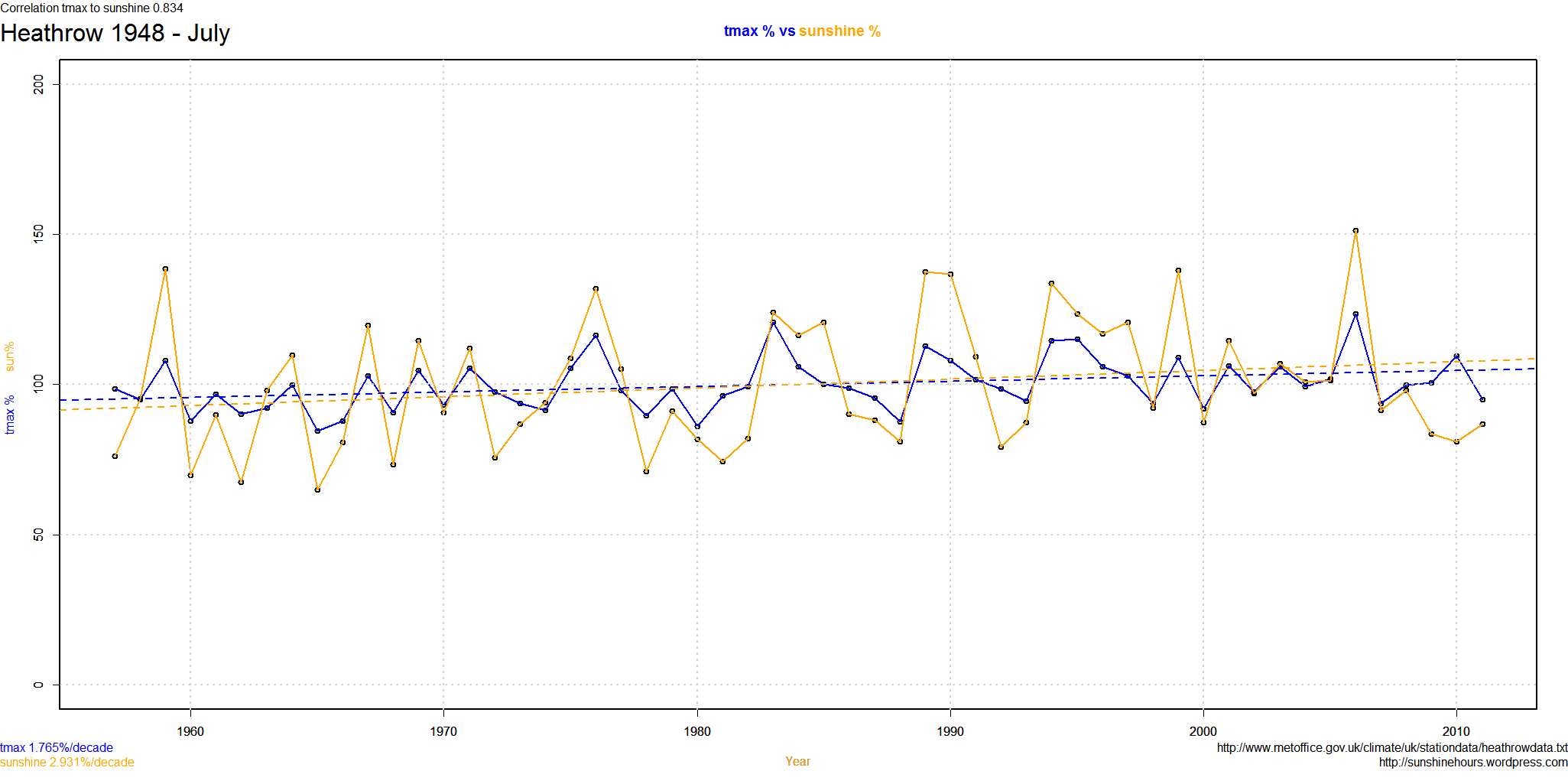
If you graphed the difference from the mean % for Tmax (Maximum Temperature) versus Bright Sunshine for the month of July, it would look like this:
You can download the UK Met data for Heathrow here.
If you graphed the difference from the mean % for Tmax (Maximum Temperature) versus Bright Sunshine for the month of July, it would look like this:
The Hockey Schtick blog has a new post about a paper noting that in the Netherlands “global summer average sunshine … dimmed during period 1958-1983 [prompting an ice age scare], but markedly increased from 1985-2010.” The paper is here.

Just a reminder that UK sunshine went up starting at almost exactly the same time:

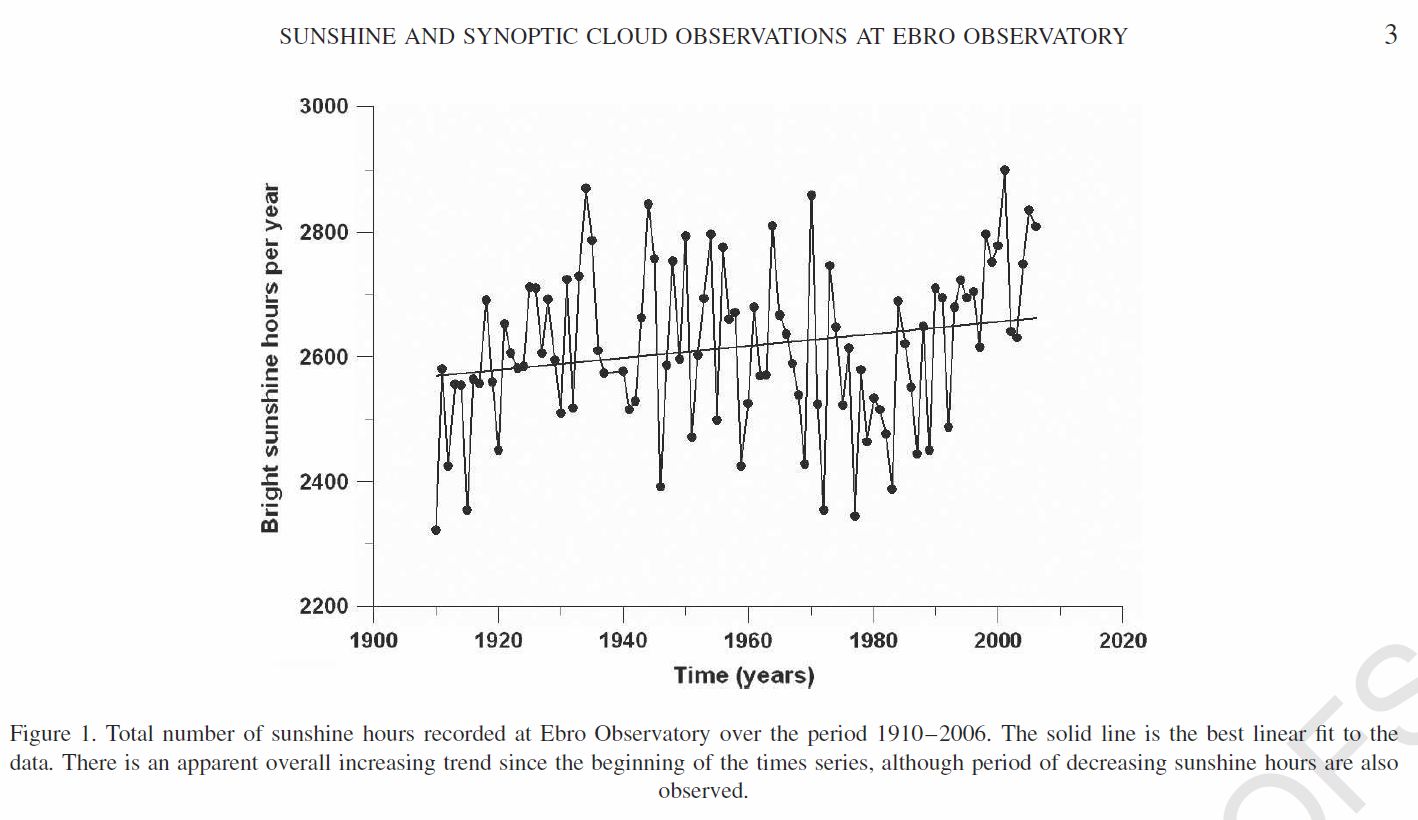
In 2008 a paper was published called “Short Communication – Sunshine and synoptic cloud observations at Ebro Observatory, 1910–2006” by J. J. Curto, E. Also, E. Palle and J. G. Sole.
I managed to download a copy. The following graph is of sunshine measured from an Observatory in Spain. If you weren’t paying attention you might think it is a graph of GISS or HADCRU temperatures … right?
“Since 1910, we find that there has been
an overall increase in the number of sunshine hours, but
with large oscillations that make this increase statistically
insignificant, while over the same time period cloudiness
has increased by a larger amount (about 12%) with high
statistical significance.
We associate the increase in both sunshine hours and
cloud amount with a shift in cloud types during the
100-year period covered by the observations.”
I recently scraped the Environment Canada website for climate data in BC and Alberta. I’ve been learning R and I thought I would graph the mean of the sunshine hours and temperature for each month. Do remember this is only stations with BOTH bright sunshine and temperature records for the month.
In Alberta the number of stations reporting sunshine peaked in the 1980s around 24.
Alberta Stations with Temp + Sunshine July
In BC the number peaked around 64 in 1988.
 sunshine hours