UK Gatwick Gusher

Just one shale formation could produce 25% of the UK’s oil. Isn’t this better than financing Russia or Saudi Arabia?

The so-called Gatwick Gusher, a shale basin in the United Kingdom, could add as much as $74 billion to the nation’s economy, a study finds.

U.K. Oil & Gas Investments commissioned Ernst & Young to examine the future potential of oil production from the Weald shale basin.

“Assuming it can be extracted from a development site at the volumes projected by U.K. Oil & Gas, has the potential to generate significant economic value to the U.K. economy,” the report read.

Oil & Gas U.K., the industry’s lobbying group, said the North Sea oil sector is in for a long period of decline, with less than $1.4 billion in new spending expected in 2016. Inland shale, meanwhile, has the potential to add between $10 billion and $74.6 billion to the British economy in gross value, the commissioned report said.

Operators are working to assess the potential in the shale area by testing the Horse Hill-1 oil discovery. Preliminary estimates made by the company last year put the entire Horse Hill reserve total as high as 100 billion barrels of oil. If its full potential is reached, the future production from the area could provide as much as a quarter of the nation’s total oil demand over its lifespan, based on 2014 demand levels.
UK Blackout Emergency Plan Costs Soar

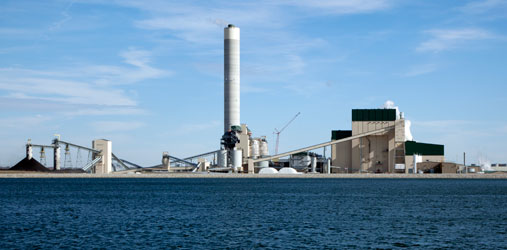
Coal will come to the rescue in the UK at a cost.Plant-wide_Slider02

The cost of ensuring Britain could turn its lights back on after a catastrophic nationwide blackout has soared by at least £12m this year, as National Grid is forced to pay struggling old coal plants to “keep warm” in case of an emergency.

Britain’s so-called “black start” plans are designed to ensure that electricity supplies could be swiftly restored in the event of an unprecedented power failure plunging all or part of the country into darkness.

As most power plants need to draw some electricity from the grid to start generating, National Grid has to ensure the UK retains a certain number of black start plants that are able to fire up independently using their own generators.

Historically, several of the UK’s coal plants have been relied upon to form part of the black start plan.

But rising green taxes, cheap gas prices and the growth of renewables are together rendering the coal plants increasingly uneconomic, with some closing down for good and most others now only running for parts of the day.

This poses a threat to Britain’s emergency plans because if the plants are not generating when a catastrophic power failure hits, they will take far longer to start up.

Energy regulator Ofgem has now given National Grid permission to pay the plants millions of pounds to keep “warm”, so that they would be ready to start up quickly in an emergency.


EU/UK Steel: A Tiny Bit Of Sanity (That Won’t Go Anywhere)


Cheap Chinese steel is killing the EU/UK steel industry. The reasons are pretty simple. China relies on cheap coal for most of its energy needs while the UK and EU are squandering trillions to build wind farms and solar farms (in a northern climate?). And fossil fuels are punished.

I’ve been going on about this for a while. It is amazingly stupid to drive all the jobs from the UK/EU (or Canada) to China where the energy is dirtier and the labor conditions are appalling.

So there is this German Government minister who maybe finally got it.

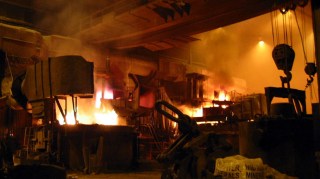
In the fight against cheap steel from China, German Economics Minister Sigmar Gabriel (SPD) is proposing a ‘climate MOT’ for imported products: “At the level of the World Trade Organization there are forms of certification, for example, where the environment, nature or health are at risk. I can imagine a similar certification for steel products, a kind of `climate MOT` for steelmaking, Gabriel told the Westdeutsche Allgemeine Zeitung on Wednesday. “The basic idea: Only those are allowed onto the European market who comply with the same standards that we meet in the EU.” Gabriel called on the EU to adopt a tougher stance in the dispute with China over cheap steel.SteelMill_interior

MOT = Ministry of Transport. This is shorthand for: “To drive a car it must be tested and running at a certain level of safety and air cleanliness.”

The same should be true for importing any goods. If it is steel imported from China to the UK, the energy used in China must be as “clean” as the energy mix forced onto steelmakers in the UK and the wages must be comparable.

The sane should be true for all manufactured goods.

But what really happens is that the coal power plants producing cheap electricity are shut down in the UK and the steel is made in China. And the jobs (paying much less) go to China. And more CO2 (which I don’t care about … but some do) is produced than if the steel was made in the UK. And 40,000 jobs disappear. While the rich laugh.


.

EU Subsidized Cheaper Energy For China Steel


Every once in a while I joke that China has a spy high up in the EU making the EU do stupid stupid things … then I read these stories and I think I might be right.

British taxpayers have been forced to subsidise the very Chinese steel companies that are threatening 40,000 UK jobs, critics say.

It comes after revelations that the European Investment Bank has given so-called “soft loans” to China of £80million as part of a climate policy intended to lower emissions.

The astonishing figures include a loan of £40million to one of the world’s worst “steel dumping” culprits, the Wuhan Iron & Steel Corporation.

To add insult to injury Wuhun, the world’s eighth largest steel producer, boasts the Chinese state as its main shareholder. Wuhun is such a prolific steel dumper that it has now been especially targeted by the European Commission, which wants to slap it with 36.6 per cent tariffs.

Just five years ago, however, EU bankers decided to lend it €50million (£40million) to put towards a €207million (£167million) Euro Combined Cycle Plant.

The loan was paid out under the China Climate Change Framework Loan II. The money is supposed to persuade the steel giants to invest in lower emission technology.

Furious critics last night pointed out the irony that the loan was concerned with reducing the cost of power generation while one of the complaints of Tata Group is the high cost of energy associated with its steel production operation in South Wales.

UK Industry Facing Massive ‘Green’ Power Costs


UK industry is facing  massive energy ‘policy’ cost increases. This article summarizes the estimated costs for energy intensive users (like steel mills) and the businesses that rely on them:

In 2014 DECC estimated that prices to Energy Intensive users were 26% higher than they would be in the absence of policies.

By 2020, in the Low Fossil Fuel price scenario, which now seems more likely than not, a large Energy Intensive Industry (EII) with a full cost relief package would face electricity prices (p/kWh) that are 22% higher than they would be in the absence of policies.

Those unable to qualify for relief would see prices 76% higher than they would be without policies. No estimates are available for 2030, perhaps because DECC does not expect there to be any Energy Intensive Industries remaining in that year.

The electricity price impacts on other parties trading with EIIs are also large.

Medium sized businesses would see prices 77% higher than they would be in the absence of policies in 2020, and 114% higher in 2030.

Small sized businesses would see prices 61% higher in 2020 and 95% higher in 2030.

Domestic households would see prices 42% higher than they would otherwise be in 2020 and 60% higher in 2030.

To these must be added electricity system costs, for grid expansion and management, and in the presence of large renewable fleets these could easily reach totals not much less than the subsidy costs themselves.

– See more at: http://www.thegwpf.com/climate-policies-and-the-future-of-manufacturing/


UK Green Taxes Killing the Steel Industry


Green taxes are killing the UK steel industry.

The U.K.’s steel crisis – worsened by Tata Steel Ltd.’s decision to sell its plant in Port Talbot, South Wales – has been exacerbated by three green taxes that the government implemented to boost clean energy, according to the manufacturers’s association EEF.

The three levies are the Carbon Price Floor, Renewables Obligation and Feed-In Tariff policies. Each works differently. Together, they increase steelmakers’ energy costs by about 30 pounds ($43) per megawatt-hour this year, Richard Warren, senior energy and environment policy adviser for EEF, said in an interview.

Electricity is an enormous cost for steel companies. The U.K.’s seven steel plants used about 3.2 million megawatt-hours of power in 2014, according to the EEF, not including what they generated themselves.

The German solution is to exempt industries and pass the cost of those exemptions onto the poor and then kill them.

Europe’s suicidal green energy policies are killing at least 4o,000 people a year.

That’s just the number estimated to have died in the winter of 2014 because they were unable to afford fuel bills driven artificially high by renewable energy tariffs.

But the real death toll will certainly be much higher when you take into account the air pollution caused when Germany decided to abandon nuclear power after Fukushima and ramp up its coal-burning instead; and also when you consider the massive increase in diesel pollution –  the result of EU-driven anti-CO2 policies – which may be responsible for as many as 500,000 deaths a year.


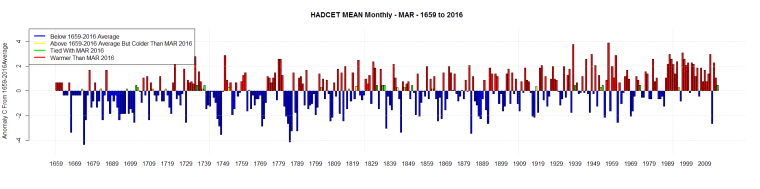
HADCET March 2016 Mean Temperature – Tied For 143rd Warmest out of 355

 HADCET (Central England Temperature) Longest temperature record in existence.

HADCET March 2016 was tied for 143th warmest out of 355 at 5.8C. 

The warmest March was 1957 at 9.2C.

The barplot is the Marches since 1659. The temperature is the anomaly from the 1659 to 2016 average.

The yellow bars are the years warmer than March 2016. Green bars indicate a tie with March 2016. Click twice for bigger.

HADCET MEAN Monthly - MAR - 1659 to 2016


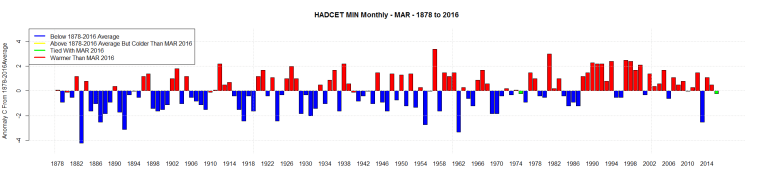
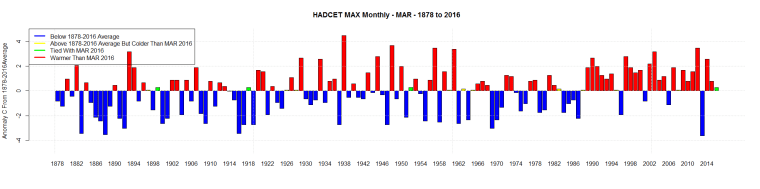
HADCET only goes back to 1878 for MIN and MAX. Here are those graphs.


HADCET MIN Monthly - MAR - 1878 to 2016

HADCET MAX Monthly - MAR - 1878 to 2016


UK Going Green By Shutting Down Industry

This is insane. And cruel to the formerly employed in the UK.

A fortnight ago, the energy minister, Andrea Leadsom, declared grandly that Britain, alone in the world, would commit to a target of reducing net carbon emissions to zero. ‘The question is not whether but how we do it,’ she told Parliament. It is now becoming painfully clear how this target will be reached: not by eliminating our carbon emissions but by exporting them, along with thousands of jobs and much of our manufacturing industry.

This week, Tata Steel announced that its entire UK business is to be put up for sale. That came after Stephen Kinnock, whose South Wales constituency includes Tata’s giant plant at Port Talbot, joined a union delegation to the headquarters of Tata Steel in India to beg the company to keep the plant open. Some 750 job losses have already been announced there; more than 1,000 jobs, including these, will be lost across Britain as our steel industry struggles to compete with lower-cost producers overseas.

Britain has the highest energy costs in Europe, thanks to decisions taken not in Brussels but in Whitehall. Crusaders like Ms Leadsom have, over the years, made sure that our manufacturers feel the force of green levies, unlike Germany, which exempts its own industry. The idea is that by making energy more expensive, people are encouraged to use less of it. This is working very effectively, as the soon-to-be-unemployed Welsh steelworkers will attest. If the plant closes, carbon emissions in Port Talbot will fall dramatically.

All European producers face much higher costs than Chinese steelmakers thanks to the EU Emissions Trading System. But Britain imposes its own green taxes on top of this in the form of the Carbon Price Floor and the Renewables Obligation — an epic act of self-harm. Tata points out that its energy costs for running steel plants in Britain are 25 per cent more than they would be in Germany and 50 per cent more than they would be in France. This is due to decisions by the UK government to spread the pain of green tariffs so that businesses are hit as hard as consumers.

The odds are that the steel being bought from China produces more CO2 than the steel bought from Tata in the UK.

Green offshoring is the suicidal act of idiots. They send the jobs and CO2 production overseas and do nothing for the people who lose their jobs.


UK at Risk of Blackouts For Next Four Years

This is what “green” means. No more security of energy supply. Blackouts. 100s of thousands of jobs gone (transferred to China/India so they can use cheap energy from coal)

The former boss of one of Britain’s biggest energy suppliers has warned that the safety buffer separating Britain from power cuts will be uncomfortably slim for up to four years.

Experts had already warned this winter that Britain was at its highest risk of blackouts in more than a decade before the announcement of a succession of closures of coal-fired power stations.

Paul Massara, a former chief executive of npower, warned yesterday that the tight supply would last for up to four winters, in contrast with rosier forecasts from the regulator that the safety buffer between capacity and peak electricity

http://www.thetimes.co.uk/article/britain-on-the-brink-of-blackouts-for-four-winters-h55qpbv3z


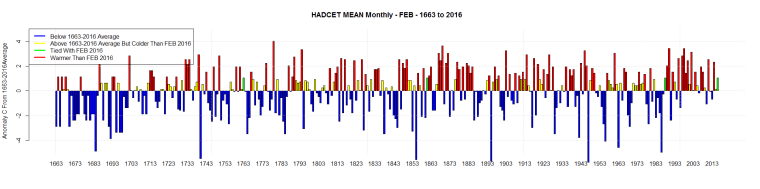
HADCET Feb 2016 Mean Temperature – Tied For 106th Warmest out of 354

You remember  HADCET (Central England Temperature)? Longest temperature record in existence!.

You remember the hoopla about February 2016 being the hottest of all time?

HADCET February 2016 was tied for 106th warmest out of 354.

The barplot is the Februaries since 1663. The temperature is the anomaly from the 1663 to 2016 average.

The yellow bars are the years warmer than February 2016. Green bars indicate a tie with February 2016. Click twice for bigger.

HADCET MEAN Monthly - FEB - 1663 to 2016

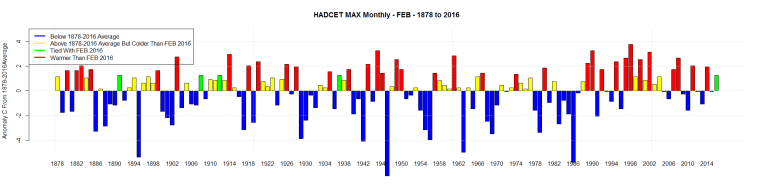
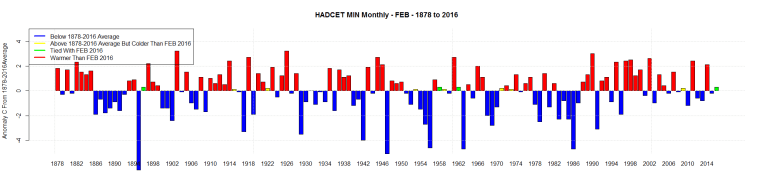
HADCET only goes back to 1878 for MIN and MAX. Here are those graphs.

HADCET MAX Monthly - FEB - 1878 to 2016 HADCET MIN Monthly - FEB - 1878 to 2016