USA: CO2 Down 10% in 14 Years – Frack!

Fracking Saves The Day

The U.S. Department of Energy published data last week with some amazing revelations — so amazing that most Americans will find them hard to believe. As a nation, the United States reduced its carbon emissions by 2 percent from last year. Over the past 14 years, our carbon emissions are down more than 10 percent. On a per-unit-of-GDP basis, U.S. carbon emissions are down by closer to 20 percent.

Even more stunning: We’ve reduced our carbon emissions more than virtually any other nation in the world, including most of Europe.

How can this be? We never ratified the Kyoto Treaty. We never adopted a national cap-and-trade system, or a carbon tax, as so many of the sanctimonious Europeans have done.

The answer isn’t that the EPA has regulated CO2 out of the economy. With strict emission standards, the EPA surely has started to strangle our domestic industries, such as coal, and our electric utilities. But that’s not the big story here.

The primary reason carbon emissions are falling is because of hydraulic fracturing — or fracking. Some readers now are probably thinking I’ve been drinking or have lost my mind. Fracking technology for shale oil and gas drilling is supposed to be evil. Some states have outlawed it. Hillary Clinton and Bernie Sanders have come out against it in recent weeks. Schoolchildren have been bombarded with green propaganda about all the catastrophic consequences of fracking.

 They are mostly lies. Fracking is simply a new way to get at America’s vast storehouse of tens of trillions of dollars worth of shale oil and gas that lies beneath us, coast to coast — from California to upstate New York. Fracking produces massive amounts of natural gas, and, as a consequence, natural gas prices have fallen in the past decade from above $8 per million BTUs to closer to $2 this year — a 75 percent reduction — due to the spike in domestic supplies.

This free fall in prices means that America is using far more natural gas for heating and electricity and much less coal. Here is how the International Energy Agency put it: “In the United States, (carbon) emissions declined by 2 percent, as a large switch from coal to natural gas use in electricity generation took place.”

read the rest …

CO2 to the Rescue!

Wow. CO2 to the rescue!

Rising levels of carbon dioxide in the atmosphere are accelerating the growth of B.C.’s forests by one to three per cent a year, enough to cancel out the impact on the climate from the mountain pine beetle outbreak by 2020, according to a new study from the Pacific Institute for Climate Solutions.

“This turnaround will happen much sooner than we had imagined,” said lead author and Environment Canada climate scientist Vivek Arora.

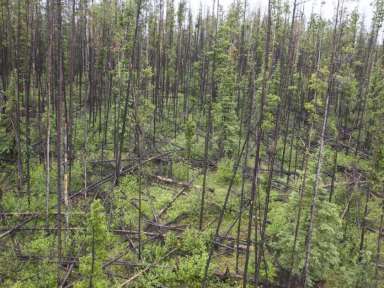
The pine beetle infestation, which killed countless trees over 18 million hectares, had a double impact — dramatically reducing the ability of western Canadian forests to store carbon, and worse, releasing massive quantities of carbon as dead stands of pine rotted or burned. The combined effect turned B.C. forests from a carbon sink (a reservoir) into a carbon source during the peak years of the outbreak between 2009 to 2011, said co-author Werner Kurz of the Canadian Forest Service. post-beetle-fallen-pine-trees-damages-from-a-helicopter-shot

Computer models estimate that B.C. forests stored 328 million tonnes less carbon dioxide and released in excess of one billion tonnes of CO2 into the atmosphere during the outbreak, which began in 1999.

However, the effects of global warming — rising temperatures, higher rainfall, and an atmosphere richer in carbon dioxide — have created a “fertilization effect” which has accelerated the growth of trees, especially in the high-latitude forests that cover much of Canada, Russia and Europe.

Relatively cool temperatures in Canadian forests typically limit tree growth and carbon uptake to less than half the rate seen in tropical latitudes. But that is beginning to change.

New research suggests that climate change has increased the rate of growth and carbon storage in our forests, so much so that an additional one billion tonnes of carbon dioxide will be stored by our trees between the pine beetle outbreak and 2020.

Trees are smart enough to use the CO2. Humans are dumb enough to want to store it in CCS facilities underground.

Flashback: AGW Cult Hates Asthmatics

Once upon a time asthma inhalers  had a teensy amount of CFC’s (chlorofluorocarbons) in them.

But those asthmatics and their inhalers were evil and had to be punished because they ran afoul of the Montreal Protocol

“Albuterol inhalers contributed less than 0.1 percent of the CFCs released when the treaty was signed.”

The CFC inhalers were banned in the USA in 2008 and replaced with HFA inhalers which did not work as well.

HFA did not shoot the medication as far back as CGC did.13227

So … to placate the rabid AGW cults, 10s of million of asthmatics were forced to use substandard inhalers that cost more.


Landfill: the slow, green way to recycle

The title of this post is Bishop Hill’s suggestion for a new cool catchphrase for landfills since it appear recycling is a massive money losing scam. It made me chuckle.

The news that a vast, shiny, new state of the art recycling centre in Lancashire is to be mothballed after incurring “catastrophic losses” will not come as much of a surprise to anyone who keeps an eye on the green scene. A moment’s thought by anyone with more than a couple of braincells to rub together leads to the inevitable conclusion that expending vast resources – energy, labour, capital, chemicals and the like – to turn low value items into even lower value items is not much of an economic proposition. With councils increasingly cash-strapped, it is becoming ever harder to sustain the illusion that recycling is anything other than virtue-signalling from middle-class poseurs.

Perhaps landfill needs to have its brand detoxified. Rather than wasting all those precious resources on collecting refuse to turn it into heaven knows what, let’s use the power of Mother Nature to break down and recycle what can be broken down, leaving what is inert to cause no trouble to anyone. Yes, it will be slower than what passes for recycling now, but aren’t greens in favour of using slower, more natural approaches whenever they can?


Alberta Electrical Generation: Apr 10, 2016 14:35

As some of you my have noticed I like to mock the idea that wind can take over for fossil fuels.

The mainstream media will generate lots of stories of the maximum amount of power wind can generate. They never show minimums.

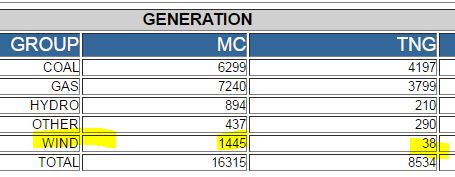
As Apr 10, 2016 14:35  (MC=Maximum Capability / TNG=Total Net Generation)

Wind 38MW out of 8534MW being generated and 38 out of 1445 capability for wind.

AESO_Capture

BC and Alberta – Coal and Hydro

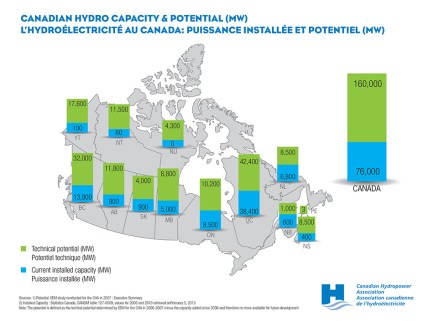
Canada has a lot of hydro power. BC (on the west coast) has about 14GW of capacity and Alberta has about 0.9GW.

Alberta gets 65% of its power from coal. Coal power plants do not easily change power output. Hydro can. And does.CHA-map-CapacityPotential-2015-940px

So there are some interesting power trading going on. And things will change if the Alberta NDP succeeds in its plan to shutdown all of Alberta’s coal power plant.

The following is some excerpts for an interesting insight into power trading (a little over a year old). Yes it is an ad for software … but it is darned interesting.

A major obstacle for power traders is the inability to store generated power. However, hydro power has a unique flexibility that most other power producers do not: operators can turn these facilities on and off in the blink of an eye. This practice can turn hydro dams into huge storage facilities.

Ninety percent of British Columbia’s power comes from hydro dams, and the aforementioned “power storage” ability of these units gives BC Hydro greater flexibility when deciding to sell or buy power. As in every business, in the power industry energy producers want to sell their final products at the highest possible rate. At night, power demand, and therefore cost, is low, making energy producers less profitable.

On the other hand, more than 50% of the power generated in Alberta in 2013 came from coal-powered plants. The major downside of this type of power production is the long and costly shut down procedure. This makes the export of surplus power mandatory, since production cannot be tailored to consumption, as is the case with hydro-produced power. Alberta’s unused production is exported to other provinces (mostly to British Columbia: 87%),[1] and mostly in off-peak hours when there is a surplus of production. This power is being exported at unfavorable terms for Alberta plants, given that they need to get rid of the power they cannot store. Prices of exported power are therefore much lower than prices of power imported during peak hours.

1

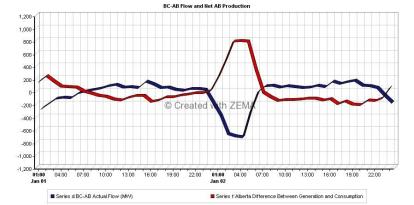
In the graph above, the dark blue strip represents traded (flow) power between British Columbia and Alberta. As we can see, there is a trough that starts at 1 a.m. on January 2 and ends at 7 a.m. At the same time, the red stripe represents the difference between production and consumption in Alberta. The graph clearly shows that abundant power is being exported to British Columbia, given that it cannot be consumed or stored in Alberta. After 7 a.m., though, the opposite occurs. The difference between production and consumption becomes negative, meaning that Alberta needs to import the shortfall amount of power. As the red stripe becomes negative, the blue stripe becomes positive—a mirror image. This is just one example how imports from British Columbia grow in proportion to the gap between production and consumption in Alberta.

Canada’s Federal NDP to Alberta: “Drop Dead”

What a surprise. The Federal NDP (the socialist party that wants to run Canada) wants to kill the oil and gas industry in Alberta (which is governed by the Provincial NDP).

Alberta’s Environment Minister attacked a proposed NDP policy road map known as the “Leap Manifesto” on Friday, calling the sweeping climate-change plan a betrayal of Albertans who voted for Rachel Notley’s New Democrats.

Speaking a few city blocks away from where 1,500 NDP delegates were gathered for the federal party’s convention, Shannon Phillips said the proposed plan was unworkable in the short term and didn’t recognize Alberta’s climate efforts.

“A lot of people can say a lot of things and talk a lot of things from their downtown Toronto perch, but in Alberta our focus is on ensuring that we’ve got good-paying jobs,” Ms. Phillips said. “That is not talking, that’s doing.”

Party members will vote Sunday on a resolution that would adopt the Leap Manifesto as a reference point to shape the NDP’s policy discussions over the next two years. The document is at the centre of the struggle for the federal party’s leadership. It calls for a speedy transition away from fossil fuels, the rejection of new pipelines and a ban on trade deals.

Isn’t it time for Alberta to ban all purchases of goods from Ontario?

Generating Your Own Electricity Cheaper

I do a lot of reading on climate and electricity generation.  Sometimes I come across stuff that surprises me.

One of those is a couple of blog posts / news articles that show that generating your own electricity may be way cheaper than getting it from the grid. That’s because NG is cheap and bulk electricity from power companies forced to subsidize renewables is not.

The data from this one is from the end of 2014. But a quick check shows costs would be similar today. The scale of generation is condo building sized using CHP natural gas — the hot water is used too.

If you have read my blog entitled, “What is the Best Kind of Generator For a Condominium Building” you will know that the cost of electricity from the grid is increasing and that the most cost effective way to generate our own electricity is by using a natural gas powered combined heat and power (CHP) generation system.

We will recall that when we use the waste heat from the generator for space heating or hot water heating in the building. We then get heat and electricity from the gas we burn in the generator. Using the combined heat and power (CHP) approach the efficiency of natural gas generators is boosted into the 70 to 90% range.Cost of Electricity 2006-2014

So, let’s do some calculations and see if it makes financial sense for a condominium to generate its own electricity.

If we know that the energy consumption rate of a typical 65kW gas generator is 900 Mega joules per hour and that the energy content of natural gas is typically about 40 Mega Joules per cubic metre, then the generator will consume about 900 Mega joules per hour divided by 40 Mega joules per cubic metre or 22.5 cubic metres of gas per hour. Since 35% of the energy is used to generate electricity and the generator total fuel efficiency is 85%, we can divide 35% by 85% to determine that 41% of the fuel is being used to generate the 65kW of electricity. So, if we multiply 22.5 cubic metres per hour total gas consumption by the 41% portion used to generate electricity, we find that the generator is consuming 22.5 times 41% or 9.23 cubic metres per hour to generate 65 kilowatt Hours (kWHr) of electricity.  If we use the 18.5¢ per cubic metre 2014 cost for natural gas we can determine that the generator is using 9.23 cubic metres per hour times 18.5¢ or about $1.71 per hour to generate 65 kWhr of electricity. We can determine the cost per kilowatt hour by dividing the hourly cost by amount of electricity or $1.71 per hour for gas divided by 65 kWHr electricity generated, which equals about 2.6¢ per kilowatt hour.   (These calculations are made on the basis that the other 59% of the fuel is being used to generate useful heat that will have the same value as the cost of the natural gas used to create the 50% heat.)

This 2.6¢ per kilowatt hour electricity cost will fluctuate with cost of natural gas and from generator to generator and we need to add about 1.2¢ per kilowatt hour for operation and maintenance, giving us a total cost of about 3.8¢ per kilowatt hour. It is easy to see that 3.8¢ will be much less than the current mid-peak cost of 11.4¢ per kilowatt hour from your local electrical utility.

This article is about a new grocery store, but the key paragraphs are here:

But the 19,000 square foot Sunripe is the centerpiece.

“It will have a little more of a modern look than the existing London and Sarnia stores” says Willemsen. With LED lighting and a natural gas generator Willemsen says the store will be able to go off the Provincial power grid.

“Natural gas is so inexpensive that we will be able to produce our own electricity cheaper than buying it from Hydro One”.

Willemsen says he is taking steps to make the new store as energy efficient as possible. Cooking equipment will be natural gas and the store will have a white roof to reflex the sun. Heat from refrigeration compressors will be reclaimed and directed back into the heating system.

CHP for greenhouses (and don’t forget the subsidies and incentives)

Then there are the sites touting micro-CHP that would be eligible for feed-in-tariffs in the UK.