83,000 Raptor Fatalities at Wind Farms in USA in 2012

This is just awful. The Wildlife Society estimates 83,000 raptor fatalities at wind farms in the USA for 2012.

“I used national averages from hundreds of carcass placement trials intended to characterize scavenger removal and searcher detection rates, and I relied on patterns of carcass distance from wind turbines to develop an adjustment for variation in maximum search radius around wind turbines mounted on various tower heights. Adjusted fatality rates correlated inversely with wind-turbine size for all raptors as a group across the United States, and for all birds as a group within the Altamont Pass Wind Resource Area, California. I estimated 888,000 bat and 573,000 bird fatalities/year (including 83,000 raptor fatalities) at 51,630 megawatt (MW) of installed wind-energy capacity in the United States in 2012.”


Finally! One Bird Slaughterer Brought To Justice

FINALLY!

“WASHINGTON (AP) — A major U.S. power company has pleaded guilty to killing eagles and other birds at two Wyoming wind farms and agreed to pay $1 million as part of the first enforcement of environmental laws protecting birds against wind energy facilities.

Until the settlement announced Friday with Duke Energy Corp. and its renewable energy arm, not a single wind energy company had been prosecuted for a death of an eagle or other protected bird — even though each death is a violation of federal law, unless a company has a federal permit. Not a single wind energy facility has obtained a permit.

The Charlotte, N.C.-based company pleaded guilty to killing 14 eagles and 149 other birds at its Top of the World and Campbell Hill wind farms outside Casper, Wyo. All the deaths, which included golden eagles, hawks, blackbirds, wrens and sparrows, occurred from 2009 to 2013.

“Wind energy is not green if it is killing hundreds of thousands of birds,” said George Fenwick, president of the American Bird Conservancy, which supports properly sited wind farms. “The unfortunate reality is that the flagrant violations of the law seen in this case are widespread.””


(h/t Tom Nelson)


NOAA Winter Temperatures By State From 1998 to 2013

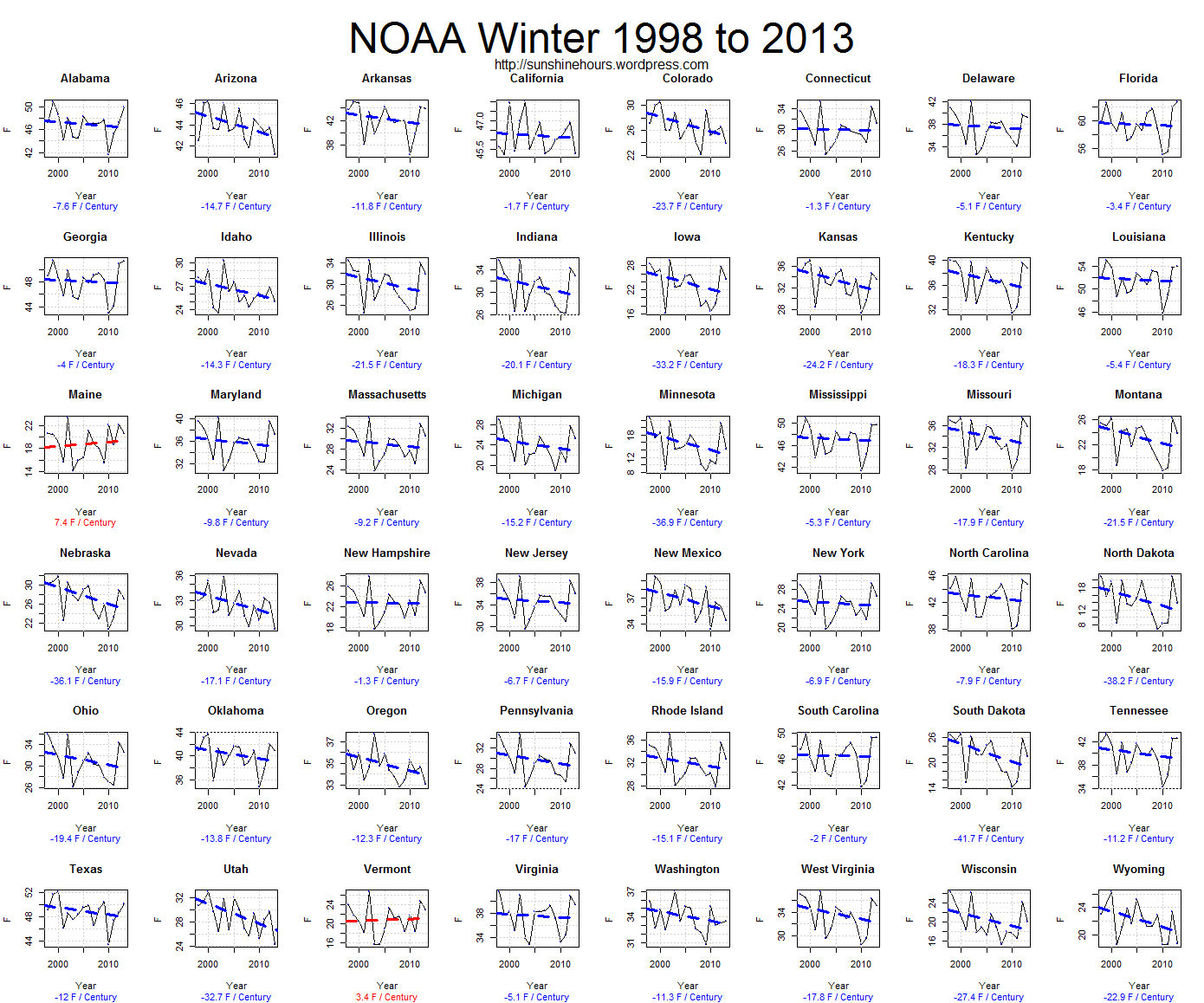
I’ve had a request to show Winter (Dec/Jan/Feb) temperatures by state. I am showing from 1998.  That would be to Dec 2012 / Jan+Feb 2013.

Only two states have a warming trend. Maine and Vermont. South Dakota is cooling at -41F/Century. The full list is below the graph.

Click for bigger.

NOAA Winter 1998 to 2013

State Trend in F/Decade
South Dakota -41.7
North Dakota -38.2
Minnesota -36.9
Nebraska -36.1
Iowa -33.2
Utah -32.7
Wisconsin -27.4
Kansas -24.2
Colorado -23.7
Wyoming -22.9
Illinois -21.5
Montana -21.5
Indiana -20.1
Ohio -19.4
Kentucky -18.3
Missouri -17.9
West Virginia -17.8
Nevada -17.1
Pennsylvania -17
New Mexico -15.9
Michigan -15.2
Rhode Island -15.1
Arizona -14.7
Idaho -14.3
Oklahoma -13.8
Oregon -12.3
Texas -12
Arkansas -11.8
Washington -11.3
Tennessee -11.2
Maryland -9.8
Massachusetts -9.2
North Carolina -7.9
Alabama -7.6
New York -6.9
New Jersey -6.7
Louisiana -5.4
Mississippi -5.3
Delaware -5.1
Virginia -5.1
Georgia -4
Florida -3.4
South Carolina -2
California -1.7
Connecticut -1.3
New Hampshire -1.3
Vermont 3.4
Maine 7.4

NOAA/USA – How Far Can You Go Back And Get a Negative Trend For January

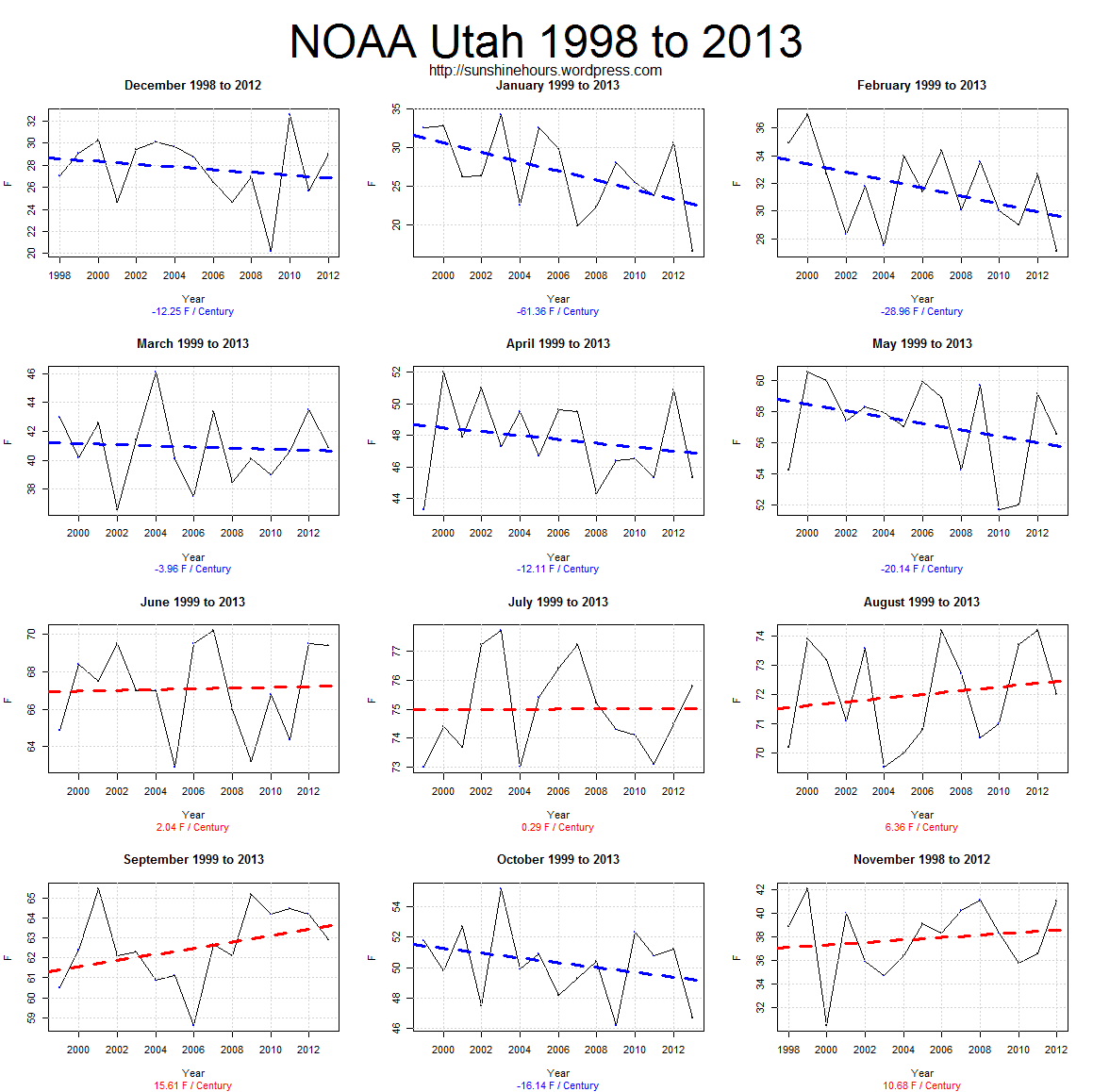
Over the last few days I have presented data for Arizona, Washington and Utah showing massive cooling trends in January for the last 15 years.  I did something similar for HADCET last month.

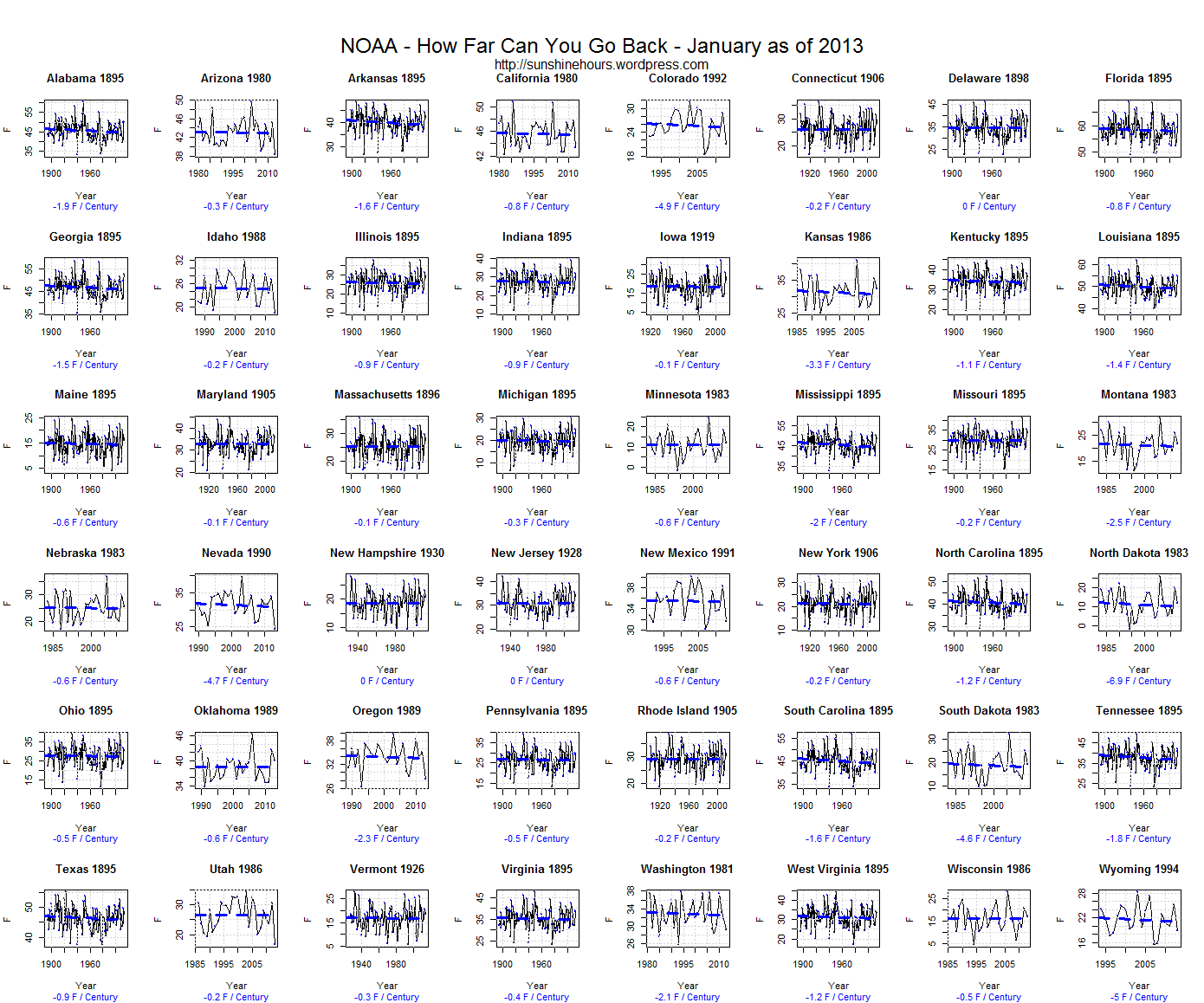
So I thought I would do the same “How Far Can You Go Back” for the lower 48 states for January.  I was somewhat surprised. 20 states have a negative trend from 1895 (the beginning of the NOAA data).

Alabama in January (for example) is cooling at -1.9F/Century since 1895. You can check NOAA’s data here if you like. I did, just to make sure.

The top 6 cooling trends:

From 1983 North Dakota -6.919 F/Century
From 1994 Wyoming -4.992
From 1992 Colorado -4.862
From 1990 Nevada -4.704
From 1983 South Dakota -4.613
From 1986 Kansas -3.344

Click to make the graph bigger:

NOAA - How Far Can You Go Back - January as of 2013

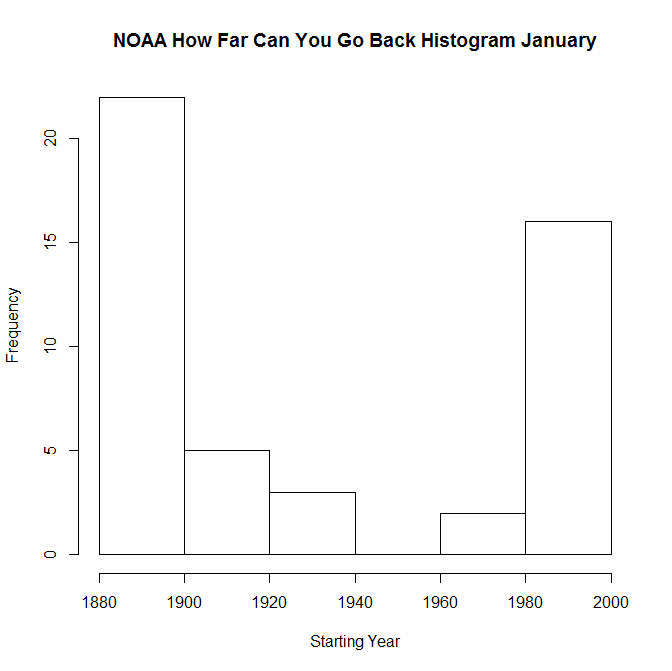
And the distribution:

HIST NOAA - How Far Can You Go Back - January as of 2013

50th Daily Record in a Row for Antarctic Sea Ice Extent (and 104th in total)

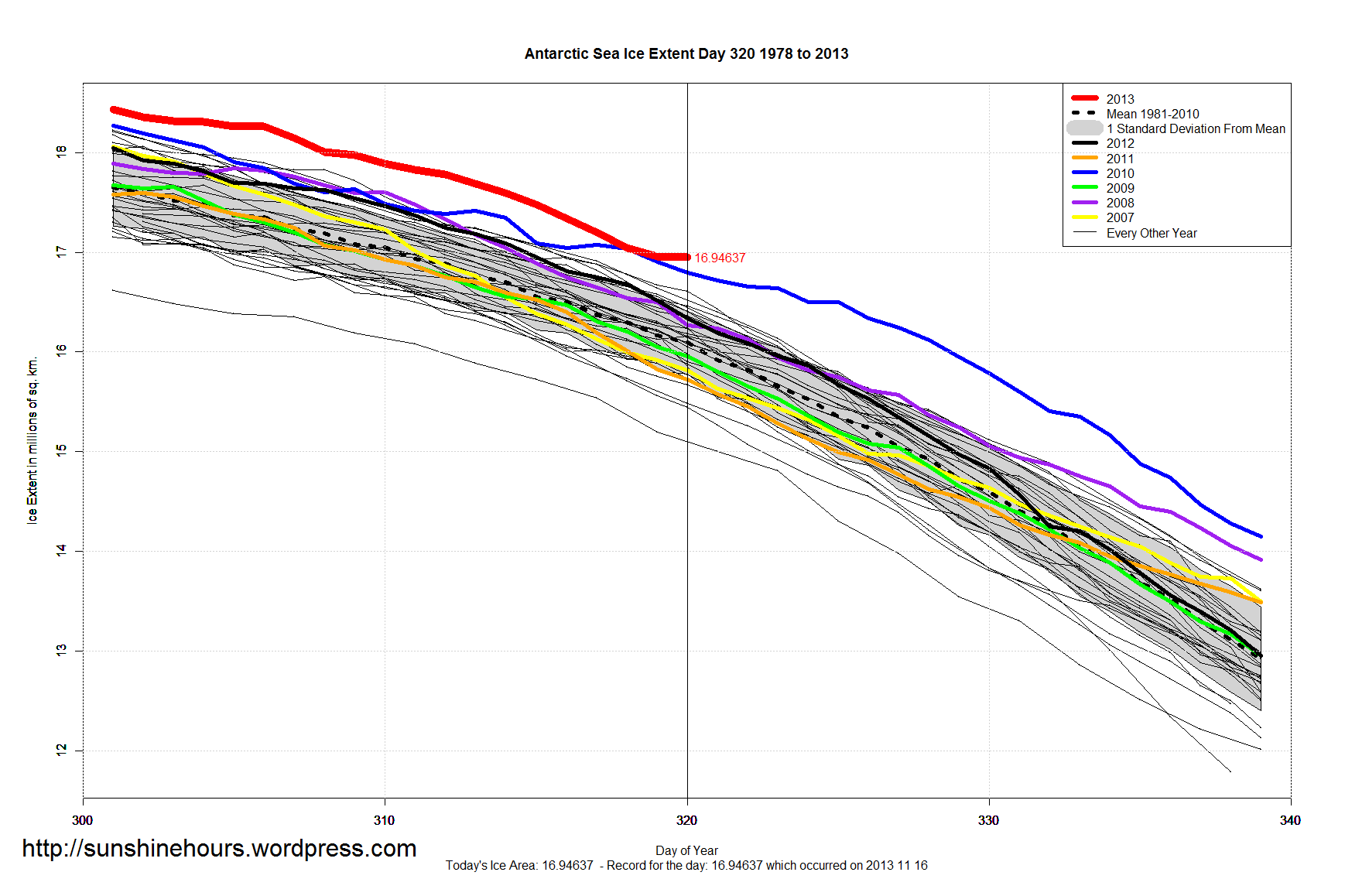
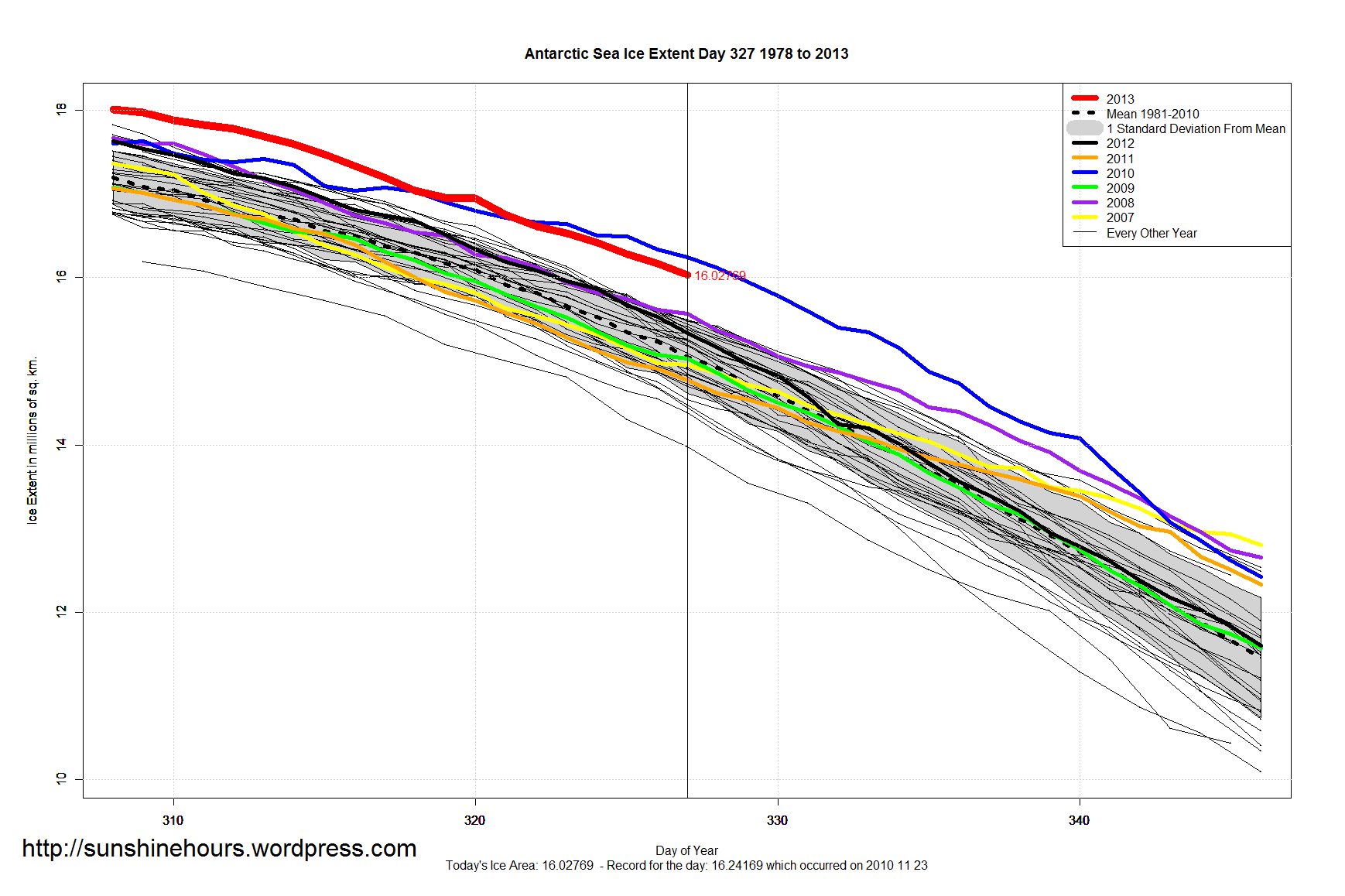
November 16th 2013 (Day 320) saw the 50th Daily Record for Antarctic Sea Ice Extent in a row! It was also the 104th daily record for 2013.

I thought this graph would show 2013 below the 2010 line, but melting slowed from 150,000 sq km per day to 80,000 sq km and then 20,000 sq km per day in the last 2 days.

Antarctic_Sea_Ice_Extent_Zoomed_2013_Day_320_1981-2010

Year No of Records
2008 123
2013 104
2010 92
2007 21
2009 8
2012 8
2000 4
2004 3
1979 2
2006 1

Washington State January Cooling At 23F / Century

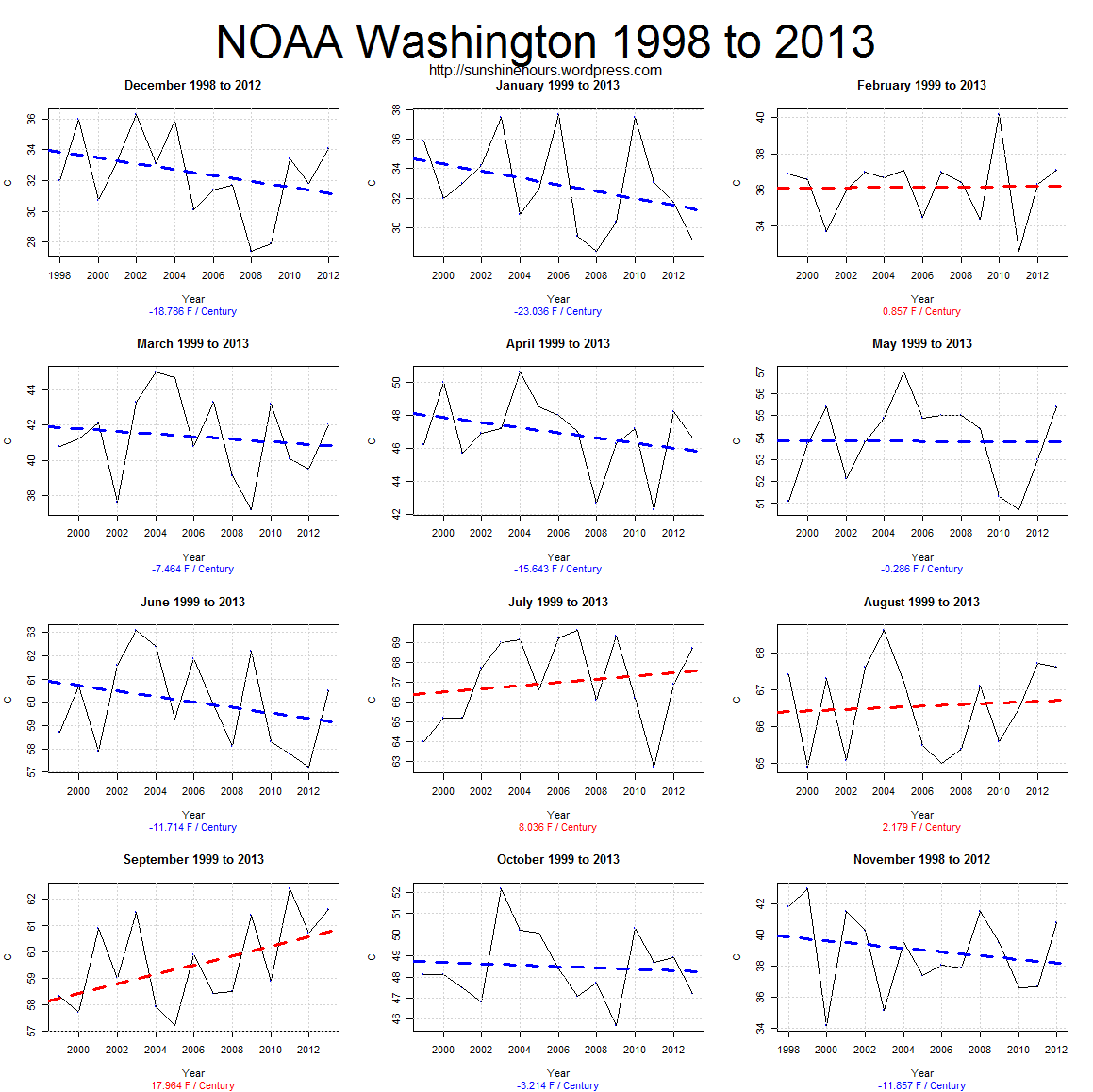
Correction: The original graph on the Y axis said C for Celsius. The correct unit is F for Fahrenheit. All mentions of F are correct. Graph has been corrected.

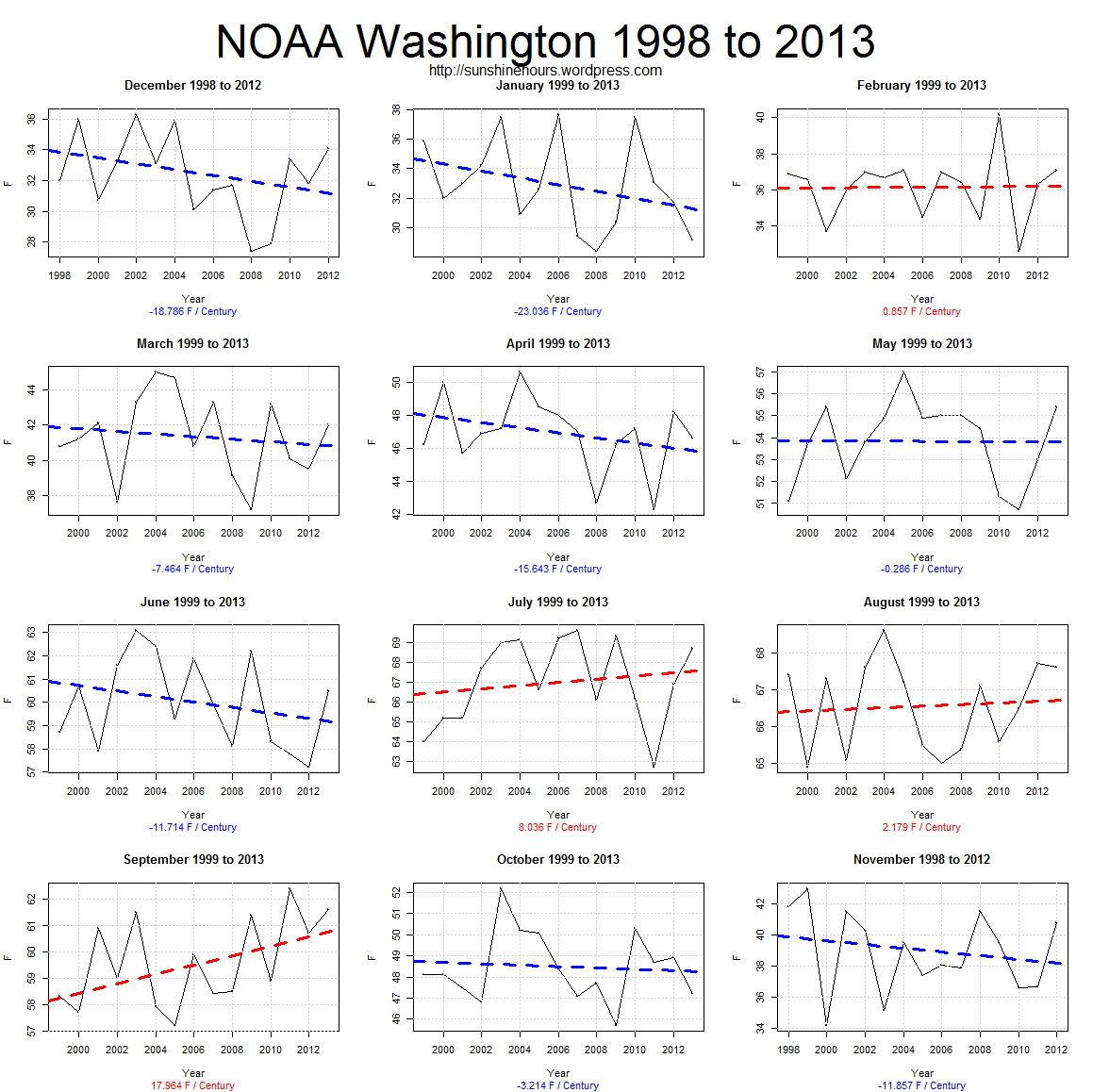
Did you know January in Washington State is cooling at 23F/Century according to the NOAA? O that December is cooling at -18F/Century?

September though is warming like crazy. 8 out of the 12 months are cooling. I’d call February flat -0 .8F / century is pretty negligible.

Here is the last 15 years broken down by month.

FC Corrected NOAA Washington 1998 to 2013


The Funnel Effect = Mass Insect Mortality at Solar Farms = Migratory Bird Deaths

Have you heard about the funnel effect?  It appears solar plants can draw in millions of insects and fry them. And then migratory birds drop in to eat the insects and the birds then get fried too.

“USFWS also noted an issue ReWire hasn’t covered before, and we suspect it has something to do with that funnel effect: the mortality of insects. The agency says the Palen solar project may have a serious effect on insects, based on experience at BrightSource’s Ivanpah Solar Electric Generating System (ISEGS) site, now nearing completion in San Bernardino County. “Staff with the CEC reported large mortalities of insects killed during flux testing at the ISEGS site,” says USFWS. “[A]mong those documented include migratory monarch butterflies and dragonflies.”

A subsequent passage in the note on insects is an important summary of the relevance of insect mortalities to risk to other wildlife:

The ecological effects of mass insect mortalities have not been investigated
and may lead to greater levels of mortality than have been anticipated. In particular,
concentrations of insects are likely to draw insectivorous and omnivorous migratory
birds, including many raptors, which may increase the risk of bird mortalities.

If you have a facility that both attracts an entire food chain and then poses a risk of mortality or injury to individual animals at any level in that chain, then you’ve created an ecosystem-wide population sink that can metaphorically “funnel” individual animals from a wide stretch of habitat to a single spot where they meet their demise.

http://www.kcet.org/news/rewire/commentary/usfws-mysterious-funnel-effect-harming-wildlife-at-unnamed-solar-plant.html