Right now the mean for the year for Global Sea Ice Anomaly percent is +0.9% above the 1981-2010 mean.
The anomaly have been over +4% earlier in the year and is now almost -2%.
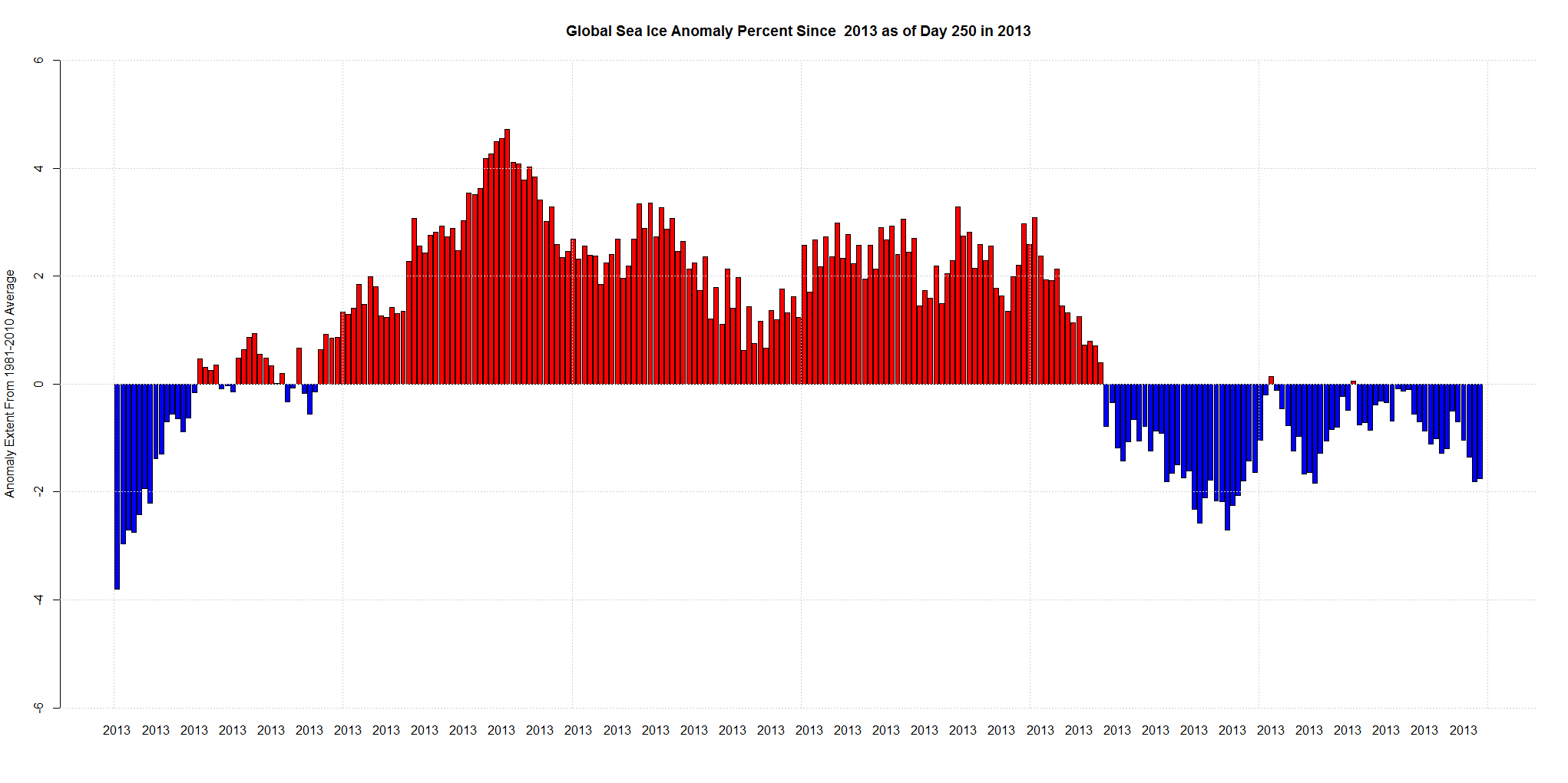
Right now the mean for the year for Global Sea Ice Anomaly percent is +0.9% above the 1981-2010 mean.
The anomaly have been over +4% earlier in the year and is now almost -2%.
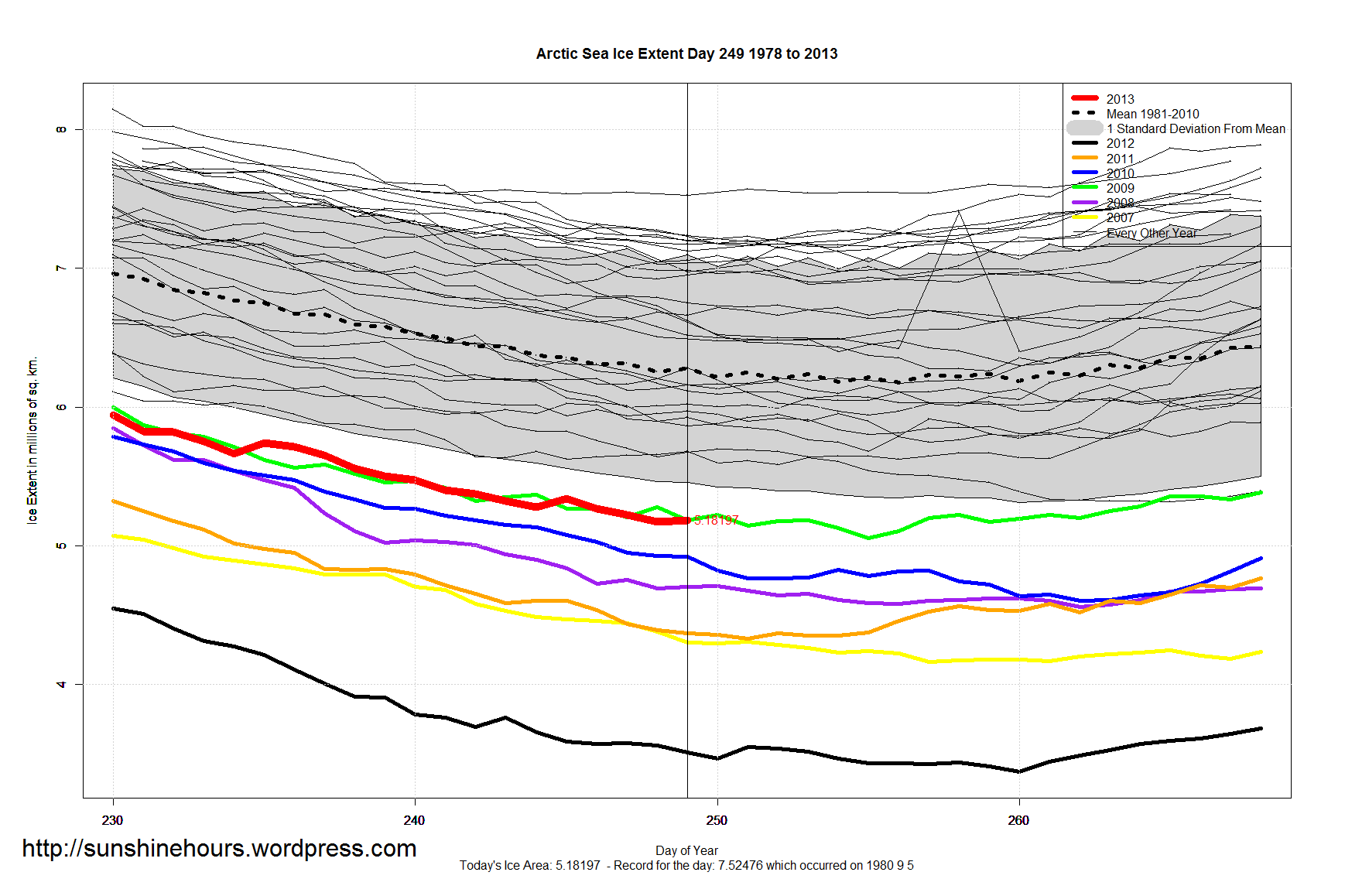
Arctic Sea Ice Extent increased for the 2nd day in a row. The increase was 19,270 sq km. Minimum is getting close. Yesterday was day 250. Day 248 is the lowest value for 2013.
If day 248 turned out to be the minimum, it would be tied for third earliest with 1994. 1987’s minimum was day 245. 1997’s was 246.


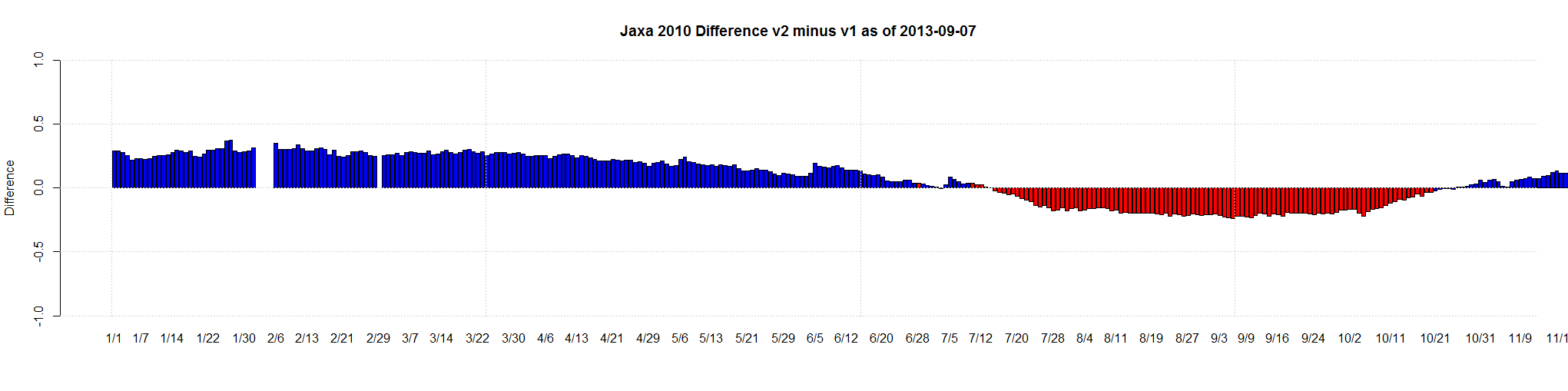
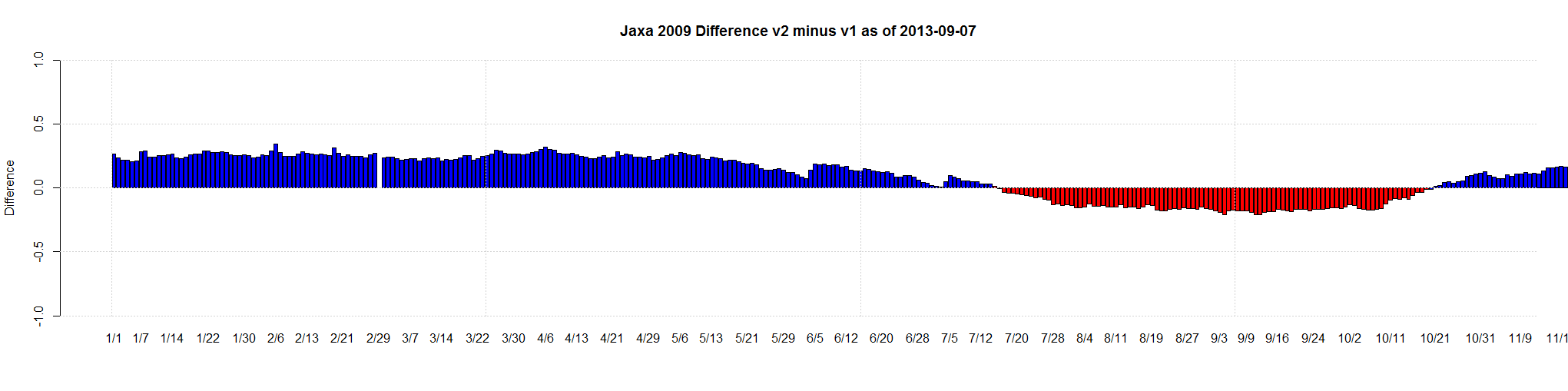
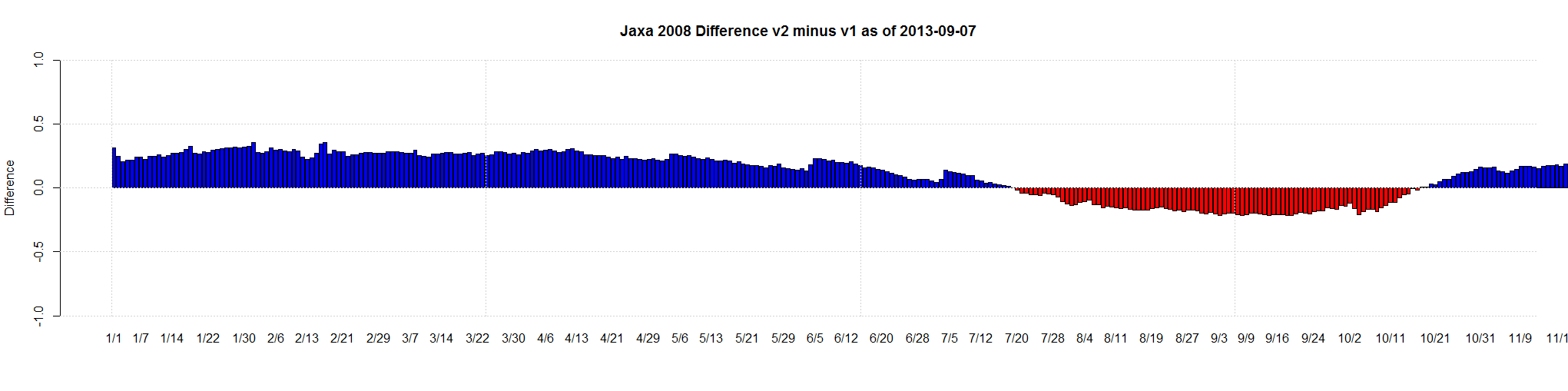
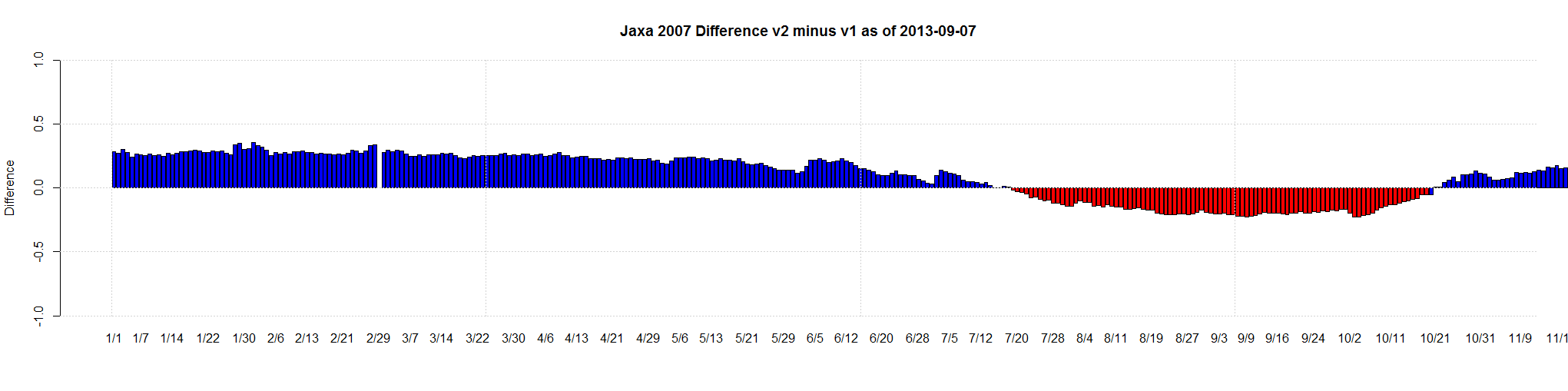
Yesterday I posted all the JAXA V2 versus V1 graphs. I was in a rush and I didn’t set the axis to be identical.
Here are the fixed graphs:


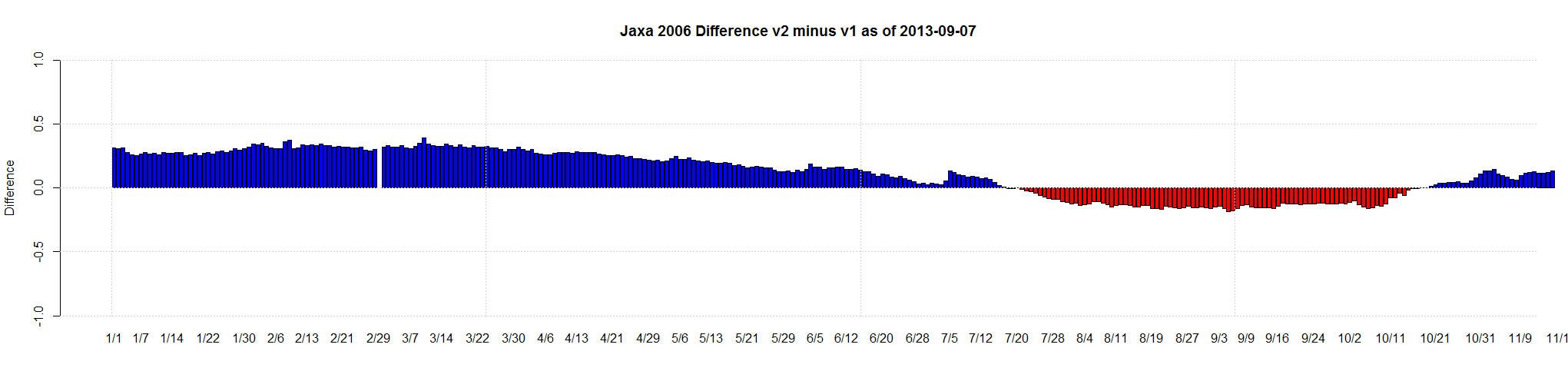
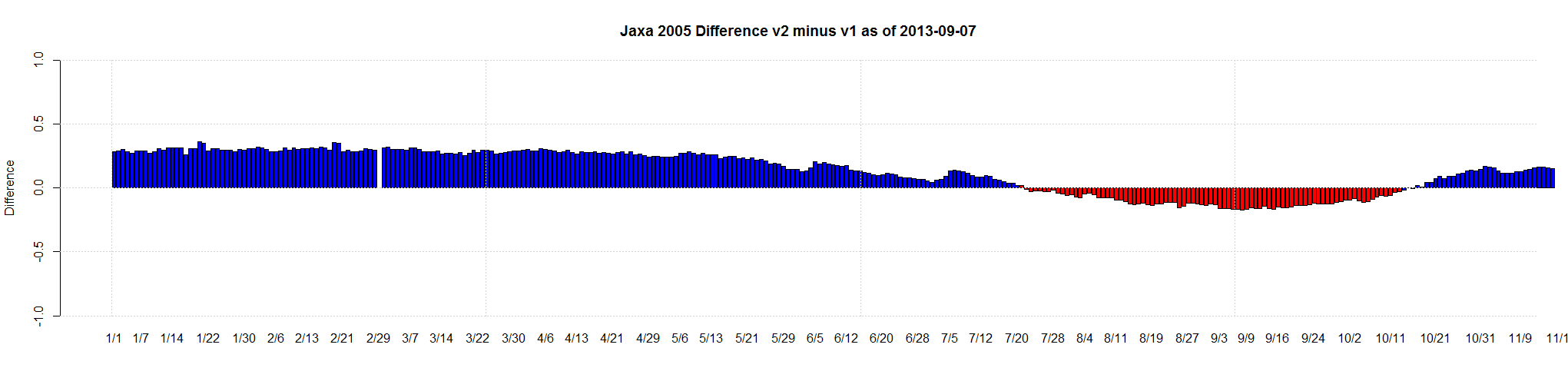


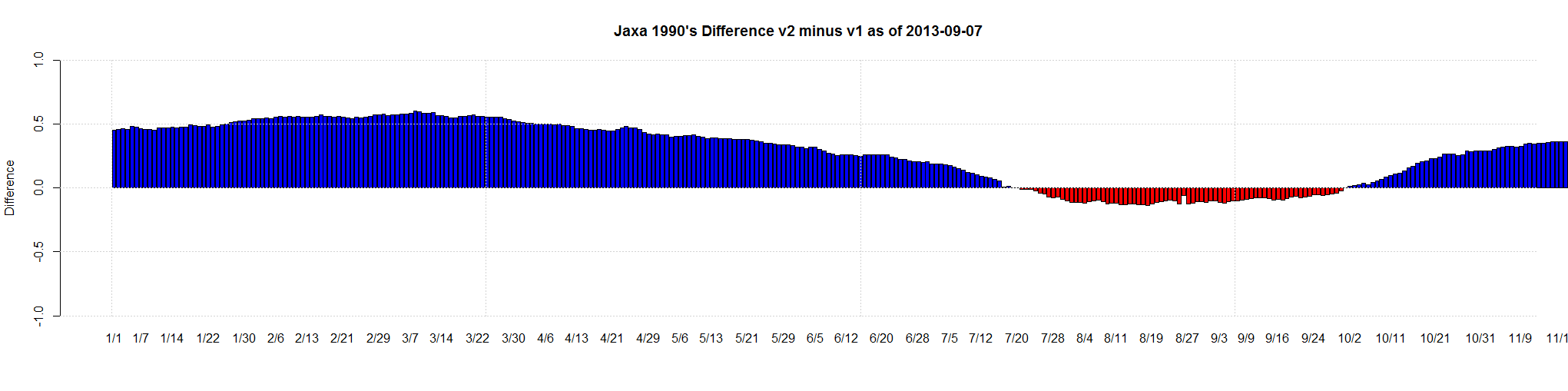
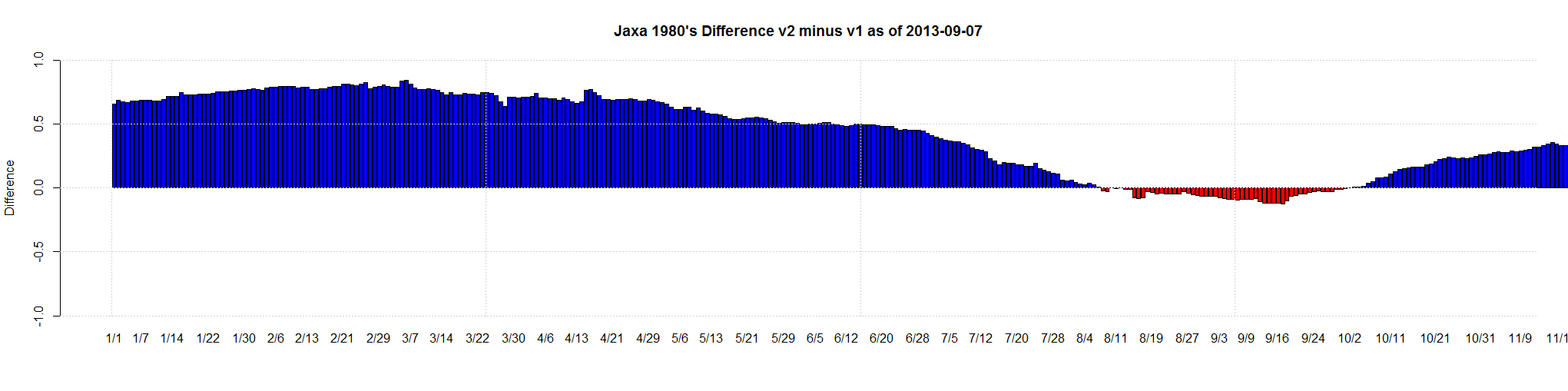
Yesterday I graphed the difference between JAXA version 1 and version 2 here and here.
Some AGW apologists said “Whats the big deal … the rankings didn’t change?”
So I graphed the difference between the 2007 minimum (2nd lowest) and the 2012 minimum (lowest).
Guess what? JAXA V2 increased the difference between 2007 and 2012 by 200,000 sq km. V2 dropped 2007 by 200,000 sq km. V2 dropped 2012 by 400,000 sq km.
Gotta love the AGW cult. They never lose an opportunity to adjust the data in their favor.
Red/pink are from 2007. V1 is red. V2 is pink.
Blue/lightblue are 2012. V1 is blue. V2 is lightblue.

Arctic Sea Ice Extent Gained 10,500 sq km on Day 249 (September 6th). Minimum is (still) near!

UPDATE: Graphs with identical axis here.
Earlier today I noted that JAXA version 2 is out and I certainly didn’t like the new revision.
Here are all the years/decades compared. Remember the 1980’s, 1990’s and 2000’s are averages for the whole decade. And 2002 is incomplete and starts in June. And 2013 is incomplete because the year isn’t over.
I don’t understand how the 1980s / 1990s / 2000s “red” adjustment is so small compared to 2013 etc.


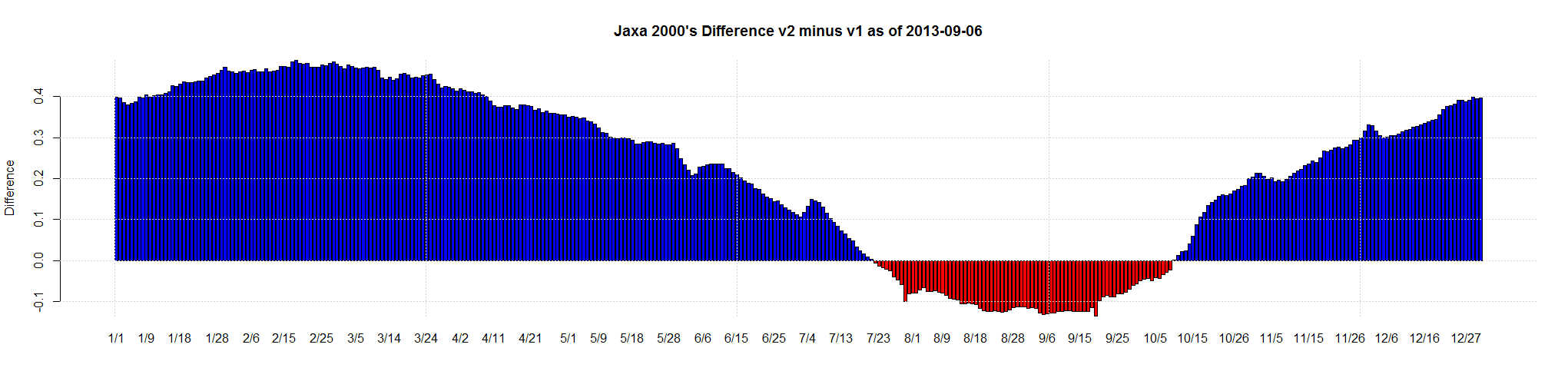


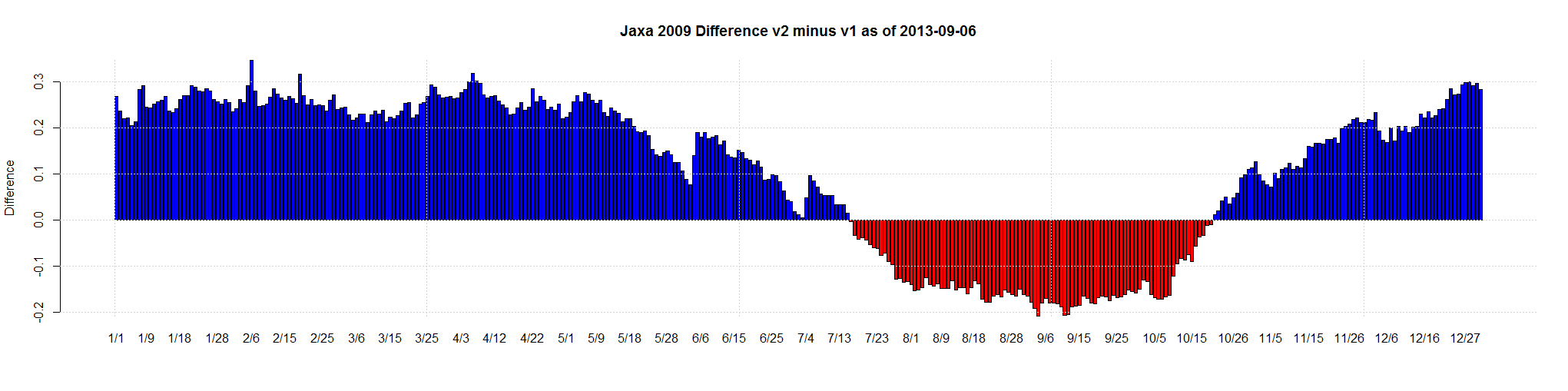

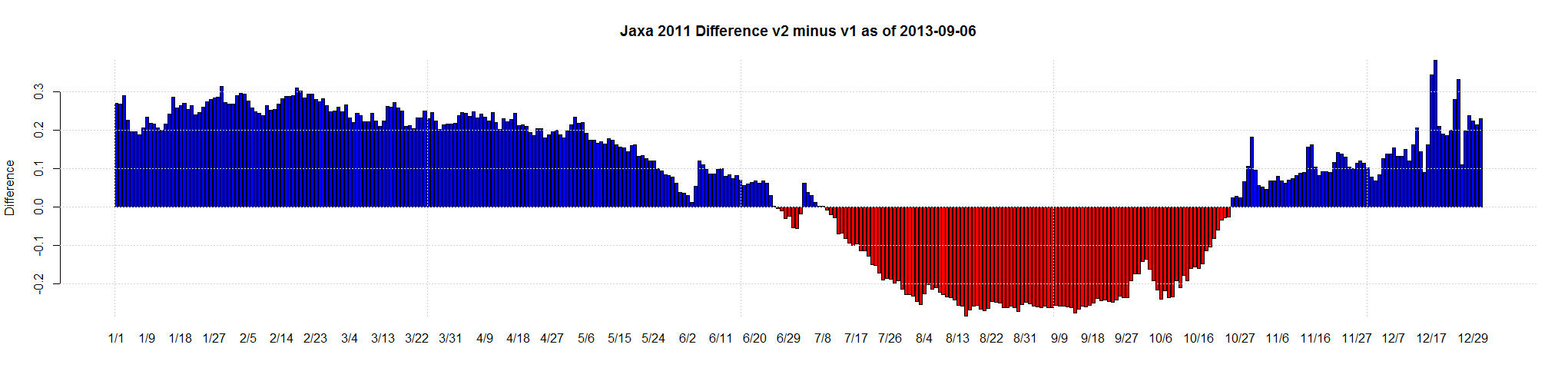

UPDATE: All the graphs are here.
Jaxa is one of the other sea ice monitoring agencies. They just came out with a version 2 of their data.
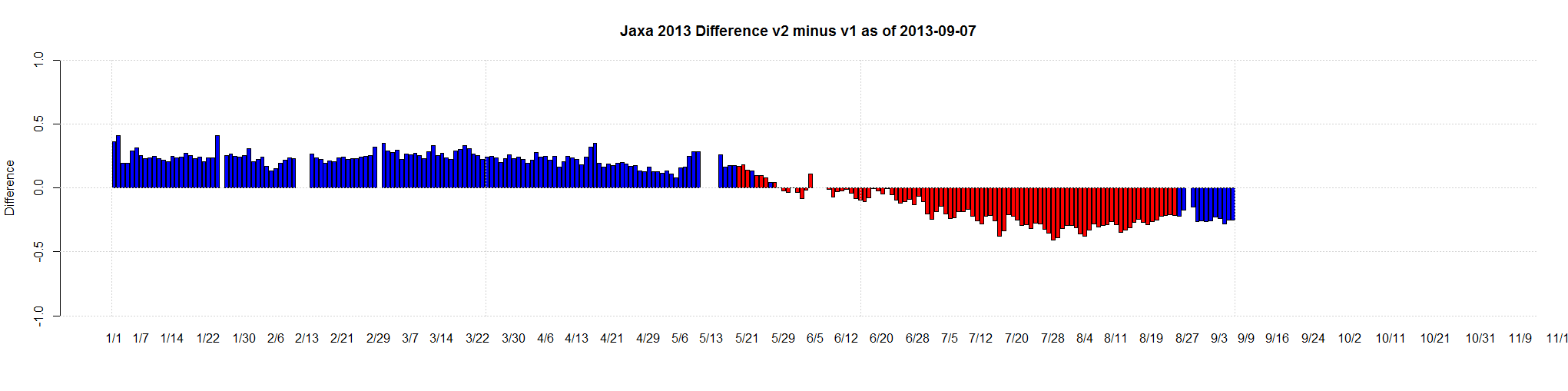
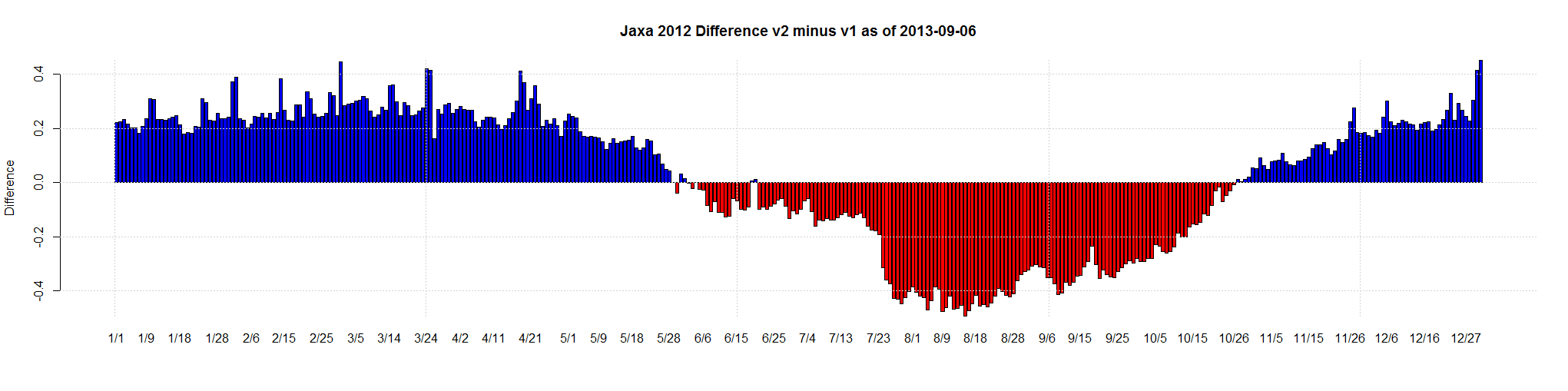
I thought … why not graph the difference between version 1 and version 2 for 2013.
Red = Version 2 Lower Than Version 1
Blue = Version 2 Higher Than Version 1
Guess what the following graph shows? It makes the minimum dramatically lower (400,000 sq km lower) and the maximum higher so the minimum looks even worse when graphed.
For shame.

“Climate change has forced professional snowboarder Forrest Shearer to go on the run. Over the past decade he’s seen the winter decrease from a six-month season (November to April) to a three-month season (January to March), so he has to travel to find the winter, wherever it may be. “Before we could go in our backyard,” says Shearer, a resident of Utah who has appeared in and worked on numerous snowboarding films. ”
http://www.sikids.com/athletes-give-back/winter-athletes-climate-change
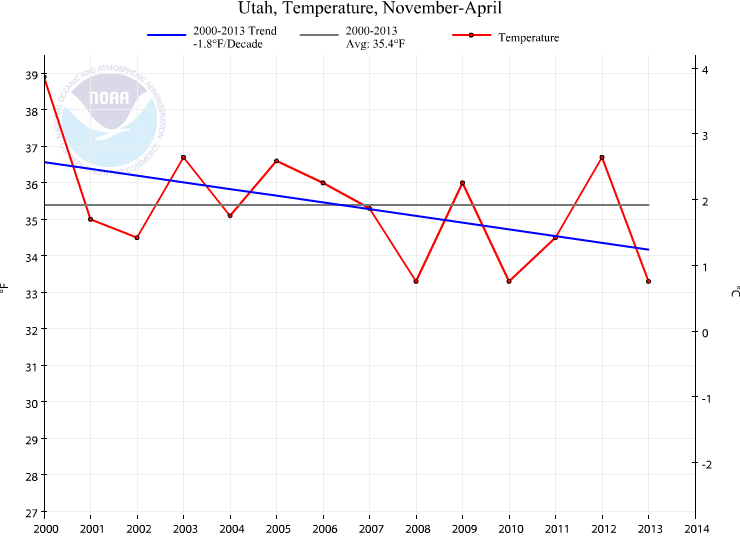
For the last 10 years (According to the NOAA) November to April temperatures in Utah fell -2F.

The highest mark for temperature was 2000.
“Ice buildup in the Amundsen Gulf is responsible for barge delays that have many Northern coastal communities running short on supplies.
Normally, a supply barge arrives in the area in early summer to replenish stocks of fuel and other necessities in those communities. But this year, that trip is being held up by ice. As much as 30 to 40 per cent of the Arctic Ocean remains covered in ice.
“We have not seen ice with this type of coverage in quite a few years and I really don’t know how far back we might’ve seen it,” says Bill Smith, a spokesman with Northern Transportation Company Ltd., which services the communities.”
http://www.cbc.ca/news/canada/north/story/2013/09/03/north-barge-delays.html
(h/t Alec aka Daffy Duck)
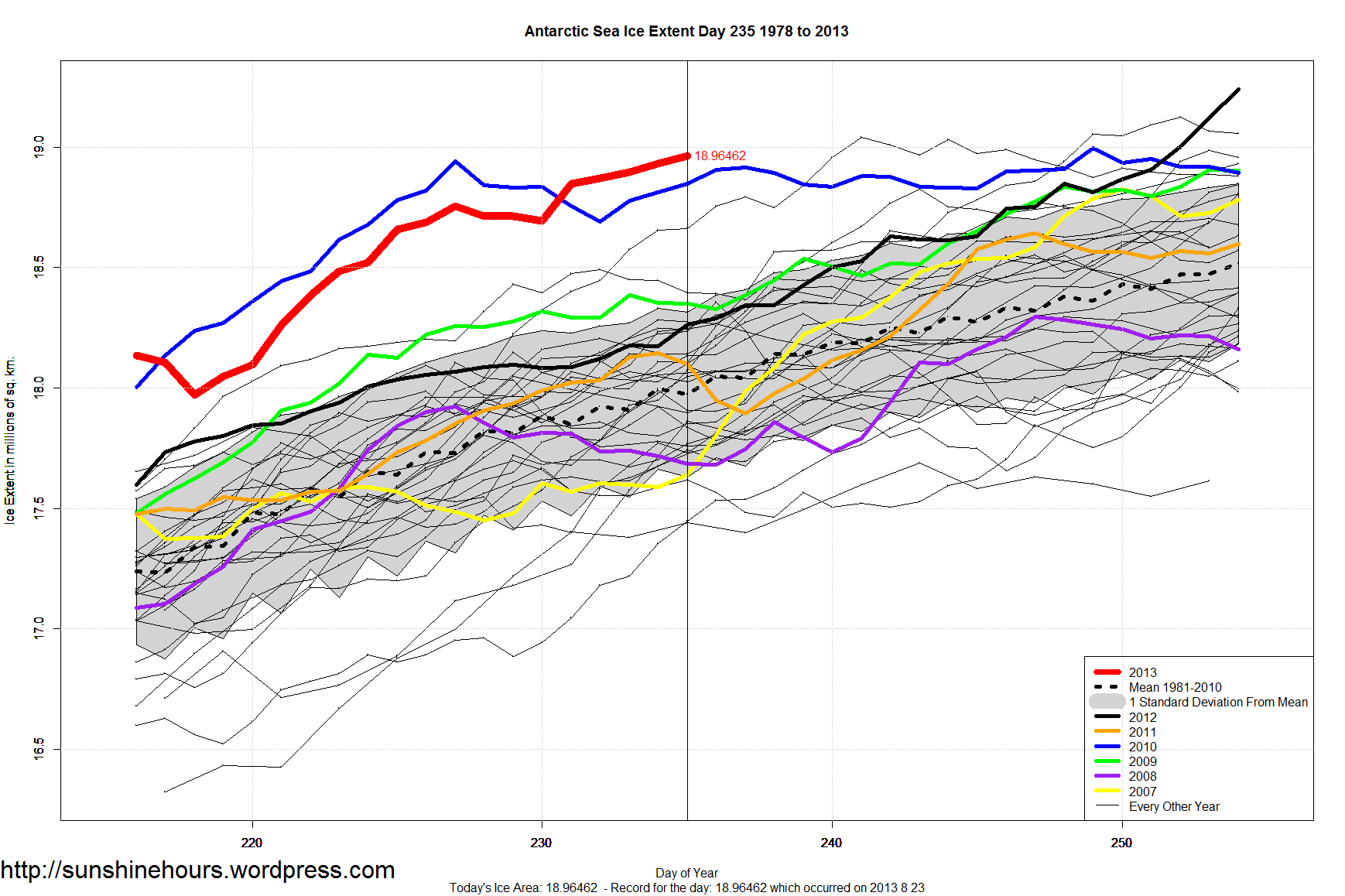
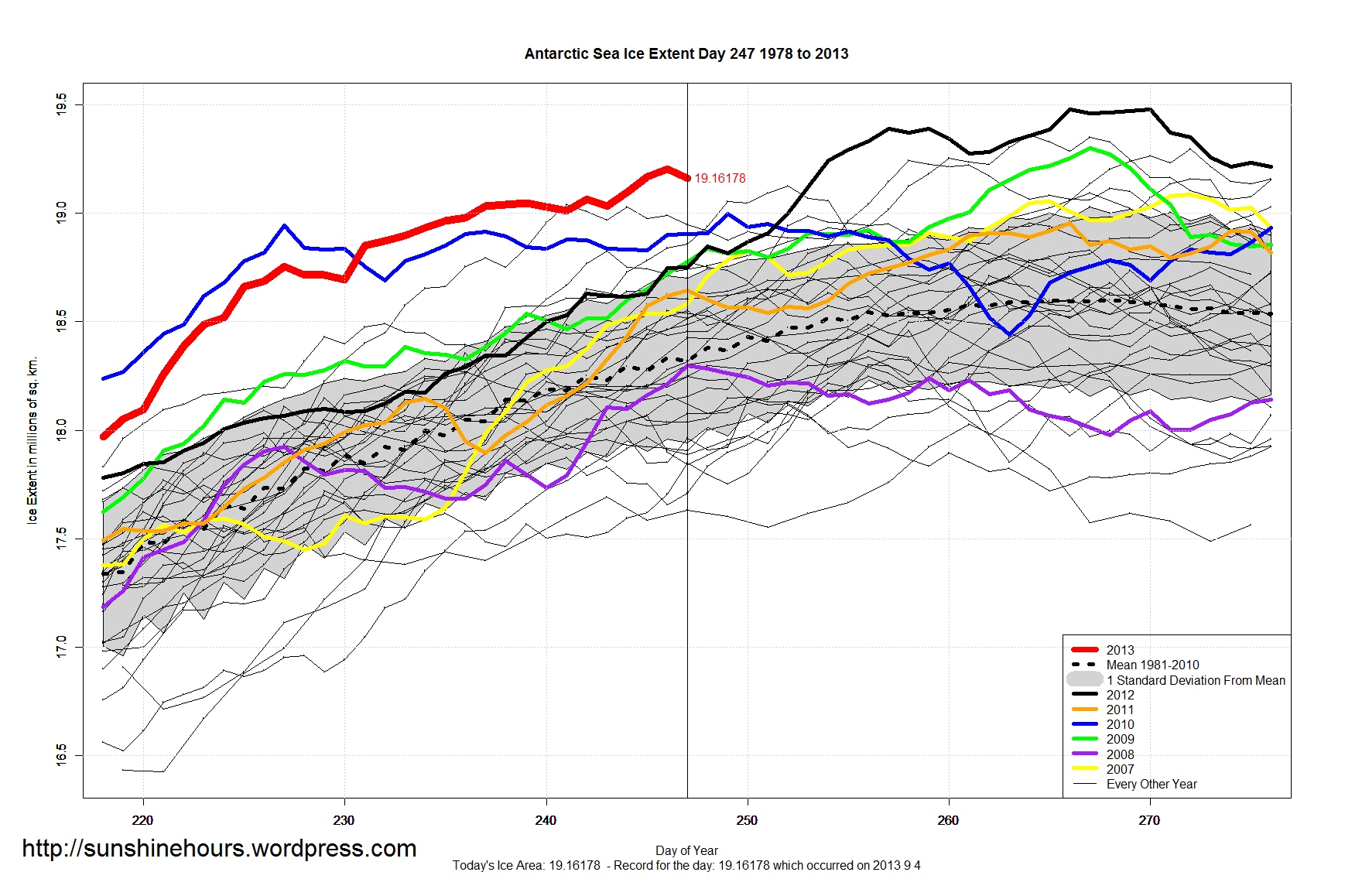
September 34 (Day 247) saw the 39th Daily Record of the Year for Antarctic Sea Ice Extent.
Antarctic Sea Ice Extent is 19.16 million sq km.
If you add up the number of daily records, 2013 is a distant 3rd behind 2008 and 2010. However, if you also add in 2nd place finishes, 2013 slightly edges out 2010. And 118 days remain in the year.
| Year | Firsts | Seconds | Top 2 |
| 2008 | 125 | 49 | 174 |
| 2013 | 39 | 109 | 148 |
| 2010 | 107 | 39 | 146 |
| 2006 | 20 | 28 | 48 |
| 2009 | 8 | 33 | 41 |
| 2012 | 27 | 11 | 38 |
| 2007 | 21 | 2 | 23 |
| 1998 | 4 | 16 | 20 |
| 2005 | 3 | 15 | 18 |
| 1979 | 2 | 12 | 14 |
| 2004 | 5 | 4 | 9 |
| 2000 | 4 | 3 | 7 |
| 1980 | 1 | 3 | 4 |
Click graph for bigger. Data is here.
 sunshine hours