Cooling since 1900

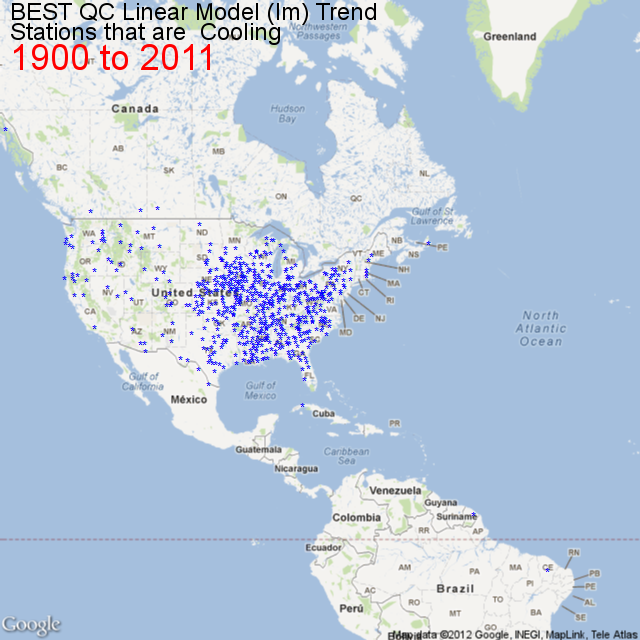
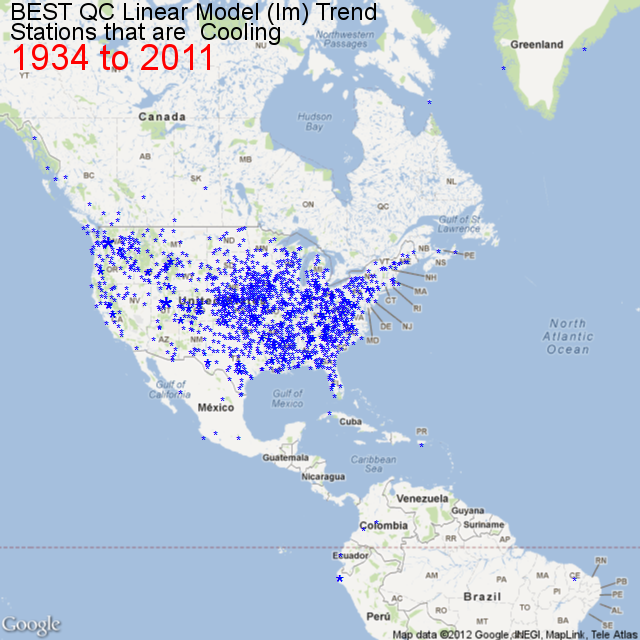
I have been looking at the BEST data and playing around with [R] and came across a package for [R] called RGoogleMaps that allows you to download a 640×640 Google Map tile and add text or points.

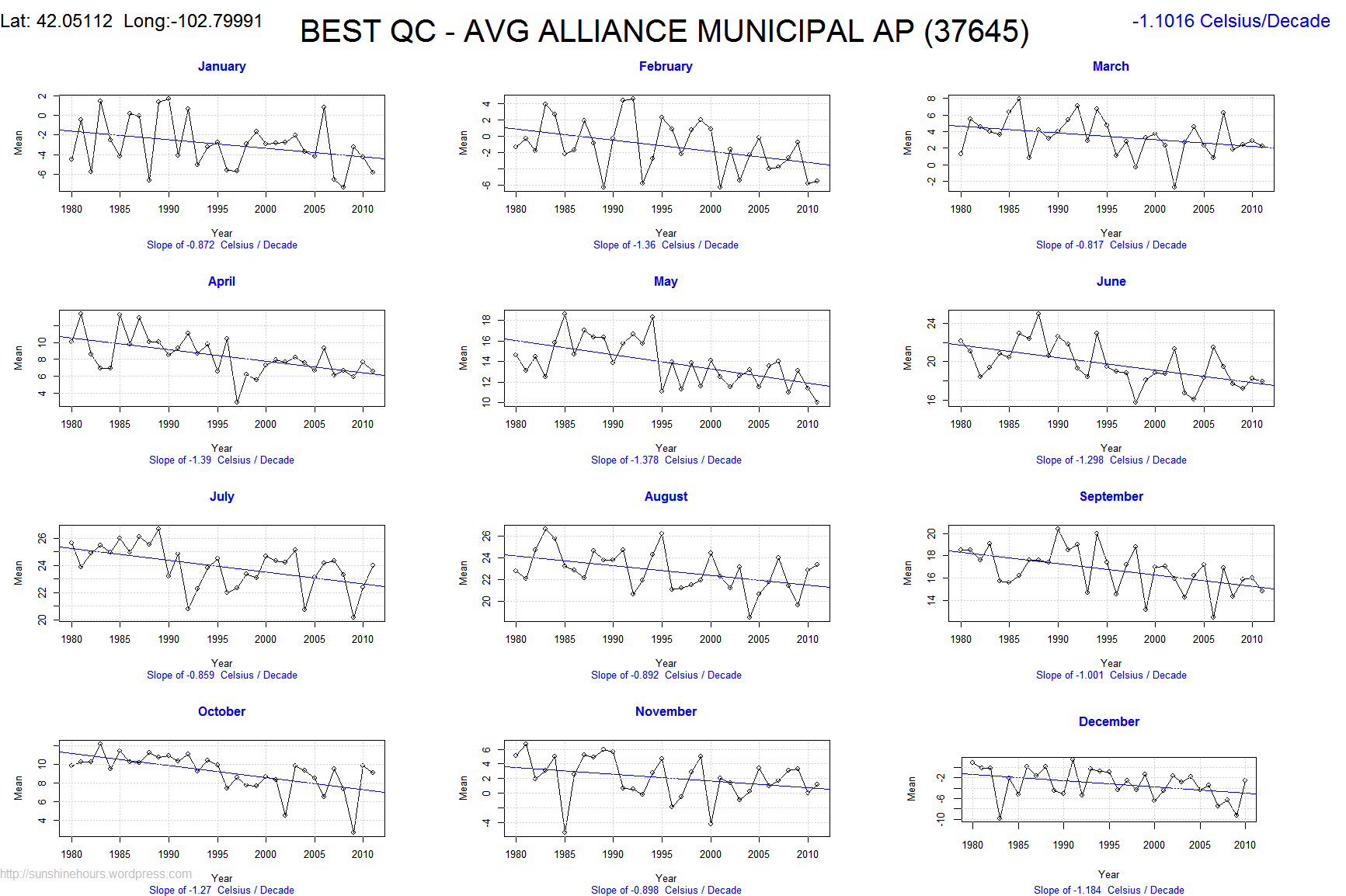
I thought why not find which climate stations have been cooling from 1900 and map them. This isn’t every station (it is most of them) but this map is zoomed in to the USA.

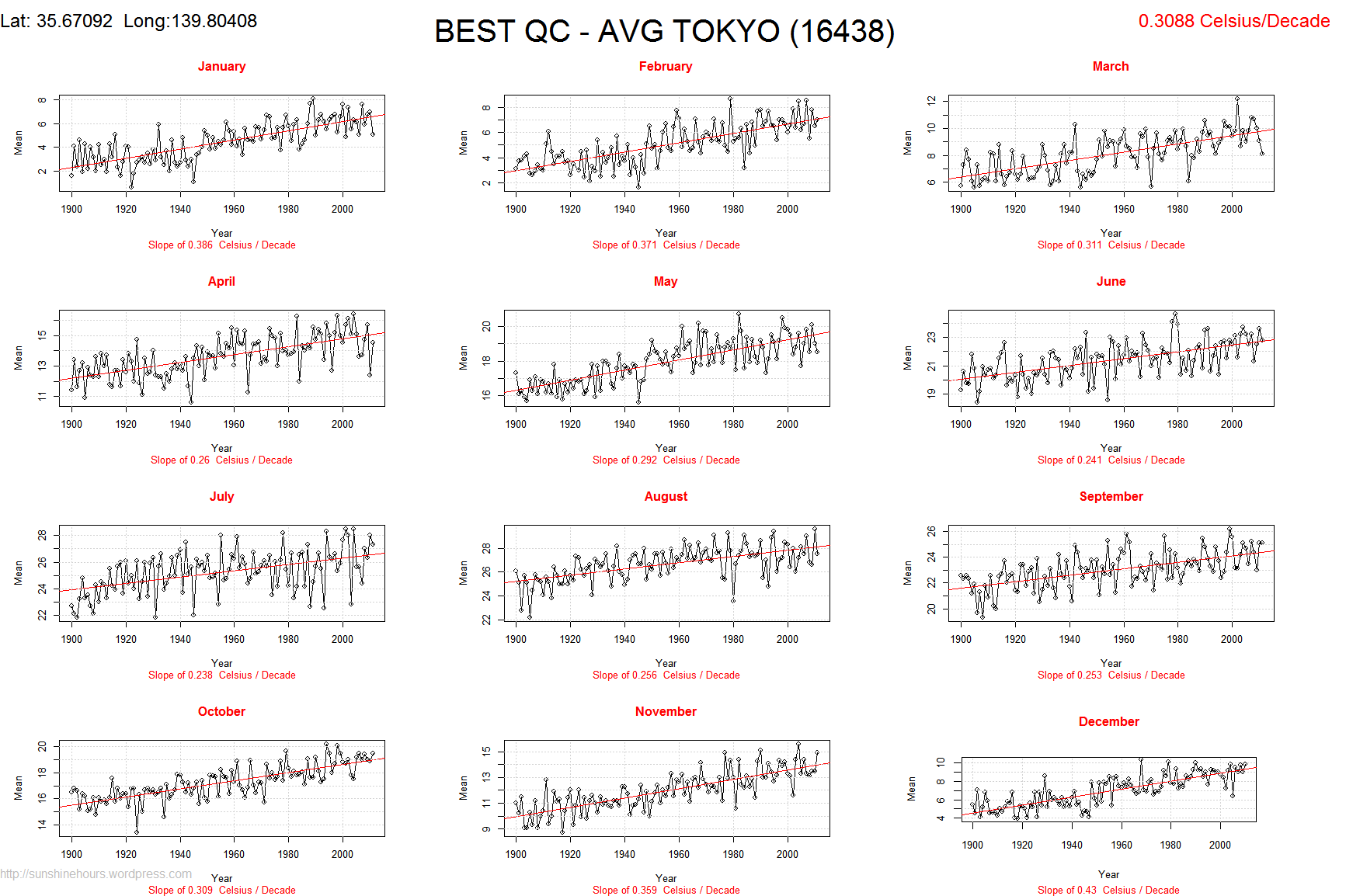
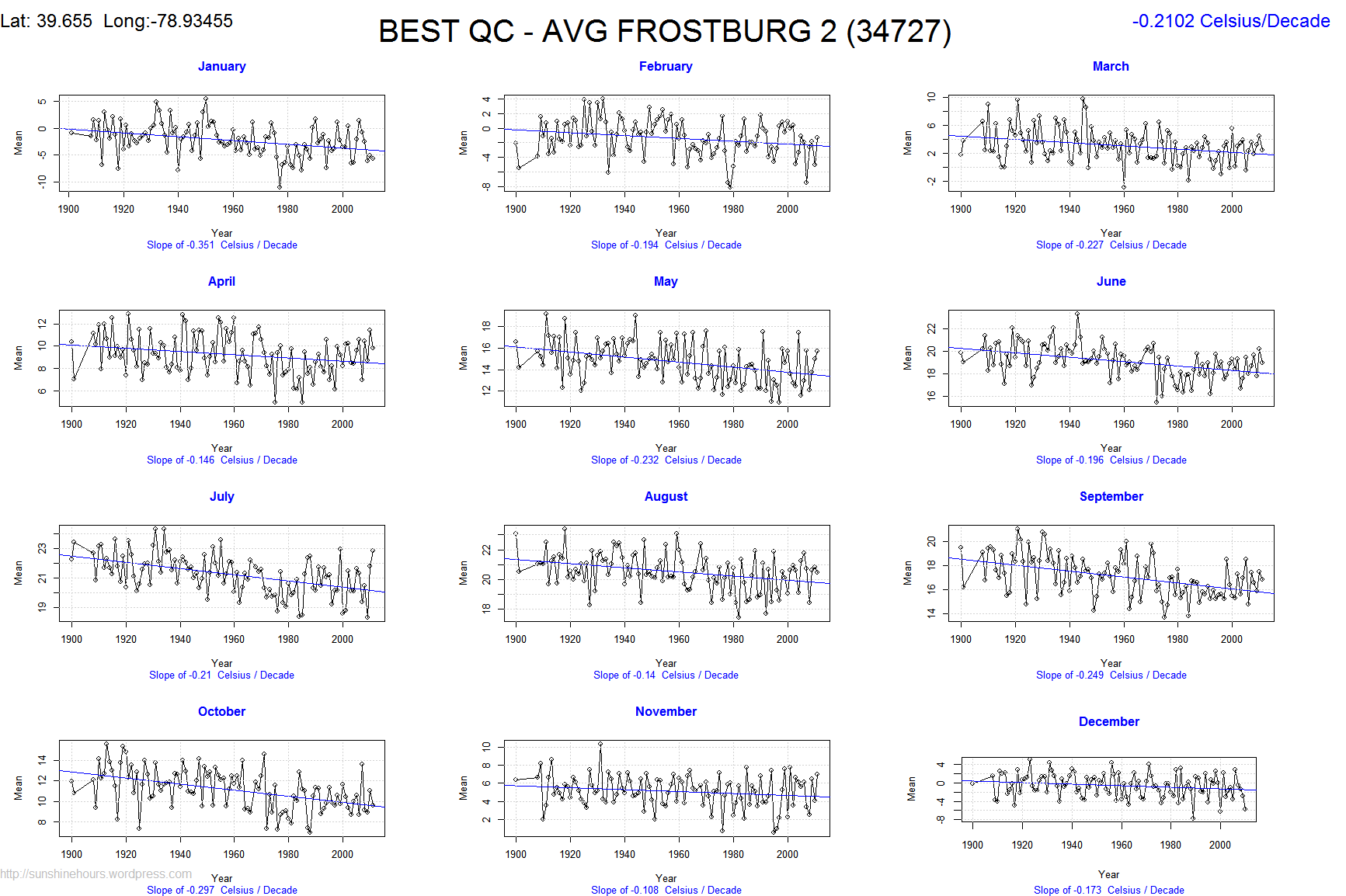
Warming and Cooling – Tokyo and Frostburg

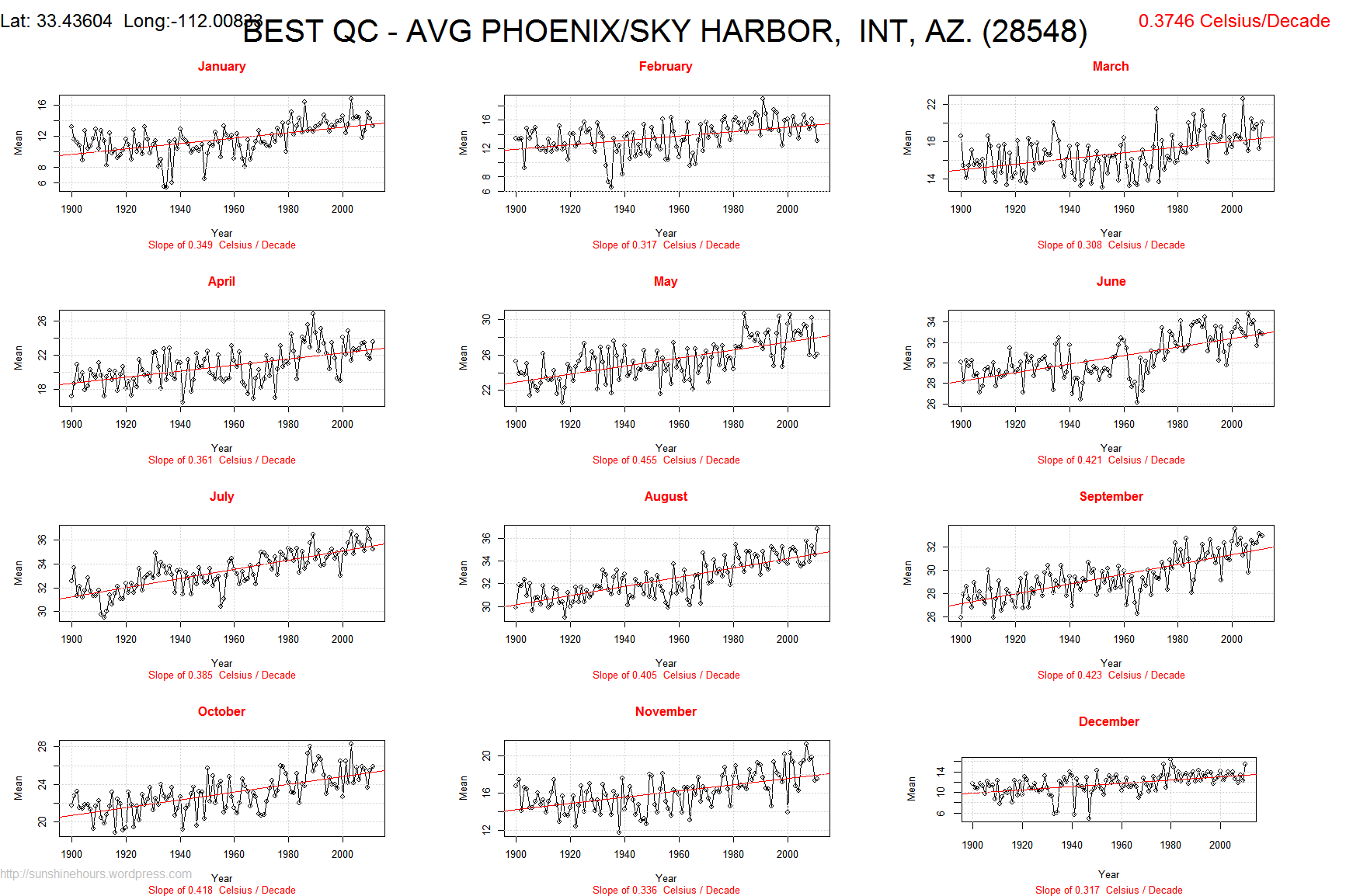
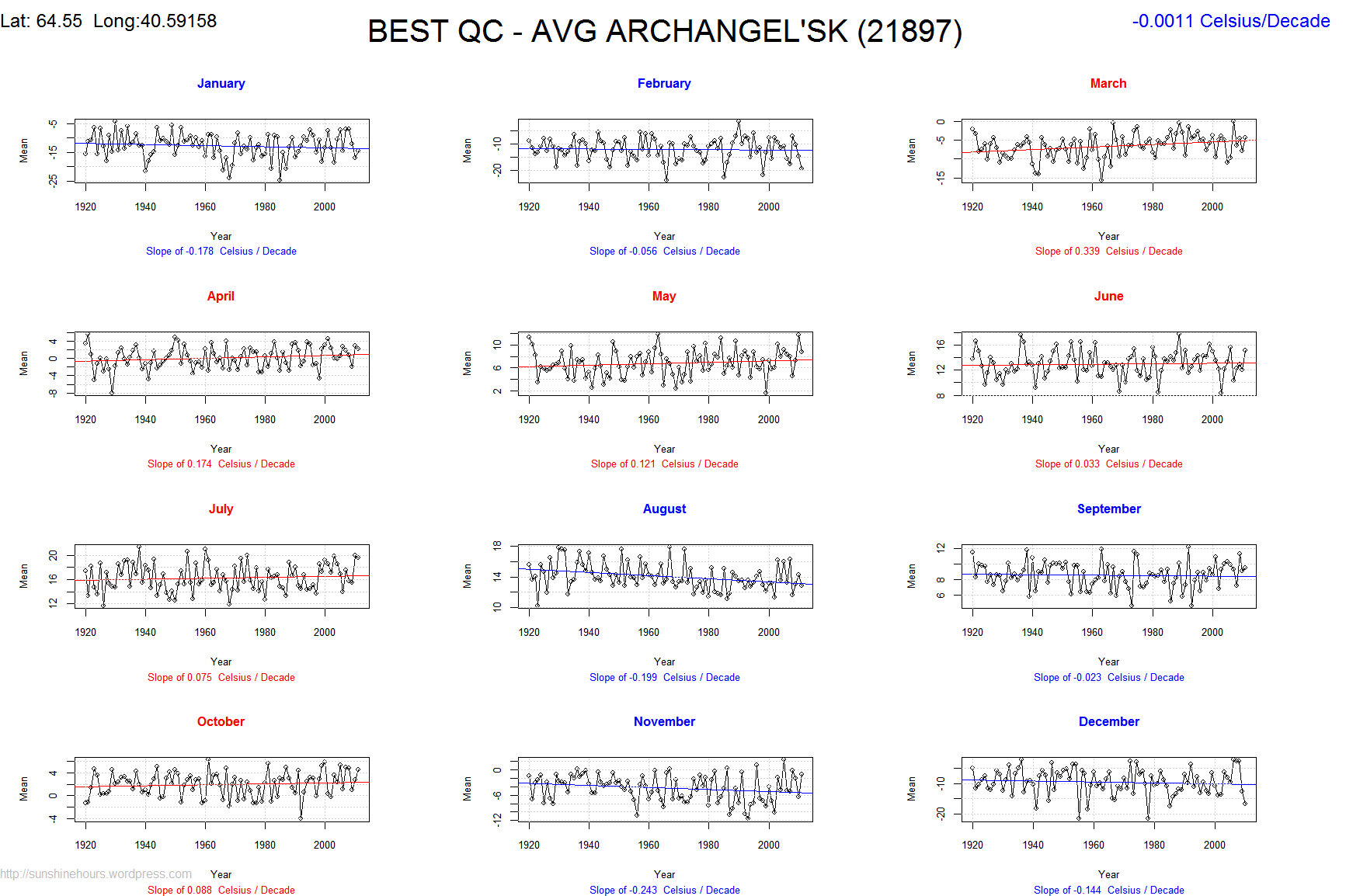
I was working with the BEST data and decided to look at which stations cooled the most and warmed the most since 1900. It turns out, of the 1957 stations that have data in 1900 and 2011, 1320 have a warming trend and 636 have a cooling trend.

Don’t get me wrong,  I’m not saying the BEST data is right. There is a lot of data discarding going before it gets to the Quality Controlled set, and I haven’t analyzed yet.

Tokyo makes the warming top 10. It is warming at the rate of .31C per decade since 1900.

Phoenix also makes the top 10. .37C per decade.

Frostburg is the station cooling the most, -.21C per decade.

Auditing the latest BEST and EC data for Malahat

Over the last few weeks I’ve been looking at the latest BEST data and sometimes comparing it to data from Environment Canada (EC) I scraped off their website.

To start with I am looking at one station. In BEST it is StationID 7973 – “MALAHAT, BC”.  In EC it is station MALAHAT which is Station_No 1014820.

I am comparing the BEST SV (Single Valued) data to the BEST QC (Quality Controlled) data.  The first  minor problem is that the EC data has records from the 1920s and 1930s that BEST does not have (that I have found). Thats no big deal. The next problem is that out of 166 MOnth/Year records, not one of them matched exactly. BEST SV and QC data is to 3 decimal points while EC is to 1.

For example. Jan 1992 has QC = 5.677, as does SV, while EC = 5.8. Close. But not an exact match.

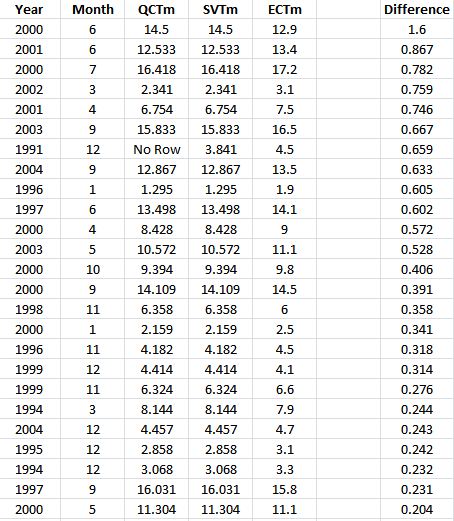
However, the real problem is that  there are 5 records that have been discarded between SV and QC. Two out of the five make no sense at all, and one is iffy.

Where it says “No Row” it means BEST has discarded the record completely between SV and QC.
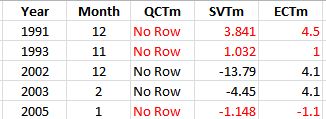
1991 is iffy. EC has it has 4.5, SV has 3.841. Close, but not that close

1993 makes no sense at all.

2002 is fine. Thats a huge error. But where the heck did BEST get the -13.79 number in the first place.

2003 is fine. But again,   where the heck did BEST get the -4.45 number in the first place.

Finally, 2005 makes no sense at all. There is little difference between -1.1 and -1.148. Certainly most records are that different.

And those are just the discarded records!

There are another 48 record with a difference of .1C or greater and  here are the greater than .2C ones.
What a mystery. 
EBRO Observatory (Spain) and Bright Sunshine

In 2008 a paper was published called  “Short Communication – Sunshine and synoptic cloud observations at Ebro Observatory, 1910–2006” by J. J. Curto, E. Also, E. Palle and J. G. Sole.

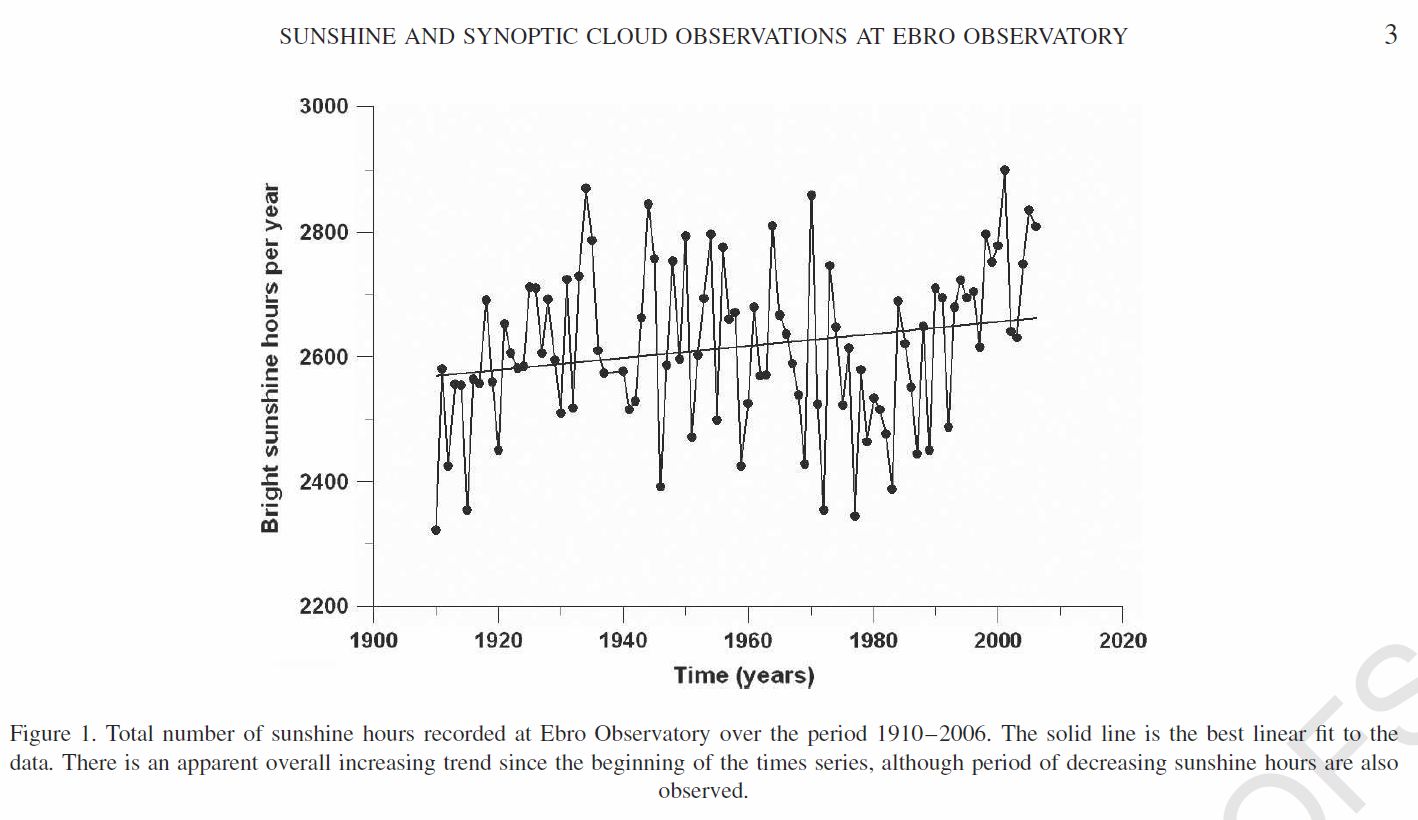
I managed to download a copy. The following graph is of sunshine measured from an Observatory in Spain. If you weren’t paying attention you might think it is a graph of GISS or HADCRU temperatures … right?


Since 1910, we find that there has been
an overall increase in the number of sunshine hours, but
with large oscillations that make this increase statistically
insignificant, while over the same time period cloudiness
has increased by a larger amount (about 12%) with high
statistical significance.
We associate the increase in both sunshine hours and
cloud amount with a shift in cloud types during the
100-year period covered by the observations.”

Sunshine and Temperature in Alberta and BC Canada

I recently scraped the Environment Canada website for climate data in BC and Alberta. I’ve been learning R and I thought I would graph the mean of the sunshine hours and temperature for each month. Do remember this is only stations with BOTH bright sunshine and temperature records for the month.

In Alberta the number of stations reporting sunshine peaked in the 1980s around 24.

Alberta Stations with Temp + Sunshine July

In BC the number peaked around 64 in 1988.

BC Stations with Temp + Sunshine July

Temperatures at a standstill for 10 years

Dr. David Whitehouse:

“If you look at the instrumental temperature record, HadCrut3 for example, it’s obvious that there are features in the temperature curve that each require an explanation. The initial low temperatures and rough standstill between 1850 – 1910 (there was a brief warmish phase at about 1875). The rise between 1910 and 1940, the standstill between 1940 – 1980, the rise 1980 – 2000 and the standstill 2000 – 2010. Standstills are not unusual. It is also interesting that in the 50 years since 1960 when the IPCC says greenhouse gasses became the dominant climate driver, there has been temperature increases in only two of five decades! In fact, since the start of the instrumental period in 1850 only 50 of the 160 years have been part of an increasing trend.

Recently the UK Met Office conducted a series of simulations incorporating climate change models with decadal fluctuations in climate and concluded that one out of every eight decades would show a ten-year standstill, but that no standstill will last as long as 15 years. Since we have three standstill decades since 1960 this data seems to be somewhat outside the conclusions of the simulations. Each year is now significant as a prolonged hiatus in temperature acquires more and more statistical significance in taking the observations away from the theoretical predictions.

The IPCC says there should be an increase, on average, of 0.2 deg per decade. In Hadcrut3 the increase for 1979 – 2008 is 0.18 deg per decade which seems to fit in with the IPCC estimates. However, the trend for the past decade is zero making a revised estimate for the 1980 – 2000 period as 0.27 deg per decade.

Looking at atmospheric data, which is independent of the weather station data used in HadCrut3 (I am grateful to Lubos Motl for these figures), from RMS AMU between January 1979 and 2011 the increase was 0.14 deg per decade. However, the figure for 2001 – 2011 is minus 0.04 deg per decade. That is, if anything, the world has got cooler, although still within a statistical constant line within errors of measurement.

http://thegwpf.org/the-observatory/3192-warming-what-warming.html

Decrease in Cloud Cover causes 3x as much warming as CO2

The decrease in Earth’s reflectance from 1984 to 2000 translates into an albedo decrease equivalent to a forcing of 6.8W/m^2.

That is almost 3 times as much warming as claimed by the IPCC for warming caused by CO2 from 1850 – 2.4W/m^2.

http://hockeyschtick.blogspot.com/2011/05/study-finds-global-warming-from-natural.html

http://www.iac.es/galeria/epalle/reprints/Goode_Palle_JASTP_2007.pdf