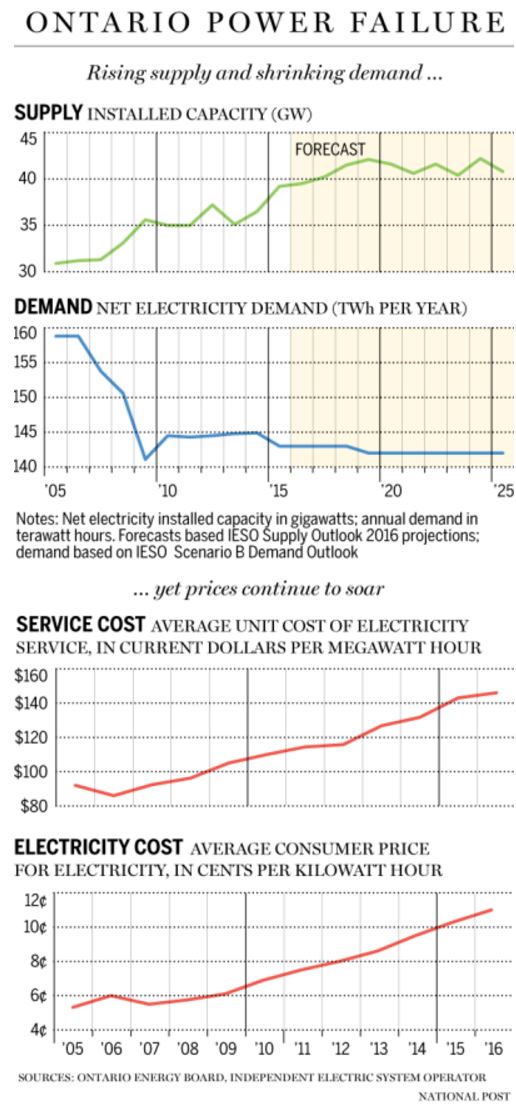
Ontario Boondoggle – The Giant Scam Costing Consumers 100s of billions


Poor Ontario. An energy policy created by green activists is a grotesquely expensive mess that consumers will be paying for …. for the rest of their lives.

Read and weep here. Unfortunately Canada now has a pretty Prime Minister who will drag us down the same road and commit economic suicide.

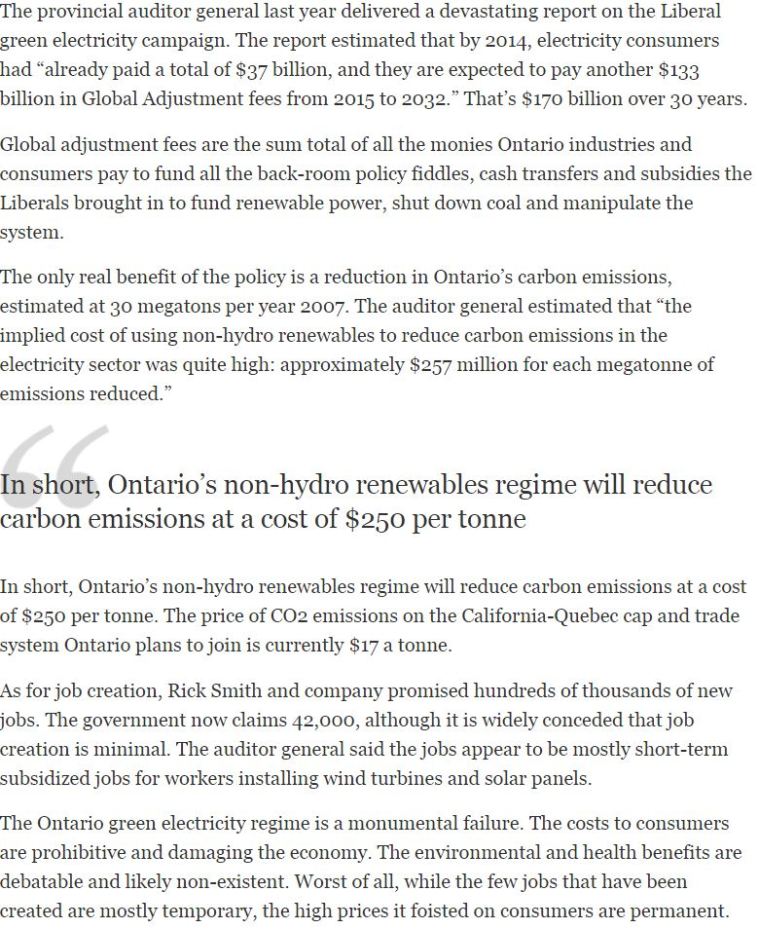
ontarioboondoggle

ontarioboondoggle_2


Ontario Wood Pellets Would Have Produced Less Than Half Of The (net) CO2 as Norwegian Wood Pellets

Ontario is importing “advanced biomass” wood pellets from Norway. See the post here is you are coming in late.

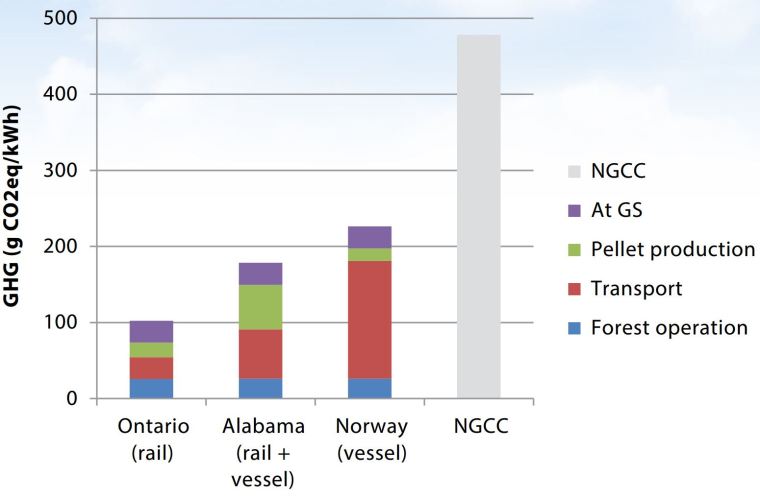
I was looking for total CO2 figures for the Atikokan plant. I haven’t found any yet. But I did find an OPG document showing CO2 production of 4 scenarios at Thunder Bay (which is also burning Norwegian Wood). One of those scenarios is a Natural Gas Combined Cycle power plant. It showed that plant producing a huge amount of CO2 compared to wood pellets. I know that isn’t true from this article.

Then I realized the the wood pellet CO2 numbers are based not on actual amount of CO2, but on the “net CO2” which is CO2 minus the fudge factor applied by the AGW cult to claims that since the trees are renewable most of the CO2 doesn’t really count. (page 10  and 11 here)

The key is where they use the term (net) as in “Green House Gas (GHG) Life Cycle Assessment (net)”

Anyway … back to comparing Ontario Wood Pellets to Norway Wood Pellets.

From this OPG document:

Capture_Norway_CO2

See all that CO2 produced by transporting all those pellets from Norway!


Ontario Spent 170 million to Convert a Coal Power Plant to burn Norwegian Wood Pellets

Ontario has shut down its coal power plants. One of those coal power plants was Atikokan. What OPG decided to do (because they needed dispatchable power) was to convert the plant to biomass. And that biomass was wood pellets. Not just any wood pellets. It was “Advanced Biomass”.

Advanced biomass has been treated to withstand exposure to rain, and has handling and storage properties similar to those of coal. It is still in the early stages of development, which is why OPG purchases advanced biomass fuel from Norway.

Before we get to CO2 and squandering hundreds of millions to change from one fuel you burn to anther fuel you burn …. you may ask yourself why you need to make wood pellets waterproof.

Wet biomass catches on fire. Or explodes.

Biomass fuel has a wide range of possible refuse items: pellets, chip logs, forestry, sewage sludge, methane, meat and bone, palm kernels, cereal, sawdust, bioenergy crops, or landfill gas. When a biomass fuel is stored in a pile, waiting for transport or use, the biomass can spontaneously heat through oxidation. In order for this to happen, three conditions must sync: rate of heat generation, air supply, and insulation properties of the immediate surroundings. With most biomass material, there is a high moisture content combined with air and/or bacterial fermentation – both of which can cause spontaneous combustion through oxidation.

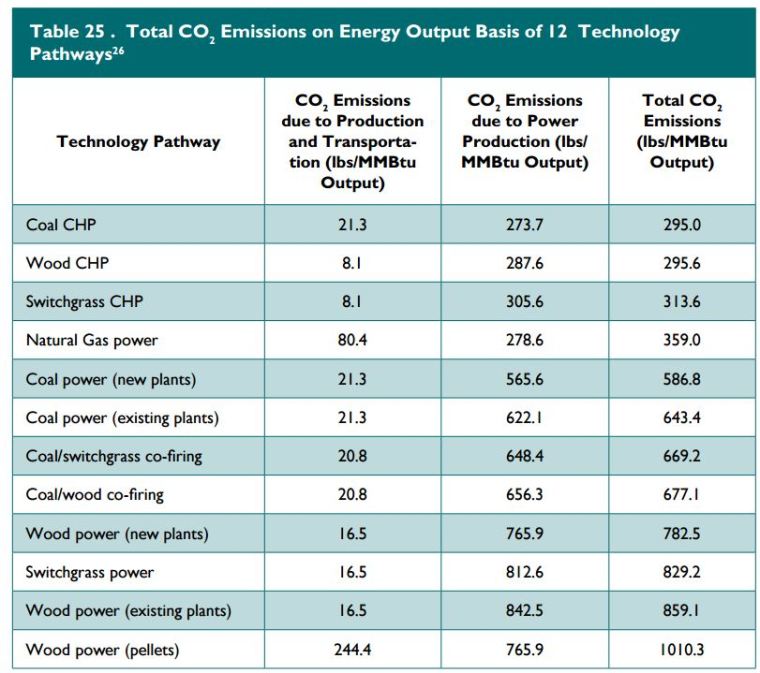
Back to CO2. The study I have referenced before told us that wood pellets (especially those transported long distances like USA to UK) produce way more CO2 than coal. So I would assume that if you buy wood pellets from Norway, your power plant is producing more CO2 than if you had not spent 170 million and were still burning coal.

CO2emissions


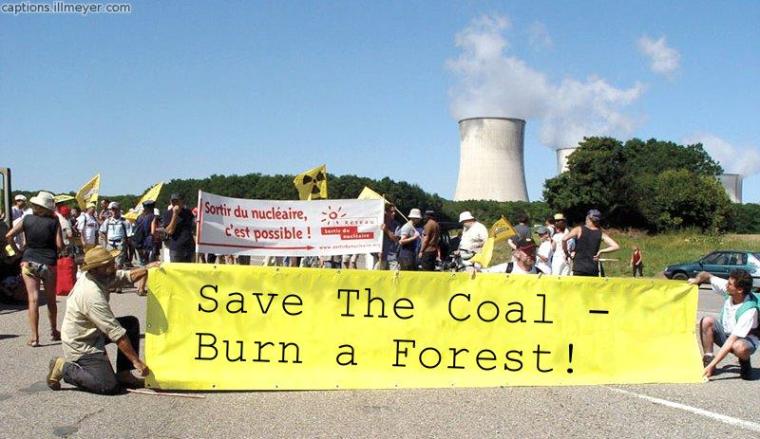
‘Green’ logic confuses me.Killing Norwegian forests and turning the wood into special waterproof pellets and then using a lot of fossil fuel to ship it to Ontario to burn in a closed down resurrected coal power plant seems crazy to me.


SaveTheCoal


Wood Pellets are 3x to 4x More Expensive Than Coal And Produce More CO2.

UPDATE: See 1.5 year old numbers for coal versus wood in USA at bottom

I’m not a big fan of coal. But I do oppose stupidity. Switching from coal (which produces CO2 and particulate matter when burned) with wood pellets (which produces CO2 and particulate matter when burned) that kill forests seems kind of dumb.

How much CO2 and particulate matter is hard to find out. This post suggests wood pellets produce more CO2 than coal when you account for all of the transportation costs.

This article suggests wood pellets costs 150 to 200 a ton when coal is going for 51$ a ton.

“Wood pellets are much more expensive, about $150 to $210 a ton, compared to about $51 for coal in Newcastle, Australia, the global benchmark. Lyra wouldn’t provide a price for sugar-cane pellets, though he said they’re “competitive” with wood.

These products don’t compete on price,” said Lyra. “Companies that are looking to use renewables as a replacement have assets fueled by coal that has a deadline to disappear.”

It would make sense ( in the green stupidity way) to replace coal with trees and then pay 4x the cost and still produce lots of CO2.

As for CO2, the above referenced article says:

“Bagasse pellets emit about one-16th the carbon dioxide of coal, when burned in Brazil

That is the key. If you transport the pellets (whether wood or sugar cane) it produces a lot more CO2.

This article is interesting.

“Burning wood pellets releases as much or even more carbon dioxide per unit of energy as burning coal, so in order for burning pellets to be carbon-neutral the carbon emitted into the atmosphere has to be recaptured in regenerated forests, Abt says. Residual wood, such as tree thinnings and unused tree parts left over at timber mills, is the best material for wood pellets, says Abt. But he and others say that not enough of such waste wood exists to feed the growing demand for wood pellets.

So the industry has turned to whole trees.”

Ouch!

“The accounting now used for assessing compliance with carbon limits in the Kyoto Protocol and in climate legislation contains a far-reaching but fixable flaw that will severely undermine greenhouse gas reduction goals (1). It does not count CO2 emitted from tailpipes and smokestacks when bioenergy is being used, but it also does not count changes in emissions from land use when biomass for energy is harvested or grown. This accounting erroneously treats all bioenergy as carbon neutral regardless of the source of the biomass, which may cause large differences in net emissions. For example, the clearing of long-established forests to burn wood or to grow energy crops is counted as a 100% reduction in energy emissions despite causing large releases of carbon.”

http://science.sciencemag.org/content/326/5952/527.summary

UPDATE:

“The cost of a unit of electricity consumed within the U.S. ranged between $171 and $175.40 per MWh, depending upon the pine rotation age. The cost of pulpwood procurement (stumpage, logging, and pulpwood transportation) was about 26 percent of the overall cost across rotation ages. Manufacturing of wood pellets and generation of electricity at the power plant contributed about 30 and 40 percent, respectively, toward the overall cost of a unit of electricity across rotation ages. The average unit cost was $173 per MWh, which was 73 percent and 157 percent higher than the average obtained from coal, at $100 per MWh, and natural gas, at $67 per MWh, respectively.

This cost differential is the main reason U.S. electric utilities show little interest in utilizing wood pellets. Therefore, special policy incentives will be needed to promote wood pellets as a potential feedstock, instead of coal and natural gas.”

http://biomassmagazine.com/articles/10903/how-pellets-compare-to-fossil-fuels-in-carbon-intensity-and-cost


Ontario Converts 4,000MW of Coal Power Plant to 44MW of solar

Ontario Canada is converting a 4,000MW coal power plant to a 44MMW solar farm.

“Through the IESO’s new Large Renewable Procurement program, solar providers will receive an average of 15.67 cents/kWh for their clean energy.”

“The province’s pivot toward renewables has not come without significant economic ramifications, however. On-peak power cost consumers 17.5 cents/kWh in Nov. of 2015, compared to just 9.7 cents/kWh in the same month of 2006, according to the Ontario Energy Board—an 80 per cent hike. For off-peak power, Ontarians paid 8.3 cents/kWh in 2015, relative to 3.4 cent/kWh in 2006—or 144 per cent more.”

There was no mention in the story how 44MW of intermittent power can replace 4,000MW of dispatchable power.

There was no mention in the story of how many jobs will be transferred to China or India.


DRAX Wood Burning Scam Unravelling


I’ve written about DRAX before. Because of loopholes in UK and EU “climate” laws the largest coal power plant is switching from coal to wood pellets sources from the USA.

DRAX has made the news again.

The report says it has found ‘misleading statements by Enviva about its emissions and environmental impacts’ in its prospectus when it was floated on the New York stock exchange last April.

The report says Enviva has claimed that ‘burning wood in power plants reduces carbon emissions compared to coal’. But the study says Drax’s own data shows that while burning coal leads to emissions of 1,901lb of carbon dioxide per megawatt hour (Mwh), the figure for wood is significantly higher – 2,128lb per Mwh.

Enviva’s claim is only possible because of a UK and EU ‘policy loophole’ – which does not apply in America – classing biomass fuel such as wood pellets as ‘zero carbon’.

According to the study, Enviva has not made this clear. Its claim to the SEC that using its pellets ‘reduces’ emissions only applies to making and shipping the pellets, not burning them.

The complaint calls on the SEC to launch an investigation to ‘establish and enforce clear guidelines applicable to companies that may be claiming climate benefits’.

Drax produces eight per cent of the UK’s electricity – enough to power six million homes. Half of its six 650 megawatt (MW) generators have been converted from coal to burn wood pellets from America. Drax spokesman Andrew Brown yesterday confirmed the firm wants to adapt its remaining three furnaces.

http://www.thegwpf.com/biofuel-emits-more-co2-than-coal-u-s-watchdog-to-probe-draxs-green-supplier/

Another UK Coal Power Plant Converted To Burn US Wood

This is just insane.

Burning wood pellets releases as much or even more carbon dioxide per unit of energy as burning coal.


“One of Britain’s dozen remaining coal-fired power plants is to be converted to burn wood pellets shipped in from North America, after the European Commission approved a £1bn subsidy contract for the project.

RWE’s Lynemouth power station in Northumberland is due to close by the end of this year under environmental rules, but will now be resurrected as a biomass plant following EU state aid approval for the consumer-funded subsidies.

The 420 megawatt plant, which produces enough electricity to power 450,000 homes, could be up and running again within 18 months, subject to a final investment decision early next year, RWE said.

The decision also boosted Drax, the Yorkshire coal plant that is awaiting state aid approval of a similar subsidy contract for the conversion of one of its units to burn biomass.”

http://www.thegwpf.com/green-madness-coal-plant-gets-green-light-to-burn-american-wood-pelets


DRAX – Grotesque Environmental Charade

The Big Crazy Forest killing DRAX is still destroying the environment.

Drax’s conversion to run half of its output on biomass means it will have to rely on wood from trees cut down in forests in America. The Sixties power station’s giant furnaces are being loaded with wood pellets carried 3,800 miles across the Atlantic in diesel-guzzling ships.

This grotesque environmental charade is being funded by government subsidies for the conversion of its coal-burning furnaces to biomass ones, which will put an estimated £23 on every family’s annual household energy bills for the next 13 years.

The vast generators of Drax are now living, humming, forest-destroying symbols of the shameful absurdity of European energy policies, and an extraordinary rebuke to this Coalition government, which claims, ever more ludicrously, to be saving the planet.

Already, the power station imports more than one million metric tons of wood pellets from the U.S. Much of this is derived from ancient deciduous trees in North Carolina.

Three months ago, 60 eminent American scientists wrote to Ed Davey pleading with him to stop ignoring the basic science and pressing on with a policy that was denuding their glorious forests.

They wrote: ‘Recent advances in science and accounting for pollution from different types of woody biomass have clarified that burning trees to produce electricity actually increases carbon emissions compared with fossil fuels for many decades and contributes to other air pollution problems.’

Read more: http://www.dailymail.co.uk/debate/article-2783061/LUNACY-The-Lib-Dem-energy-minister-switched-biggest-power-station-coal-wood-brought-diesel-guzzling-ships-U-S-The-result-It-costs-fortune-emits-pollution.html


US Scientists Beg UK To Stop Killing Trees For High CO2 Power Plants

What an insane world we live in. Did you know that burning wood pellets in power plant produces twice as much CO2 (or more) per unit of electricity as burning natural gas does?

“Some of the most distinguished scientists in the US have written to UK energy secretary Ed Davey, urging him to abandon the government’s “misguided” subsidies for companies burning wood pellets to generate electricity, such as the Drax plant in Yorkshire”

http://www.ft.com/intl/cms/s/0/6f242a06-d388-11e3-b0be-00144feabdc0.html#axzz3142c1bWV

The letter is here:

“Mounting demand for wood pellets in the UK and Europe has led to an explosive growth in facilities
across the Southern US that are manufacturing wood pellets for export to supply the European
electricity market. In 2012, the Southeastern US emerged as the world’s largest exporter of wood pellets
for biomass electricity generation. With continued investments throughout the southern US, export
volumes reached an estimated 1.75 million tons in 2012 and are expected to jump to 5.7 million tons in
2015, according to the North American Wood Fiber Review.
.

Demand for wood pellets in the UK and Europe is fueled by misguided energy policies, which
incorrectly assume that burning wood will lower carbon emissions and help address climate change.
These policies appear to subscribe to the wood pellet and power industry claim that burning wood is a
carbon neutral process because new trees will eventually absorb and store the carbon that was released
when wood is burned. In addition, industry claims of sustainability are often based on citing positive
growth to harvest rates in the South. We dispute these claims for the following reasons:

First, a growing body of evidence suggests that trees rather than wood waste are the primary source of
the wood pellets exported to the UK from the Southern US. Recent advances in science and accounting
for pollution from different types of woody biomass have clarified that burning trees to produce
electricity actually increases carbon emissions compared with fossil fuels for many decades and
contributes to other air pollution problems.

etc etc

DRAX is spending  £700 million to kill trees and produce more CO2 all because of EU directives claiming wood is “carbon neutral” and therefore eligible for green subsidies.

What an insane world.


Coal Vengeance on Drax

Hurrah!

“Britain’s biggest power station is suing the Government for losing a lucrative contract after a Mail on Sunday investigation revealed that it burns wood from precious US forests as a ‘green’ alternative to coal.

Drax is committed to switching from coal to ‘biomass’, or wood pellets.

In December, Energy and Climate Change Secretary Ed Davey promised the North Yorkshire plant two lucrative ‘contracts for difference’ – which would see it earn £105 for every megawatt hour it generates, rather than the normal price of £50.

But this paper revealed that much of its biomass is shipped in from historic wetland hardwood forests – 3,000 miles away in North Carolina.

“Environmentalists” say this is destroying endangered species’ habitats, and increasing greenhouse gases in the atmosphere.”


http://www.dailymail.co.uk/news/article-2614104/Power-station-sues-government-axeing-contract-MoS-exposed-switch-coal-wood-precious-U-S-forests.html


However, keep in mind it was “Environmentalists” who have worked hard to stop fracking. Natural gas has half the CO2 per mega-joule of energy compared to coal. And it is much, much cleaner than coal or wood.


Embed from Getty Images