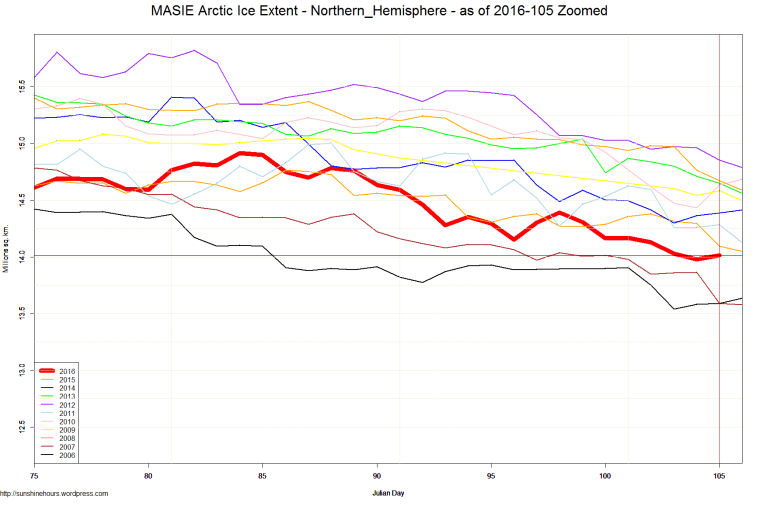
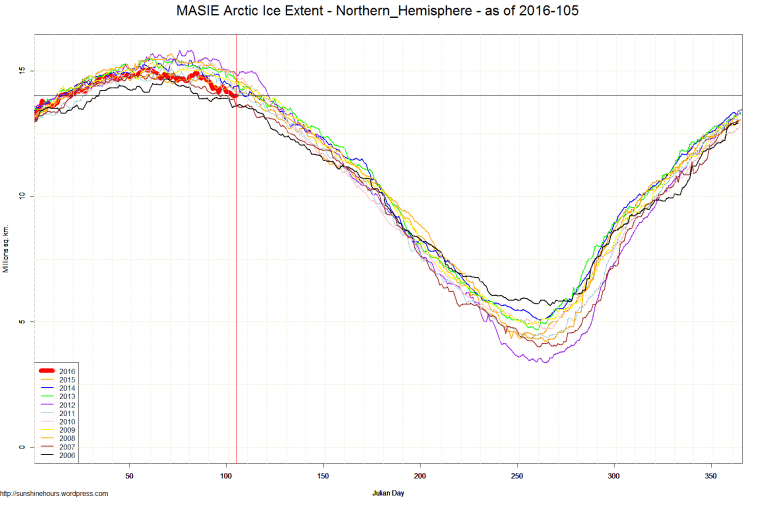
JAXA sea ice extent data from Japanese Aerospace Exploration Agency.
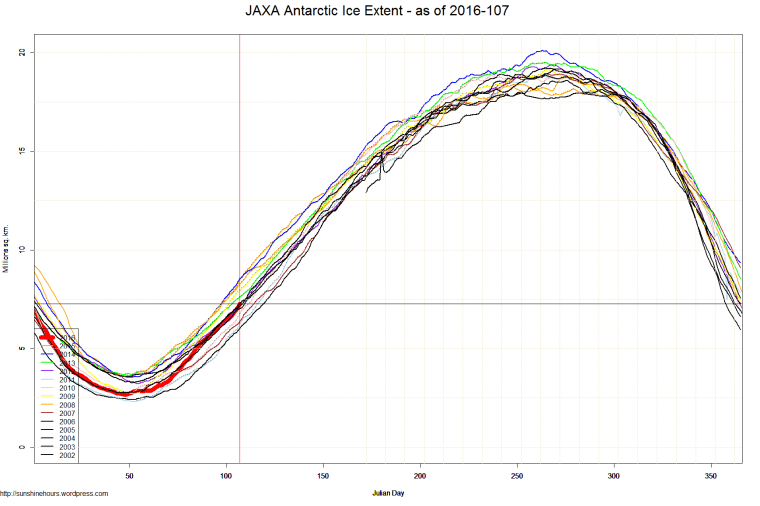

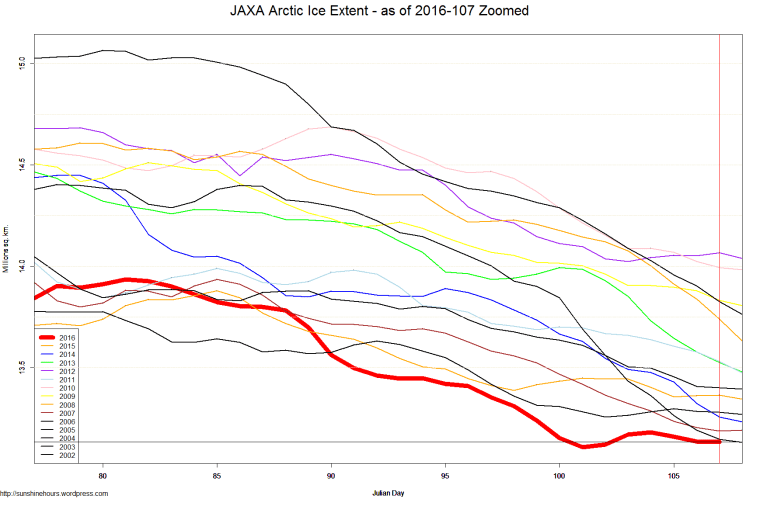

JAXA sea ice extent data from Japanese Aerospace Exploration Agency.
China is building a network of Ultra High Voltage power lines to move electricity long distances. They even have plans to build UHV lines to Germany so they can sell the Germans cheap electricity generated by coal.
“There are 2300 new coal plants with 1400GW of capacity planned worldwide”
“China’s proposed investment in long-distance, ultra-high voltage power transmission lines will pave the way for power exports from China to as far away as Germany.”
While UHV has been used in Russia and other counties in the past, China is perfecting it. The US grid, for example, operates at 500kv or lower.
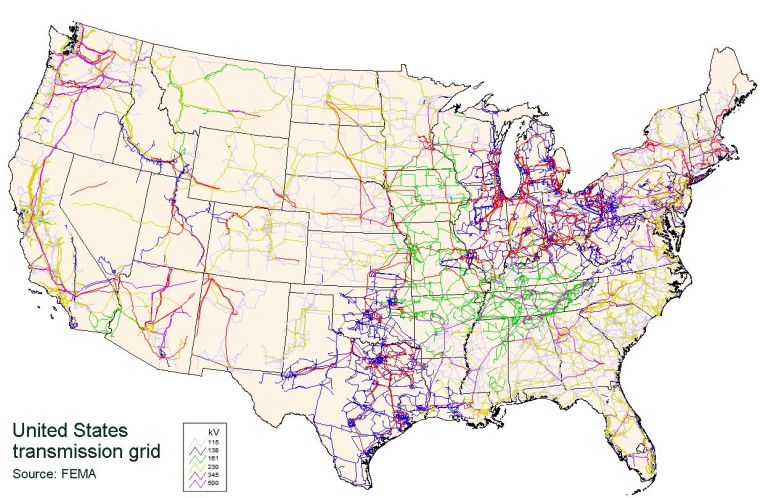
UHV allows the transmission of very large amounts of electricity with more efficiency. What are the advantages of UHV?
Increased Transmission Capacity: A single 1000 kV UHV-AC circuit can transmit +/-5 GW, approximately 5 times the maximum transmission capacity of a 500 kV AC line. An 800 kV UHV-DC transmission line is even more efficient, with a capacity to transmit 6.4 GW.
Extended Transmission Distance: A 1000 kV UHV-AC line will economically transmit power distances of up to 2,000 km (1240 miles), more than twice as far as a typical 500 kV AC line . An 800 kV UHV-DC power line can economically transmit power over distances of up to 3,000 km (1,860 miles).
Reduced Transmission Losses: If the conductor cross-sectional area and transmission power are held constant, the resistance losses of a 1000 kV UHV-AC line is 25% that of the 500-kV AC power line. The resistance loss of an 800 kV UHV-DC transmission line is an even more remarkable 39% of typical line power erosion.
Reduced Costs: The cost per unit of transmission capacity of 1000 kV UHV-AC and 800 kV UHV-DC transmission is about 75% of 500 kV AC costs.
Reduced Land Requirements: A 1000 kV UHV-AC line power line saves 50% to 66% of the corridor area that a 500 kV AC line would require. An 800 kV UHV-DC line would save 23% of the corridor area required by a 500 kV DC line.
I was reading a paper suggesting the world could rid itself of fossil fuels in a decade. Ha ha.
One quote jumped out at me: “The study highlights numerous examples of speedier transitions that are often overlooked by analysts. For example, Ontario completed a shift away from coal between 2003 and 2014”
How did Ontario win its war on coal? Nuclear and Hydro. As I write this I checked Ontario current stats:
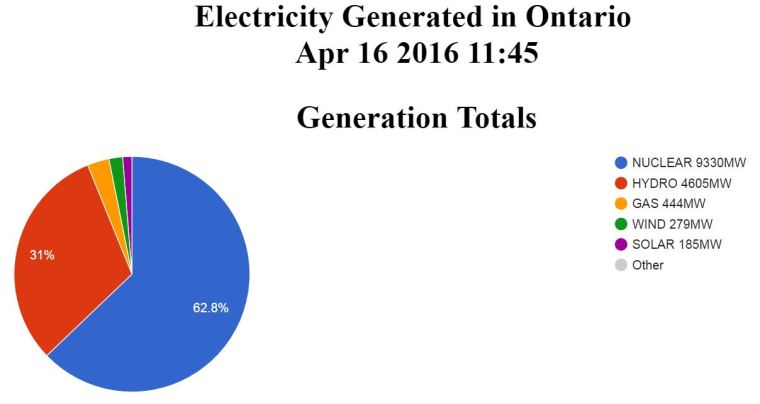
Did Ontario suddenly build new nuclear power facilities or new hydro dams in 10 years? No.
No new dams. No new nuclear power facilities.
“Since 2003, Bruce Power, which operates a massive nuclear plant near Lake Huron, has refurbished and placed back into service two of its units. Today, Bruce Power’s eight units make it the “world’s largest operating nuclear site” with a capacity of about 6,300 megawatts.”
“The Sir Adam Beck plant, which harnesses the power of the water tumbling over Niagara Falls, was upgraded in 2005. In 2013, a giant tunnel that funnels even more water to the plant was completed. To the north, several expansions of the Lower Mattagami River complex … ”
Sure, you can get rid of coal in 10 years if you’ve already built the dams or the nuclear power plants. Because you know damn well environmentalists won’t want you to build any new dams or nuclear power plants.
JAXA is sea ice extent data from Japan (only goes back to 2002).
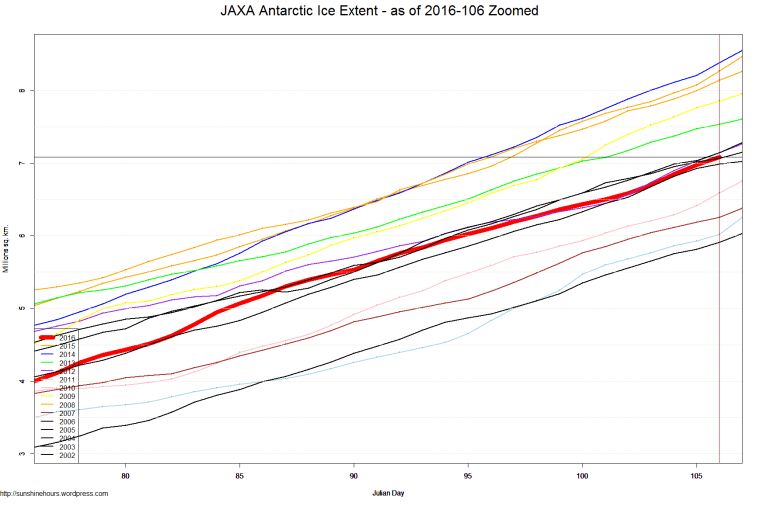
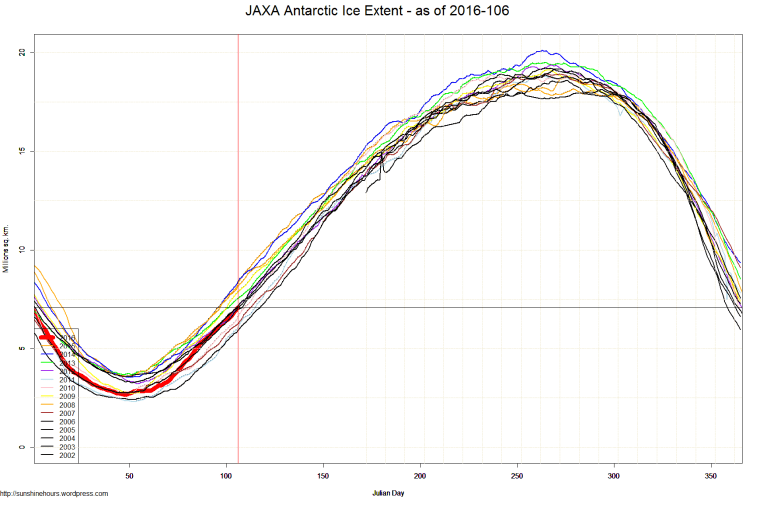
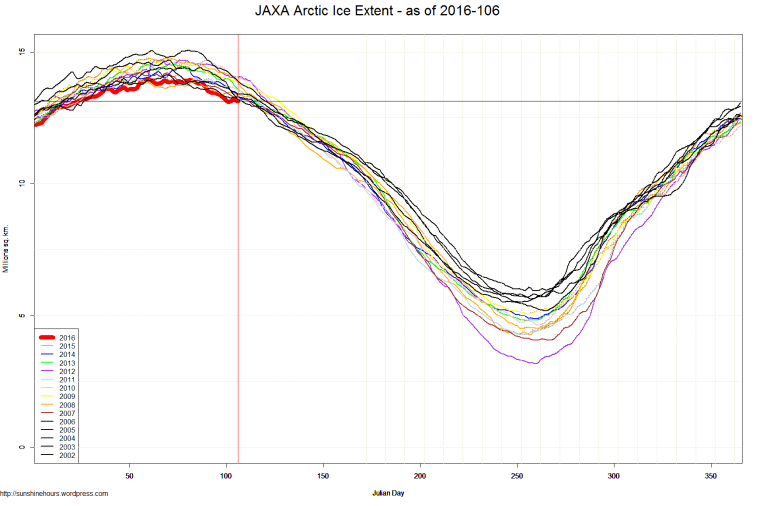
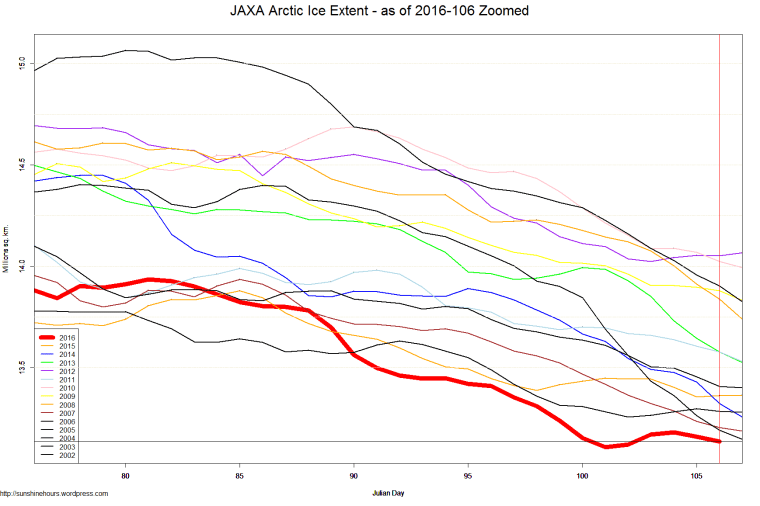
DMSP-5D3 (Defense Meteorological Satellite Program Block 5D3) is the eleventh and most recent version of the military meteorological satellites of the Defense Meteorological Satellite Program.
F15 was launched in 1999. Others followed.
And now a couple of them are no longer capable of producing sea ice data.
DMSP F17 is no longer producing reliable sea ice data from its sensors.
NSIDC has suspended daily sea ice extent updates until further notice, due to issues with the satellite data used to produce these images. The vertically polarized 37 GHz channel (37V) of the Special Sensor Microwave Imager and Sounder (SSMIS) on the Defense Meteorological Satellite Program (DMSP) F-17 satellite that provides passive microwave brightness temperatures is providing spurious data. The 37V channel is one of the inputs to the sea ice retrieval algorithms, so this is resulting in erroneous estimates of sea ice concentration and extent. The problem was initially seen in data for April 5 and all data since then are unreliable, so we have chosen to remove all of April from NSIDC’s archive.
DMSP F19 is no longer controllable.
NOAA satellite operators unexpectedly lost the ability to command one of the Air Force’s primary weather satellites on Feb. 11 and now officials from both organizations are racing to determine if the spacecraft can return to service, officials told SpaceNews.
The satellite, known as the Defense Meteorological Satellite Program Flight 19, is used to help weather forecasters predict fog, thunderstorms and hurricanes that could impact military operations. Launched in April 2014, the spacecraft is the Air Force’s newest weather satellite on orbit.
Air Force officials do not yet know the cause of the problem, or if the satellite can be recovered, Andy Roake, a spokesman for Air Force Space Command, said in a March 2 email.
“Operators lost the ability to command and control Defense Meteorological Satellite Program Flight 19 (DMSP F-19) Feb. 11, 2016 and subsequently are making attempts to regain connectivity,” he said. “The satellite is in a stable configuration while operators continue to troubleshoot the anomaly.
“At this time, it is not known what caused the anomaly or if the satellite will be recovered, and the anomaly is under investigation. There are no other known issues with the satellite.”
Air Force Space Command disclosed the problem with the satellite March 2 in response to questions from SpaceNews.
The DMSP constellation requires at least two primary satellites and two backup satellites to gather cloud imagery. As a result of the problem, the Air Force has reassigned an older satellite, DMSP Flight 17, which launched in 2006 and had been serving as a backup, into a primary role, Roake said.
More info here:
Instruments on this series are:
OLS (Operational Linescan System) weather imager
SSMIS (microwave imager and sounder)
SSULI ultraviolet limb imager
SSUSI ultraviolet spectrographic imager and nadir airglow photometer
SSI/ES-3 thermal plasma instrument
SSJ/5 precipitating particle spectrometer
SSF laser threat warning sensor
Following instruments are on the individual satellites:
| DMSP-5D3 F-15: | OLS, SSM/I, SSJ/4, SSI/ES-2, SSM-Boom, SSZ |
| DMSP-5D3 F-16: | OLS, SSMIS, SSI/ES-3, SSJ5, SSM-Boom, SSULI, SSUSI, SSF |
| DMSP-5D3 F-17: | OLS, SSMIS, SSI/ES-3, SSJ5, SSM-Boom, SSULI, SSUSI, SSF |
| DMSP-5D3 F-18: | OLS, SSMIS, SSI/ES-3, SSJ5, SSM-Boom, SSULI, SSUSI, SSF |
| DMSP-5D3 F-19: | OLS, SSMIS, SSI/ES-3, SSJ5, SSM-Boom, SSULI, SSUSI, SSF |
| DMSP-5D3 F-20: | OLS, SSMIS, SSI/ES-3, SSJ5, SSM-Boom, SSULI, SSUSI, SSF |
The DMSP-5D3 series was to be succeded by the jointly with NASA and NOAA developed NPOES system, which was cancelled in 2010 due to massive cost overruns. As a replacement, they were to be replaced by the military DWSS series, which in turn also was cancelled.
The last satellite, DMSP-5D3 F20, which is in storage since the 1990ies, might eventually not launch, as the Senate drafted a bill, which prohibits the Air Force from spending any money on the DMSP-5D3 F20 launch pending certification from the secretary of defense that the military cannot obtain comparable data at a lower cost from other sources, such as civilian or international weather satellites. In the omnibus spending bill for fiscal year 2016, lawmakers provided no funding neither for DMSP nor for the launch of DMSP-5D3 F-20 around 2018, effectively ending the program.
DMSP-5D3 F19 has stopped responding to commands on 11 February 2016 for reasons unknown. It remains unclear, if the satellite can be recovered. In the aftermath of this failure, the USAF is reconsidering the future of DMSP-5D3 F-20.
California is planning for TOU (Time of Use) pricing for electricity that matches up with renewables like solar and wind:
From late morning until the sun sets, California produces a significant amount of solar power; and the future for solar is so bright, we’re reaching for our shades. With TOU pricing, we can shift demand to match up with the abundant solar electricity we produce – making the cheapest price windows for TOU rates likely from 10 AM until 4 PM. The good news is, the success of clean energy programs in California over the past decade means we’ll be able to meet peak demand by simply re-aligning our energy use to synch up with plentiful, clean, and cheap electricity.
Starting January 1, 2019, after a period of study, public outreach, and education, California’s large investor-owned utilities (Pacific Gas and Electric, San Diego Gas and Electric, Southern California Edison) will switch households to time-of-use (TOU) electricity pricing.
This simplified rate structure rewards customers who shift some of their electricity use to times of the day when clean energy is plentiful.
Why would you run the dishwasher at 6 PM, for example, if it were cheaper to wash the dishes overnight when wind energy is abundant and cheap?
The last line is an actual quote.
Why? Because you want clean dishes? You can’t sleep with the dishwasher running?
Do you want to be able to afford electricity for showering, laundry or charging your electric car?
Then stay home in the middle of the day (but only when it is sunny). or only do those things when it is windy!
If you don’t you know they will punish you with grotesquely high electricity rates.
Cheap Chinese steel is killing the EU/UK steel industry. The reasons are pretty simple. China relies on cheap coal for most of its energy needs while the UK and EU are squandering trillions to build wind farms and solar farms (in a northern climate?). And fossil fuels are punished.
I’ve been going on about this for a while. It is amazingly stupid to drive all the jobs from the UK/EU (or Canada) to China where the energy is dirtier and the labor conditions are appalling.
So there is this German Government minister who maybe finally got it.
In the fight against cheap steel from China, German Economics Minister Sigmar Gabriel (SPD) is proposing a ‘climate MOT’ for imported products: “At the level of the World Trade Organization there are forms of certification, for example, where the environment, nature or health are at risk. I can imagine a similar certification for steel products, a kind of `climate MOT` for steelmaking, Gabriel told the Westdeutsche Allgemeine Zeitung on Wednesday. “The basic idea: Only those are allowed onto the European market who comply with the same standards that we meet in the EU.” Gabriel called on the EU to adopt a tougher stance in the dispute with China over cheap steel.
MOT = Ministry of Transport. This is shorthand for: “To drive a car it must be tested and running at a certain level of safety and air cleanliness.”
The same should be true for importing any goods. If it is steel imported from China to the UK, the energy used in China must be as “clean” as the energy mix forced onto steelmakers in the UK and the wages must be comparable.
The sane should be true for all manufactured goods.
But what really happens is that the coal power plants producing cheap electricity are shut down in the UK and the steel is made in China. And the jobs (paying much less) go to China. And more CO2 (which I don’t care about … but some do) is produced than if the steel was made in the UK. And 40,000 jobs disappear. While the rich laugh.
.
Cool video of a drone scouting in the Antarctic:
The Royal Navy’s ice patrol ship HMS Protector has launched tiny pilotless aircraft from her decks for the first time to assist with navigating through the Antarctic.
A quadcopter and a 3D-printed aircraft have scouted the way for the survey ship so she can find her way through the thick ice of frozen seas.
It’s the first time the Royal Navy has used unmanned aerial vehicles in this part of the world. The Service has been operating ScanEagle ‘eyes in sky’ from frigates in the Gulf for the past couple of years which feed vital live imagery back to ships on maritime security patrols.