Europe Energy Costs: Choose Eating or Heating

The rich don’t care about energy costs. They can lobby for carbon taxes and massive subsides for wind knowing full well it is a trivial amount of their spending.

The poor though. They get screwed.

“An estimated 54 million Europeans suffer from energy poverty, according to a European Commission analysis, which blames rising prices, low income and energy inefficient homes for forcing people to choose between eating or heating.

You are in energy poverty if you cannot afford to heat your home at an affordable cost. Almost 11% of the EU’s population are faced with that reality, according to the Commission.

Despite this, less than a third of the member states officially recognise energy poverty, and only a few define it in their national laws.

Consumers spend on average 6.4% of their total consumption on electricity, gas, heating and cooling – up by 15% compared to five years ago.A693C0 elderly lady holding her hands near an electric fire
Fuel poverty is not about being poor, but about a combination of low-quality housing and high energy prices causing financial difficulties, and ultimately compromising health and well-being.

Eurostat figures for 2014, the most recent year with complete results, showed that almost half of Bulgarians suffer from energy poverty.

40% of its 6.9 million 2014 population – about 2.8 million people – can’t afford to heat their homes.

The figures, obtained by EurActiv.com, revealed that just over a third of Greeks (32.9%) – more than 3.5 million people – were in the same situation.

28% of the Portuguese population,  27.5% of Cypriots, 26.5% of Lithuanians and 22.1% of Maltese are in energy poverty, according to the EU’s statistics service.

Latvia (16.8%), Romania (12.3%), Hungary (11.6%) come next in the scale. Italy scores at 18% and Spain 11%.

Energy poverty is particularly prevalent in southern and central European households but by no means exclusively so.
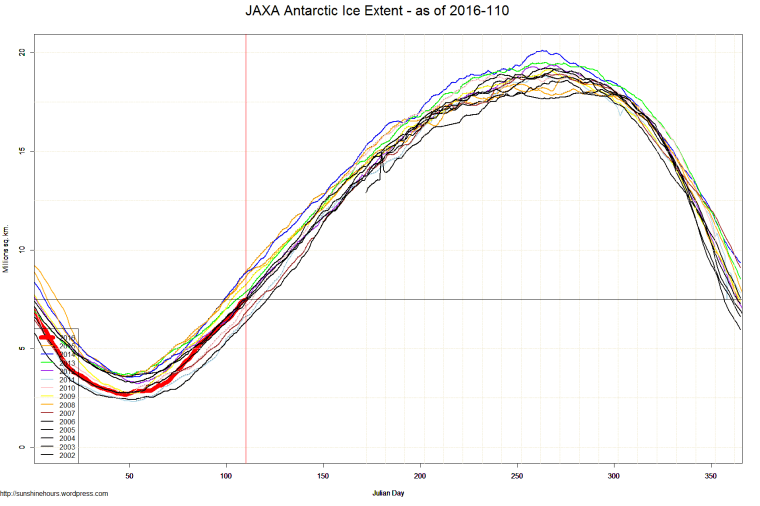
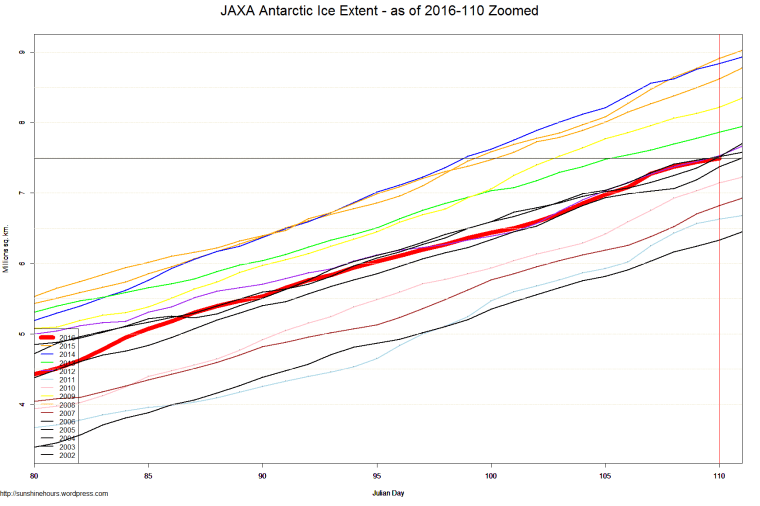
 

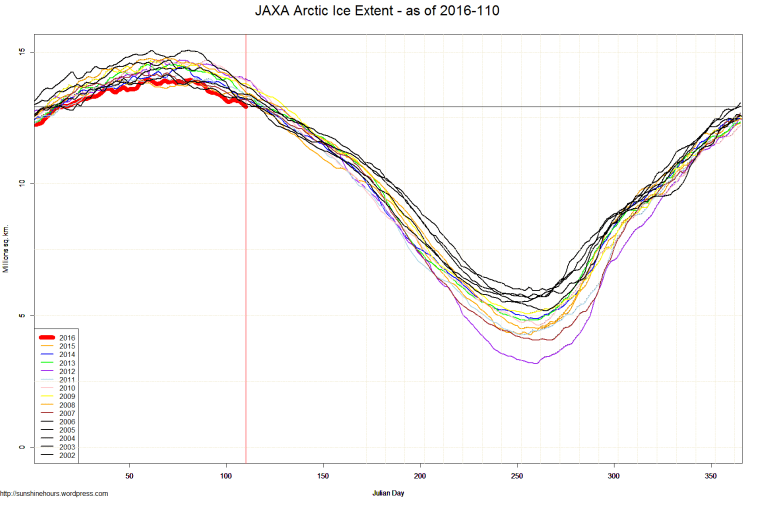
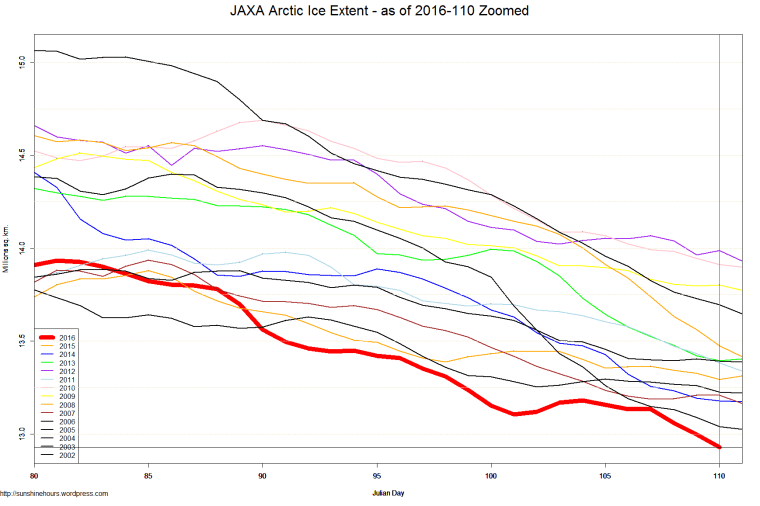
JAXA Sea Ice Extent (Antarctic and Arctic) – Day 110 – 2016

JAXA sea ice extent data from Japanese Aerospace Exploration Agency.

JAXA Antarctic Ice Extent - as of 2016-110

JAXA Antarctic Ice Extent - as of 2016-110 Zoomed

JAXA Arctic Ice Extent - as of 2016-110

JAXA Arctic Ice Extent - as of 2016-110 Zoomed


UK Gatwick Gusher

Just one shale formation could produce 25% of the UK’s oil. Isn’t this better than financing Russia or Saudi Arabia?

The so-called Gatwick Gusher, a shale basin in the United Kingdom, could add as much as $74 billion to the nation’s economy, a study finds.

U.K. Oil & Gas Investments commissioned Ernst & Young to examine the future potential of oil production from the Weald shale basin.

“Assuming it can be extracted from a development site at the volumes projected by U.K. Oil & Gas, has the potential to generate significant economic value to the U.K. economy,” the report read.

Oil & Gas U.K., the industry’s lobbying group, said the North Sea oil sector is in for a long period of decline, with less than $1.4 billion in new spending expected in 2016. Inland shale, meanwhile, has the potential to add between $10 billion and $74.6 billion to the British economy in gross value, the commissioned report said.

Operators are working to assess the potential in the shale area by testing the Horse Hill-1 oil discovery. Preliminary estimates made by the company last year put the entire Horse Hill reserve total as high as 100 billion barrels of oil. If its full potential is reached, the future production from the area could provide as much as a quarter of the nation’s total oil demand over its lifespan, based on 2014 demand levels.

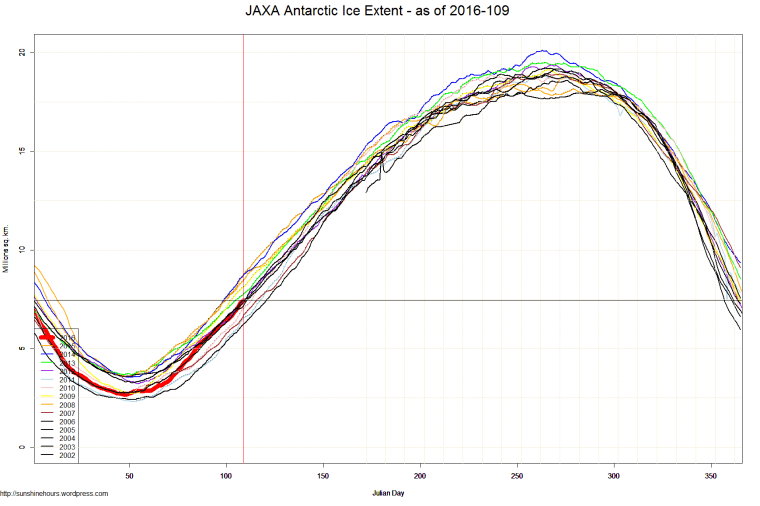
JAXA Sea Ice Extent (Antarctic and Arctic) – Day 109 – 2016

JAXA sea ice extent data from Japanese Aerospace Exploration Agency.

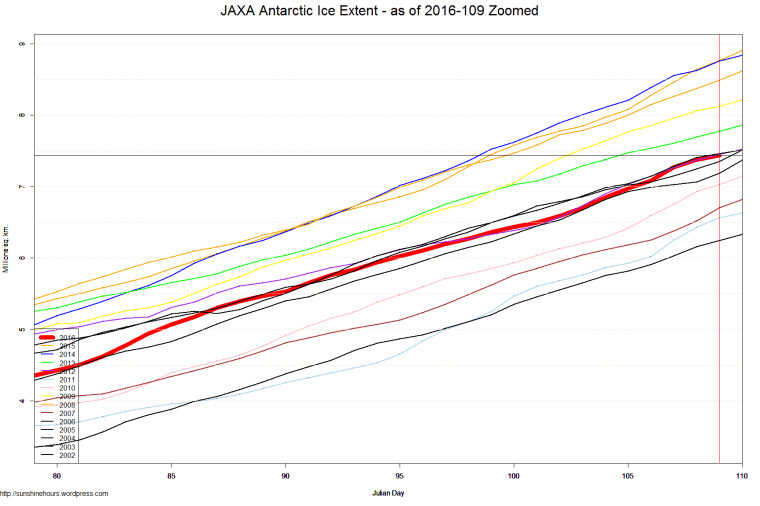
JAXA Antarctic Ice Extent - as of 2016-109

JAXA Antarctic Ice Extent - as of 2016-109 Zoomed

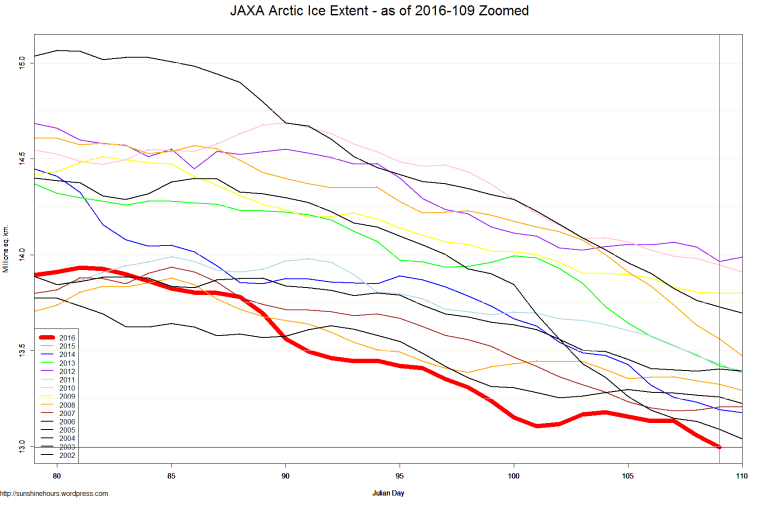
JAXA Arctic Ice Extent - as of 2016-109 Zoomed

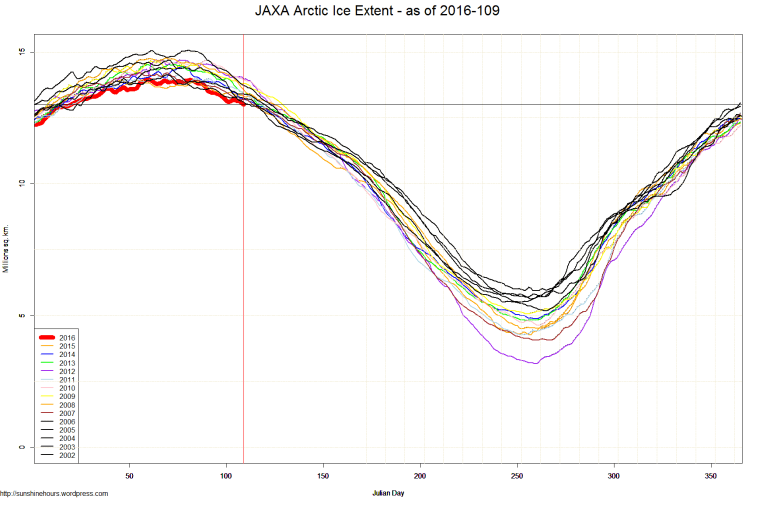
JAXA Arctic Ice Extent - as of 2016-109


Could 2016/2017 Be The Strongest La Niña On Record?

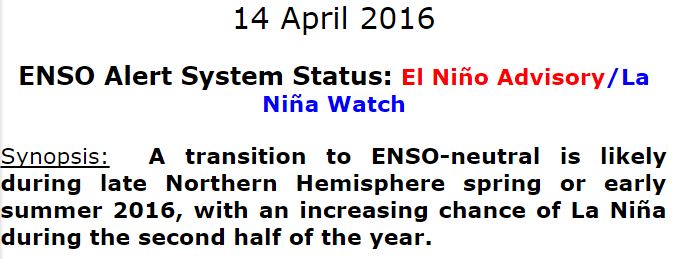
It is not uncommon for a La Nina to follow an El Nino.

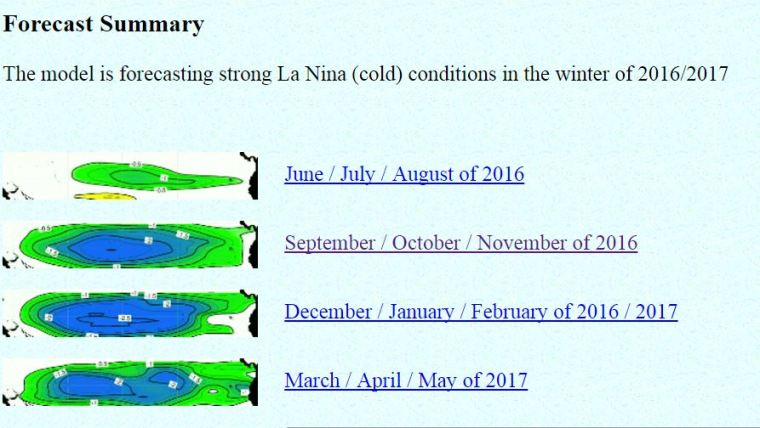
SCRIPPS issues forecasts. Joe Bastardi points out they are not always right, but if they are right this time, he says:

Its forecast for this event, if real, would be spectacular. Not only would it be the biggest El Niño to La Niñas transition, but the strongest La Niña on record.

SCRIPPS

NOAA is predicting La Nina here.

ENSOAlert

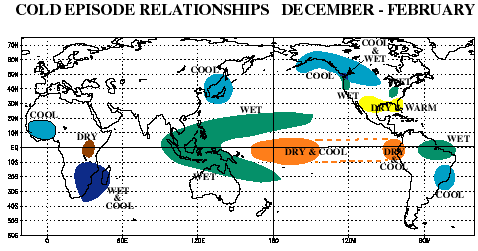
The global effects of La Nina:

cold_la_nina


UK Blackout Emergency Plan Costs Soar

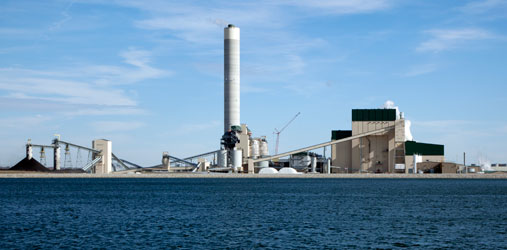
Coal will come to the rescue in the UK at a cost.Plant-wide_Slider02

The cost of ensuring Britain could turn its lights back on after a catastrophic nationwide blackout has soared by at least £12m this year, as National Grid is forced to pay struggling old coal plants to “keep warm” in case of an emergency.

Britain’s so-called “black start” plans are designed to ensure that electricity supplies could be swiftly restored in the event of an unprecedented power failure plunging all or part of the country into darkness.

As most power plants need to draw some electricity from the grid to start generating, National Grid has to ensure the UK retains a certain number of black start plants that are able to fire up independently using their own generators.

Historically, several of the UK’s coal plants have been relied upon to form part of the black start plan.

But rising green taxes, cheap gas prices and the growth of renewables are together rendering the coal plants increasingly uneconomic, with some closing down for good and most others now only running for parts of the day.

This poses a threat to Britain’s emergency plans because if the plants are not generating when a catastrophic power failure hits, they will take far longer to start up.

Energy regulator Ofgem has now given National Grid permission to pay the plants millions of pounds to keep “warm”, so that they would be ready to start up quickly in an emergency.


JAXA Sea Ice Extent (Antarctic and Arctic) – Day 108 – 2016

JAXA sea ice extent data from Japanese Aerospace Exploration Agency.

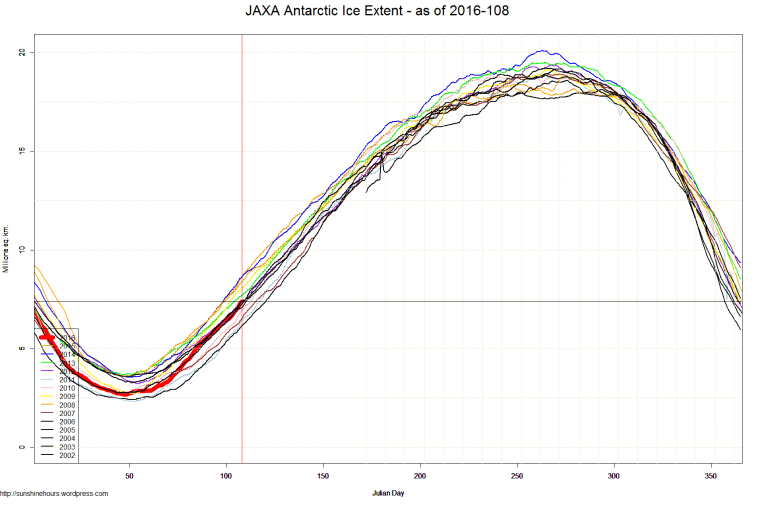
JAXA Antarctic Ice Extent - as of 2016-108

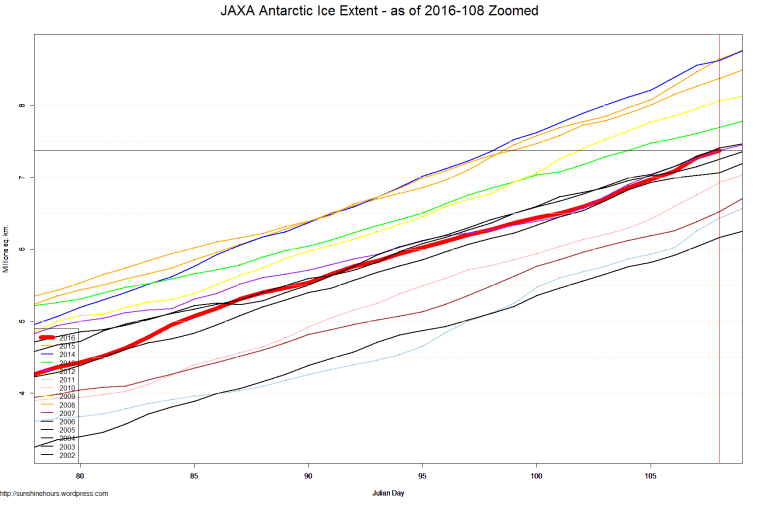
JAXA Antarctic Ice Extent - as of 2016-108 Zoomed

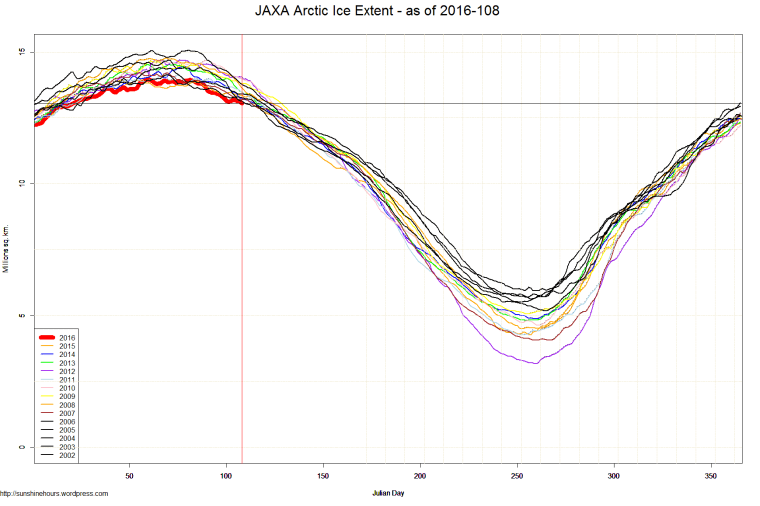
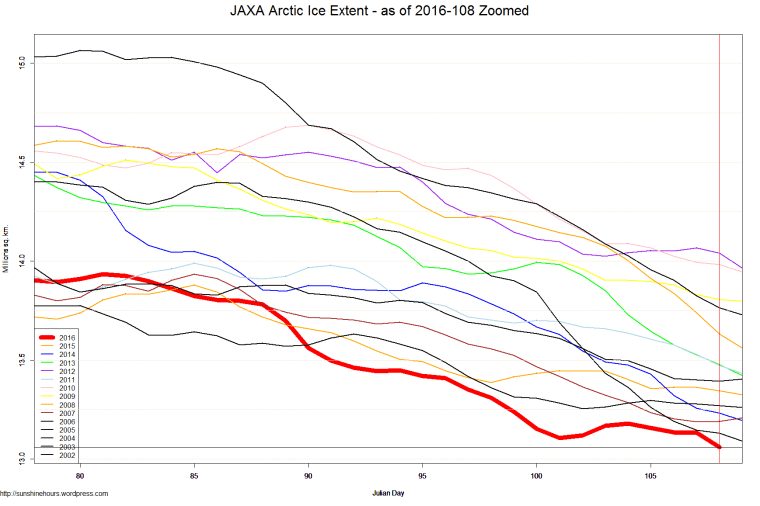
JAXA Arctic Ice Extent - as of 2016-108

JAXA Arctic Ice Extent - as of 2016-108 Zoomed


As Glaciers Retreat, They Give up the Bodies and Artifacts They Swallowed

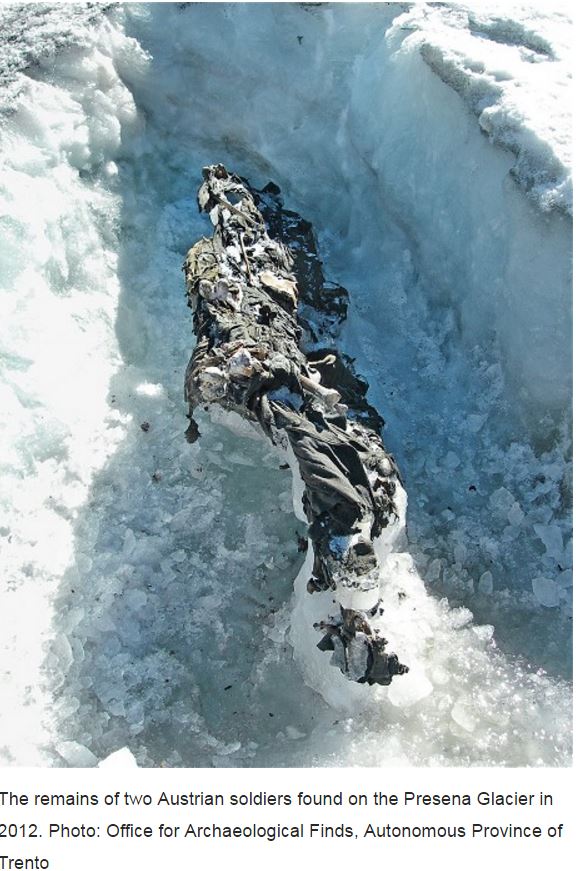
The Smithsonian has an interesting article on artifacts and bodies emerging from melting glaciers.

As Glaciers Retreat, They Give up the Bodies and Artifacts They Swallowed

Now, thanks largely to decades of global warming, the Presena glacier running through the battleground is slowly melting away. And with that melting the remains of the White War are slowly emerging. Remarkably well-kept artifacts have been streaming down with the melting water of the glacier since the early 90s

They don’t seem to get it. Just like the P-38s on Greenland , for something to emerge from the ice would imply to me that things are returning to where they were when the artifacts/bodies were deposited on the ice.

Artifacts and bodies ended up on the ice. Snow fell. The snow turned to ice and entombed the artifacts. After 100 or 5,000 years it is now as warm as it was long ago.


Melting glaciers in northern Italy reveal corpses of WW1 soldiers

WhiteWar