UK Sunshine Hours versus Tmax

You can download climate data from the UK Met here.

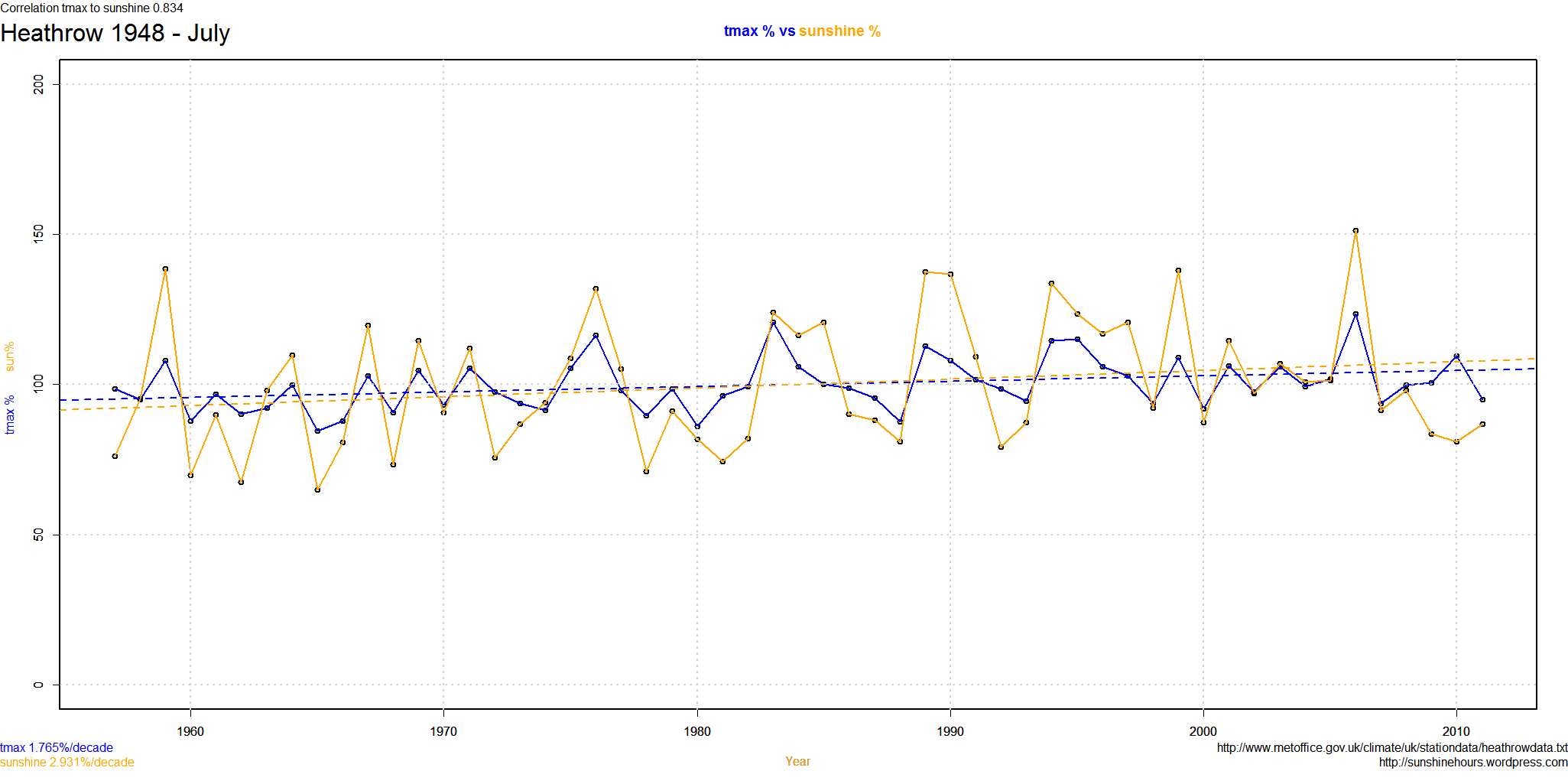
If you graph the difference between the median sunshine hours against the difference  between the median maximum temperature (Tmax) you see sunshine on the rise and tmax on the rise.

Don’t forget to ask the AGW side whether climate variables other than CO2 have changed recently.

Arkansas NOAA temperatures versus some old Sunshine Data.

Carrick posted a link to some old sunshine data.

There were two entries for Arkansas. Data ends in 1990. There are multiple columns. I chose the first: “Flat-Plate Collector Facing South at Fixed Tilt=0”.

For July the correlation was .629 and .685. Considering that I am comparing local sunshine to the whole states temperature, not bad. Too bad there isn’t more recent data.

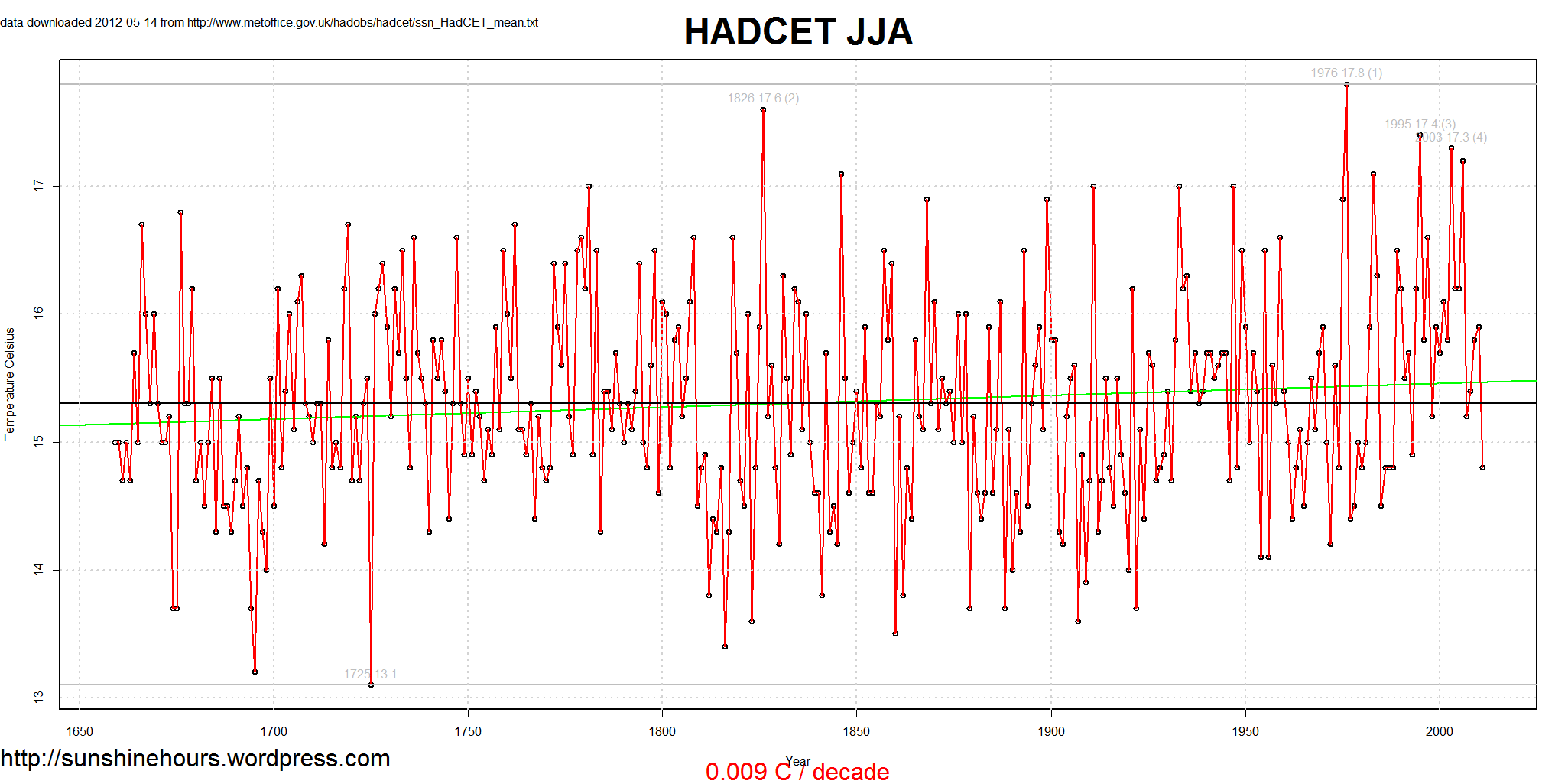
HADCET June July and August trend for 350 years is a measly .009C per decade

HADCET is the Central England Temperature record maintained by the UK Met. The seasonal mean data is available here.

If you graph JJA (June, July and August) the trend is a measly .009C per decade.

The two warmest years are 1976 and 1826. 2011 JJA was 14.8C, below the mean, and 3C colder than 1976.

We were told we were going to fry as “Global Warming” gets going.

Steig’s “Hockey Stick” and CRUTEM3 Southern Hemisphere.

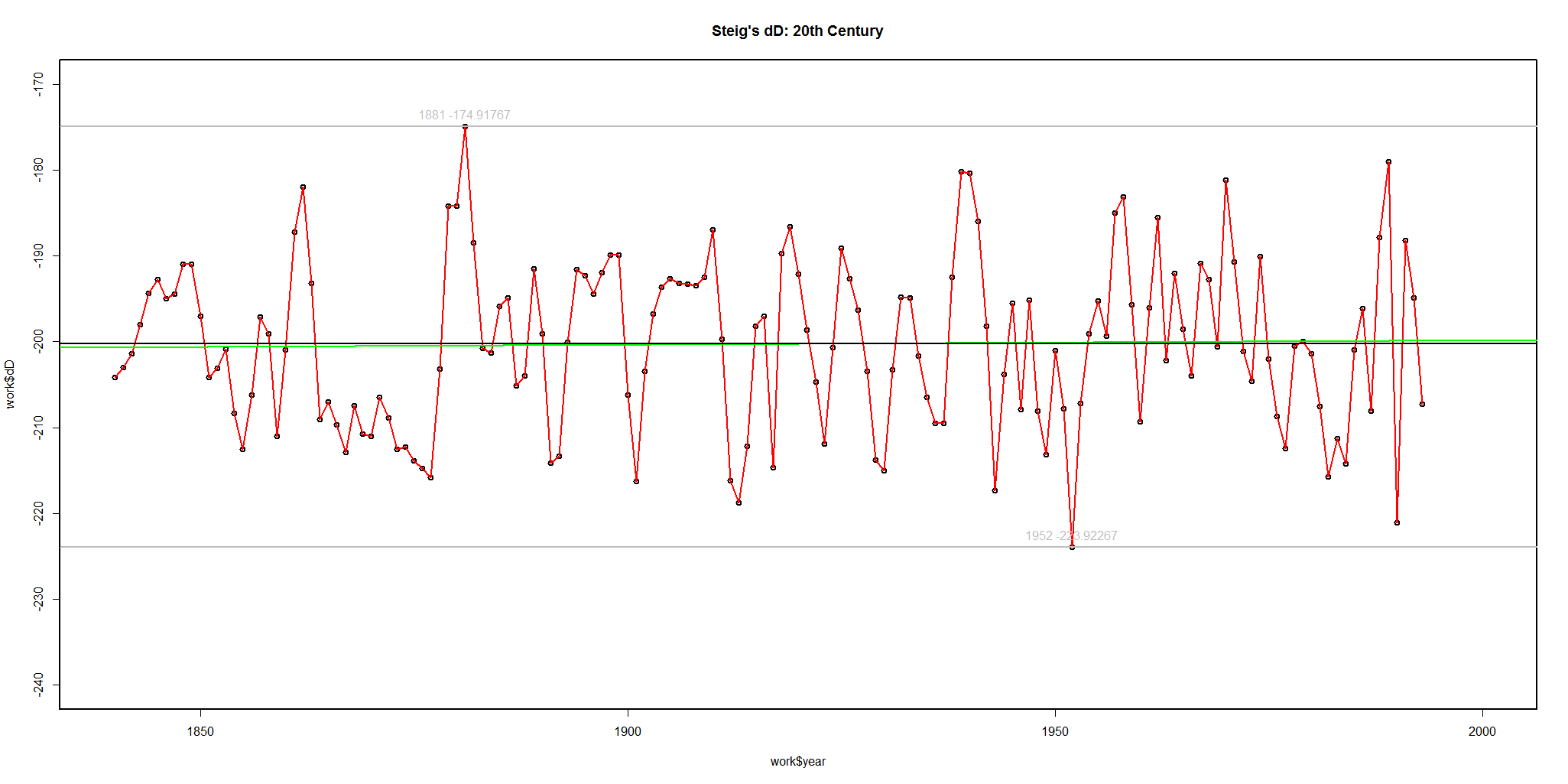
Steve McIntyre has a post up looking at Siple Dome ice core data and Gavin Schmidt’s claim that the data shows”exceptionally high values in the late 20th Century “.

Steve includes an R script and a link to the data so I graphed it myself with a few minor tweaks. The peak year in the period from 1840 to 1994 was 1881.

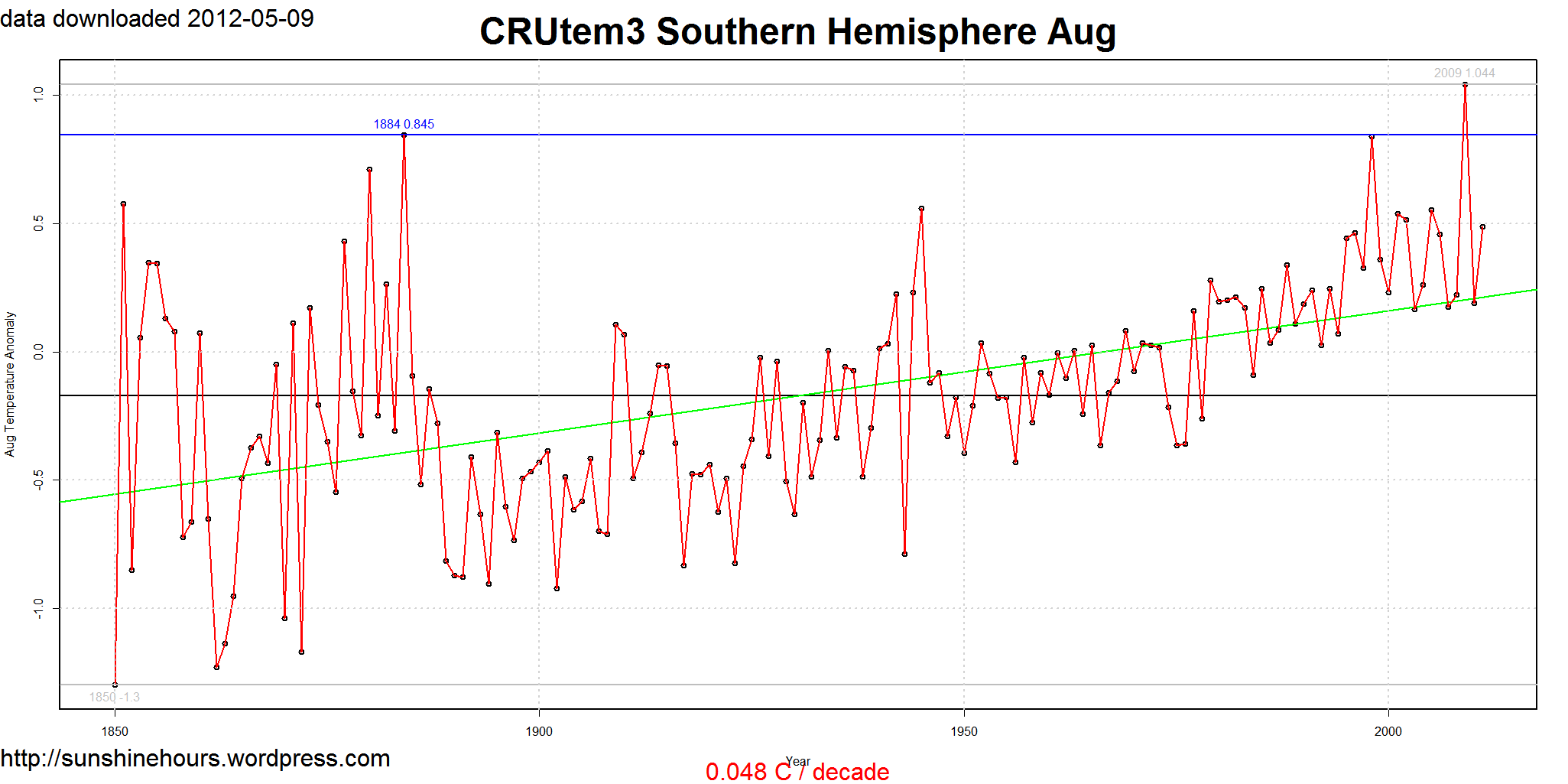
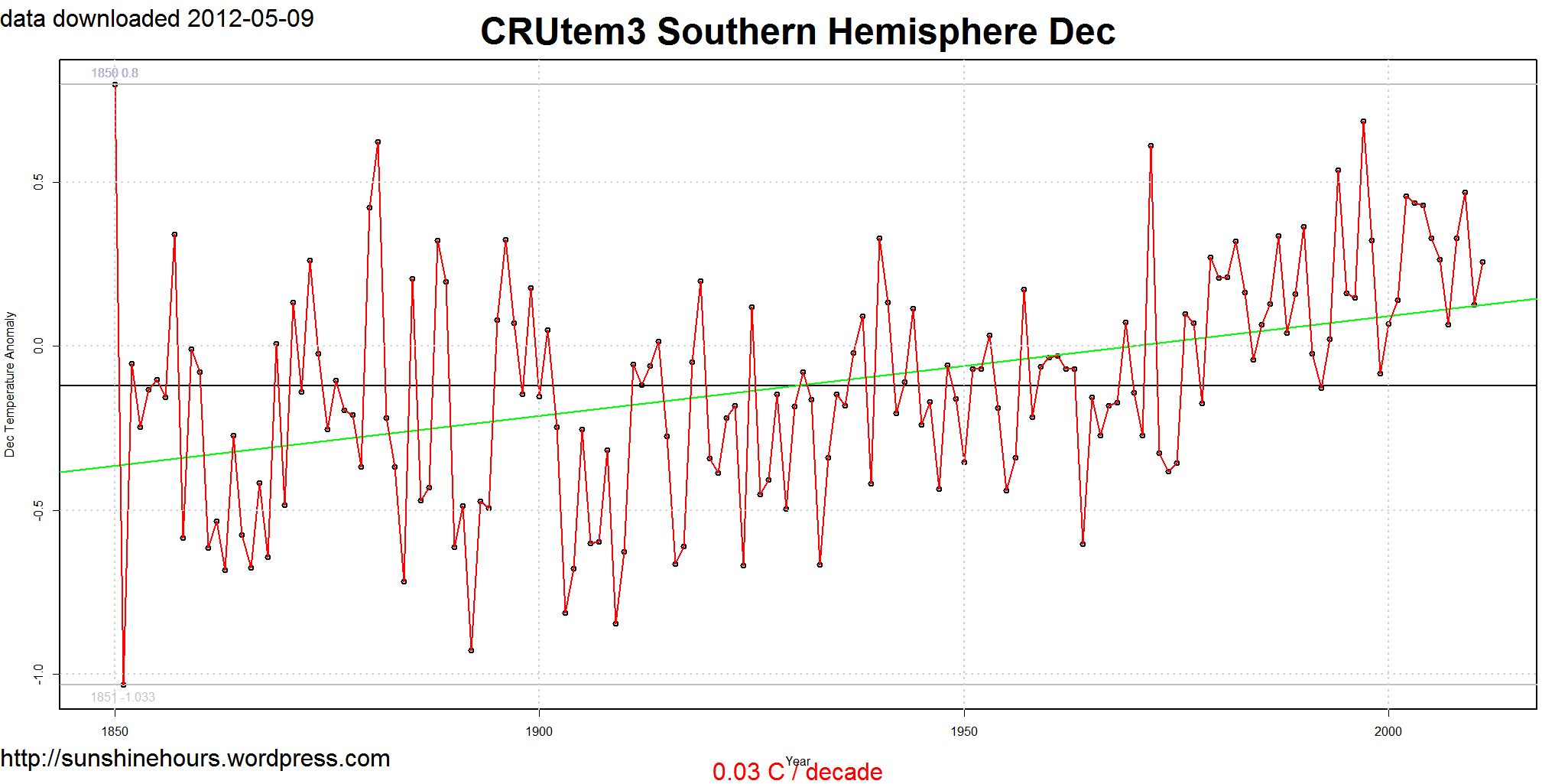
In the last few days I’ve been graphing some of the data so I thought I would look at CRUTEM3 Southern Hemisphere to see if 1881 was exceptionally warm. And there is some confirmation of ~1881 being really, really warm. These are the ones that jumped out at me (graphs are below).

The 2nd warmest August in the Southern Hemisphere was 1884.

The 3rd warmest December was 1881.  (First was 1850, 2nd was 1977)

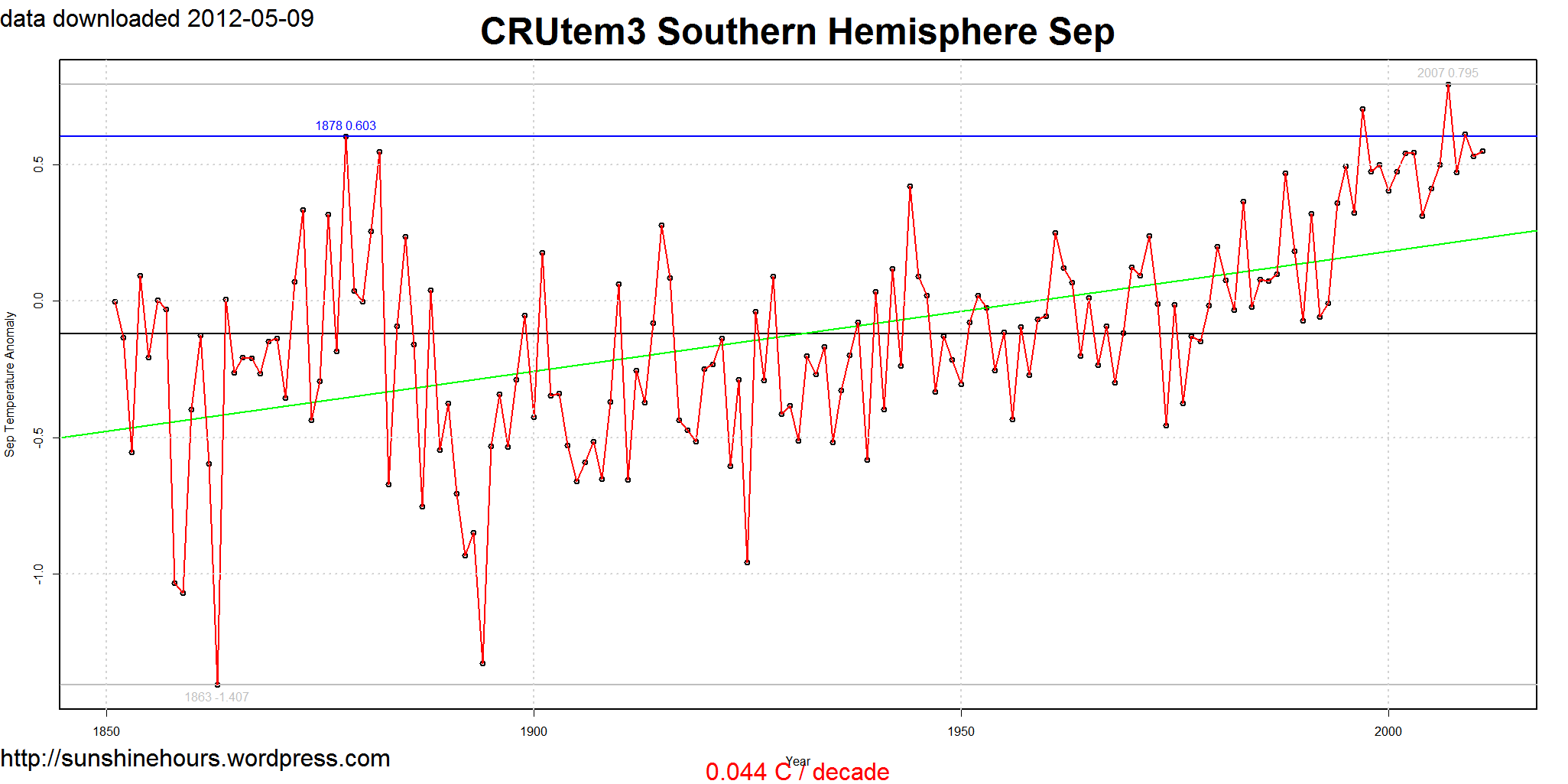
The 3rd warmest September was 1878.

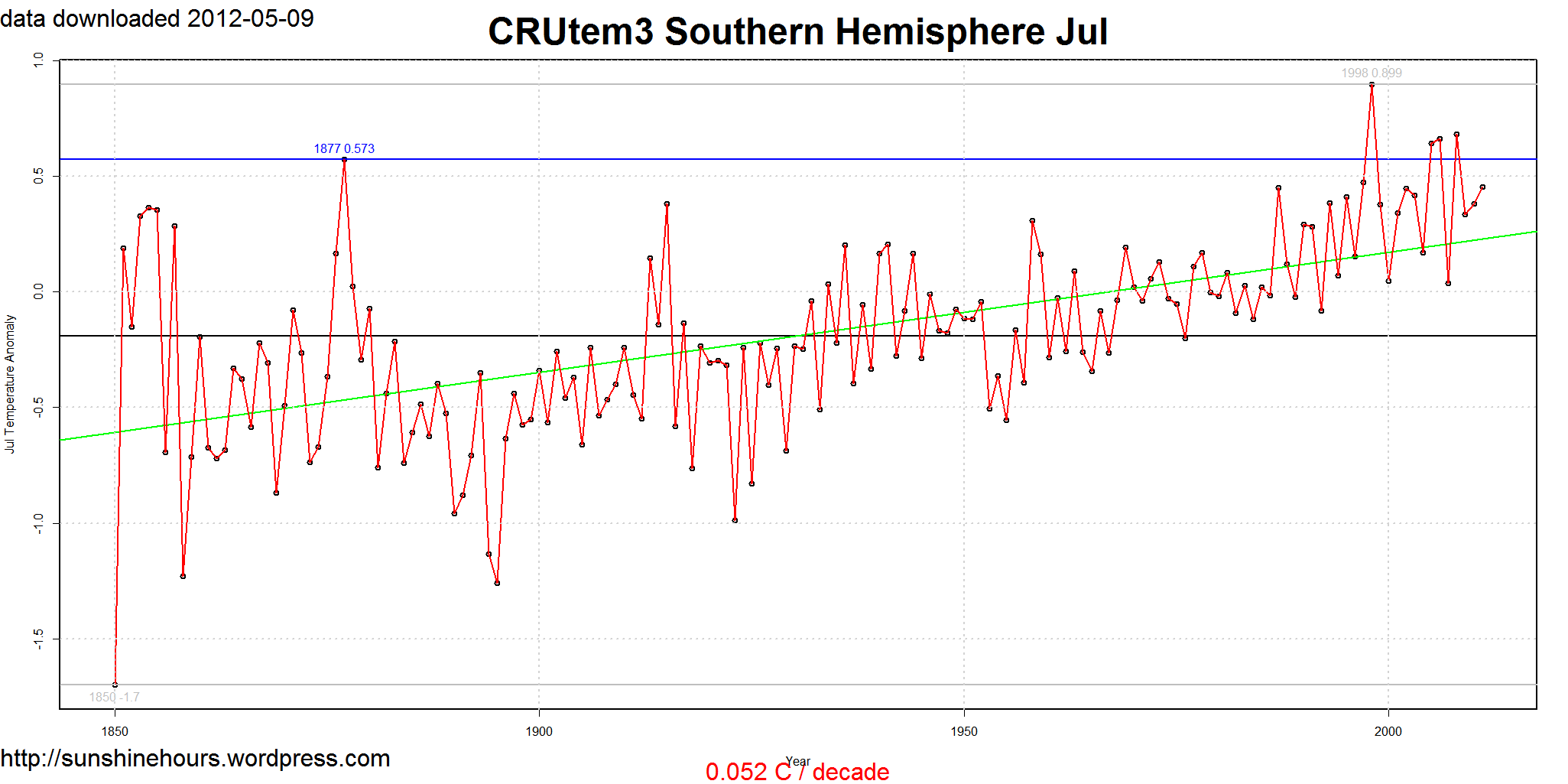
The 5th warmest July was 1877.

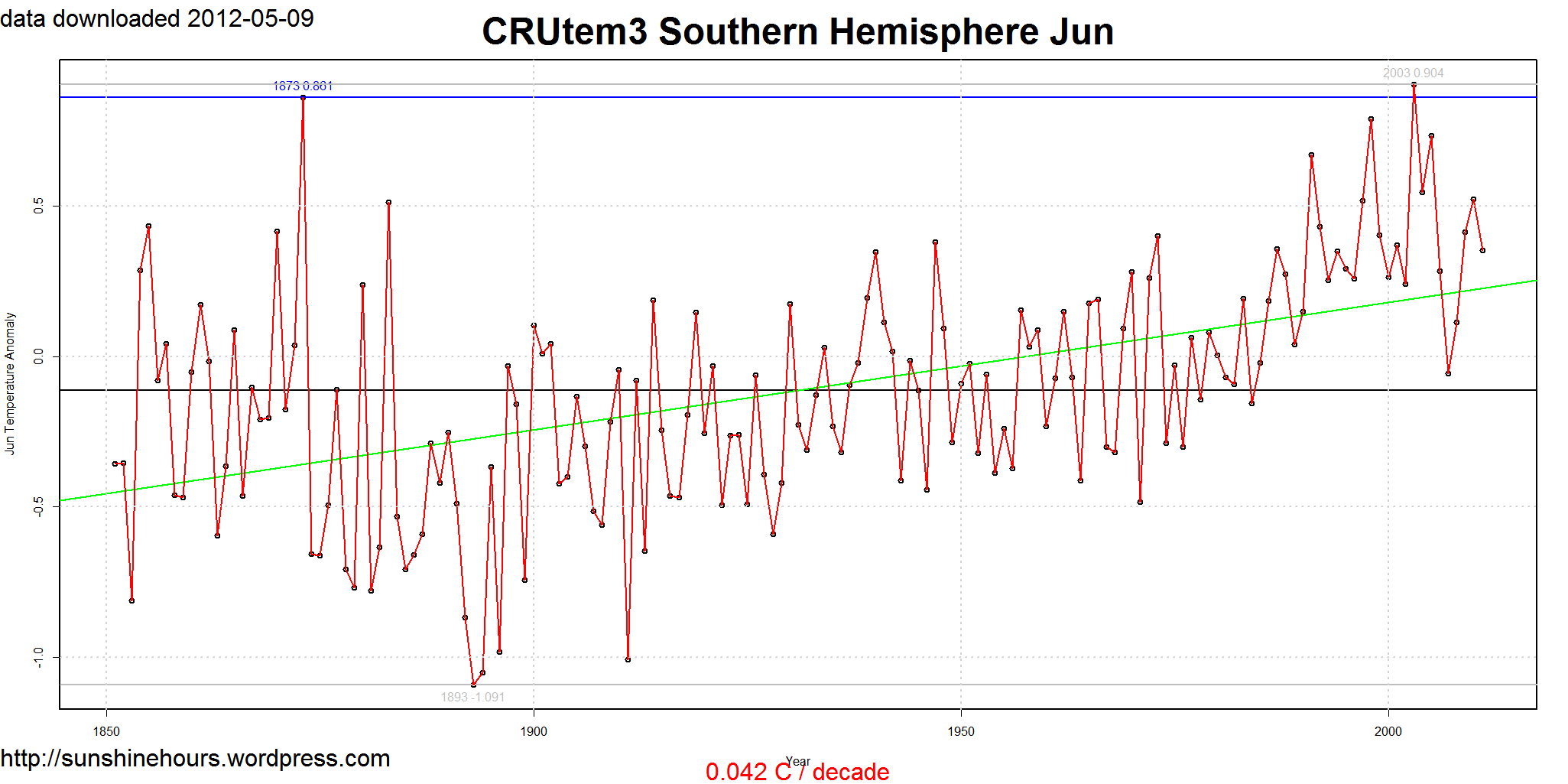
The 2nd warmest June was 1873.


I appreciate Gavin prompting Steve to look at the data so I would look at the CRUTEM3 SH data and realize …. what “global” warming?

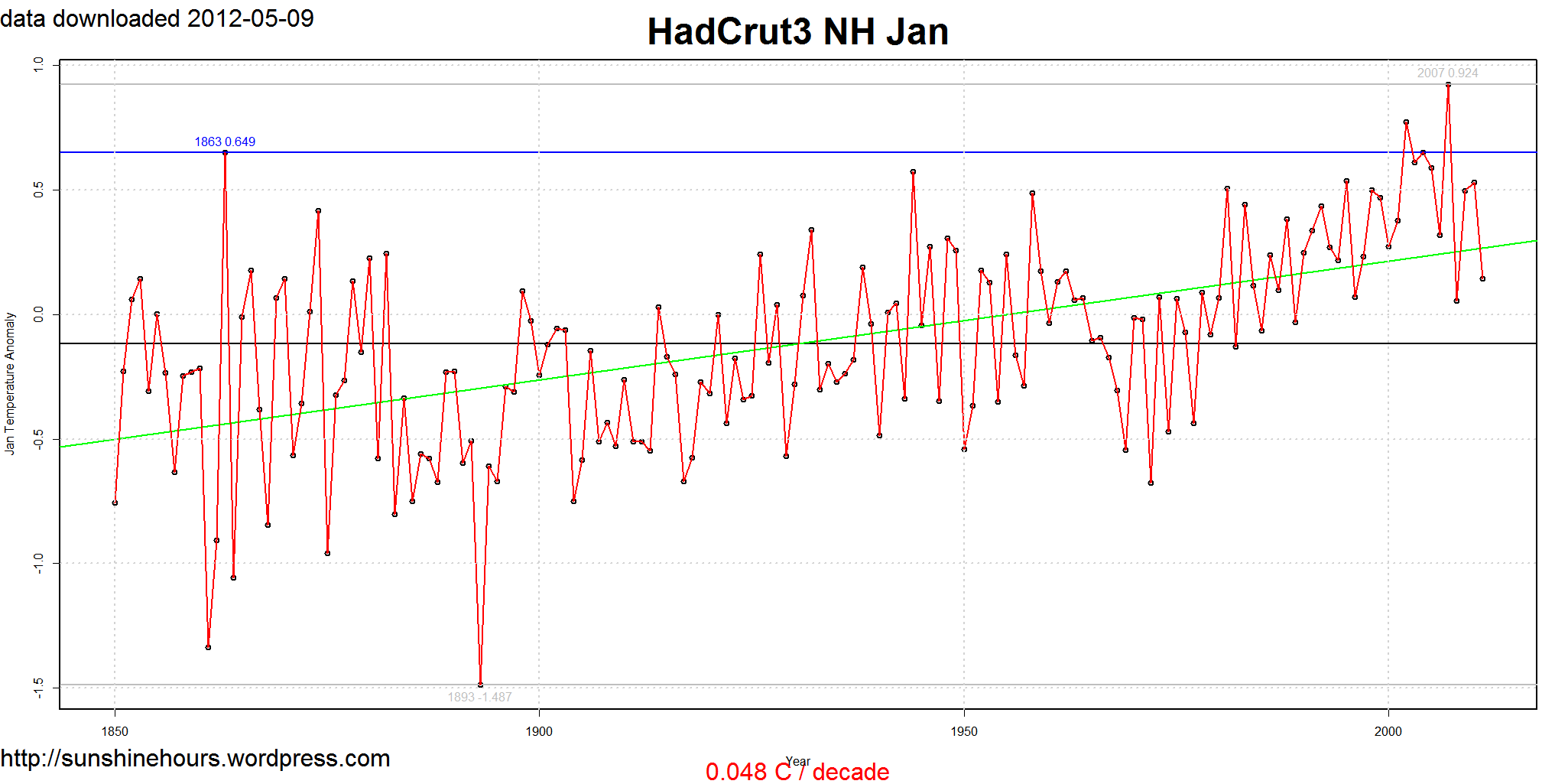
HADCRUT3 Northern Hemisphere – December and January

Update:  January data is just as unscary as December. I’ve added it at the bottom.

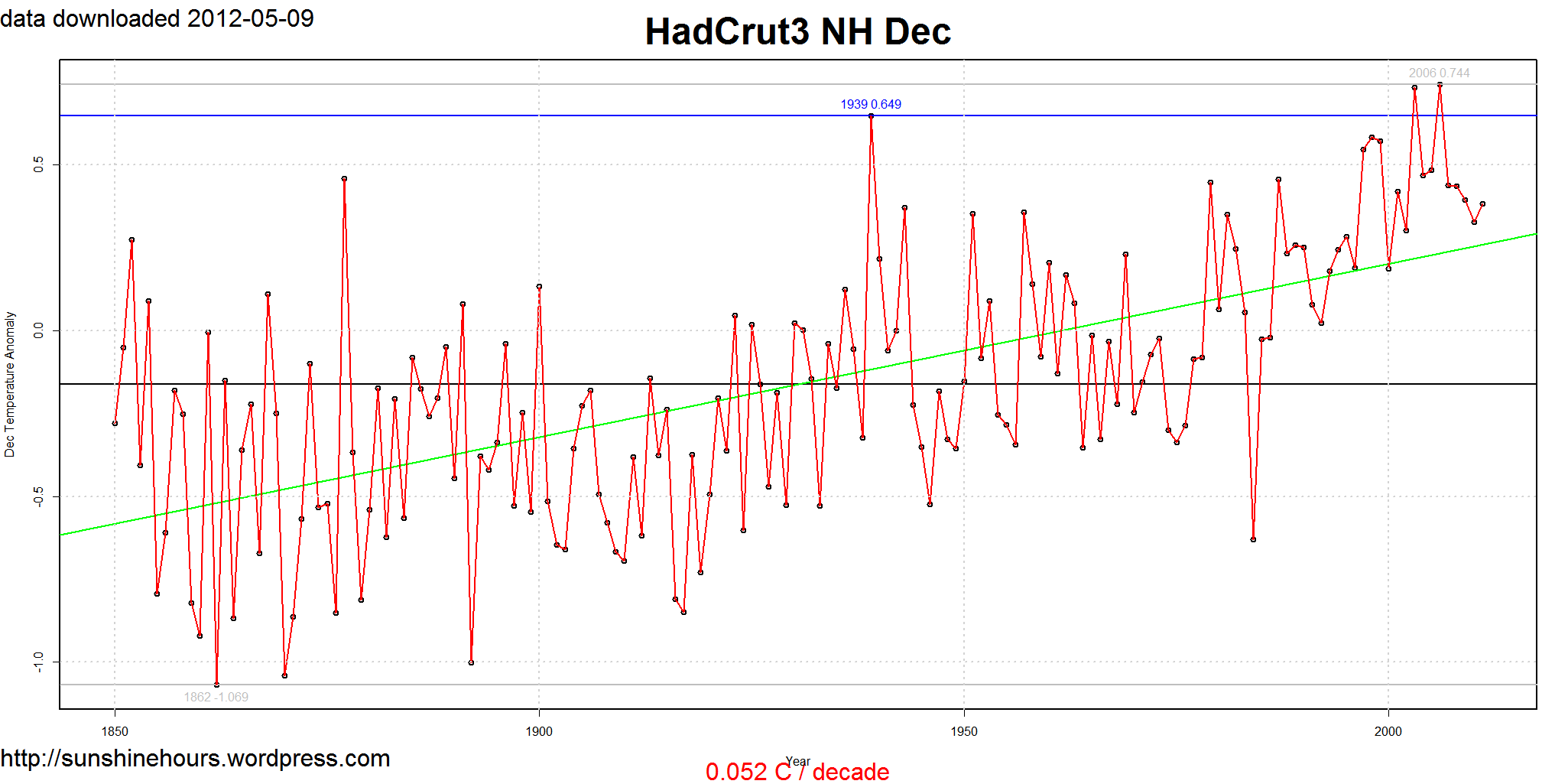
Has anyone ever noticed that the 3rd warmest December in the Northern Hemisphere (according to HADCRUT3) was 1939?

Anyone who wants to remake our fossil fuel economy based on this graph is insane. On top of 2006 being only .095C warmer than 1939, it was only .3C warmer than 3 years in the 1940s/50s. And its just as cold as those 40s/50s years now.


Only two years warmer than January 1863. Doesn’t look too scary. And January’s subsequent to 2007 were much colder than 1863.

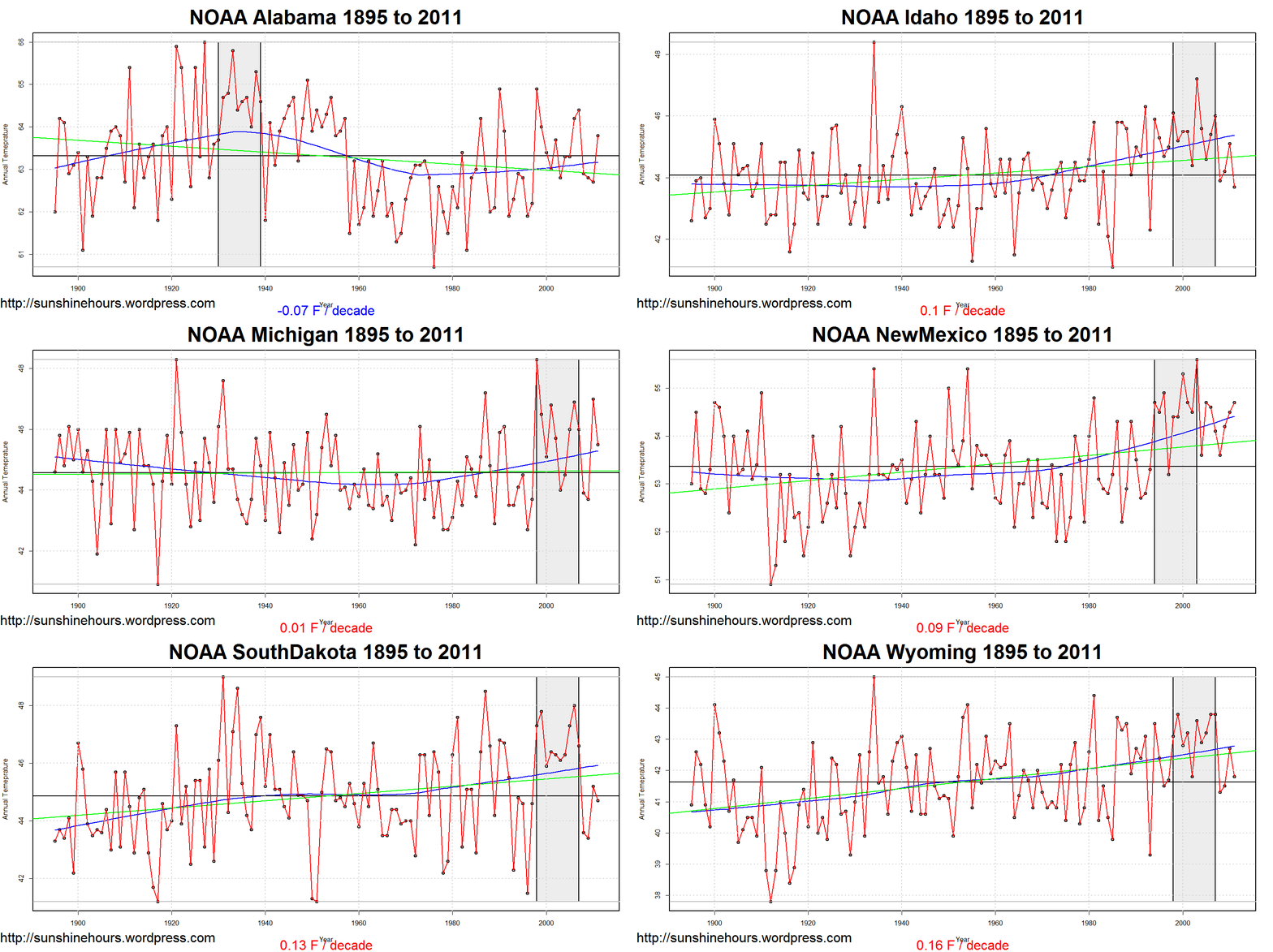
NOAA 17 of 48 states warmest decade was far in the past

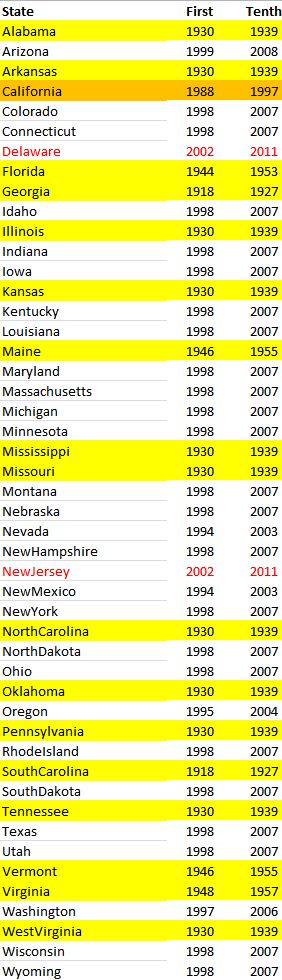
Using the NOAA data I thought I would look and see when the warmest 10 years were for each state.

17 states warmest 10 years were well in the past. Only 2 were 2002 to 2011. All of the rest but one overlapped 1998. And California was an outlier with 1988 to 1997 as the warmest 10 years. At the bottom of this post is the list with some highlighting.

Here is an animated gif of the 48 states with the warmest 10 years highlighted in gray. Click on it for the full effect.

Is the USA warming? The NOAA data says”It depends” – Part 2

Part 2 of 3. Part 1 explains the series.  Part 1a and Part 1b have some nice graphs

In part 1 I took a look at the NOAA data when it starts in 1895. I then thought why not write an R script to find the trends for each state using every possible year as a start date.

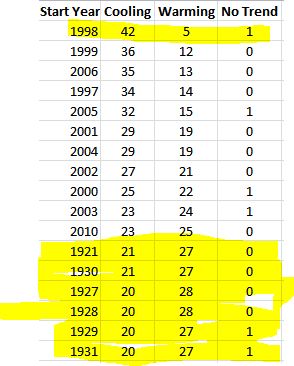
42 of 48 states were cooling and 1 had no trend from 1998. No surprise. The world started to cool in 1998. I’ll return to 1998 in the future.

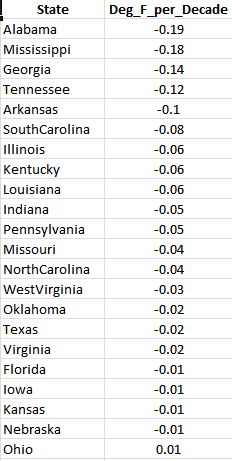
But look at 1921. And 1930. 21 states have been cooling since 1921 and 1930. 1921 is an important pivot point in US climate.
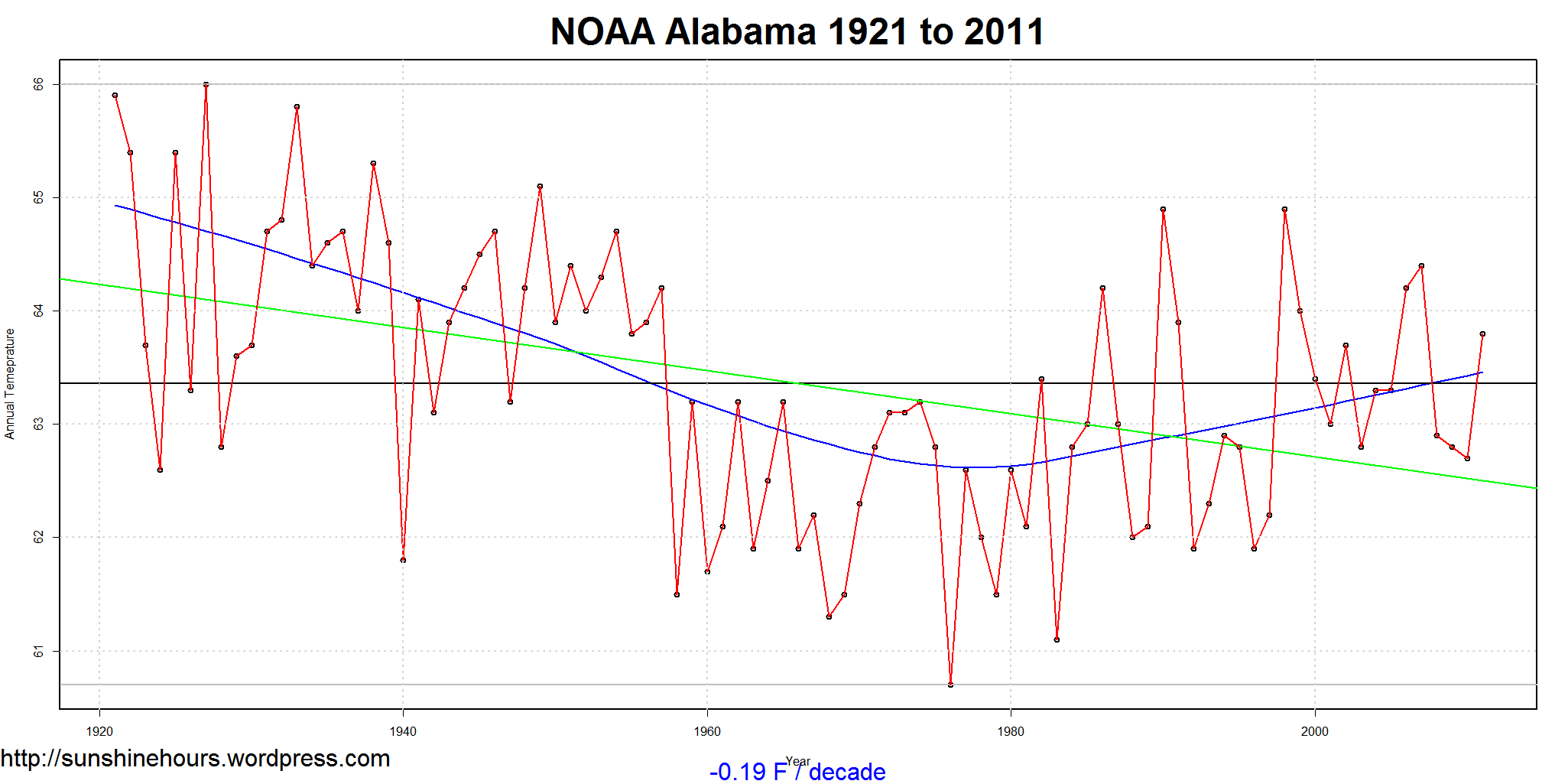
The trend for Alabama is cooling at -0.19F / decade since 1921.

The green line is the trend, the blue line is the default loess fit, the red line is the data, the black line is the average for the whole period, and the faint top and bottom grey lines are max and min.

Does anyone see the mark of CO2 warming in that graph?

Here is the list of states cooling from 1921. (Plus Ohio since .01F is so small)
I’ll include the graph for Tennessee with a new addition — the grey rectangle highlights the 10 warmest consecutive years.