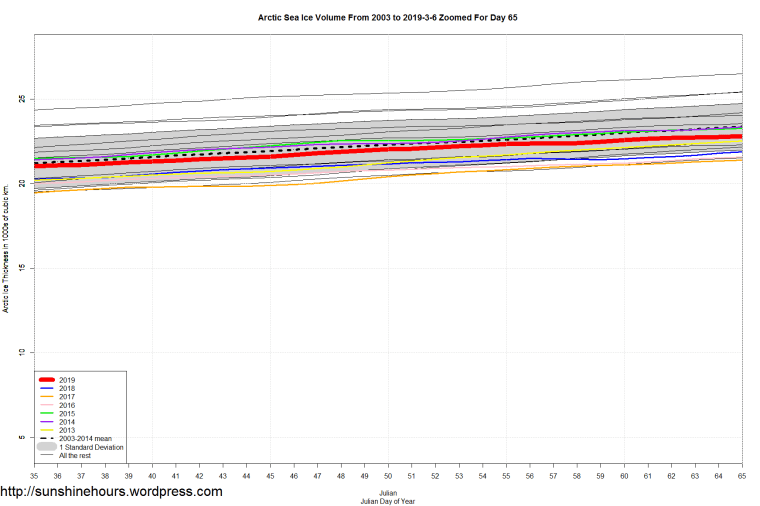
Arctic Sea Ice Volume 06-Mar-2019
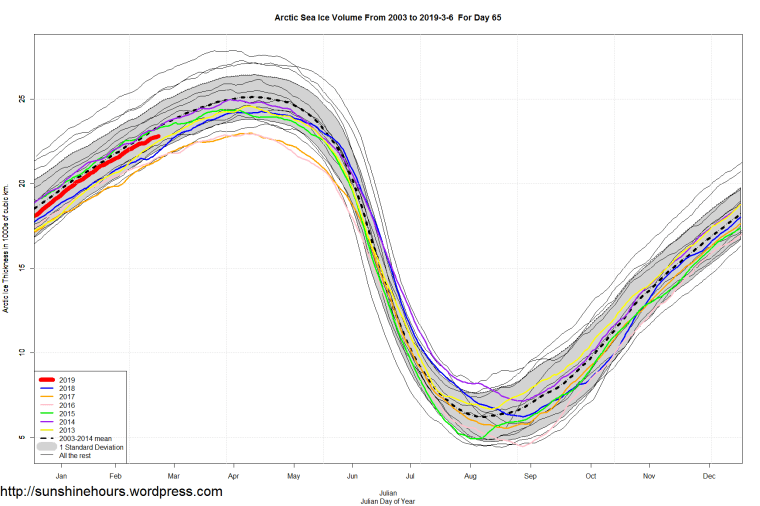
From DMI
The End of Recycling?
Nobody wants the junk anymore.
After decades of earnest public-information campaigns, Americans are finally recycling. Airports, malls, schools, and office buildings across the country have bins for plastic bottles and aluminum cans and newspapers. In some cities, you can be fined if inspectors discover that you haven’t recycled appropriately.But now much of that carefully sorted recycling is ending up in the trash.
For decades, we were sending the bulk of our recycling to China—tons and tons of it, sent over on ships to be made into goods such as shoes and bags and new plastic products. But last year, the country restricted imports of certain recyclables, including mixed paper—magazines, office paper, junk mail—and most plastics. Waste-management companies across the country are telling towns, cities, and counties that there is no longer a market for their recycling. These municipalities have two choices: pay much higher rates to get rid of recycling, or throw it all away.
Most are choosing the latter. “We are doing our best to be environmentally responsible, but we can’t afford it,” said Judie Milner, the city manager of Franklin, New Hampshire. Since 2010, Franklin has offered curbside recycling and encouraged residents to put paper, metal, and plastic in their green bins. When the program launched, Franklin could break even on recycling by selling it for $6 a ton. Now, Milner told me, the transfer station is charging the town $125 a ton to recycle, or $68 a ton to incinerate. One-fifth of Franklin’s residents live below the poverty line, and the city government didn’t want to ask them to pay more to recycle, so all those carefully sorted bottles and cans are being burned. Milner hates knowing that Franklin is releasing toxins into the environment, but there’s not much she can do. “Plastic is just not one of the things we have a market for,” she said.
Read the rest here
Cold Kills: Rhode Island
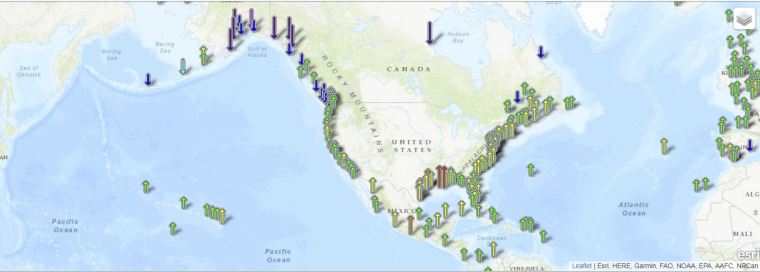
NOAA: average global sea level rise rate of 1.7-1.8 mm/yr
The NOAA has updated its tide gauge data for 2018 and says theaverage global sea level rise rate is 1.7-1.8 mm/yr.
Thats a measly 5.6 inches by 2100.
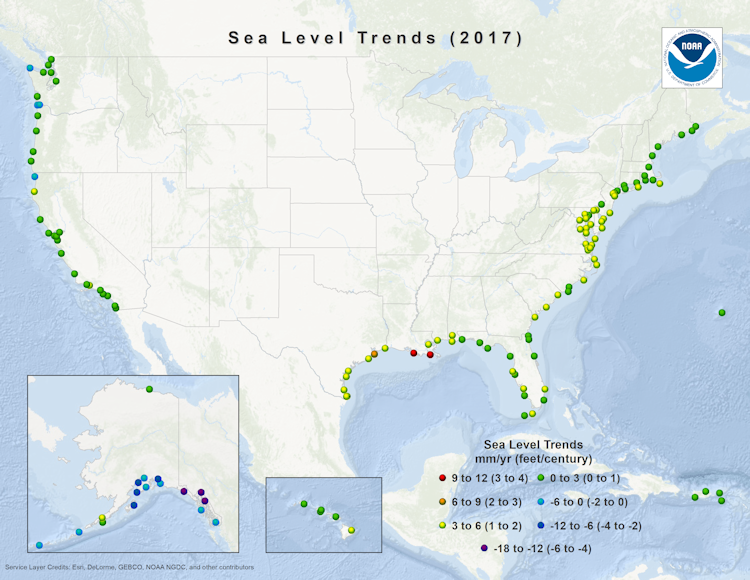
The map of relative sea level trends provides an overview of variations in the rates of local sea level change at long-term tide stations (based on a minimum of 30 years of data in order to account for long-term sea level variations and reduce errors in computing sea level trends based on monthly mean sea level).
The variations in sea level trends seen here primarily reflect differences in rates and sources of vertical land motion.
Areas experiencing little-to-no change in relative sea level are illustrated in green, including stations consistent with average global sea level rise rate of 1.7-1.8 mm/yr. These are stations not experiencing significant vertical land motion.
Stations illustrated with positive sea level trends (yellow-to-red) are experiencing both global sea level rise, and lowering or sinking of the local land, causing an apparently exaggerated rate of relative sea level rise.
Stations illustrated with negative trends (blue-to-purple) are experiencing global sea level rise and a greater vertical rise in the local land, causing an apparent decrease in relative sea level. These rates of relative sea level rise reflect actual observations and must be accounted for in any coastal planning or engineering applications.
Burning wood for power ‘breaches EU treaty’
It ain’t easy being green.
Campaigners are seeking to stop the EU counting wood as a renewable energy source, in a lawsuit which has been filed at the Court of Justice.
Plaintiffs from six European countries and the US argue that burning biomass for heat and power is a false solution to climate change. The EU Renewable Energy Directive promotes logging of ancient forests, according to the brief, contravening the bloc’s higher principles and individuals’ rights.
The suit challenges a major plank of efforts to generate 32 percent of EU energy from renewable sources by 2030. Nearly two thirds of EU renewables come from various forms of bioenergy, with more projects in planning.
Carbon sinks
“We are burning up our forest carbon sink and injecting it into the atmosphere,” said Mary Booth, lead science advisor to the case and president of the US-based Partnership for Policy Integrity.
“There is forest biomass being shipped thousands of miles to meet biomass demand in the EU. We think that needs to stop.”
At the point where it is burned, wood emits more carbon dioxide than coal. However, the EU treats wood burning as carbon neutral, on the basis trees will grow back, absorbing carbon dioxide from the air.
A spokesperson for the European Commission climate change division would not comment on the legal merits of the case.
The commission’s policy framework aimed to guarantee “sustainable development of bioenergy, while at the same time enhancing the role of land and forests as carbon sinks,” she said.
Renewables
That was endorsed by member states and the European Parliament when they adopted the directive last year.
Carbon accounting of forest management has long been fraught with controversy, as scientists like Booth warn it does not reflect the true climate impact. Instead of being harvested, she said in a press call, trees should be allowed to mature and store carbon.
The plaintiffs will also raise concerns about damage to biodiversity, cultural heritage and human health in their regions. These range from the deterioration of peat bogs in Ireland to threats to Estonia’s pagan religious traditions.
From a legal perspective, counsel Peter Lockley explained, the case needed to demonstrate the renewables directive clashes with higher law – enshrined in the Treaty on the Functioning of the European Union – in a way that directly concerned individuals.
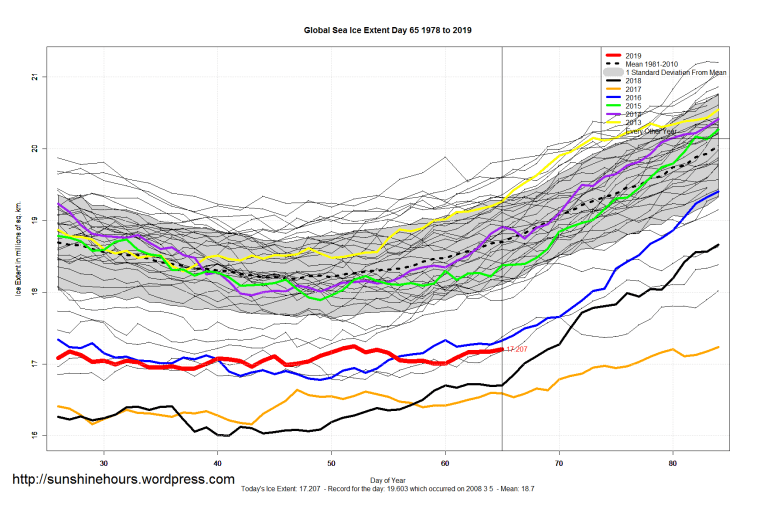
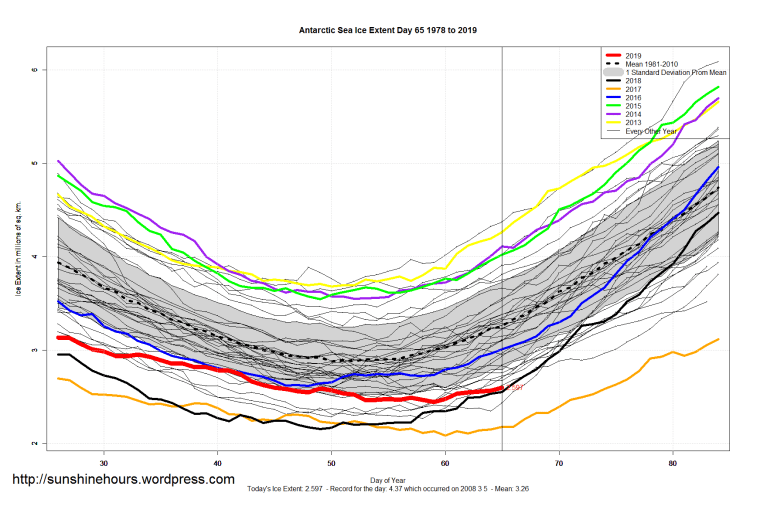
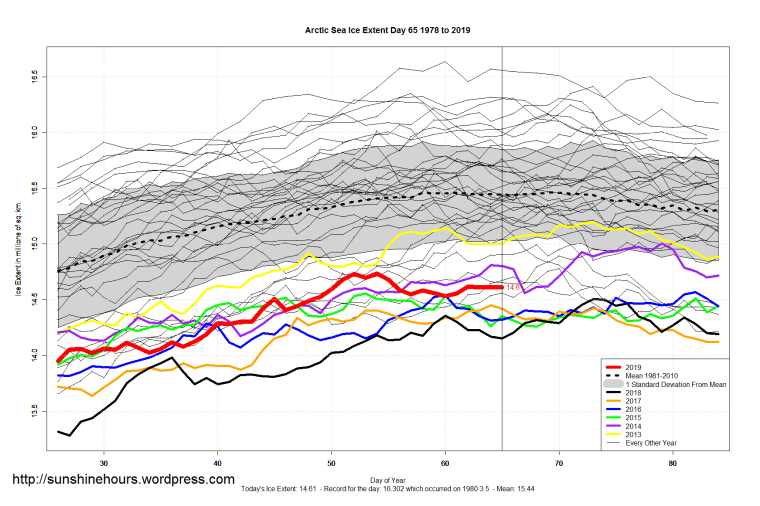
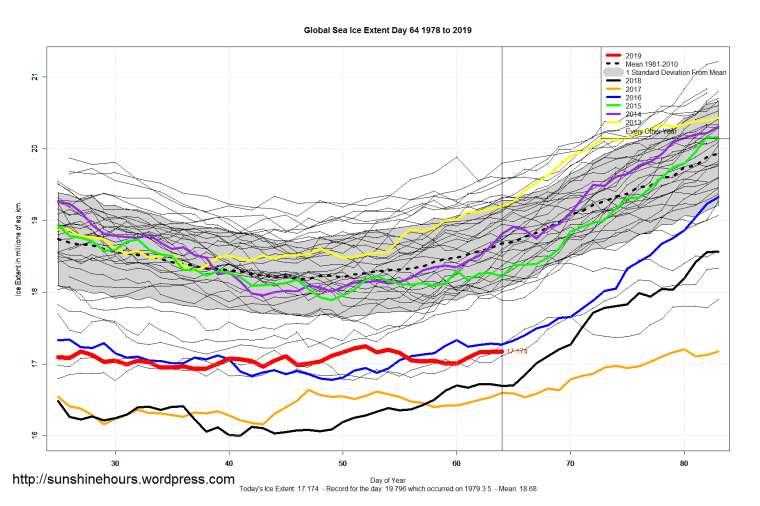
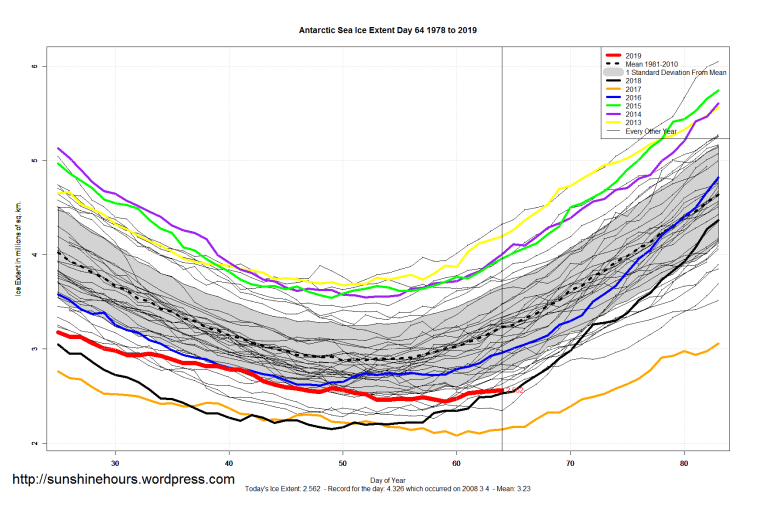
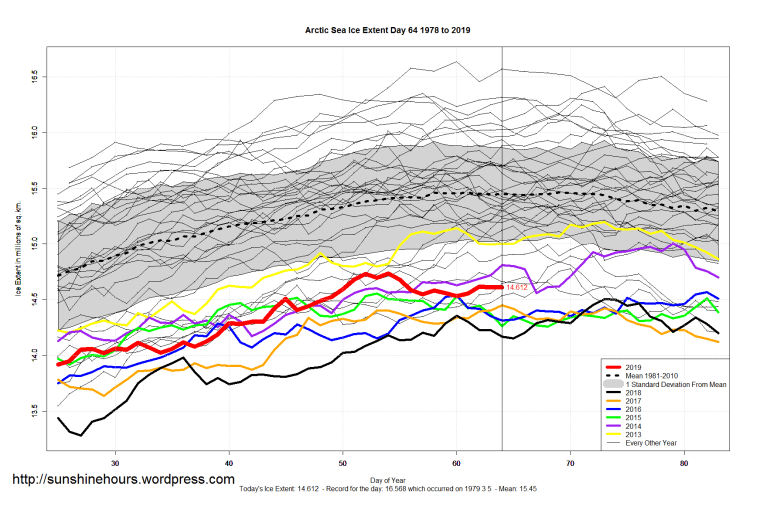
Sea Ice Extent (Global Antarctic and Arctic) – Day 64 – 2019
Arctic Sea Ice Volume 05-Mar-2019
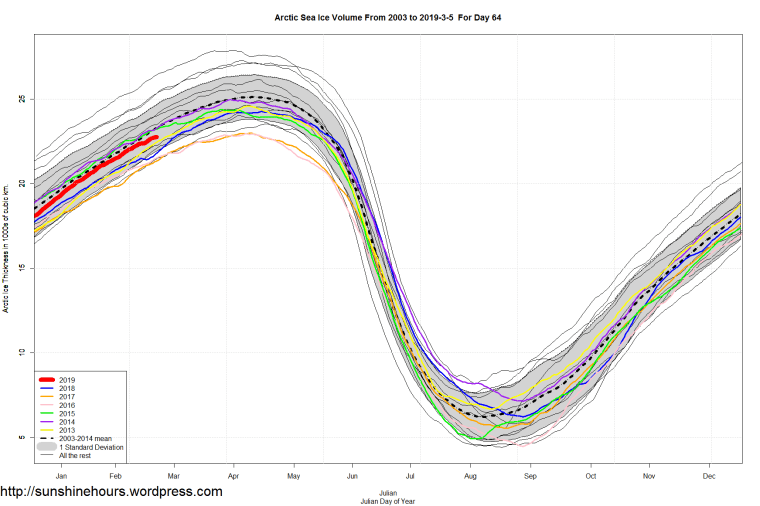
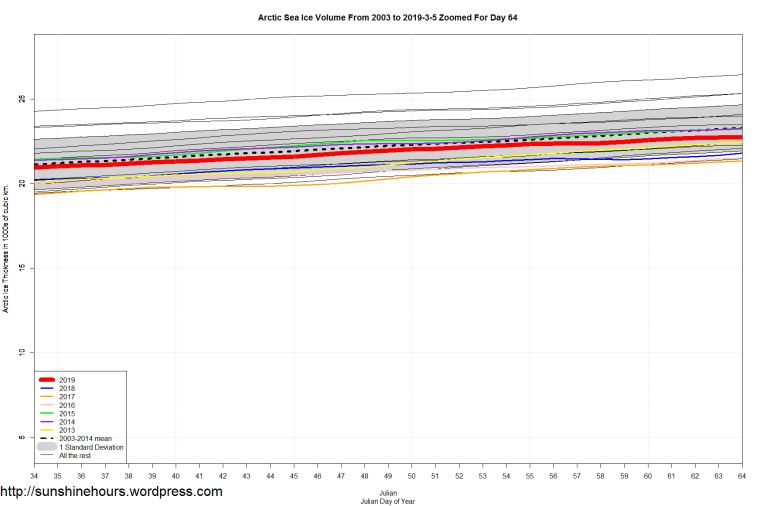
From DMI
Atmospheric Rivers Could Flood California
Atmospheric rivers could flood California again.
Storms capable of causing a $1 trillion flood in California have hit multiple times in the past, so it is only a matter of time before one occurs again. The most recent one occurred back in the winter of 1861 – 1862. A 45-day period of torrential rains from multiple storms carrying a strong “atmospheric river” (AR) of tropical moisture impacted the state, turning California’s Central Valley into a lake 300 miles long and over 20 miles wide. The resulting floods put downtown Sacramento under 10+ feet of water, forcing movement of the state capital to San Francisco.
Sediment research has found that six storms even more severe than the 1861 – 1862 storm hit California in the years 212, 440, 603, 1029, 1418, and 1605 AD.
If a storm with an equivalent amount of precipitation were to hit California now, it might do $900 billion (2019 dollars) in damage, according to a 2011 study by the USGS called the “ARkStorm Scenario” (the “AR” stands for Atmospheric River, and the “k” stands for the number one thousand, since the storm could be expected to bring 1-in-1000-year rains to some locations). The storm they modeled could flood up to 25% of all buildings in the state, breach approximately 50 levees, and force the evacuation of 1.5 million people.
Sacrameno 1862

Read it all here
Yes they try and claim “Climate Change” is going to make things worse. But to anyone with a brain the historic floods make it clear these atmospheric rivers are normal and will occur again.
Green Icebergs
Scientists May Soon Solve Century-Old Mystery of Green Icebergs
Most icebergs appear white or blue when floating in seawater, but since the early 1900s explorers and sailors have reported seeing peculiar green icebergs in certain parts of Antarctica.
The strange green icebergs have always baffled scientists, but now a new study suggests iron oxides in rock dust from Antarctica’s mainland are turning some icebergs green.
According to the study published in the Journal of Geophysical Research: Oceans, marine ice varies in color due to the “abundance of foreign constituents in the seawater,” particularly iron-oxide materials. Researchers formulated the theory after they detected “large amounts of iron” during a 2016 research trip to the Amery Ice Shelf in East Antarctica.
“Previously, dissolved organic carbon (DOC) had been proposed to be responsible for the green color,” authors Stephen Warren, Collin Roesler, Richard Brandt, and Mark Curran explained in the paper. “Subsequent measurements of low DOC values in green icebergs, together with the recent finding of large concentrations of iron in marine ice from the Amery Ice Shelf, suggest that the color of green icebergs is caused more by iron‐oxide minerals than by DOC.”
Iron is a key nutrient for phytoplankton, microscopic plants that form the base of the marine food web. But iron is scarce in many areas of the ocean. If the researchers’ theory is confirmed, it would mean green icebergs are ferrying precious iron from Antarctica’s mainland to the open sea when they break off, providing this key nutrient to the organisms that support nearly all marine life.
“It’s like taking a package to the post office,” Warren, a glaciologist at the University of Washington and lead author of the study, said in a statement. “The iceberg can deliver this iron out into the ocean far away, and then melt and deliver it to the phytoplankton that can use it as a nutrient.”
Warren had been studying the green iceberg phenomenon since 1988. He analyzed samples taken from a green iceberg near the Amery Ice Shelf and found they were not made from regular glacier ice, but from marine ice, which is ocean water frozen to the underside of an overhanging ice shelf.

Seawater sometimes freezes to the underside of ice shelves, creating a layer of what’s called marine ice. (Credit: AGU)
When an oceanographer testing an ice core from Amery Ice Shelf found marine ice near the bottom of the core had nearly 500 times more iron than the glacial ice above, Warren began to suspect iron oxides in the marine ice could be turning blue ice green.
Warren believes iron oxides in “glacial flour,” a powder created when glaciers grind against bedrock, from rocks on Antarctica’s mainland are responsible for creating the stunning emerald icebergs. He now wants to to sample icebergs of different colors for their iron content and light-reflecting properties (icebergs are usually blue in color, because the ice absorbs more red light than blue light).
If their theory proves correct, green icebergs could be more important than scientists thought.
 sunshine hours