Drone Guides Ship In Antarctic (with video)

Cool video of a drone scouting in the Antarctic:

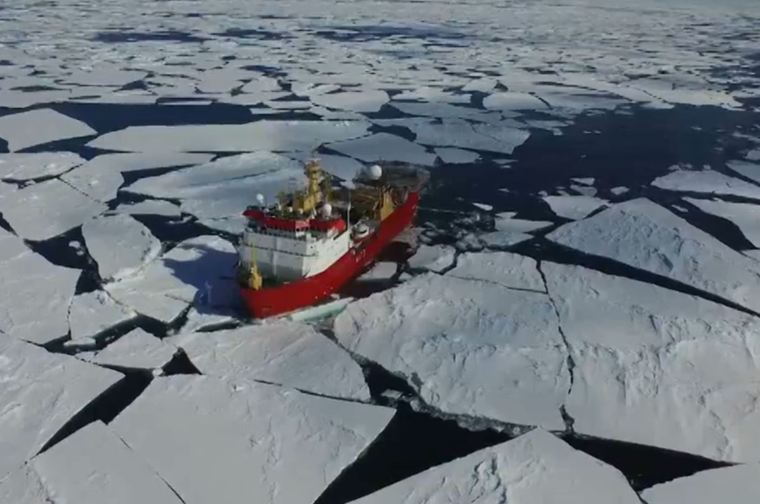
The Royal Navy’s ice patrol ship HMS Protector has launched tiny pilotless aircraft from her decks for the first time to assist with navigating through the Antarctic.

A quadcopter and a 3D-printed aircraft have scouted the way for the survey ship so she can find her way through the thick ice of frozen seas.HMCSProtector
It’s the first time the Royal Navy has used unmanned aerial vehicles in this part of the world. The Service has been operating ScanEagle ‘eyes in sky’ from frigates in the Gulf for the past couple of years which feed vital live imagery back to ships on maritime security patrols.
Read more: http://www.portsmouth.co.uk/news/defence/watch-drone-guides-hms-protector-through-stunning-antarctic-sea-ice-1-7329267


Greenland Melting: Broken Satellite ‘Confirms’

I was reading this article on Greenland melting. And then I read this:

Capture

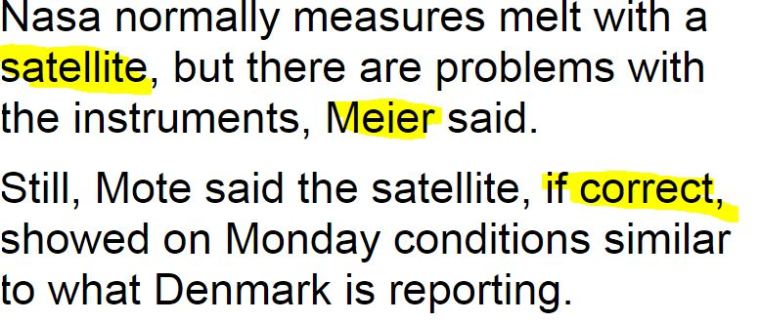
Meier is (I assume) Walt Meier of the NSIDC.

Ok … so the satellite that was producing spurious massive jumps in Arctic/Antarctic Sea Ice is being used to confirm the melting of Greenland despite being told the satellite is broken.

Yup. Sounds typical.

On Monday and Tuesday, about 12 per cent of the ice sheet surface area — 656,000 square miles or 1.7 million square kilometers — showed signs of melting ice, according to Peter Langen, a climate scientist at the Danish Meteorological Institute.

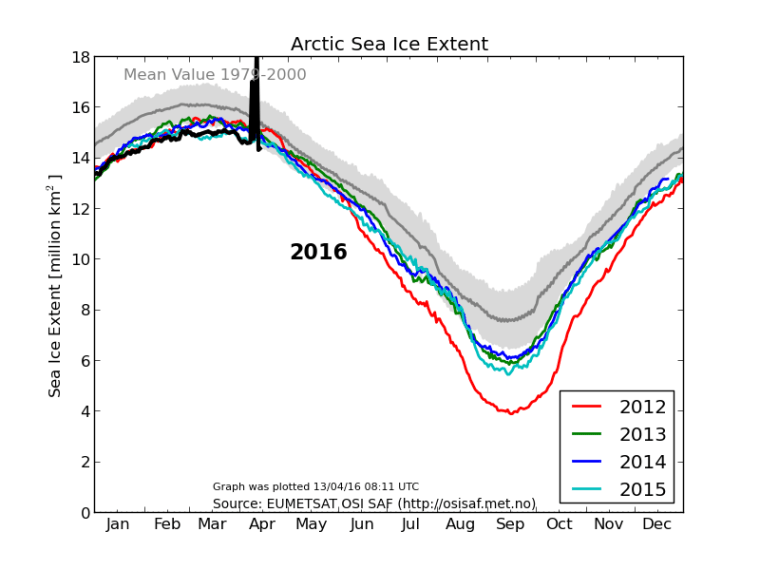
This is the DMI graph of the arctic sea ice extent using data from the same satellite … I think.

DMI_JUMPY_icecover_current_new

Wait. This just in.(I’m flabbergasted).

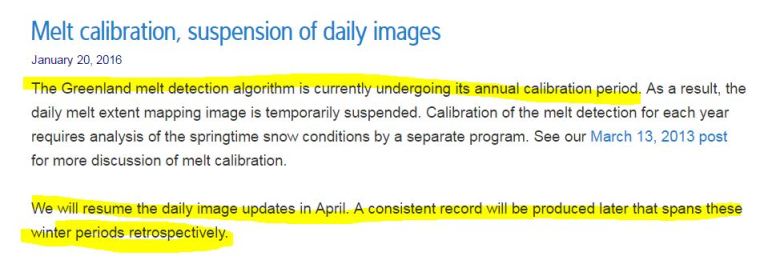
Greenland calbration

Greenland Surface Melt dataset produced by:

DMSP 5D-2/F11, DMSP 5D-2/F13, DMSP 5D-2/F8, DMSP 5D-3/F17, NIMBUS-7

F17 is the satellite producing spurious sea ice data.


Antarctica GAINING 82 to 112 gigatons of Ice per Year

“According to the new analysis of satellite data, the Antarctic ice sheet showed a net gain of 112 billion tons of ice a year from 1992 to 2001. That net gain slowed   to 82 billion tons of ice per year between 2003 and 2008.”

“Zwally’s team calculated that the mass gain from the thickening of East Antarctica remained steady from 1992 to 2008 at 200 billion tons per year”

The good news is that Antarctica is not currently contributing to sea level rise, but is taking 0.23 millimeters per year away,” Zwally said.


http://www.nasa.gov/feature/goddard/nasa-study-mass-gains-of-antarctic-ice-sheet-greater-than-losses


Antarctica Losing 159 Gigatons Per Year … Tick Tock … only 188,679 years to go

I’m sure you have seen the headlines. The continent of Antarctica is losing 159 gigatons of ice every year now. (Almost all of it where there are volcanoes under the ice)

The world is coming to an end surely if that is happening. (And lets be honest, that is a big IF because the AGW Kult lies)

NSIDC: “The Antarctic Ice Sheet contains 30 million cubic kilometers (7.2 million cubic miles) of ice.”

A gigaton of ice is approximately one cubic kilometer of ice.

So … at 159 gigatons per year, how long before Antarctica melts? That would be 30,000,000 / 159.


188,679 years.


I’m guessing our interglacial will end long before that. And the ice will have stopped melting and started growing.

What the Kult doesn’t tell you is that the minute Antarctica stops melting is the moment most of humanity will start to die because that when the interglacial ends.

And it will end.


Where is the ice loss?

antarcticaiceloss-1

(Image: CPOM/Leeds/ESA)


Precedented Warming in Antarctica

Warmists like to claim warming in every part of the world is unprecedented.

This paper says just the opposite. Warming has been more dramatic in the 1700s and 1800s than today.

“We present a new stable isotope record from Ellsworth Land which provides a valuable 308-year record (1702-2009) of climate variability from coastal West Antarctica. Climate variability at this site is strongly forced by sea surface temperatures (SSTs) and atmospheric pressure in the tropical Pacific and related to local sea ice conditions. The record shows that this region has warmed since the late 1950s, at a similar magnitude to that observed in the Antarctic Peninsula and central West Antarctica, however, this warming trend is not unique. More dramatic isotopic warming (and cooling) trends occurred in the mid-19th and 18th centuries, suggesting that at present the effect of anthropogenic climate drivers at this location has not exceeded the natural range of climate variability in the context of the past ~300 years.

http://onlinelibrary.wiley.com/doi/10.1002/2013GL057782/abstract