NOAA September 2012 = 15 Year Trend By State

There has been much discussion in the climate blogosphere over the flat line in HADCRUT over the last 15 years.

Here are the 15 year trends from NOAA by State. Highlighted = Cooling

State 15 Year Trends in F/Decade
Alabama 0.1
Arizona -0.2
Arkansas 0
California 0.5
Colorado -0.3
Connecticut 0.4
Delaware 1
Florida -0.2
Georgia -0.1
Idaho -0.7
Illinois -0.1
Indiana -0.1
Iowa -0.7
Kansas -0.3
Kentucky -0.2
Louisiana 0.1
Maine 0.7
Maryland 0.4
Massachusetts 0.2
Michigan -0.3
Minnesota -0.7
Mississippi 0.1
Missouri 0
Montana -0.9
Nebraska -0.8
Nevada -0.1
New Hampshire 0.3
New Jersey 0.8
New Mexico 0.1
New York 0.4
North Carolina 0.2
North Dakota -0.9
Ohio 0
Oklahoma 0.3
Oregon -0.6
Pennsylvania -0.1
Rhode Island 0.1
South Carolina 0.3
South Dakota -1
Tennessee 0
Texas 0
Utah -0.5
Vermont 0.8
Virginia 0.5
Washington -1.2
West Virginia 0.1
Wisconsin -0.6
Wyoming -0.1

HADCRUT4 and Met Office Claims

Read this article: Met Office reply to David Rose Sunday Mail article:

As we’ve stressed before, choosing a starting or end point on short-term scales can be very misleading. Climate change can only be detected from multi-decadal timescales due to the inherent variability in the climate system. If you use a longer period from HadCRUT4 the trend looks very different. For example, 1979 to 2011 shows 0.16°C/decade (or 0.15°C/decade in the NCDC dataset, 0.16°C/decade in GISS). Looking at successive decades over this period, each decade was warmer than the previous – so the 1990s were warmer than the 1980s, and the 2000s were warmer than both.”

Ok, lets look at a non-arbitrary endpoint (the last datapoint) and go back in 5 year increments.

HADCRUT4 Last 5 years colder than previous 5 years

Mean of the anomaly of the last 5 years = .45C

Mean of the anomaly of the previous 5 years = .49C

Mean of the anomaly of the previous previous 5 years = .41C

HADCRUT3 – Last 5 years colder than previous AND colder than the previous previous 5.

Mean of the anomaly of the last 5 years = .39C

Mean of the anomaly of the previous 5 years = .45C

Mean of the anomaly of the previous previous 5 years = .41C


Warming stopped. HADCRUT3 trend is negative.

IPCC predicted .2C per decade. HADCRUT4 has been created to change the negative trend of HADCRUT3 to a positive one.

But even with the “adjustments”, the last 15 years trend in HADCRUT4 is 1/6th that predicted by the IPCC.


NOAA September 2012 – States by Ranking

Update: Histogram added at bottom.

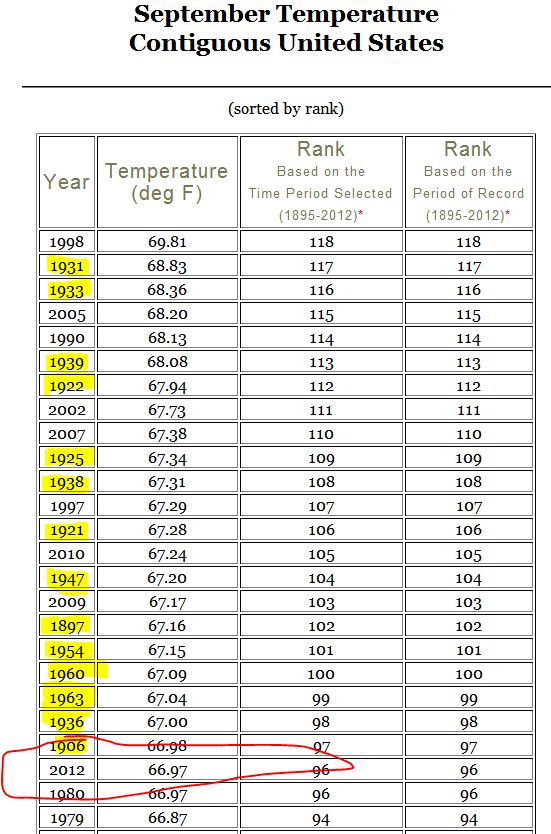
NOAA September 2012 – Ordered By Rank out of 118.  No State broke the record for its warmest September.

As an example, Indiana had the 30th warmest September, meaning 88 were warmer. The warmest September for Indiana was 1925 — 8.1F warmer than 2012!

Minnesota and North Dakotas record for September is 1897! Arizona’s is 1899.

State Sep 2012 Sep Rank Warmest Temp
Indiana 64.1 30 1925 72.2
Illinois 64.7 32 1925 72.7
Kentucky 67 34 1925 76.5
Alabama 73 35 1925 83.1
Missouri 66.7 37 1931 74.7
Ohio 63.2 37 1931 69.6
Iowa 61.8 39 1931 70
Michigan 58.5 41 1908 65.4
Tennessee 69 43 1925 79.2
Wisconsin 57.8 43 1931 64.8
Kansas 67.6 44 1931 76.7
North Carolina 69.8 47 1921 76.6
Georgia 74.1 52 1925 83.5
Mississippi 74.2 52 1925 82.9
Pennsylvania 62.3 52 1931 67.8
West Virginia 64 55 1900 69.9
Minnesota 57.1 56 1897 64
Virginia 67.1 56 1930 73.4
South Carolina 73.4 61 1925 81.6
Louisiana 77.2 62 1911 81.7
Maryland 67.2 63 1930 72.3
Rhode Island 62.9 64 1961 67.5
Arkansas 73.1 65 1925 80.1
Florida 79.5 65 1925 82.5
Maine 56.4 65 1961 62.7
Nebraska 63.4 67 1931 69.8
New York 60 67 1961 66.5
Vermont 58.1 75 1961 65.1
North Dakota 57.2 77 1897 63.4
Massachusetts 61.9 78 1961 66.8
New Hampshire 58.3 78 1961 64.5
Texas 76.7 79 1911 81
Oklahoma 74.1 83 1931 79.8
Connecticut 62.9 84 1961 67.7
New Mexico 66.1 85 2010 68.8
Arizona 73.7 88 1899 77.5
South Dakota 62.5 89 1897 68
Delaware 69.5 91 1930 73.1
Colorado 59.6 92 1998 62.6
New Jersey 67 92 1961 71.4
Washington 60.6 93 1967 63.7
Oregon 60.9 100 2011 63.2
Montana 58.4 104 1998 62.3
Idaho 59.3 107 1990 62.2
Wyoming 58.3 109 1998 60.4
Utah 64.1 110 2001 65.5
California 72.7 113 2009 73.6
Nevada 65.4 116 2009 66.5


A histogram of Warmest Septembers (kinda looks like it is giving the 1920s/30s finger to the IPCC):


AGW “Experts” Are Idiots!

Experts: Global warming means more Antarctic ice (h/t Marc Morano)

“This subtle growth in winter sea ice since scientists began measuring it in 1979 was initially surprising, they say, but makes sense the more it is studied.”

Translation: It was embarrassing us, so we’ll make something up.

“A warming world can have complex and sometimes surprising consequences,”

Translation: Antarctica is cooling, we don’t know why, so we will claim it is warming.

“”It sounds counterintuitive, but the Antarctic is part of the warming as well.”

Translation: More Ice = Warming and Less Ice = Warming. Our scam wins either way!

“But that doesn’t mean we shouldn’t be paying attention to it and shouldn’t be talking about it.”

Translation: We ignored the records in 2006 and 2012 and finally a few bloggers embarrassed us so much about 2012 that we had our buddy Seth Borenstein make up some crap.

“Antarctica’s weather peculiarities, on the other hand, don’t have much effect on civilization.”

Translation: It threatens our gravy train of grant money so we kept quiet about it.

“And the wind works in combination with the ozone hole, the huge gap in Earth’s protective ozone layer that usually appears over the South Pole”

Translation: We plan to ignore the ozone hole over the Arctic … which we never predicted either.

“Antarctic sea ice is also getting snowier because climate change has allowed the air to carry more moisture.

Guffaw.

“Winter sea ice has grown by about 1 percent a decade in Antarctica. ”

Actually, only one year before 1998 (1980 had 3) had days over 19 million sq km of Antarctic Ice. 2006 had 30 and 2012 had 28.

“computer models have long predicted that Antarctica would not respond as quickly to global warming as other places. ”

Translation; Models said it would melt too. Our models are crap.

“Scientists on the cruise with Maksym are spending eight to 12 hours a day on the ice bundled up against the fierce wind with boots that look like Bugs Bunny’s feet.”

Translation: Clown Feet would be more appropriate.
USCRN vs NOAA September 2012

USCRN vs NOAA September 2012 update.

The USCRN is a new ‘state of the art’ United States Climate Reference Network. The USCRN “consists of 114 stations developed, deployed, managed, and maintained by the National Oceanic and Atmospheric Administration (NOAA) in the continental United States for the express purpose of detecting the national signal of climate change.”

This is the monthly Mean from both NOAA and USCRN for September 2012 for the 48 continental states.

16 states show USCRN stations warmer than NOAA (bold) and 32 show NOAA warmer than USCRN.

NOAA – USCRN = NOAA state temperature average minus USCRN state temperature average.

Ignoring area weighting, the NOAA temperature averaged 0.80F warmer than USCRN.

State NOAA USCRN NOAA – USCRN
Alabama 73 71.72 1.28
Arizona 73.7 74.61 -0.91
Arkansas 73.1 71.24 1.86
California 72.7 72.37 0.33
Colorado 59.6 59.76 -0.16
Florida 79.5 80.36 -0.86
Georgia 74.1 74.97 -0.87
Idaho 59.3 61.88 -2.58
Illinois 64.7 61.52 3.18
Indiana 64.1 64.76 -0.66
Iowa 61.8 63.14 -1.34
Kansas 67.6 66.02 1.58
Kentucky 67 67.19 -0.19
Louisiana 77.2 75.83 1.37
Maine 56.4 55.58 0.82
Michigan 58.5 54.86 3.64
Minnesota 57.1 54.23 2.87
Mississippi 74.2 71.24 2.96
Missouri 66.7 65.84 0.86
Montana 58.4 55.72 2.68
Nebraska 63.4 62.83 0.57
Nevada 65.4 67.52 -2.12
New Hampshire 58.3 59.45 -1.15
New Mexico 66.1 64.17 1.93
New York 60 59.63 0.37
North Carolina 69.8 66.26 3.54
North Dakota 57.2 57.98 -0.78
Ohio 63.2 62.24 0.96
Oklahoma 74.1 71.73 2.37
Oregon 60.9 61.34 -0.44
Pennsylvania 62.3 64.4 -2.1
Rhode Island 62.9 61.88 1.02
South Carolina 73.4 74.03 -0.63
South Dakota 62.5 61.34 1.16
Tennessee 69 64.22 4.78
Texas 76.7 76.84 -0.14
Utah 64.1 63.75 0.35
Virginia 67.1 68.36 -1.26
Washington 60.6 58.28 2.32
West Virginia 64 57.2 6.8
Wisconsin 57.8 57.56 0.24
Wyoming 58.3 58.22 0.08

NSIDC Ignored Antarctica in 2006 Too

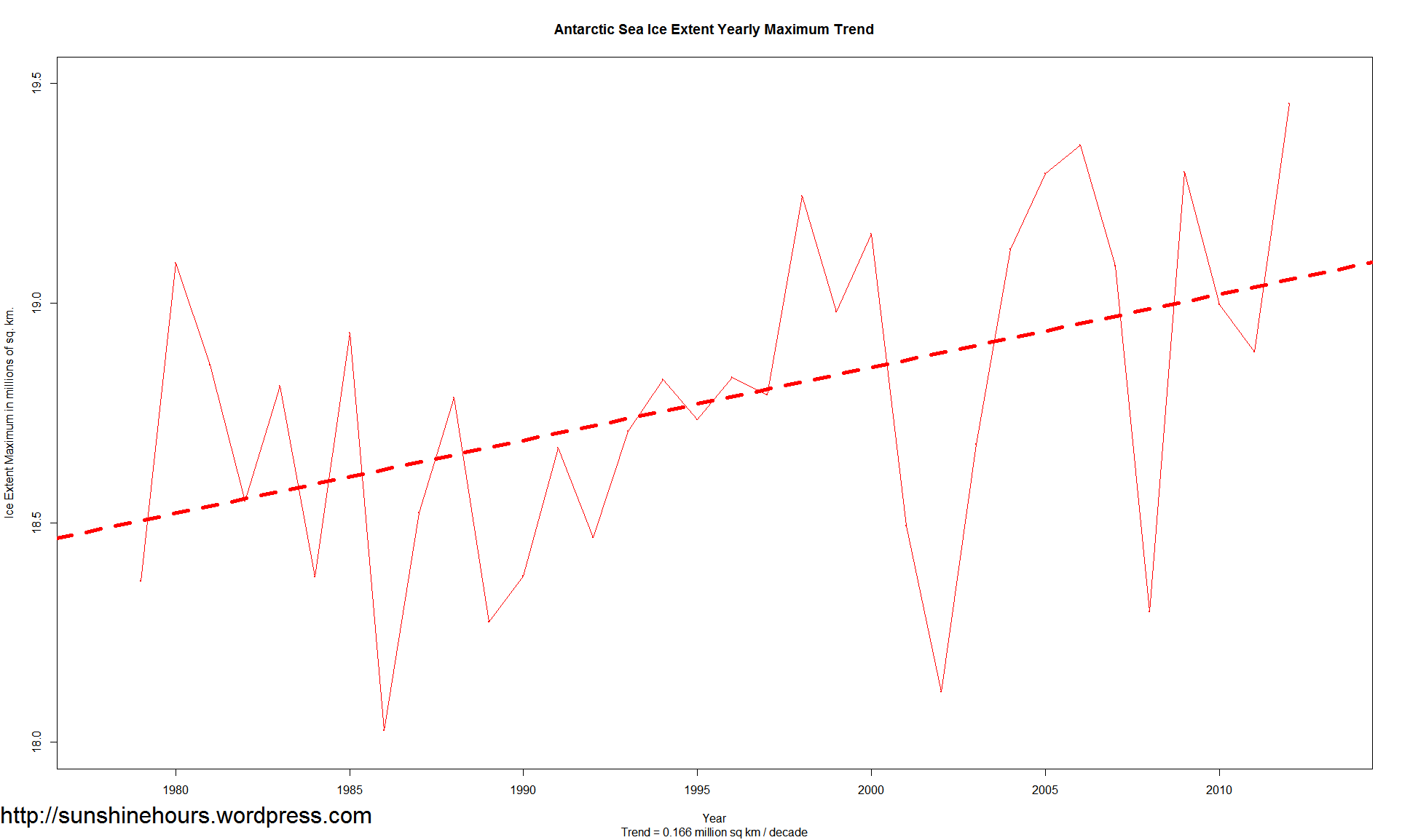
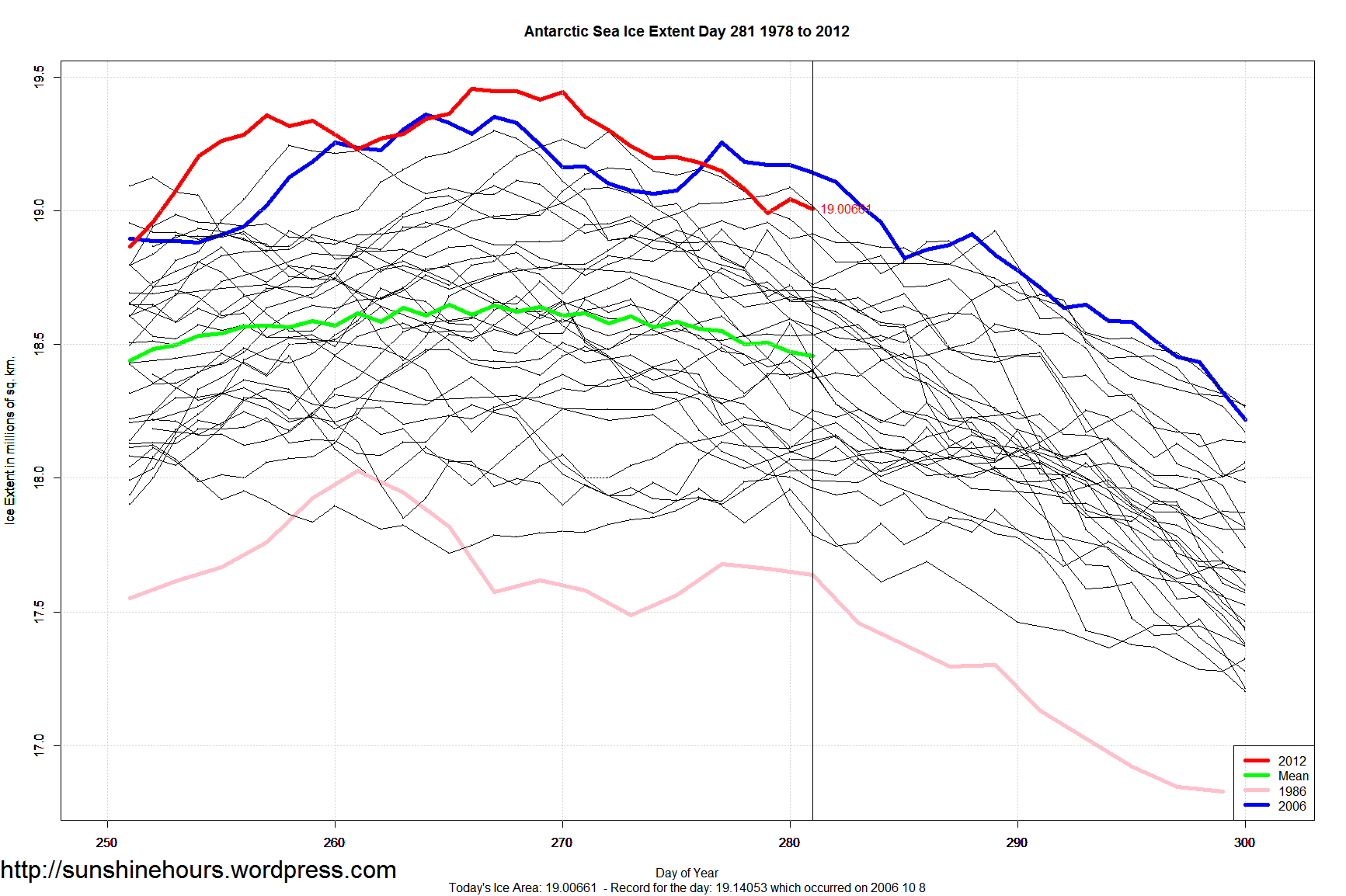
Antarctic Sea Ice Extent set an all time record in 2012. The previous record was set in 2006. In 2006 there were 30 days where the ice extent was over 19 million sq km. That record has not been broken and was 9 days more than the previous record holder (1998).

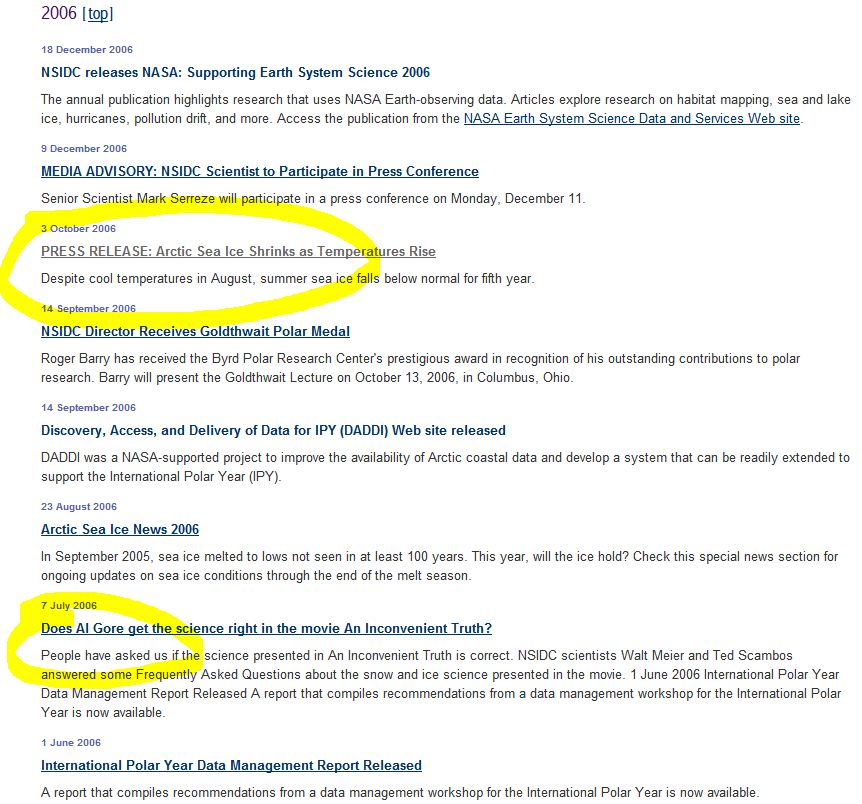
So what did the NSIDC have to say about it in 2006?

Nothing.

They mentioned the Arctic a lot. And Al Gore’s movie. And that there was going to be an open house. But they ignored Antarctica. If they were scientists and not propagandists shouldn’t they be interested in both poles and maximum records too?


28 days of 19 million sq km Antarctic Sea Ice Extent

Only 9 years in the satellite era have seen Antarctic Sea Ice Extent hit 19 million sq km.  2006 had 30 days. In the last 2 days  2012 has trend up again over 19 million and put it within 2 days of tying the all time record. Aside from 1980, all of those years have been since 1998 which some people claim have been the hottest years in the history of human beings. Antarctic Sea Ice Extent disagrees.

Year Days Above 19 million Last Day Above 19 million
2006 30 283
2012 28 281
1998 21 281
2005 13 278
2009 11 271
2007 9 275
2004 6 254
2000 5 274
1980 3 269

Click for larger …

USCRN vs NOAA August 2012

USCRN vs NOAA August 2012 update. (I’m late because USCRN didn’t post August monthly temperatures until October 3rd after they posted September data).

The USCRN is a new ‘state of the art’ United States Climate Reference Network. The USCRN “consists of 114 stations developed, deployed, managed, and maintained by the National Oceanic and Atmospheric Administration (NOAA) in the continental United States for the express purpose of detecting the national signal of climate change.”

This is the monthly Mean from both NOAA and USCRN for August 2012 for the 48 continental states.

14 states show USCRN stations warmer than NOAA (bold) and 34 show NOAA warmer than USCRN.

NOAA – USCRN = NOAA state temperature average minus USCRN state temperature average.

Ignoring area weighting, the NOAA temperature averaged 0.83F warmer than USCRN.

State NOAA USCRN NOAA – USCRN
Alabama 78.3 77.37 0.93
Arizona 80.8 81.62 -0.82
Arkansas 80 78.44 1.56
California 77.5 75.56 1.94
Colorado 67.9 68.57 -0.67
Florida 81.6 82.04 -0.44
Georgia 78.3 78.75 -0.45
Idaho 68.5 71.24 -2.74
Illinois 73.5 69.62 3.88
Indiana 71.8 74.3 -2.5
Iowa 70.9 71.24 -0.34
Kansas 76.2 75.38 0.82
Kentucky 74.3 74.66 -0.36
Louisiana 81.8 81.14 0.66
Maine 68 67.37 0.63
Michigan 67.5 64.94 2.56
Minnesota 66.5 64.04 2.46
Mississippi 79.3 77.63 1.67
Missouri 76.4 75.08 1.32
Montana 67.2 64.26 2.94
Nebraska 72.6 72.09 0.51
Nevada 73.9 74.9 -1
New Hampshire 68.8 70.25 -1.45
New Mexico 73.9 72.19 1.71
New York 68.7 68.36 0.34
North Carolina 75.7 71.96 3.74
North Dakota 66.8 66.62 0.18
Ohio 71.6 71.42 0.18
Oklahoma 81.3 79.97 1.33
Oregon 67.6 66.74 0.86
Pennsylvania 70.2 72.86 -2.66
Rhode Island 71.8 70.34 1.46
South Carolina 77.9 77.54 0.36
South Dakota 70.9 69.84 1.06
Tennessee 75.5 69.98 5.52
Texas 83.7 83.82 -0.12
Utah 74.1 73.26 0.84
Virginia 74.3 75.65 -1.35
Washington 67.8 64.46 3.34
West Virginia 70.9 63.68 7.22
Wisconsin 67.3 68.36 -1.06
Wyoming 67.6 66.62 0.98