West Coast has been cooling since 1983!

Update:  See the cooling as an animated gif.

Did you know it is cooling on the west coast of North America from 1983 to 2011? Before I show you how I found that out and what I found, I will tell you a story.

About a month ago I was reading the Victoria Times Colonist and read an article titled Warmer weather in B.C. threatens waterfront, forests. The key sentence to me wasAn analysis of 62 years of Environment Canada weather data by the University of Victoria’s Pacific Climate Impacts Consortium has found that B.C.’s temperature has been warming by about 0.25 degrees Celsius per decade”  which came from this report .

My first thought was “No Way”. I live in BC. It hasn’t been warming recently. But how was I to prove otherwise?  I sent an email to Francis Zwiers who is the Director and I sent him a couple of screen shots from GISS from a few nearby climate stations showing that it has been warmer , and recently it hasn’t been warming. I sent a screenshot of Clearbrook (and a few others) which is right on the border with BC in Washington State. Fig 1 Clearbrook from GISS.
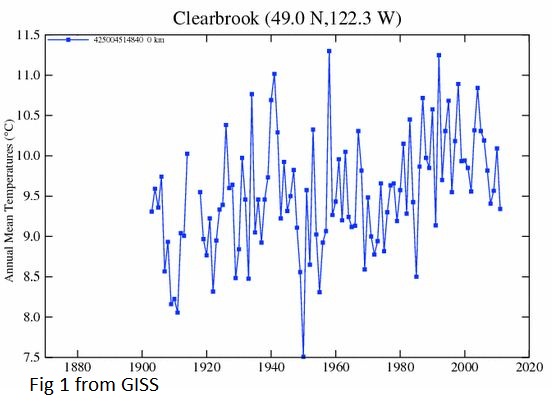
The key number in the quote was 62 years, which means they were using 1950 as a starting year. Clearbrook exhibits one of the common signatures of west coast climate stations – 1950 was amazingly cold. You can see that temperatures dropped 3.5C from 1940 to 1950.1950 on the west coast is kind of like a micro Little Ice Age. Sure it warmed after 1950 because every year was warmer than 1950.

After a few emails back and forth I asked for his data. Guess what he said? “It’s publically available from Environment Canada.” Sound familiar? That kind of ticked me off. To be fair, after a couple more emails he offered to send me the data and also pointed me at an Environment Canada website where I could scrape it myself or I could wait for the public access portal they were planning.

By then I had decided it was time to learn R. I wrote an R script to scrape the EC site for data and then I came across a tip that would allow me to segment a plot into 12 subplots and thought why not show each month.  I picked Victoria Int A from 1998 to 2011. I chose to take the lm  (linear model) value from [R] and multiply it by 10 to show the trend in C per decade.

Fig 2 – Victoria Int A 1998 to 2011
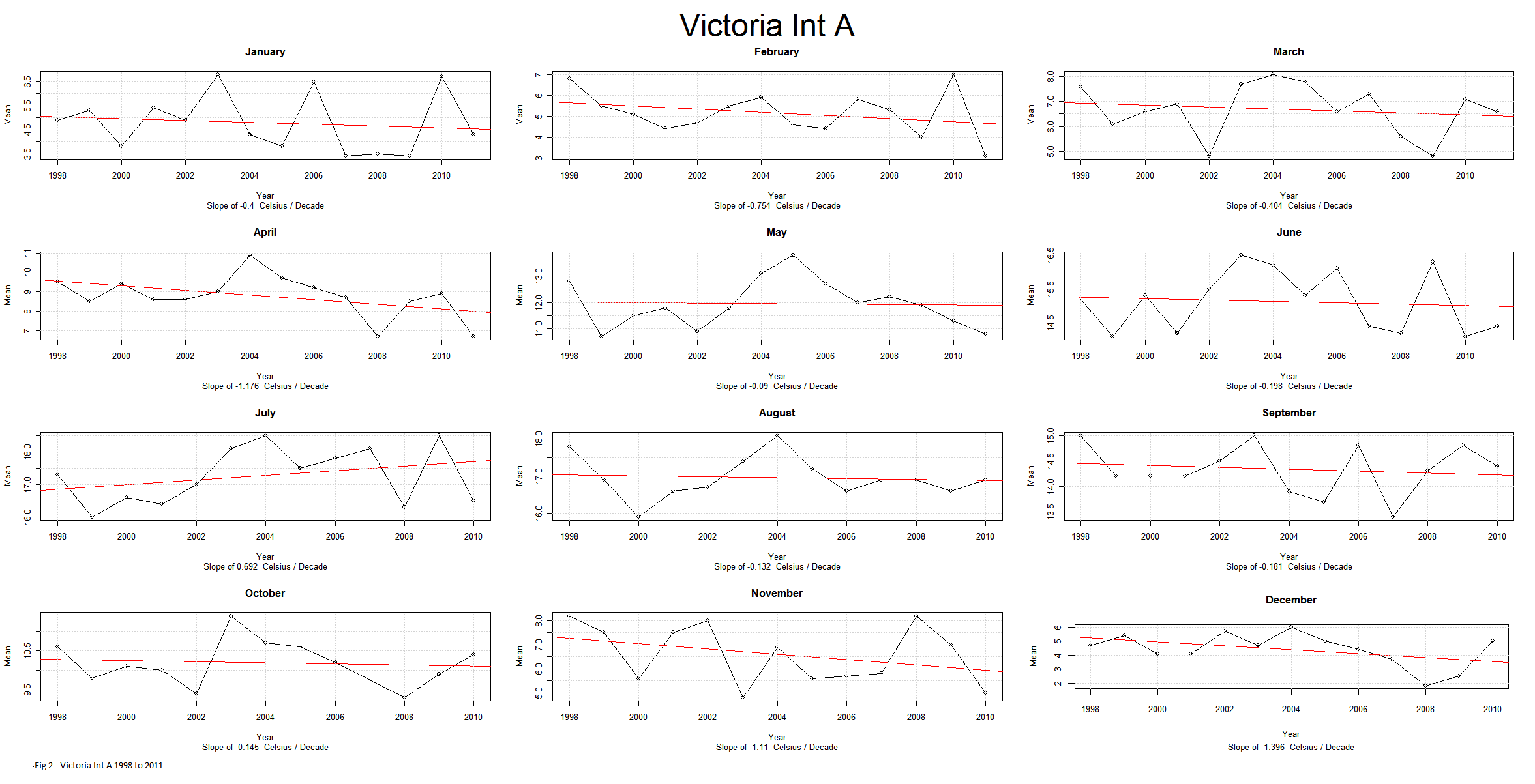
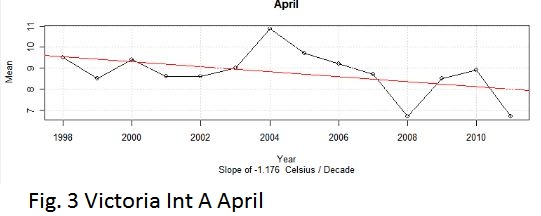
Even though it was an airport some months were cooling. Fig. 3 Victoria April 1998 to 2011
Then the BEST data came out with a new release. I decided to compare BEST with Environment Canada and found some interesting things out. But that’s a different story. I decided to rewrite my [R] script and analyze the Quality Controlled release, and I came up with another idea of “mapping” the stations by color (red for warming and blue for cooling) against latitude and longitude.

The code to do Victoria (or any other station) is not complex. Assuming you have the BEST data loaded as BESTdata and the column names are Year, Tm, Month and Station_ID here is a snippet of code to graph Victoria.

months <- c(“January”,”February”,”March”,”April”,”May”,”June”,”July”,”August”,”September”,”October”,”November”,”December”)
dev.new(width=1200,height=800)
split.screen( figs = c( 4, 3 ) )
par( oma = c( 0, 0, 3, 1 ) )
sid<- 7998
dfOneStation <- subset(BESTdata,Station_ID == sid & Year >= 1990,select=c(Year,Tm,Month))
decslope.all <- 0
decslope.count <- 0
for (i in 1:12) {
screen(i)
dfOneStation.m <- subset(dfOneStation,Month == i )
r = lm(dfOneStation.m$Tm~dfOneStation.m$Year)
Decadal_slope <- round(coef(r)[2],digits=4) * 10
decslope.all <- decslope.all + Decadal_slope
decslope.count <- decslope.count + 1
mTitle = paste(months[i],Decadal_slope,”Celsius/Decade”)
if (Decadal_slope > 0) {
colmain = “red”
} else { colmain = “blue”}

plot(dfOneStation.m$Year,dfOneStation.m$Tm,main=mTitle,type=”o”,xlab=”Year”, ylab=”Temperature”,col.main=colmain)
abline(r,col=colmain)
}
ds <- decslope.all/decslope.count
if (decslope.all > 0) {
colmain = “red”
} else { colmain = “blue”}
mtext(paste(sid,” “,round(ds,digits=4),” Celsius/Decade”,sep = “”,collapse = NULL), outer = TRUE, cex=2,line=1 ,col=colmain)

Fig. 4 is Victoria done using code snippet
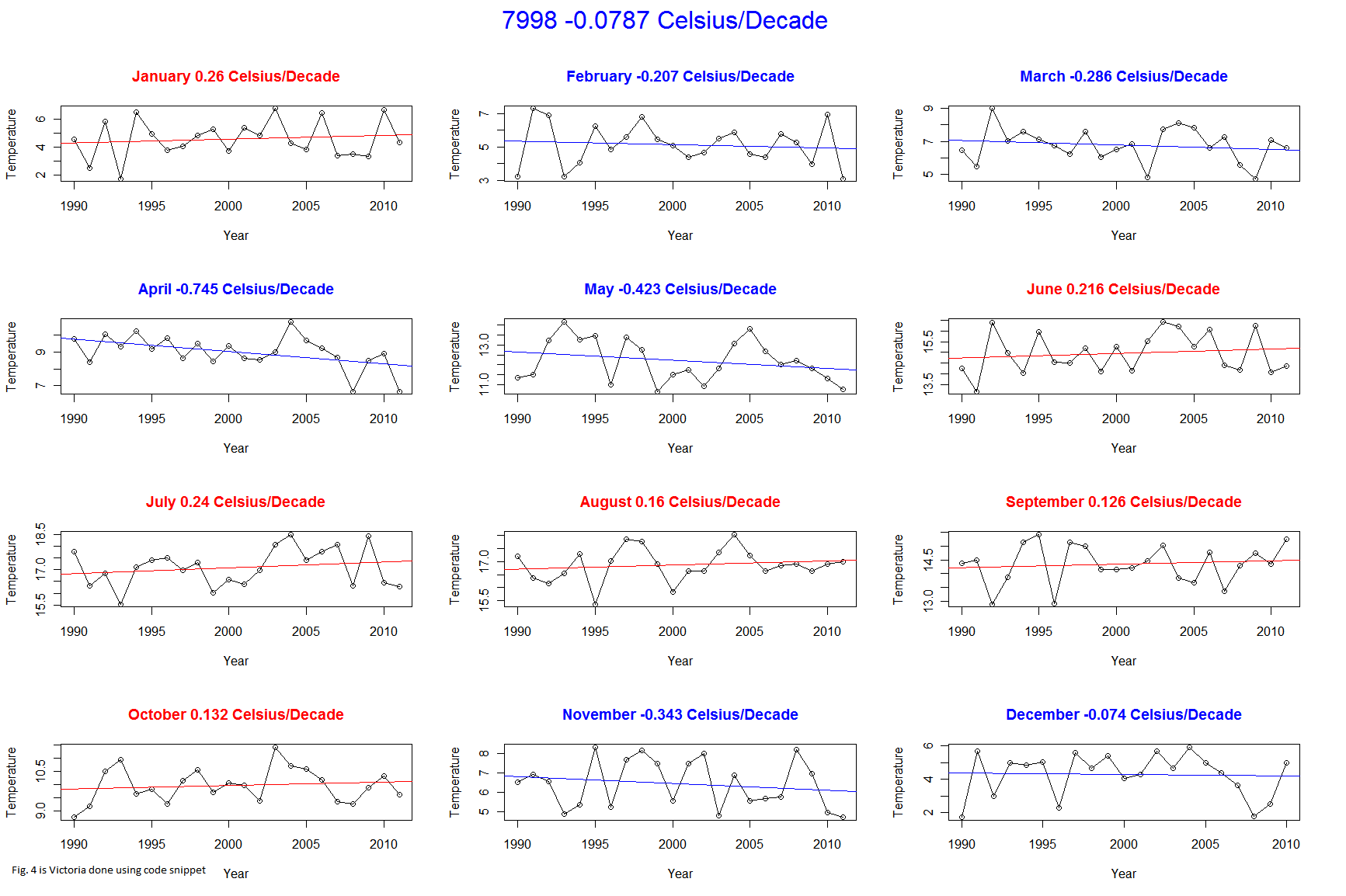
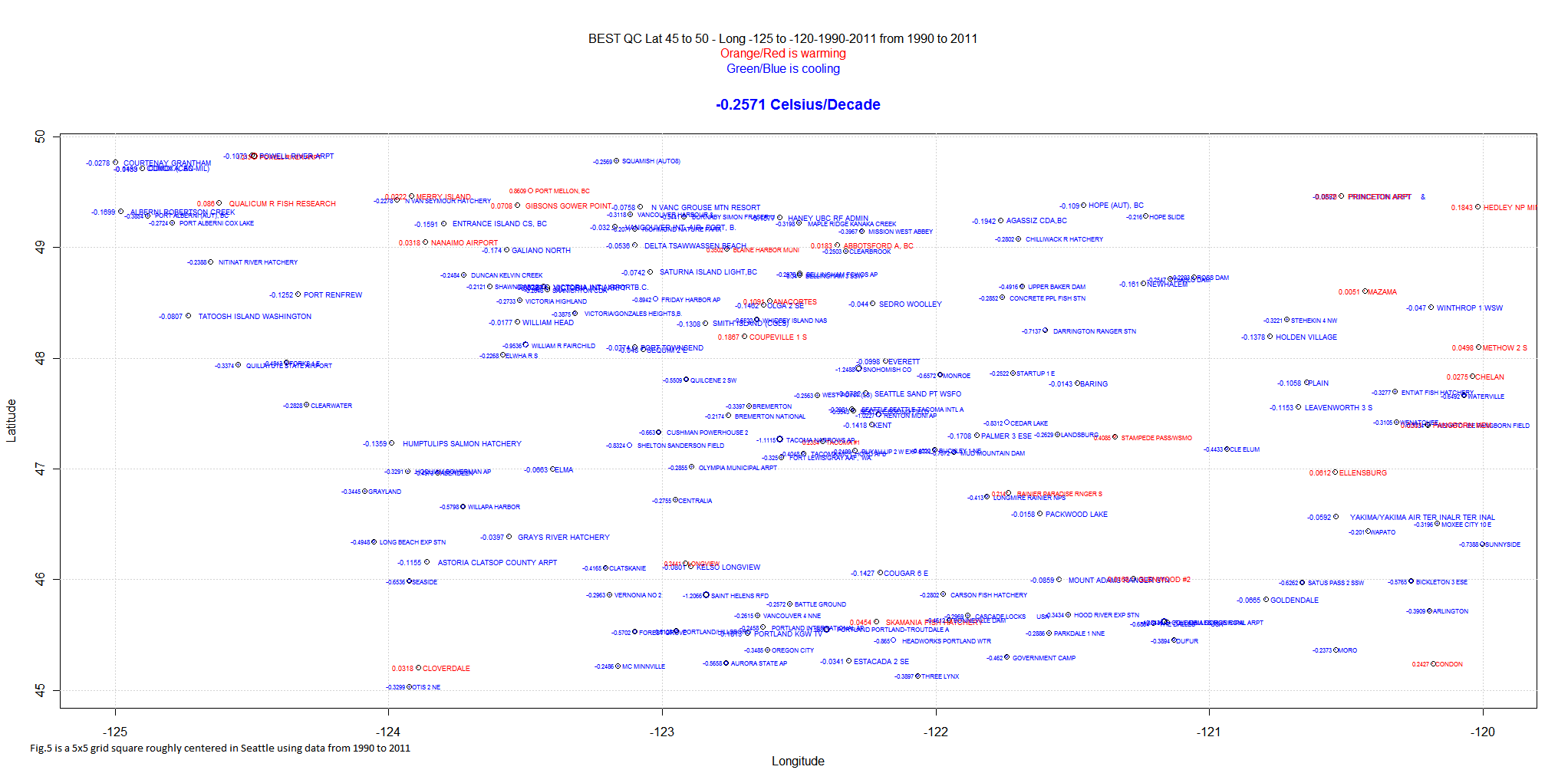
Fig. 5 is a “map” Fig. 5 is a 5×5 grid square centered around Seattle using data from 1990 to 2011 (only stations with data in 1990 and data in 2011) It is really cooling by -.2571 Celsius per decade.
And, just to be fair, Fig. 6 is the same grid square 1945 to 2011. Notice that a few stations are still cooling and the warming trend is only .1C per decade.
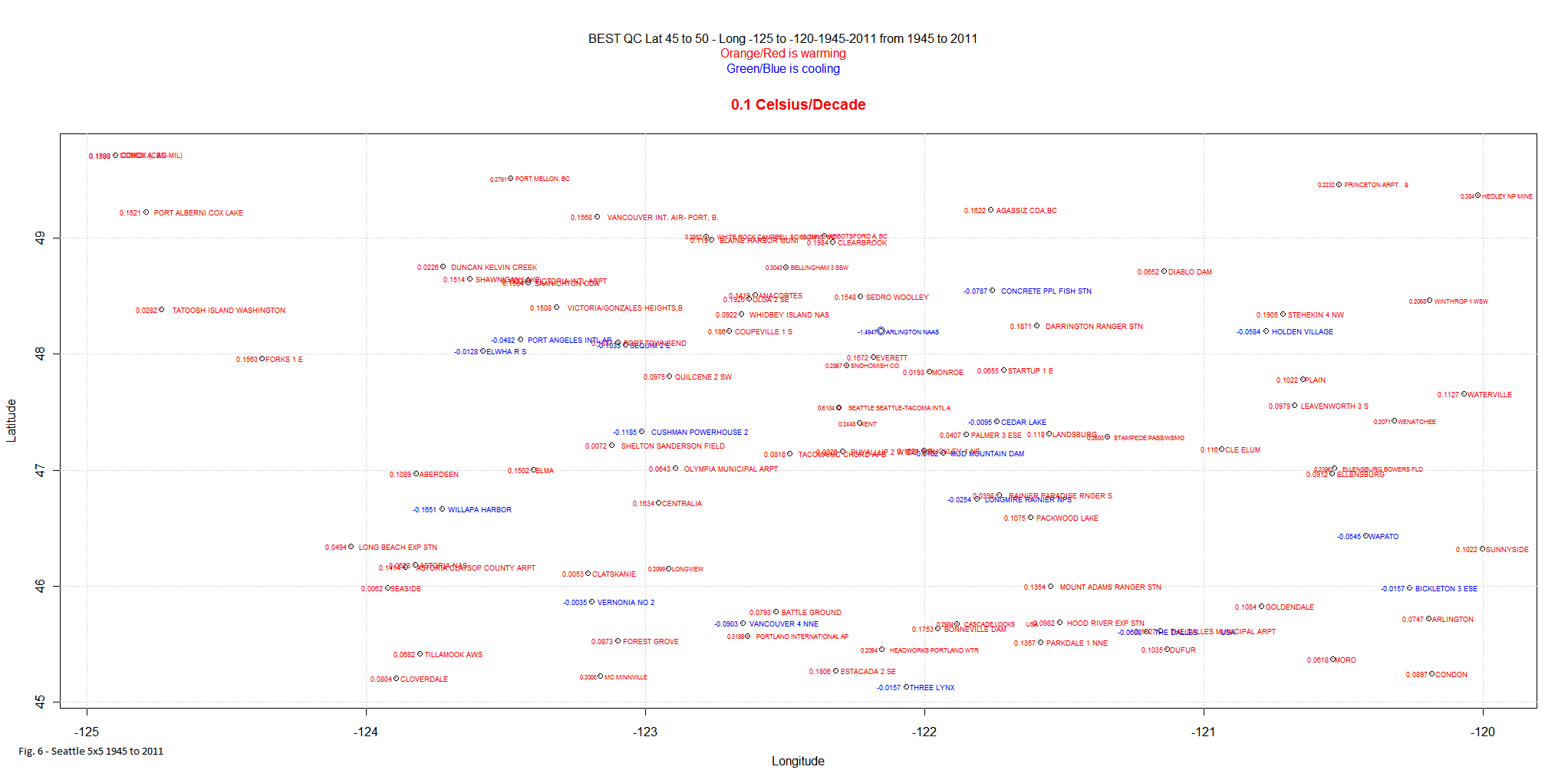
Fig. 7 is Clearbrook for 1990 to 2011 and Fig. 8 is Clearbrook for 1945 to 2011.

Notice that on both graphs there is still one or more months that are contrary to the overall trend. That is quite common.  Of course sometimes the trends are quite miniscule one way or the other. And other times they are huge.

After running my script for a few regions I am just amazed at the difference between stations. Fig. 9 is Crete Nebraska, warming at a miniscule .031C/Decade since 1910! And yet July, August, September and October (not shown) are cooling and have never been as warm as the 1930s:

I could bounce all over the world with fascinating examples.

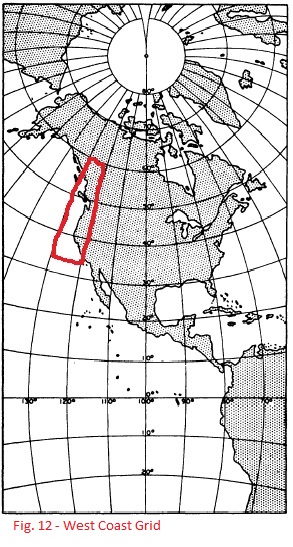
But, is the west coast warming? In this case, by West Coast, I mean a box Latitude 32 to Latitude 60 and Longitude -130 to -120. It is slightly cooling from 1983 to 2011. There appears to have been a climate shift well before the 1998 one seen in the global indexes like CRU.  Fig. 10 – West Coast 1983-2011
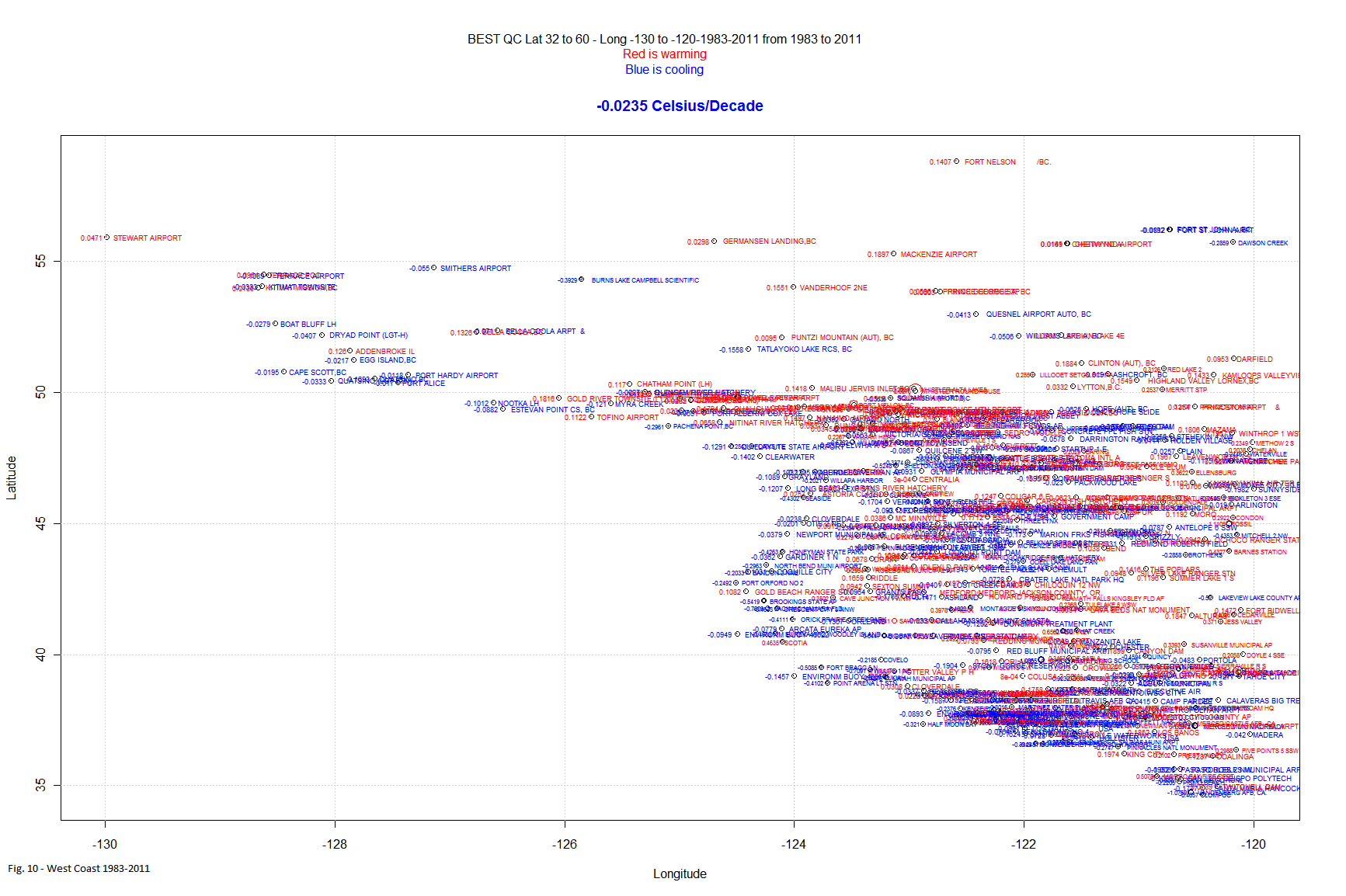
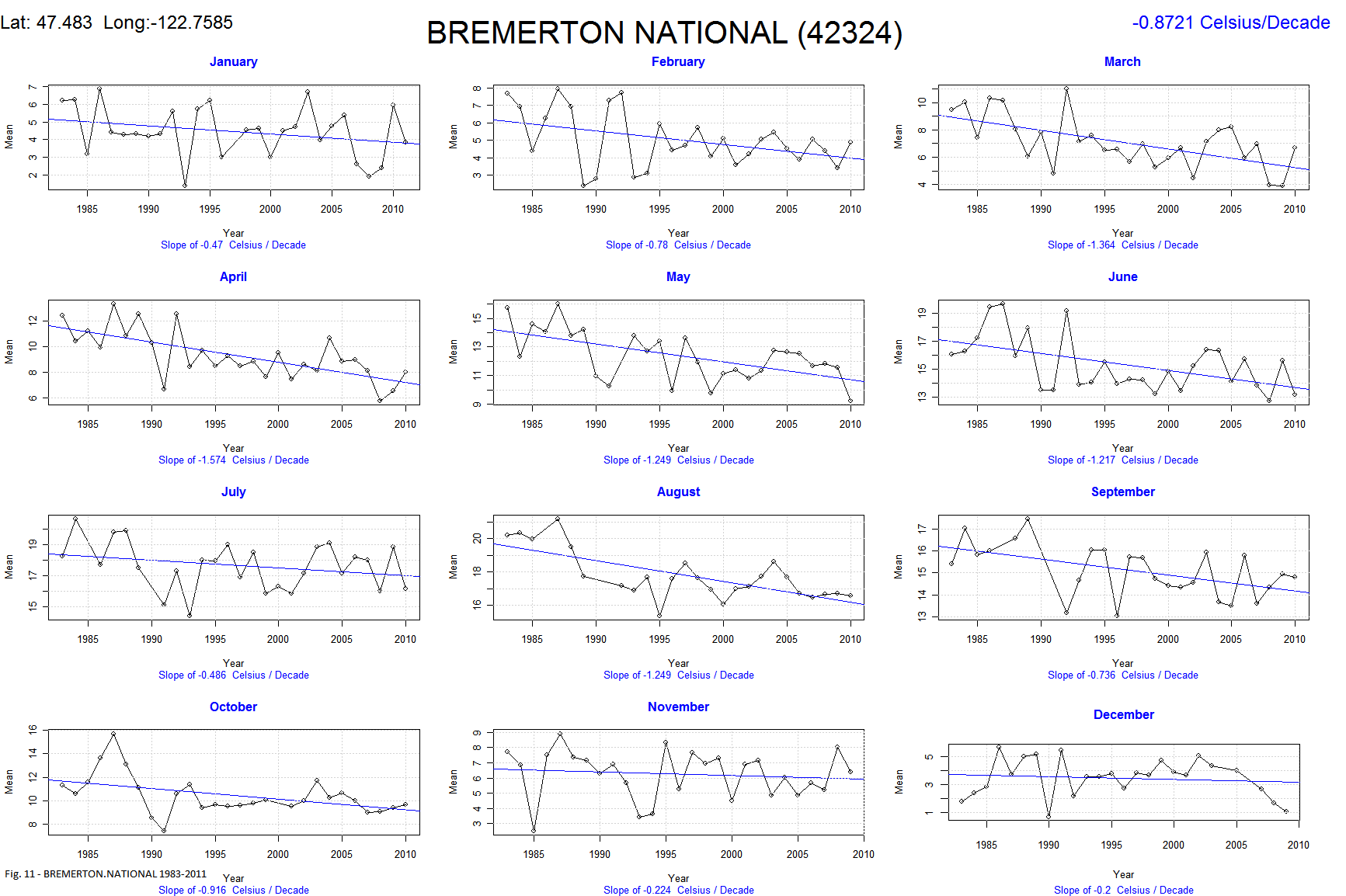
One of the stations with the biggest cooling trend is Bremerton National. It is cooling at a rate of -.87 Celsius/decade.  And it is an airport! Fig. 11 – BREMERTON.NATIONAL 1983-2011
The grid I call the West Coast is shown here in Fig. 12
Climate Data and Elevation

Yesterday, The Cheefio mentioned “During the times I was looking at GIStemp, I’d noticed that GHCN had reduced the high altitude coverage. Thermometers had fled the mountains for lower elevations.”

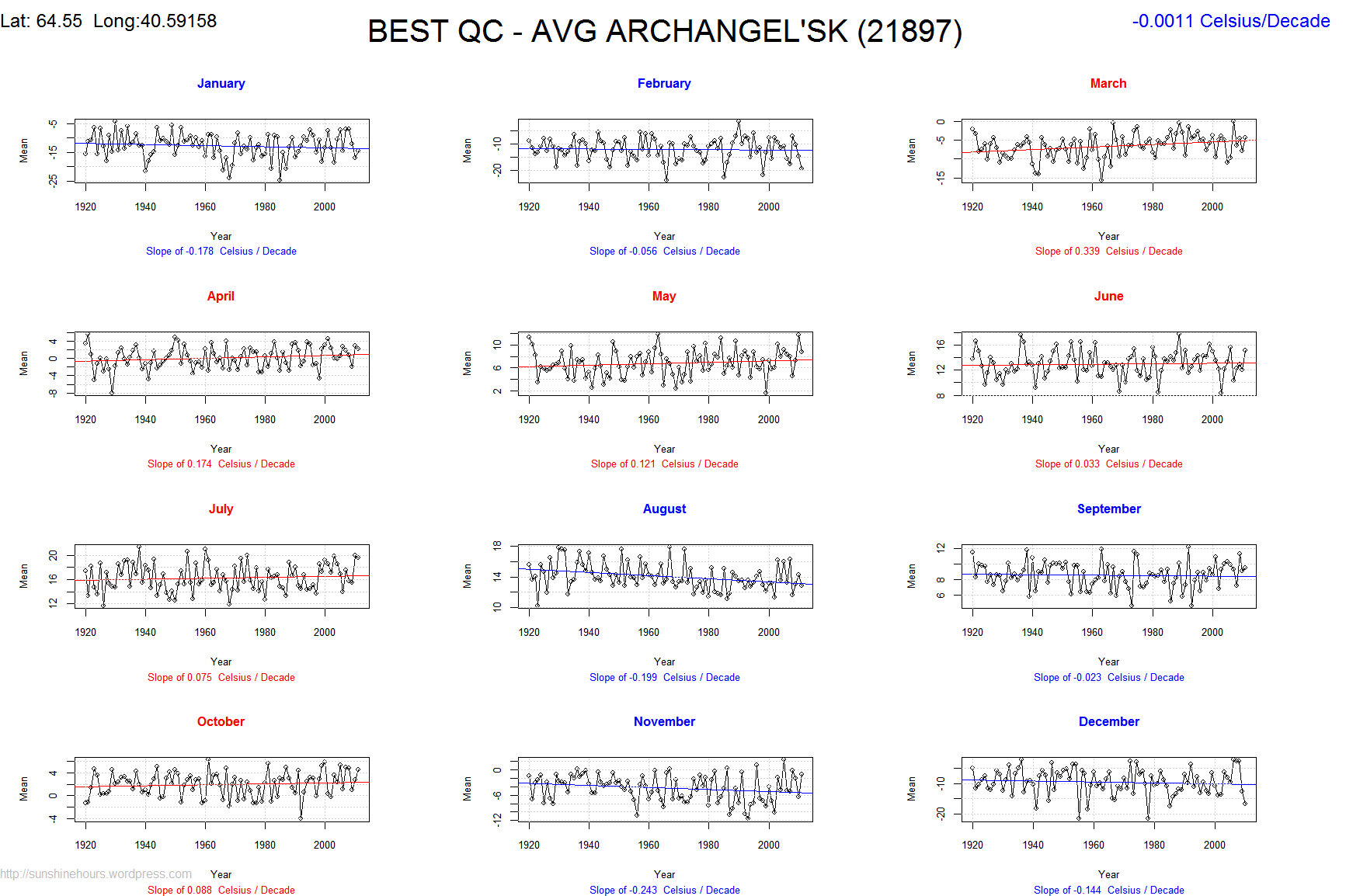
I’ve been using the Berkley Earth dataset, quality controlled. (not that I trust it for reasons demonstrated here) .

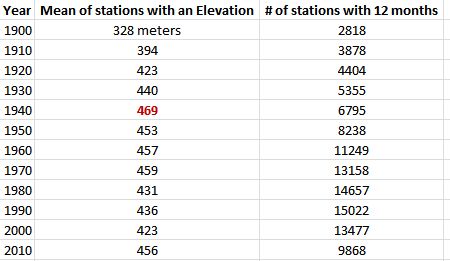
So I thought I would take a quick and dirty snapshot of the BEST data elevation. I looked all stations that had an elevation and had 12 months of data at the decadal rollover (1900, 1910 … 2010).

It looks like the Cheefio was right, with the peak year being near 1940 and then dropping for the next 60 years . (Of course the Elevation may have peaked slightly higher before or after 1940 … I didn’t do every year).

According to a lapse rate calculator I found online, a 46m drop would raise temperature by .45C from 1940 to 2000. I’m not quite sure what to make of the big drop in stations in 2010 and subsequent rise in elevation. The number drops back to 423m in 2010 if you change the criteria to any data in 2010. I must assume many of the stations were incomplete for 2010.

How Well Do We Know What The Temperature Was in 1900?

As part of my investigation into the BEST data (which I do not trust, but I’d like to understand) I thought I would see how many weather stations there were at various times and places.

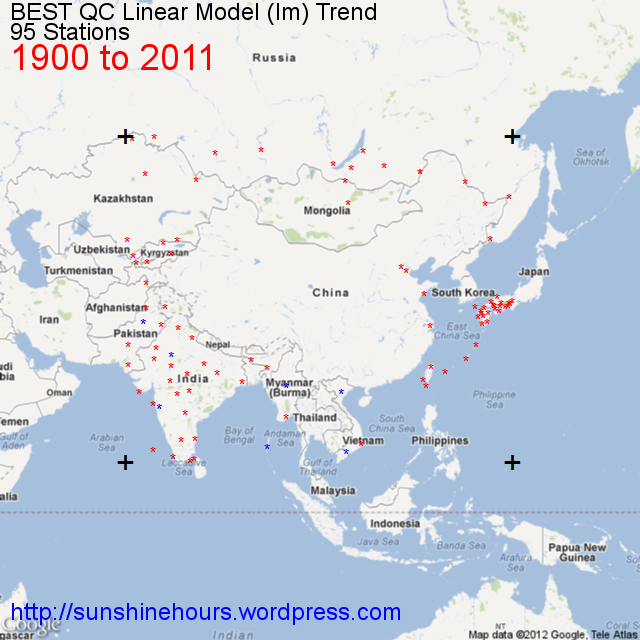
We really don’t know what the temperature was in 1900. There are only 95 stations (the four big + are the boundary of the data) in the following image.

China is essentially a blank .


Depopulation and cooling at the county level

I’ve been trying to figure out why so many weather stations are cooling since 1900 in the US. You can check out the map of their locations here.

I’ve been using the Berkley Earth dataset, quality controlled. (not that I trust it for reasons demonstrated here) .

Then I came across a list of US Counties with 2010 population and Latitude and Longitude here. And I found a list of Population By County with data for 1900,1910,1920 up to 1990 here. So I wrote a small [R] script to import the files, massage them a tiny bit so I could merge them by FIPS code.

#http://www.census.gov/geo/www/2010census/centerpop2010/county/CenPop2010_Mean_CO.txt
filenameCLL = "F:/R/CenPop2010_Mean_CO.txt"

#http://www.nber.org/data/census-decennial-population.html
# download the xlsx file
## Change all . to 0 using text editor before next step
filenameCC = "F:/R/cencounts.csv"

dfCLL dfCLL[4:5, "fips"] dfCLL$fips
dfCC
# Merge the two files by FIPS
dfCounty = merge(dfCLL,dfCC)
# Rename 3 columns
# Notice the POPULATION column is pop2010
# For completeness I may track down pop2000

names(dfCounty)[names(dfCounty)=="LATITUDE"] <- "Latitude"
names(dfCounty)[names(dfCounty)=="LONGITUDE"] <- "Longitude"
names(dfCounty)[names(dfCounty)=="POPULATION"] <- "pop2010"

# calculate the dif
# so far no code deals with Alaska etc  where counties had 0 pop in 1900
# I just used a text editor to replace the no population placeholder . with 1
dfCounty[4:5, "difPct"] dfCounty$difPct dfCounty[4:5, "dif"] dfCounty$dif

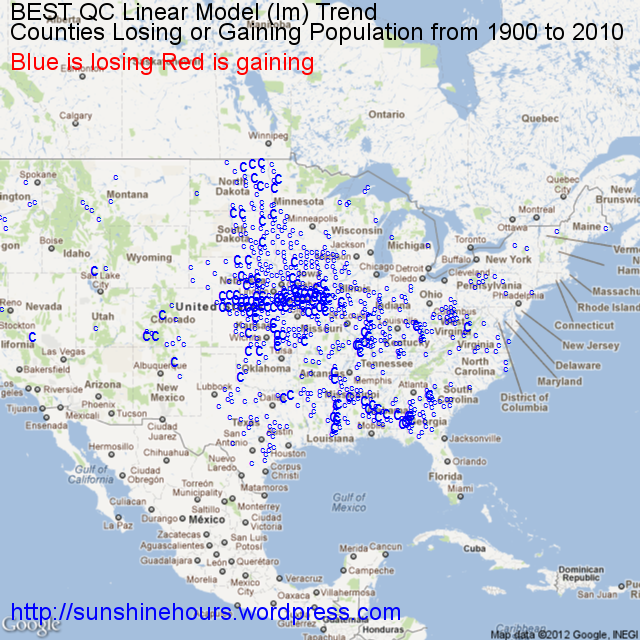
And then I mapped those counties with the R package RGoogleMaps. In the map below I am only showing the counties that have been shrinking since 1900.

Doesn’t it look a like the map of cooling stations? Admittedly there is no an exact match because the Latitude Longitude is for the center (by population I think) of the counties and there is no guarantee that just because a county is losing population the area right around the station is losing population. But it might be a good indicator, or maybe UHI at the county level is important.

But I think I am zeroing in on the reason there are so many cooling stations in the mid to eastern USA. Depopulation. Deindustrialization. Negative UHI.

And if a shrinking population can cause stations to cool despite increasing CO2, could not the opposite be true? Could not the warming be caused exclusively by population growth?

Finally, that map is just the counties shrinking since 1990.

[1] "Counties Shrinking Since 1900: 694"
[1] "Counties Shrinking Since 1910: 865"
[1] "Counties Shrinking Since 1920: 955"
[1] "Counties Shrinking Since 1930: 979"
[1] "Counties Shrinking Since 1940: 1033"
[1] "Counties Shrinking Since 1950: 957"
[1] "Counties Shrinking Since 1960: 882"
[1] "Counties Shrinking Since 1970: 814"
[1] "Counties Shrinking Since 1980: 1028"
[1] "Counties Shrinking Since 1990: 823"

Cooling Since 1900 – Zooming In To Gary Indiana

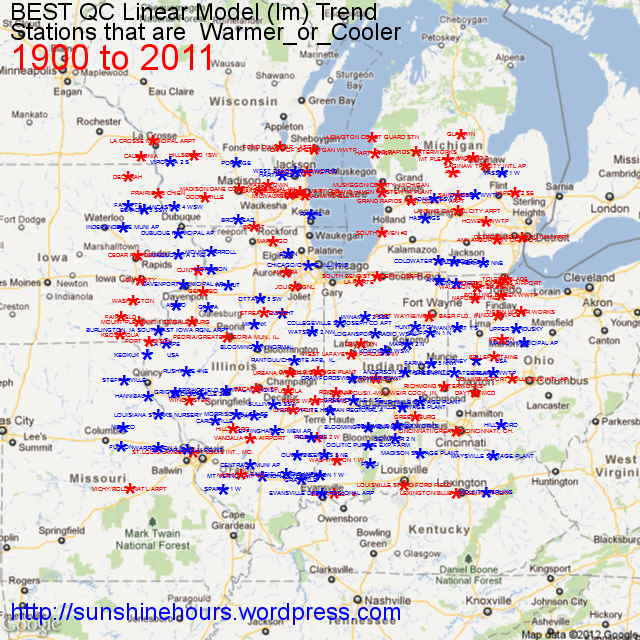
I’m trying to get handle on why so many US stations have cooled since 1900. So I thought I would zoom into an area bounded by Latitude 38 and Latitude 43.999 and Longitude 92W and 83W which is roughly centered on Gary Indiana. I am not an expert on that region, but it seems to me that a lot of the warming stations are centered in those circles Google Maps shows for cities. I suspect that UHI is the cause of much of the warming and the reason some stations are cooling is because they have less UHI.


Of the 181 stations on this map, 93 are cooling and 88 are warming.

The mean of the warming stations is 0.061C/decade.

The mean of the cooling station is  -0.051C/decade.

And the overall mean is a minuscule 0.0036C/decade.

Cooling since 1900

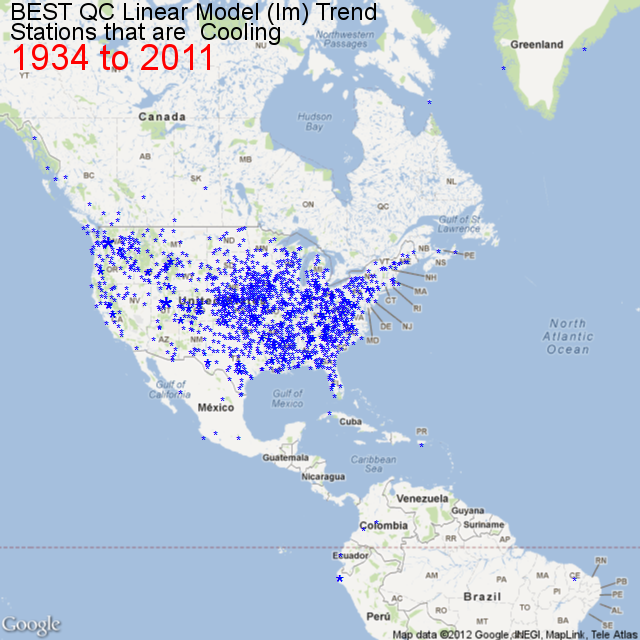
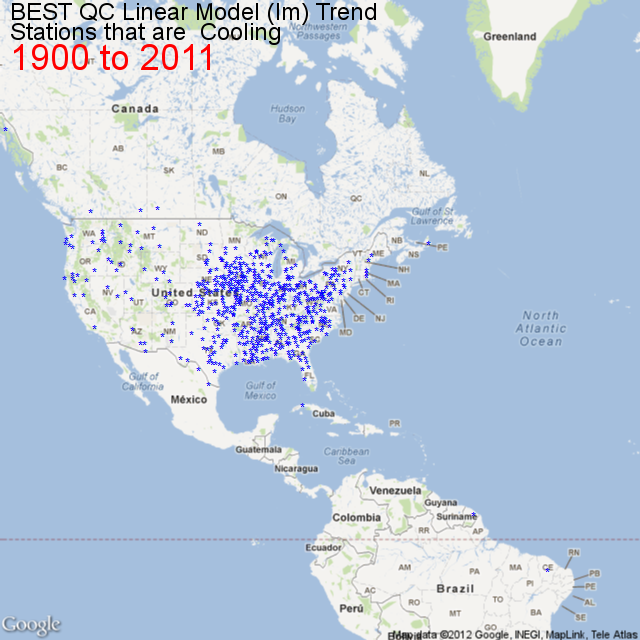
I have been looking at the BEST data and playing around with [R] and came across a package for [R] called RGoogleMaps that allows you to download a 640×640 Google Map tile and add text or points.

I thought why not find which climate stations have been cooling from 1900 and map them. This isn’t every station (it is most of them) but this map is zoomed in to the USA.

Auditing the latest BEST and EC data for Malahat

Over the last few weeks I’ve been looking at the latest BEST data and sometimes comparing it to data from Environment Canada (EC) I scraped off their website.

To start with I am looking at one station. In BEST it is StationID 7973 – “MALAHAT, BC”.  In EC it is station MALAHAT which is Station_No 1014820.

I am comparing the BEST SV (Single Valued) data to the BEST QC (Quality Controlled) data.  The first  minor problem is that the EC data has records from the 1920s and 1930s that BEST does not have (that I have found). Thats no big deal. The next problem is that out of 166 MOnth/Year records, not one of them matched exactly. BEST SV and QC data is to 3 decimal points while EC is to 1.

For example. Jan 1992 has QC = 5.677, as does SV, while EC = 5.8. Close. But not an exact match.

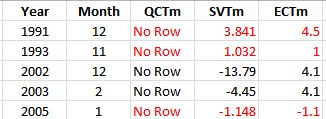
However, the real problem is that  there are 5 records that have been discarded between SV and QC. Two out of the five make no sense at all, and one is iffy.

Where it says “No Row” it means BEST has discarded the record completely between SV and QC.

1991 is iffy. EC has it has 4.5, SV has 3.841. Close, but not that close

1993 makes no sense at all.

2002 is fine. Thats a huge error. But where the heck did BEST get the -13.79 number in the first place.

2003 is fine. But again,   where the heck did BEST get the -4.45 number in the first place.

Finally, 2005 makes no sense at all. There is little difference between -1.1 and -1.148. Certainly most records are that different.

And those are just the discarded records!

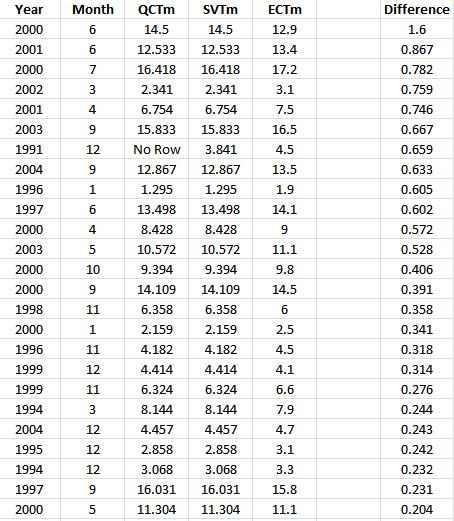
There are another 48 record with a difference of .1C or greater and  here are the greater than .2C ones.

What a mystery. 

EBRO Observatory (Spain) and Bright Sunshine

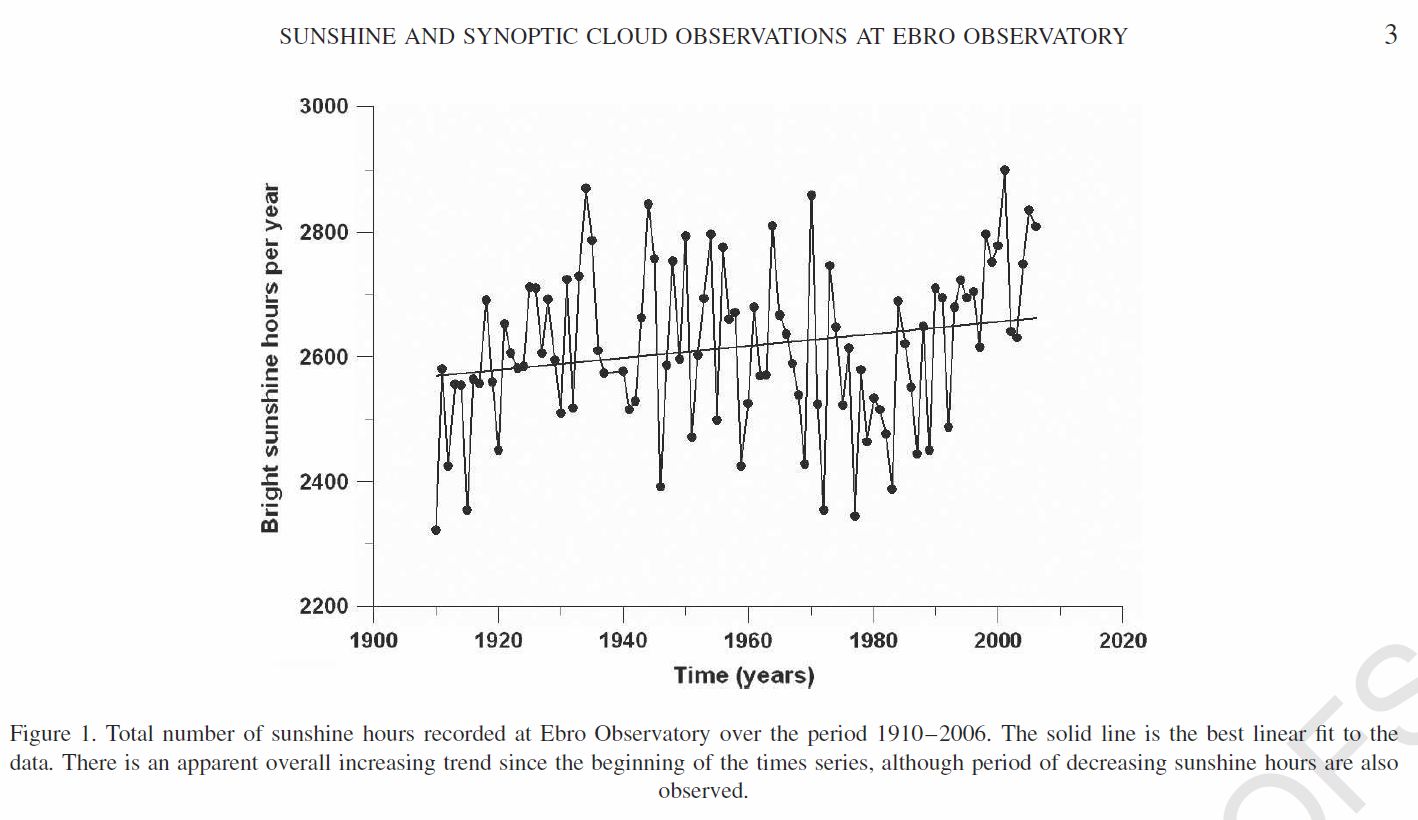
In 2008 a paper was published called  “Short Communication – Sunshine and synoptic cloud observations at Ebro Observatory, 1910–2006” by J. J. Curto, E. Also, E. Palle and J. G. Sole.

I managed to download a copy. The following graph is of sunshine measured from an Observatory in Spain. If you weren’t paying attention you might think it is a graph of GISS or HADCRU temperatures … right?


Since 1910, we find that there has been
an overall increase in the number of sunshine hours, but
with large oscillations that make this increase statistically
insignificant, while over the same time period cloudiness
has increased by a larger amount (about 12%) with high
statistical significance.
We associate the increase in both sunshine hours and
cloud amount with a shift in cloud types during the
100-year period covered by the observations.”