An addition to this post on 5 year averages using NOAA data.
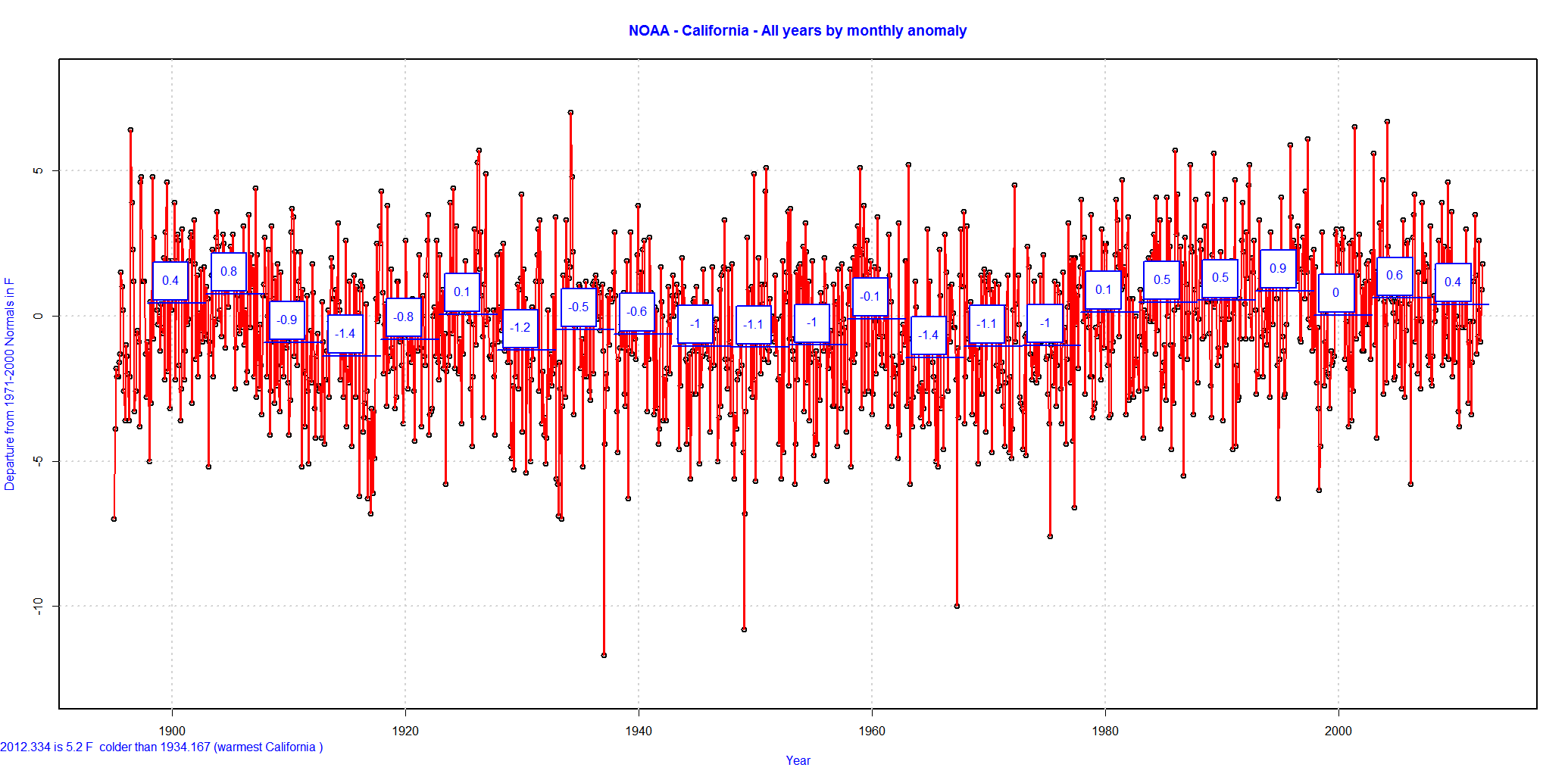
California.
The last 5 years are on average .4F cooler than 1905-1910 and the same temperature as ~1899-1904.
An addition to this post on 5 year averages using NOAA data.
California.
The last 5 years are on average .4F cooler than 1905-1910 and the same temperature as ~1899-1904.
An addition to this post on 5 year averages using NOAA data.
Arizona. The most current 5 year period is .9F colder than ~1898-1903. I wonder what the graph would look like to the left of 1895? Even hotter?

British Columbia, Canada (BC) is north of Washington/Idaho/Montana. Here is the same graph for BC as I did for Washington State in my previous post.
I downloaded monthly data from the Environment Canada (EC) websites. EC treats some stations as special and calculates anomalies against what they call Normals. As of today the Normals are calculated for 1971-2000 and I am using those special stations.
This data is in anomalies in Celsius, not Fahrenheit.
The last 5 years were exactly at the 1971-2000 average. Which puts the last 5 years colder than ~1925-1930, and colder than ~1940 and the same temperature as ~1945 and ~1960.
It is also .8C colder than the previous 5 years.
The thing that struck me about this graph is that previous 5 years were not hotter than many, many other periods. By not hotter I mean the positive anomalies were not larger. What made the previous 5 years “warmer” was the absence of really large negative anomalies. The recent 5 year period saw many anomalies around -2.5C .
And notice the y axis. There are only two positive anomalies greater than 5C in the whole record and they occurred in the 1800s. But up until 1985 there were many anomalies lower than -5C and even two greater than -10C.
I wonder if those large negative anomalies were the Little Ice Age holding onto the 20th century and the LIA finally let go … or may it is all those heated buildings clustered around weather stations making sure they don’t get too cold in the winter.

Update: I posted the follow up using data from BC here.
I took the NOAA state data and calculated the 1971-2000 average for each month and then calculated the anomalies. I then graphed every monthly anomaly and calculated the 5 year average backwards using the most recent anomaly as the start point.
Washington State is not uncommon. The last 5 years were -.3F colder than the 1971-2000 average. Which puts the last 5 years colder than ~1898-1908, and colder than ~1940.
It is also 1.1F colder than the previous 5 years.
The thing that struck me about this graph is that previous 5 years were not hotter than many, many other periods. By not hotter I mean the positive anomalies were not larger. What made the previous 5 years “warmer” was the absence of really large negative anomalies. The recent 5 year period saw the first -5F anomaly since 1995.

States with the warmest May before 1900
Georgia 76.2 1896
Idaho 58.2 1897
Indiana 68.4 1896
Kentucky 71.5 1896
Michigan 62.4 1896
Mississippi 77 1896
North Carolina 72.3 1896
Oklahoma 75 1896
South Carolina 76.5 1896
West Virginia 67.3 1896
States with the warmest May from 1900 to 1999
Alabama 76.1 1933
Arkansas 74.1 1962
Colorado 59.5 1934
Connecticut 63.1 1991
Florida 78.6 1905
Illinois 69.5 1962
Iowa 68.8 1934
Kansas 71.2 1962
Louisiana 77.3 1933
Maine 57.6 1911
Massachusetts 61.4 1944
Minnesota 64 1977
Missouri 72.1 1962
Montana 59.6 1934
Nebraska 68.5 1934
New Hampshire 59.7 1911
New Jersey 66.1 1991
New Mexico 66.8 1996
New York 61.6 1911
North Dakota 63.1 1977
Ohio 67.5 1991
Oregon 58.6 1992
Pennsylvania 64.8 1944
South Dakota 68.3 1934
Tennessee 72.7 1962
Texas 78.4 1996
Utah 61.8 1934
Vermont 59.9 1975
Virginia 68.8 1953
Washington 60 1958
Wisconsin 63 1977
Wyoming 57.5 1934
States with the warmest May this century
Arizona 72.1 2000
California 69.6 2001
Delaware 69.2 2004
Maryland 69 2004
Nevada 62.1 2001
Rhode Island 61.8 2010
May is cooling in parts of Canada and the USA. Looking at the NOAA monthly data for May, this is the recent trend (over 10 years or more).
Any ideas why?
Highlighted are more than -1F/decade cooling.
Alabama May is cooling at -0.21F/decade from 1933 to 2012
Arizona May is cooling at -4.2F/decade from 2000 to 2012
Arkansas May is cooling at -0.31F/decade from 1998 to 2012
California May is cooling at -3.41F/decade from 2001 to 2012
Colorado May is cooling at -2.58F/decade from 2000 to 2012
Connecticut May is cooling at -0.11F/decade from 1979 to 2012
Florida May is cooling at -0.04F/decade from 1995 to 2012
Georgia May is cooling at -0.19F/decade from 1933 to 2012
Idaho May is cooling at -3.53F/decade from 2001 to 2012
Illinois May is cooling at -0.26F/decade from 1998 to 2012
Indiana May is cooling at -0.06F/decade from 1998 to 2012
Iowa May is cooling at -0.62F/decade from 1985 to 2012
Kansas May is cooling at -0.71F/decade from 1998 to 2012
Kentucky May is cooling at -0.2F/decade from 1998 to 2012
Louisiana May is cooling at -0.31F/decade from 1998 to 2012
Maine May is cooling at -0.36F/decade from 1998 to 2012
Massachusetts May is cooling at -0.1F/decade from 1975 to 2012
Michigan May is cooling at -0.71F/decade from 1998 to 2012
Minnesota May is cooling at -1.26F/decade from 1985 to 2012
Mississippi May is cooling at -0.1F/decade from 1933 to 2012
Missouri May is cooling at -0.43F/decade from 1998 to 2012
Montana May is cooling at -2.46F/decade from 2000 to 2012
Nebraska May is cooling at -1.09F/decade from 1998 to 2012
Nevada May is cooling at -4.51F/decade from 2001 to 2012
New Hampshire May is cooling at -0.4F/decade from 1975 to 2012
New Mexico May is cooling at -3.07F/decade from 2000 to 2012
North Carolina May is cooling at -0.14F/decade from 1933 to 2012
North Dakota May is cooling at -2.12F/decade from 1985 to 2012
Oklahoma May is cooling at -0.56F/decade from 1996 to 2012
Oregon May is cooling at -3.57F/decade from 2001 to 2012
Pennsylvania May is cooling at -0.12F/decade from 1930 to 2012
South Carolina May is cooling at -0.17F/decade from 1933 to 2012
South Dakota May is cooling at -1.44F/decade from 1985 to 2012
Tennessee May is cooling at -0.14F/decade from 1932 to 2012
Texas May is cooling at -1.16F/decade from 1998 to 2012
Utah May is cooling at -4.18F/decade from 2000 to 2012
Vermont May is cooling at -0.47F/decade from 1975 to 2012
Virginia May is cooling at -0.17F/decade from 1930 to 2012
Washington May is cooling at -2.38F/decade from 2001 to 2012
WestVirginia May is cooling at -0.13F/decade from 1932 to 2012
Wisconsin May is cooling at -0.82F/decade from 1998 to 2012
Wyoming May is cooling at -3.07F/decade from 2000 to 2012
Regions:
Northeast Region May is cooling at -0.02F/decade from 1930 to 2012
East North CentralRegion May is cooling at -0.87F/decade from 1998 to 2012
Central Region May is cooling at -0.04F/decade from 1932 to 2012
Southeast Region May is cooling at -0.13F/decade from 1933 to 2012
WestNorth Central Region May is cooling at -1.78F/decade from 1998 to 2012
South Region May is cooling at -0.75F/decade from 1998 to 2012
Southwest Region May is cooling at -3.47F/decade from 2000 to 2012
Northwest Region May is cooling at -3.19F/decade from 2001 to 2012
West Region May is cooling at -3.82F/decade from 2001 to 2012
National
National( contiguous 48 States) May is cooling at -0.78F/decade from 2000 to 2012
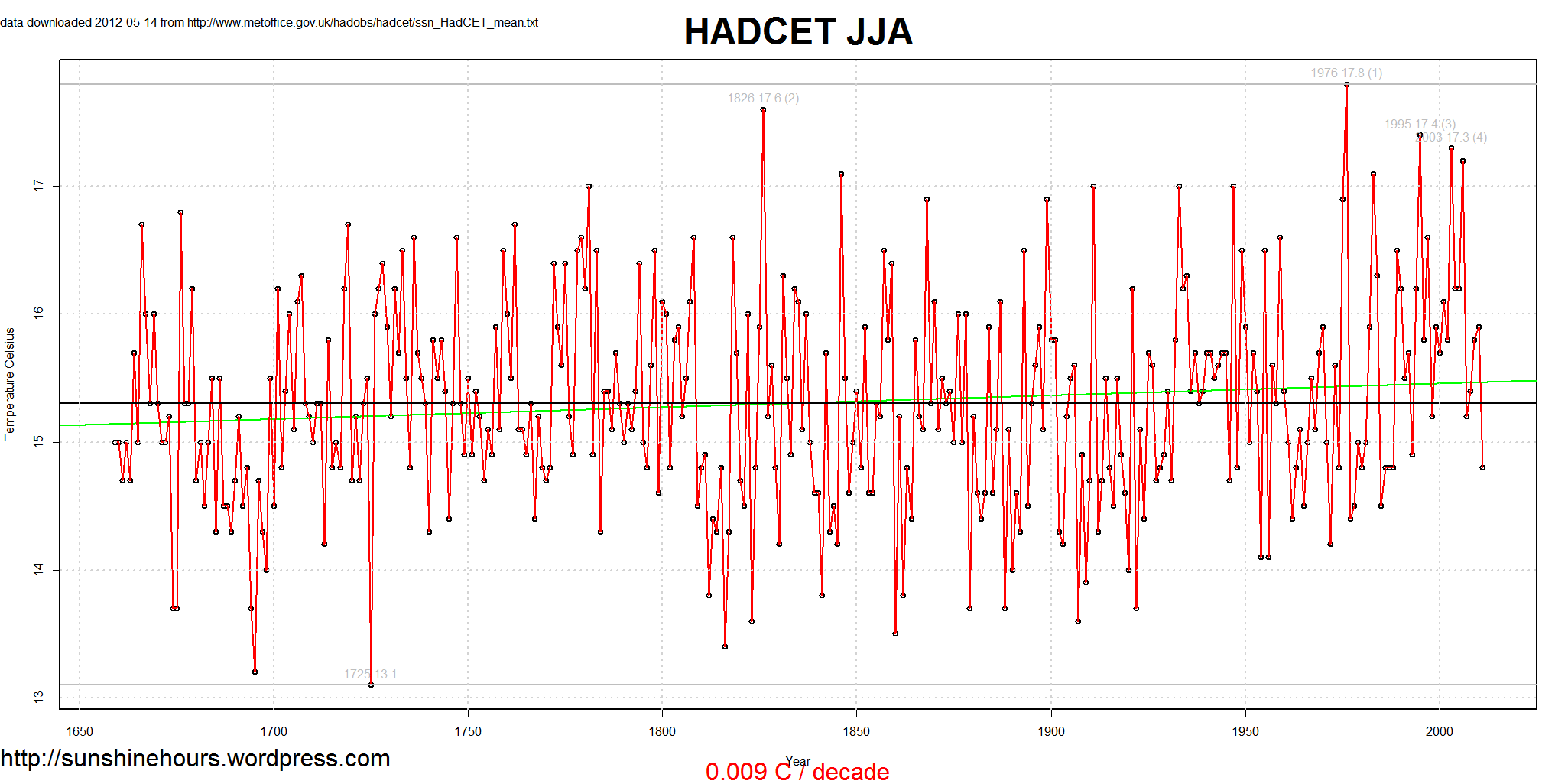
HADCET is the Central England Temperature record maintained by the UK Met. The seasonal mean data is available here.
If you graph JJA (June, July and August) the trend is a measly .009C per decade.
The two warmest years are 1976 and 1826. 2011 JJA was 14.8C, below the mean, and 3C colder than 1976.
We were told we were going to fry as “Global Warming” gets going.
Update: January data is just as unscary as December. I’ve added it at the bottom.
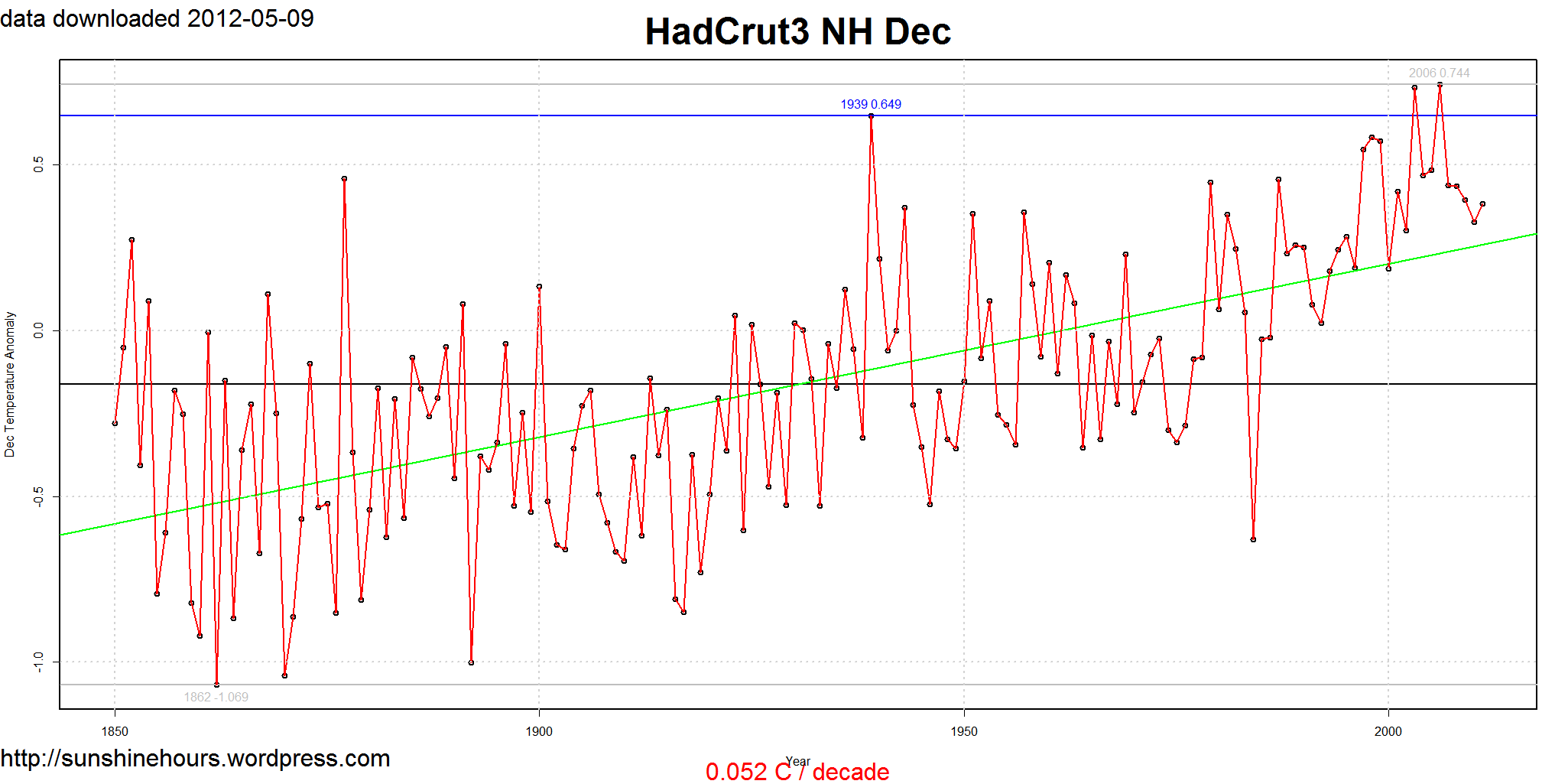
Has anyone ever noticed that the 3rd warmest December in the Northern Hemisphere (according to HADCRUT3) was 1939?
Anyone who wants to remake our fossil fuel economy based on this graph is insane. On top of 2006 being only .095C warmer than 1939, it was only .3C warmer than 3 years in the 1940s/50s. And its just as cold as those 40s/50s years now.
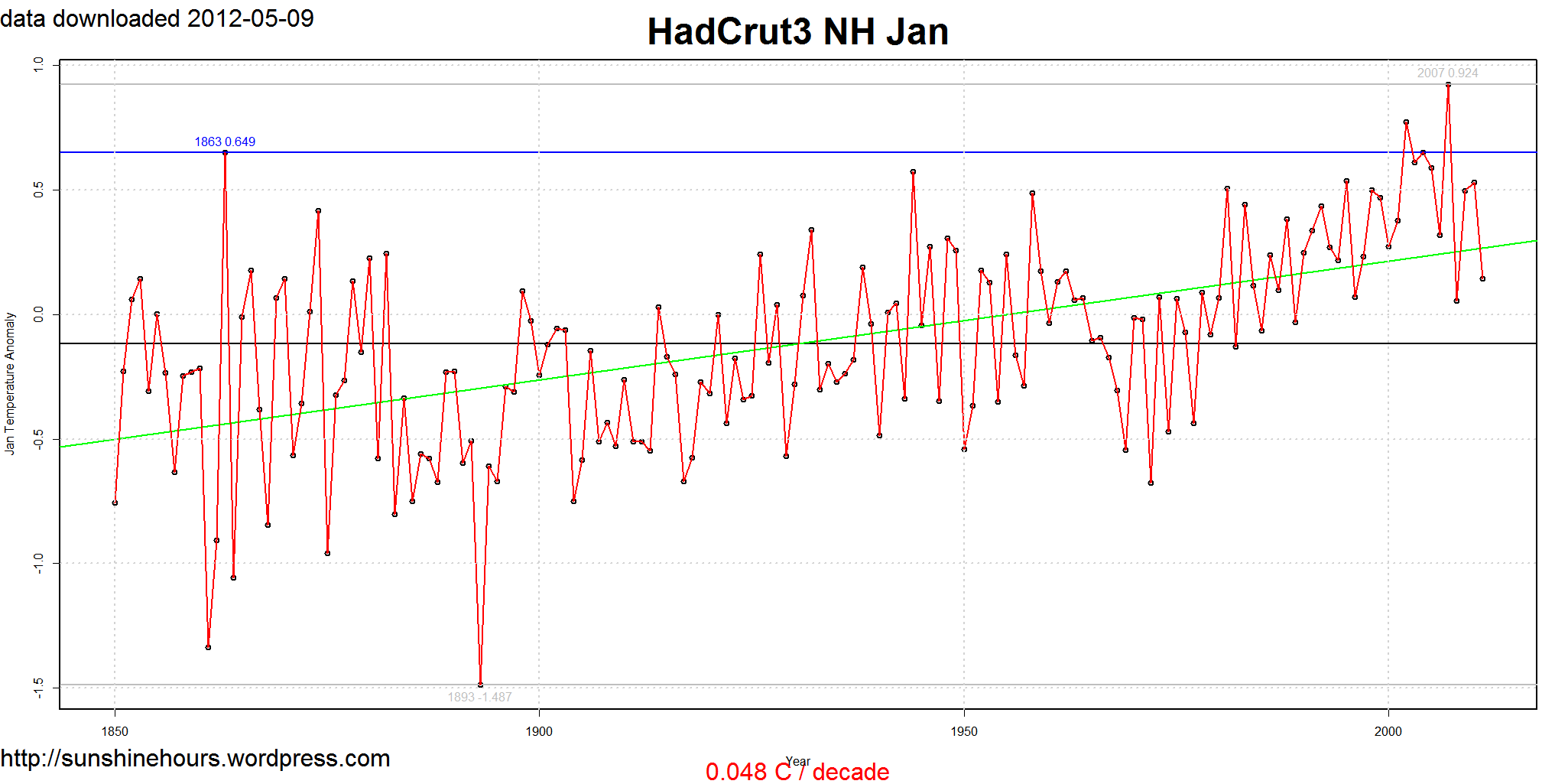
Only two years warmer than January 1863. Doesn’t look too scary. And January’s subsequent to 2007 were much colder than 1863.
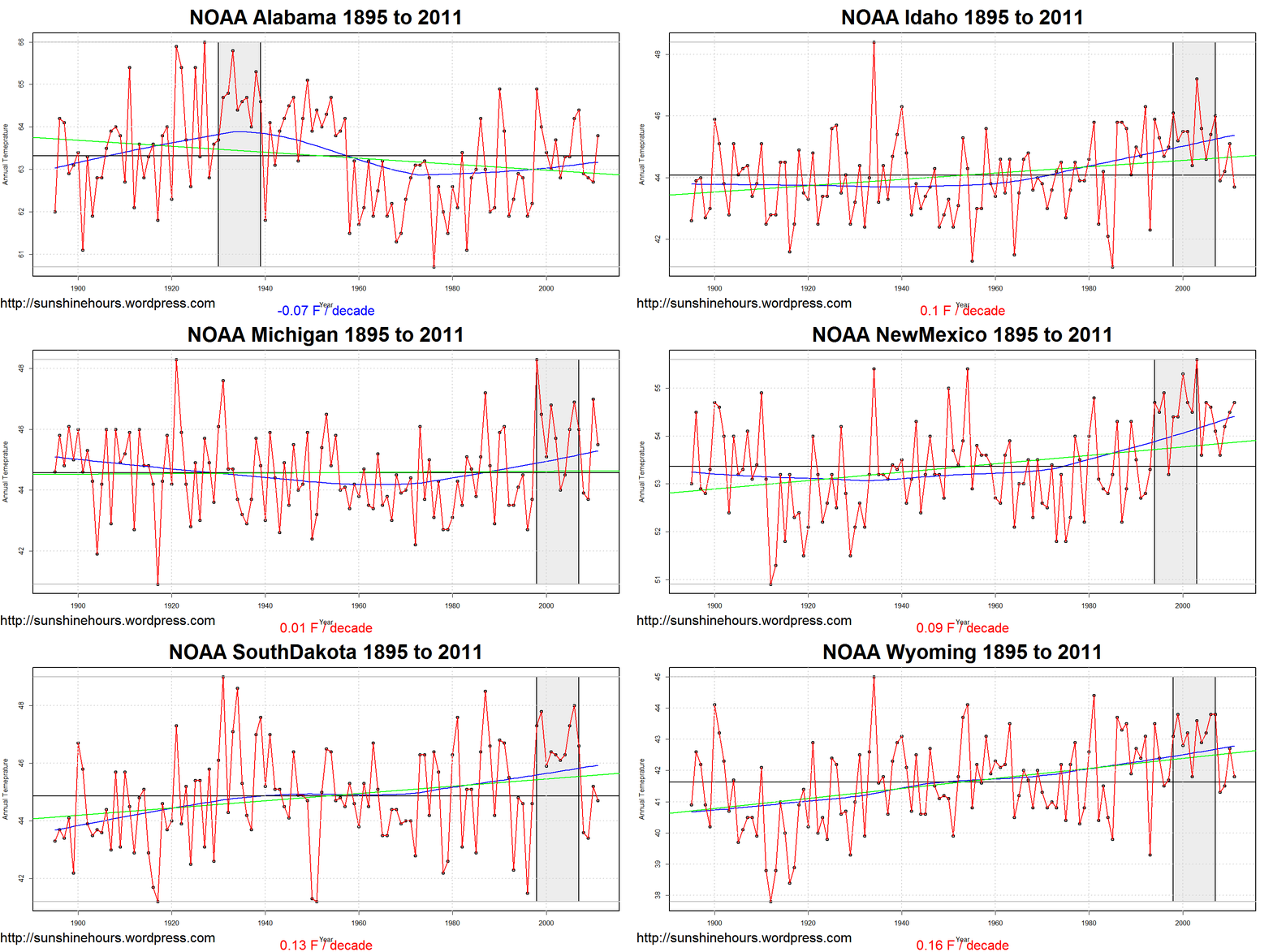
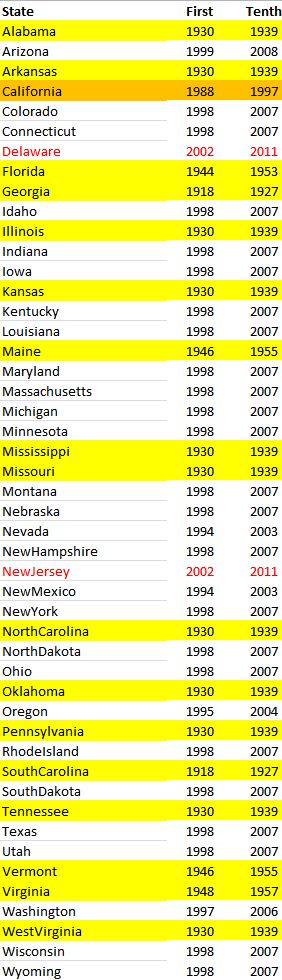
Using the NOAA data I thought I would look and see when the warmest 10 years were for each state.
17 states warmest 10 years were well in the past. Only 2 were 2002 to 2011. All of the rest but one overlapped 1998. And California was an outlier with 1988 to 1997 as the warmest 10 years. At the bottom of this post is the list with some highlighting.
Here is an animated gif of the 48 states with the warmest 10 years highlighted in gray. Click on it for the full effect.
 sunshine hours