USCRN vs NOAA August 2012

USCRN vs NOAA August 2012 update. (I’m late because USCRN didn’t post August monthly temperatures until October 3rd after they posted September data).

The USCRN is a new ‘state of the art’ United States Climate Reference Network. The USCRN “consists of 114 stations developed, deployed, managed, and maintained by the National Oceanic and Atmospheric Administration (NOAA) in the continental United States for the express purpose of detecting the national signal of climate change.”

This is the monthly Mean from both NOAA and USCRN for August 2012 for the 48 continental states.

14 states show USCRN stations warmer than NOAA (bold) and 34 show NOAA warmer than USCRN.

NOAA – USCRN = NOAA state temperature average minus USCRN state temperature average.

Ignoring area weighting, the NOAA temperature averaged 0.83F warmer than USCRN.

State NOAA USCRN NOAA – USCRN
Alabama 78.3 77.37 0.93
Arizona 80.8 81.62 -0.82
Arkansas 80 78.44 1.56
California 77.5 75.56 1.94
Colorado 67.9 68.57 -0.67
Florida 81.6 82.04 -0.44
Georgia 78.3 78.75 -0.45
Idaho 68.5 71.24 -2.74
Illinois 73.5 69.62 3.88
Indiana 71.8 74.3 -2.5
Iowa 70.9 71.24 -0.34
Kansas 76.2 75.38 0.82
Kentucky 74.3 74.66 -0.36
Louisiana 81.8 81.14 0.66
Maine 68 67.37 0.63
Michigan 67.5 64.94 2.56
Minnesota 66.5 64.04 2.46
Mississippi 79.3 77.63 1.67
Missouri 76.4 75.08 1.32
Montana 67.2 64.26 2.94
Nebraska 72.6 72.09 0.51
Nevada 73.9 74.9 -1
New Hampshire 68.8 70.25 -1.45
New Mexico 73.9 72.19 1.71
New York 68.7 68.36 0.34
North Carolina 75.7 71.96 3.74
North Dakota 66.8 66.62 0.18
Ohio 71.6 71.42 0.18
Oklahoma 81.3 79.97 1.33
Oregon 67.6 66.74 0.86
Pennsylvania 70.2 72.86 -2.66
Rhode Island 71.8 70.34 1.46
South Carolina 77.9 77.54 0.36
South Dakota 70.9 69.84 1.06
Tennessee 75.5 69.98 5.52
Texas 83.7 83.82 -0.12
Utah 74.1 73.26 0.84
Virginia 74.3 75.65 -1.35
Washington 67.8 64.46 3.34
West Virginia 70.9 63.68 7.22
Wisconsin 67.3 68.36 -1.06
Wyoming 67.6 66.62 0.98

Impact of more Antarctic Sea Ice

What is the impact of more Antarctic Sea Ice? Many warmists claim that less Arctic Sea Ice will have a more dramatic effect on earth’s albedo than increasing Antarctic Sea Ice.

Poster RACookPE1978 at WUWT disagrees and I hope he does not mind me reblogging  his comment here.

“The Antarctic Sea Ice at its 16.5 million km^2 maximum near the equinox in mid-September is a near crown-shape: A circular ring whose edge is between 62 south and 60 south latitude. During its mid-winter GROWTH range – that period BEFORE its maximum extent when its will reflect the most solar energy – it will have about 50% of its area between 66.5 south (the Antarctic Circle) and 60 south latitude.

Now, at that latitude, EVEN AT MID NH SUMMER (darkest time of the year for the Antarctic continent in mid-winter) the Antarctic sea ice WILL be reflecting light energy … for the simple reason that the Antarctic sea ice is exposed to southern hemisphere sunlight every day – even at the shortest day if the winter at June 22.

BUT … Antarctic Sea Ice is NOT at its maximum at mid-winter (the darkest days), but rather, Antarctic Sea Ice is at its maximum at the equinox when there IS sunlight for 12 hours per every latitude on the planet. Further, Antarctic Sea Ice at its maximum IS exposed to strongly absorbed sunlight at solar incidence angle between 15 and 30 degrees for 10 of those 12 hours. Worse, from a cooling world standpoint, a DECREASE in Arctic Sea ice from its present “circular cap” up between 81 north latitude and the pole DOES NOT result in increased solar absorption into the exposed sea surface, but rather an increased LOSS of heat energy from the exposed water due to evaporation and radiation.

The difference? The angle of the incidence sunlight. In the Antarctic, the light is inbound on the newly freezing sea ice at 30 degrees angle: At 30-25 degrees incidence angle, open water absorbs 90-95% of the inbound energy, sea ice reflects about 98 percent of the incident energy.

in the Arctic, at 4-8 degrees incidence angle, open (rough) water reflects 95% of the solar energy. Ice reflects about 98% of the incoming solar energy. Open water loses another 117 watts/m^2 compared to ice-covered water.

Thus, “simple” physics and geography shows that an increase in Antarctic Sea by 1.5 million km^2 ABOVE its previous “average” of 15.0 million km^2 SIGNIFICANTLY increases heat loss from the planet. An (potential) loss even of the entire remaining sea ice of 3.4 million km^2 increases heat loss from the planet.

And NO IPCC report nor ANY climate model predicts ANY increase in Antarctic sea ice at the same time as a Arctic Sea Ice decline. They only predict sea ice declines due to “a warming world” and “prove” a warming world by that same sea ice decline.”


HADSST2 Southern Hemisphere Aug 2012 – Cooling For 15 Years

Using data from the Climate Research Unit of the UEA , it appears sea surface temperatures may explain Antarctic Sea Ice at record levels.

SST in the southern hemisphere have a cooling trend of -0.068C / decade.over the last 15 years.

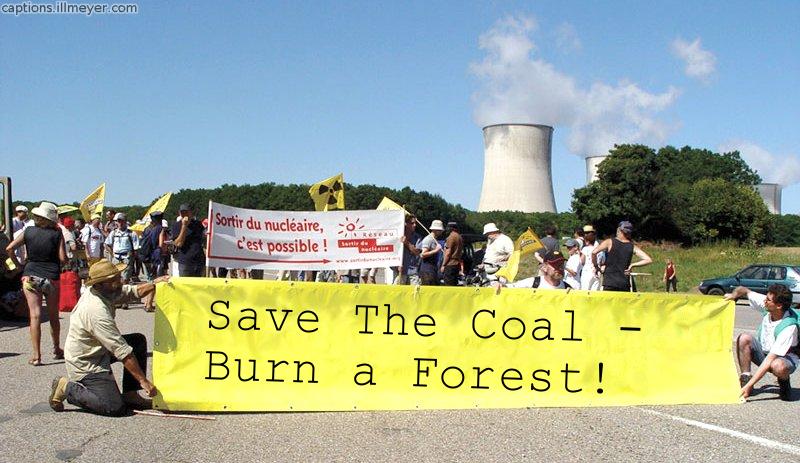
Save The Coal – Burn a Forest!

Drax Group Plc (DRX) will spend $1 billion to turn the U.K.’s biggest coal-fired plant into western Europe’s largest clean- energy producer. The utility plans to convert one of the site’s six units to burn wood pellets by June, said Chief Executive Officer Dorothy Thompson. It intends to switch two more units to wood at a later date, investments that if completed will see it harvest a forest four times the size of Rhode Island each year

“While burning biomass releases carbon dioxide, the EU deems the technology carbon-neutral because trees absorb emissions in a similar proportion to what they release in burning. Opponents argue that it’s hard to ensure enough is being planted to compensate for what is burned.”

Opponents? By opponents do they mean sane people? Or do they mean greenies who are slightly less insane than the average greenie?

“Wood pellets are bulkier than coal, need to be kept dry and handled more gently. They can create dust if stored in the open. To deal with this, Drax is building silos out of plastics, foam, steel and concrete, with conveyor floors and capable of holding 700,000 metric tons of biomass.”

This is great … all those jobs and all that plastic and foam and steel and concrete (did you know concrete produces a lot of CO2?)

Green policies are saving the poor unfortunate coal and killing off four forests the size of Rhode Island (which is actually quite small but it sounds scary).

I like trees. I have no objection to trees being cut down to provide useful things like houses and paper.

But to burn vast quantities of trees and to build up a huge new infrastructure to burn wood instead of burning coal (or preferably natural gas) is insane. But thats what green policies do. They distort the market. They rewards people for doing insane things … like burning forests instead of coal or building wind turbines (and backup power plants) instead of reliable natural gas power plants.

Imagine … power plants burning forests will act as the backup power for unreliable wind turbines!


NOAA vs USCRN July 2012

The USCRN is a new ‘state of the art’ United States Climate Reference Network.

The USCRN “consists of 114 stations developed, deployed, managed, and maintained by the National Oceanic and Atmospheric Administration (NOAA) in the continental United States for the express purpose of detecting the national signal of climate change.”

This is the monthly Mean from both NOAA and USCRN for July 2012 for the 48 continental states.

9 states show USCRN stations warmer than NOAA (bold) and 39 show NOAA warmer than USCRN.

State NOAA USCRN NOAA_minus_USCRN
Alabama 81.7 80.83 0.87
Arizona 80.3 81.41 -1.11
Arkansas 84.1 84.2 -0.1
California 75 72.32 2.68
Colorado 71.2 71.29 -0.09
Florida 82.2 81.56 0.64
Georgia 82.3 82 0.3
Idaho 70.2 71.96 -1.76
Illinois 81.7 77.54 4.16
Indiana 80.2 81.68 -1.48
Iowa 79.4 80.06 -0.66
Kansas 84.3 84.02 0.28
Kentucky 80.7 80.24 0.46
Louisiana 82.1 82.04 0.06
Maine 68 66.74 1.26
Michigan 73.3 68.9 4.4
Minnesota 74.4 70.52 3.88
Mississippi 81.8 80.15 1.65
Missouri 83.7 82.04 1.66
Montana 71.4 67.89 3.51
Nebraska 80 79.47 0.53
Nevada 73.6 73.52 0.08
New Hampshire 69.6 70.61 -1.01
New Mexico 74.6 72.91 1.69
New York 71.7 71.15 0.55
North Carolina 80.5 76.52 3.98
North Dakota 73.8 73.16 0.64
Ohio 77.6 76.28 1.32
Oklahoma 85.5 84.78 0.72
Oregon 67.4 66.42 0.98
Rhode Island 73.1 71.87 1.23
South Carolina 82.7 81.86 0.84
South Dakota 78.8 77.86 0.94
Tennessee 80.4 75.92 4.48
Texas 83.4 82.76 0.64
Utah 74.2 74.03 0.17
Virginia 79 80.24 -1.24
Washington 66.6 63.44 3.16
West Virginia 75.5 68 7.5
Wisconsin 74.7 76.64 -1.94
Wyoming 71.5 69.98 1.52

Sunshine and Temperature in Alberta and BC Canada

I recently scraped the Environment Canada website for climate data in BC and Alberta. I’ve been learning R and I thought I would graph the mean of the sunshine hours and temperature for each month. Do remember this is only stations with BOTH bright sunshine and temperature records for the month.

In Alberta the number of stations reporting sunshine peaked in the 1980s around 24.

Alberta Stations with Temp + Sunshine July

In BC the number peaked around 64 in 1988.

BC Stations with Temp + Sunshine July